

TL;DR:
- Proper documented appraisals are essential for legal compliance and avoiding costly IRS or state issues.
- The stepped-up basis resets property value to fair market value on the date of death, affecting capital gains taxes.
- Certified appraisals using USPAP standards are crucial for estate, divorce, and tax appeal purposes in New Jersey.
Inheriting property in New Jersey sounds straightforward until you realize one missed step can trigger IRS scrutiny, family disputes, or a tax bill you never expected. Most homeowners and executors assume that a deed transfer and a quick online estimate are enough to satisfy the IRS and state tax authorities. They are not. A properly documented, certified appraisal of fair market value is the foundation of every compliant estate settlement, divorce asset split, and property tax appeal involving inherited real estate. This guide walks you through exactly what a stepped-up basis appraisal means in New Jersey, how to obtain one correctly, and what costly errors to avoid.
Table of Contents
- What is stepped-up basis and why does it matter in NJ?
- How New Jersey determines fair market value: Appraisal methods explained
- Common mistakes, edge cases, and NJ-specific factors
- Using stepped-up basis appraisals for divorce, tax appeals, and estate planning
- Our take: What most NJ heirs and executors miss about stepped-up basis appraisals
- Need a certified stepped-up basis appraisal in New Jersey?
- Frequently asked questions
Key Takeaways
| Point | Details |
|---|---|
| Stepped-up basis definition | Use the property’s value at date of death as your new tax cost basis to minimize capital gains taxes. |
| IRS-compliant appraisal methods | A certified real estate appraisal is the gold standard for proving fair market value in New Jersey. |
| NJ tax rules and exceptions | NJ inheritance tax applies even after estate tax repeal, and not all assets get a step-up in basis. |
| Beyond estates | Accurate appraisals are vital for divorce settlements and property tax appeals, not just inheritance. |
| Prompt appraisals avoid headaches | Immediate, well-documented appraisals help heirs and executors steer clear of IRS and legal problems. |
What is stepped-up basis and why does it matter in NJ?
The term "stepped-up basis" refers to resetting the tax cost basis of an inherited property to its fair market value (FMV) on the date the original owner died. In plain language: if your parent bought a home in 1985 for $80,000 and it was worth $520,000 when they passed away, your starting tax basis is $520,000, not $80,000. That difference matters enormously when you sell.
Under federal IRC §1014, the stepped-up basis is determined by the FMV on the date of death or an approved alternate valuation date. This rule applies to most inherited real estate in New Jersey and directly affects how much capital gains tax you owe if you sell the property later.
Here is a quick look at what the stepped-up basis does and does not apply to:
- Inherited real estate: Qualifies. Your basis resets to FMV on the date of death.
- Retirement accounts (IRAs, 401(k)s): Do not qualify. These pass as ordinary income.
- Lifetime gifts: Do not qualify. The recipient inherits the original (carryover) basis.
- Certain irrevocable trusts: Generally do not qualify, depending on trust structure.
- Joint tenancy property: May qualify for a partial step-up depending on ownership share.
One of the most common errors we see is confusing New Jersey's inheritance tax with the federal capital gains tax. These are entirely separate obligations. As the step-up in basis rule helps minimize capital gains at the federal level, New Jersey's inheritance tax operates independently, applying based on your relationship to the deceased.
Important: New Jersey eliminated its estate tax after 2018, but the inheritance tax remains active. Class A beneficiaries (spouse, children, grandchildren) are exempt, while Class C and D beneficiaries may owe a significant percentage of the property's value.
Understanding what an estate appraisal involves is the first step toward protecting yourself from unnecessary tax exposure and legal complications.
How New Jersey determines fair market value: Appraisal methods explained
Once you understand the basis rules, the next challenge is proving the property's value to the IRS and New Jersey tax authorities. The method you use matters just as much as the number you report.
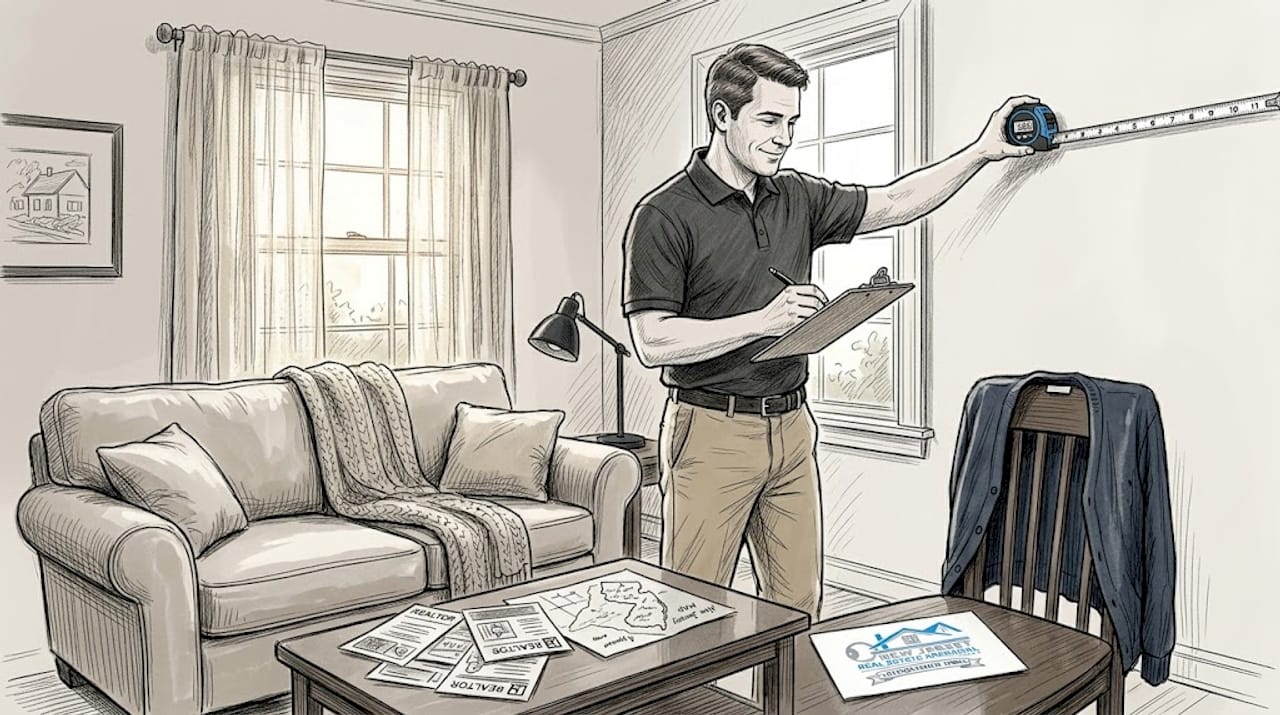
Here is how the most common valuation options compare:
| Valuation method | IRS acceptability | Legally defensible | Cost range |
|---|---|---|---|
| Certified date-of-death appraisal | High | Yes | $400 to $600+ |
| Broker price opinion (BPO) | Moderate | Limited | $100 to $250 |
| Zillow/online estimate | Low | No | Free |
| County tax assessment | Very low | No | Free |
The appraisal methodology for FMV requires a qualified appraiser to use comparable sales, property condition, and current market data. An online estimate simply cannot meet that standard in an audit.
Here is how the formal appraisal process works step by step:
- Identify the date of death. This is your valuation anchor. The appraiser will research market conditions as they existed on that specific date, not today.
- Hire a state-certified appraiser. In New Jersey, appraisers must be licensed and are required to follow USPAP (Uniform Standards of Professional Appraisal Practice) guidelines.
- Provide access and documentation. The appraiser needs interior access and any available records: prior surveys, permits, tax records, and recent improvements.
- Receive a written appraisal report. This report documents the comparable sales analysis, adjustments, and final FMV conclusion in a format accepted by the IRS and courts.
- File and retain the report. Keep the full appraisal report with your estate records. You will need it when filing taxes, closing the estate, or responding to any IRS inquiry.
Pro Tip: Order the appraisal as soon as possible after the date of death. Retroactive appraisals are legally valid, but the further you get from the valuation date, the harder it becomes to document market conditions accurately.
For a detailed walkthrough, see navigating the date-of-death appraisal process and review property valuation methods for legal success to understand which approach fits your situation.
Executors should also note that documenting FMV requires more than a printout. Official appraisal reports, brokerage statements, and organized supporting documentation are all part of a complete IRS-compliant file.
Common mistakes, edge cases, and NJ-specific factors
Understanding the standard method is essential, but New Jersey exceptions and edge cases often impact real-life outcomes in ways that surprise even experienced executors.
The alternate valuation election
Under IRC §2032, an estate can elect to use a valuation date six months after death instead of the date of death. This alternate valuation election is only useful if the property's value dropped after the owner died AND it reduces the overall estate tax owed. It is a narrow exception, not a default option.
Step-down in basis
Most people focus on the step-up. But if the property's FMV on the date of death is lower than what the deceased originally paid, your basis actually steps down. You cannot use the original purchase price as your starting point if market values have fallen.
Here is a summary of key edge cases and how they affect your basis:
| Scenario | Effect on basis |
|---|---|
| FMV higher than original cost | Basis steps up to FMV |
| FMV lower than original cost | Basis steps down to FMV |
| Property received as a lifetime gift | Carryover basis (no step-up) |
| IRA or 401(k) assets | No step-up; taxed as income |
| Alternate valuation election used | Basis set at 6-month post-death FMV |
New Jersey inheritance tax specifics
New Jersey's inheritance tax remains active even though the estate tax was eliminated after 2018. Class A beneficiaries (direct family) are exempt, but Class C and D beneficiaries can face rates from 11% to 16%. Filing L-8 and L-9 waivers with the state is often required to clear title for sale or transfer.
Property tax and senior freeze changes
If the deceased was receiving a senior freeze (property tax reimbursement), that benefit does not transfer to the heir. Property tax assessments generally remain unchanged at the time of inheritance, but the new owner must requalify for any exemptions independently.
Pro Tip: Consult with your estate attorney about L-8 and L-9 inheritance tax waivers before attempting to sell or transfer the property. Missing this step can delay a closing by weeks.
For more on legal filing requirements, review probate appraisal requirements and current NJ property appraisal process tips.
Using stepped-up basis appraisals for divorce, tax appeals, and estate planning
A stepped-up basis appraisal is not only an estate tool. It plays a critical role in divorce proceedings and property tax appeals as well.
In divorce and equitable distribution
When one spouse inherits property during a marriage, that asset may be subject to equitable distribution in a New Jersey divorce depending on how it was handled during the marriage. Courts and attorneys require a credible, documented FMV to divide assets fairly. An appraisal that is inaccurate or unsupported will not survive scrutiny in a courtroom.
Key scenarios where stepped-up basis appraisals support equitable distribution and property tax appeals:
- Confirming the value of inherited property at the time of marriage to establish separate property claims
- Establishing the current FMV for equitable split calculations
- Providing comparable sales analysis to challenge an inflated county tax assessment
- Supporting a tax appeal at the county board or state tax court level
Executor checklist: Covering every legal and tax need
- Order a certified date-of-death appraisal immediately after the owner passes.
- Identify all assets and confirm which ones qualify for a stepped-up basis.
- File the required NJ inheritance tax waivers (L-8 or L-9) before attempting a transfer.
- Retain a copy of the full appraisal report and all supporting documentation.
- Consult a CPA or tax attorney to confirm your federal capital gains position before selling.
- If planning a tax appeal, work with a certified appraiser to prepare a comparable sales analysis.
For a broader view of how these appraisals function across life events, see real estate appraisal in divorce or estate contexts.
Our take: What most NJ heirs and executors miss about stepped-up basis appraisals
After more than 26 years of completing estate, divorce, and tax appeal appraisals across New Jersey, we see the same pattern repeatedly. Families delay ordering the appraisal, assuming they have time. Others accept a Zillow number or a neighbor's opinion as their FMV documentation. Both approaches are costly mistakes.
The appraisal is not a formality. It is your Day 1 legal insurance. A certified, well-supported report locks in the stepped-up basis, gives you an IRS-defensible document, and protects against family disputes over property value down the road.
As executors and heirs should know, a prompt date-of-death appraisal is one of the most effective ways to prevent an IRS challenge. With New Jersey property values continuing to climb, the financial stakes of getting this wrong are higher than ever. A certified appraisal done right avoids audits, supports equitable outcomes in divorce, and backs up your position in any tax appeal. That is the kind of document you want from using certified appraisers for legal compliance rather than a rushed estimate.
Need a certified stepped-up basis appraisal in New Jersey?
If you are an executor, heir, or attorney managing an estate, a divorce settlement, or a tax appeal in New Jersey, getting the valuation right from the start protects everyone involved. At New Jersey Real Estate Appraisal Group, we deliver USPAP-compliant appraisal reports built to hold up in court, with the IRS, and in front of opposing counsel.

Our estate and date-of-death appraisals cover all 21 New Jersey counties, with fast turnaround and clear documentation. We also provide property tax appeal appraisals supported by comparable sales analysis. Explore our full list of NJ appraisal services or contact us today to get a fast quote and take the first step toward compliance and peace of mind.
Frequently asked questions
How do I document fair market value to the IRS for a stepped-up basis in NJ?
Obtain a certified date-of-death appraisal from a state-licensed appraiser and retain all supporting documentation, since IRS compliance requires appraisals, brokerage statements, or verifiable market data rather than informal estimates.
Does New Jersey still have an estate tax or only inheritance tax?
New Jersey eliminated its estate tax after 2018, but NJ inheritance tax applies based on the beneficiary's class, with Class A relatives exempt and others potentially owing 11% to 16%.
What assets don't receive a stepped-up basis?
Retirement accounts, lifetime gifts, and assets held in irrevocable trusts generally do not receive a stepped-up basis, as IRAs and 401(k)s are taxed as ordinary income when distributed to heirs.
Is an alternate valuation date ever better than the date of death?
If the property loses value after the owner's death, the alternate valuation election under IRC §2032 can lower the estate tax owed, but it only applies when both the estate value and the tax liability are reduced.
Can these appraisals help with property tax appeals in NJ?
Yes, a certified appraisal with comparable sales analysis is one of the strongest pieces of evidence you can present in a New Jersey county tax appeal or state tax court hearing.