
TL;DR:
- Certified appraisals follow USPAP standards, ensuring courtroom credibility and legal defensibility.
- In New Jersey, only certified appraisers meet licensing, experience, and ethical requirements for legal cases.
- Courts prioritize verified, well-documented valuations from certified appraisers over informal opinions.
When property value is disputed in a New Jersey divorce, estate settlement, or tax appeal, the quality of your appraisal report can determine the outcome. Informal valuations or opinions from non-certified sources may be dismissed outright, leaving your case without credible support at the worst possible moment. Certified appraisals are legally defensible because they follow USPAP (Uniform Standards of Professional Appraisal Practice) and industry-standard methodology. For attorneys and financial professionals who need property value to hold up under cross-examination, understanding the difference between certified and non-certified appraisers is not optional. It is essential.
Table of Contents
- What makes a certified appraiser qualified in New Jersey?
- Why certified appraisals are essential for NJ divorce, estate, and tax appeals
- How courts in New Jersey assess appraisal credibility
- Special considerations for complex or high-value property cases
- The real-world impact of hiring the right expert appraiser
- How to secure a court-ready certified appraisal in New Jersey
- Frequently asked questions
Key Takeaways
| Point | Details |
|---|---|
| Certified qualification matters | Only certified NJ appraisers meet the education and ethical standards needed for legal-grade reports. |
| Courtroom credibility | Courts favor expert, certified appraisers whose process and documentation can withstand scrutiny. |
| High-stakes protection | Certified appraisals are essential for divorce, estate, and tax appeal cases where financial outcomes depend on defensible valuation. |
| Avoid costly mistakes | Using informal or non-certified valuations can jeopardize your legal position and client interests. |
What makes a certified appraiser qualified in New Jersey?
Having set the legal stakes, let's analyze the formal qualifications that make certified appraisers reliable for courtroom and tax-related valuations. Not every person who estimates property value carries the same credentials, and in New Jersey, those distinctions matter significantly.
New Jersey follows the Appraiser Qualifications Board (AQB) standards, which set the national baseline for appraiser licensing. Certified appraisers in NJ must complete rigorous education hours, accumulate documented field experience, and pass a national examination. There are two primary certification levels:
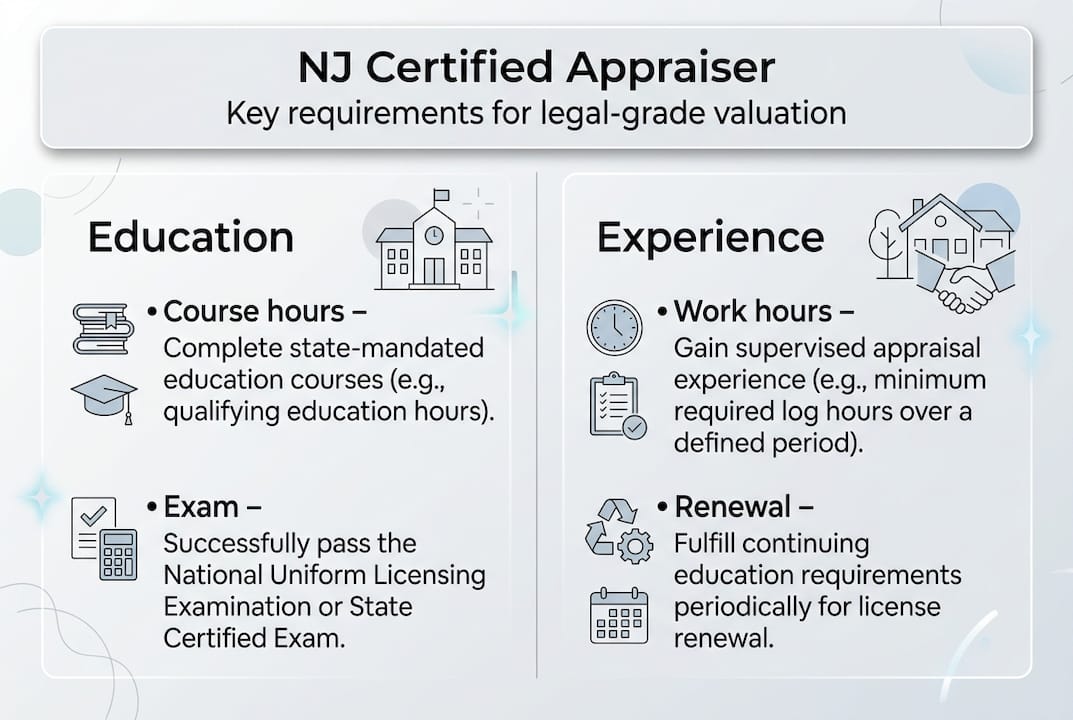
| Certification level | Education hours | Experience hours | Exam required |
|---|---|---|---|
| Certified Residential | 200+ hours | 1,500 hours | Yes |
| Certified General | 300+ hours | 3,000 hours | Yes |
Beyond initial certification, appraisers must complete continuing education every two years to maintain their license. This keeps them current on market trends, legal standards, and evolving methodology. Background checks are also part of the licensing process in New Jersey.
Certified appraisers are also bound by USPAP compliance. USPAP governs how appraisers collect data, select comparables, make adjustments, and document their conclusions. It is the ethical and procedural backbone of every credible appraisal report. Without it, a valuation is simply an opinion.
Here is what separates certified appraisers from non-certified evaluators:
- State license verification: Certified appraisers appear in the NJ state licensing database
- Documented experience: They have logged verifiable field hours under supervision
- Exam competency: They have demonstrated knowledge through a standardized national test
- USPAP training: Ethics and standards training is mandatory, not optional
- Continuing education: License renewal requires ongoing professional development
Non-certified evaluators, including real estate agents providing broker price opinions (BPOs), do not meet these standards. Their opinions may be useful for listing purposes, but they are not appropriate for legal proceedings.
Pro Tip: Always verify a New Jersey appraiser's certification status through the NJ-certified appraisal standards before engagement. A licensed, certified appraiser will have a publicly searchable credential.
Why certified appraisals are essential for NJ divorce, estate, and tax appeals
With a clear view of what certification entails, it's vital to understand when and why this qualification matters most for New Jersey legal professionals.
In divorce proceedings, property is often the largest marital asset. Attorneys hire certified appraisers to establish fair market value for equitable distribution under New Jersey law. Without a certified report, either party can challenge the valuation, and courts may disregard it entirely. The same applies to estate cases, where the IRS and probate courts require credible, documented valuations for tax filings and asset distribution.
For tax appeals, the stakes are equally high. A property owner challenging their assessment needs a certified appraisal that demonstrates a lower market value with verifiable data. An informal estimate simply will not satisfy the New Jersey Tax Court's evidentiary requirements.
Here is a comparison of certified versus informal valuations in legal settings:
| Factor | Certified appraisal | Informal valuation |
|---|---|---|
| Court admissibility | High | Low to none |
| USPAP compliance | Yes | No |
| Documented methodology | Yes | Rarely |
| Cross-examination ready | Yes | No |
| Accepted by IRS/probate | Yes | Typically no |
The process for engaging a certified appraiser follows a clear sequence:
- Engagement: Attorney or professional contacts the appraiser with case details
- Property inspection: Physical inspection and data collection
- Market research: Comparable sales analysis and market condition review
- Methodology application: Sales comparison, cost, or income approach as warranted
- Report generation: USPAP-compliant written report with full documentation
- Expert testimony: Appraiser available to testify and defend findings if needed
As noted in recent legal commentary, certified appraisals are more persuasive in adversarial proceedings precisely because they are grounded in verifiable data and professional standards. For court-ready divorce appraisals or accurate home appraisals for settlements, certification is the baseline requirement, not a bonus.
How courts in New Jersey assess appraisal credibility
After exploring their uses, let's see what happens in the courtroom. How does a certified appraiser's work hold up before a judge?
New Jersey courts, particularly the Tax Court, apply a structured lens when evaluating appraisal evidence. NJ courts examine data accuracy, defensible adjustments, and full USPAP compliance before giving weight to any appraisal report. Judges are not passive recipients of expert opinion. They scrutinize the methodology behind every number.
Common reasons appraisal reports lose credibility in court include:
- Arbitrary adjustments: Dollar or percentage adjustments without market support
- Unverifiable comparables: Sales that cannot be confirmed through public records
- Incomplete documentation: Missing inspection notes, photos, or data sources
- Inconsistent methodology: Switching approaches without justification
- Lack of USPAP compliance: Missing certifications or required disclosures
Expert testimony also plays a significant role. An appraiser who can clearly explain their methodology, defend their comparable selection, and respond to opposing counsel's challenges adds substantial credibility to your case. Courts notice when an expert is confident and well-prepared versus evasive or inconsistent.
"The persuasiveness of appraisal evidence depends not just on the numbers, but on the transparency and rigor of the process behind them."
For a defensible appraisal for NJ tax appeal or other contested matters, the appraiser's courtroom experience is just as important as their technical skill. Judges in New Jersey have seen enough appraisal reports to recognize when one is genuinely credible versus merely formatted to look professional.
Pro Tip: When selecting an appraiser for litigation support, ask directly about their tax appeal appraisal expertise and how many times they have testified in New Jersey courts. Experience under cross-examination is a real differentiator.
Special considerations for complex or high-value property cases
Beyond typical cases, let's address situations where certified expertise matters most for avoiding costly mistakes in front of a judge.
Not all properties fit neatly into standard valuation models. Unique residential properties, commercial assets, multi-family buildings, and properties in rapidly shifting markets all require a higher level of analytical skill. This is where the gap between certified and non-certified appraisers becomes most visible.
Certified appraisers working on complex assignments use advanced techniques that informal evaluators simply are not trained to apply:
- Paired sales analysis: Isolating the value contribution of a single feature by comparing otherwise identical sales
- Income approach: Capitalizing net operating income for investment or commercial properties
- Cost approach: Estimating depreciation and replacement cost for unique structures
- Regression analysis: Statistical modeling to support adjustments in data-rich markets
- Retrospective valuation: Establishing value as of a past date for estate or legal purposes
For high-value properties, a small error in methodology can translate into hundreds of thousands of dollars in dispute. Non-certified valuations risk court rejection) precisely because they lack the technical foundation to handle these edge cases.
Courts have consistently shown a preference for appraisers who can document every step of their analysis. Verified comparables, transparent adjustments, and a clearly reasoned conclusion are what separate a report that wins the day from one that gets torn apart on cross-examination.
For attorneys handling real estate appraisal for estates or complex divorce matters involving commercial holdings, the certified appraiser's ability to apply multiple valuation approaches and defend each one is not a luxury. It is a necessity.
The real-world impact of hiring the right expert appraiser
After 26 years of working with attorneys and financial professionals across New Jersey, we have seen a consistent pattern. Legal professionals who treat appraiser selection as a routine task often pay for that assumption later in the case.
The conventional view that any licensed appraiser will do is genuinely risky. Certification level, property type experience, and courtroom familiarity all affect whether a report survives scrutiny. We have reviewed cases where a technically formatted but methodologically weak report collapsed under cross-examination, forcing settlements that did not reflect true market value.
The cost difference between a certified, experienced appraiser and a less qualified alternative is modest. The cost of a rejected or discredited report, measured in attorney hours, delayed settlements, and damaged client outcomes, is not. Experienced attorneys in New Jersey increasingly insist on independently verified, credentialed experts for exactly this reason.
One misstep with a non-certified or poorly supported report can unravel months of case preparation. The details of certification directly protect your client's financial interests. When you need divorce appraisals and legal outcomes to align, the appraiser you choose is one of the most consequential decisions in the case.
How to secure a court-ready certified appraisal in New Jersey
If you're ready to protect your case with truly defensible valuation, here's how to connect directly to certified professionals.
NJREAG has delivered USPAP-compliant, court-ready appraisal reports for over 26 years across New Jersey. Whether you need a divorce appraisal in New Jersey, support for a tax appeal appraisals in NJ, or a date-of-death valuation for estate purposes, our certified appraisers are equipped to handle complex assignments with the rigor courts require.

Engaging NJREAG is straightforward. You share the property details and case context, we conduct a thorough inspection and market analysis, and you receive a fully documented, defensible report. Our appraisers are also available for expert testimony. Explore our full service NJ appraisals or request a quote today to get started.
Frequently asked questions
What is a certified appraiser and how are they different from other appraisers?
A certified appraiser in NJ has met strict state and national education, experience, and exam requirements set by the AQB, unlike non-certified appraisers whose valuations may not hold up in court.
Can I use a non-certified appraiser for a divorce or estate case in New Jersey?
Using a non-certified appraiser puts your valuation at risk of being challenged or rejected, since non-certified valuations risk rejection) due to unverifiable data and lack of credentials.
What specific methods make certified appraisal reports court-ready?
Certified appraisers apply USPAP-compliant processes including the sales comparison, cost, and income approaches, each supported by verified, documented adjustments that courts can evaluate directly.
Do New Jersey courts favor certain types of appraisers or reports?
Yes. NJ Tax Court cases consistently show that courts favor certified appraisers who present verified comparables, methodical adjustments, and demonstrated experience in the relevant property type.
What are the risks of submitting an informal valuation in a tax appeal?
Informal valuations typically lack the data credibility and documented methodology that NJ courts require, and courts favor credible certified experts over informal estimates, making case failure a real possibility.