

TL;DR:
- Accurate, well-supported property valuations are crucial for legal cases like divorce, estates, and tax appeals.
- Appraisers use sales comparison, cost, and income approaches, selecting methods based on property type and complexity.
- Court-ready appraisals follow USPAP standards, are transparent, and include detailed adjustments to ensure credibility.
Many attorneys and homeowners in New Jersey treat property valuation as a formality. It isn't. A credible appraisal can be the deciding factor in how marital assets are divided, whether an estate clears probate smoothly, or whether a tax appeal succeeds or fails. Courts don't just want a number. They want a number that is supported, documented, and defensible. If the appraisal report doesn't hold up under scrutiny, the consequences can be significant, from an unfair divorce settlement to an IRS penalty. This guide walks you through why real estate valuation matters in New Jersey legal cases, which methods appraisers use, how to handle complex properties, and what steps lead to a court-ready report.
Table of Contents
- Why real estate valuation matters in New Jersey legal cases
- The main methods used for real estate valuation in New Jersey
- Dealing with complex or unique NJ property valuation scenarios
- Best practices for securing credible, court-ready valuations in New Jersey
- A seasoned appraiser's perspective: What New Jersey clients often overlook
- Get court-ready, credible real estate valuations in New Jersey
- Frequently asked questions
Key Takeaways
| Point | Details |
|---|---|
| Legal necessity | Proper real estate valuation is essential for fair legal, estate, and tax outcomes in New Jersey. |
| Method matters | The right valuation approach, with defensible adjustments, determines court and IRS acceptance. |
| Complexity requires expertise | Unique and high-value properties demand advanced methods and expert appraisers to withstand scrutiny. |
| Credibility wins cases | Courts prioritize well-supported, USPAP-compliant valuations over values alone. |
Why real estate valuation matters in New Jersey legal cases
Real estate is often the largest asset in a divorce, estate, or tax matter. Getting the value right isn't just about accuracy. It's about protecting your legal position.
In divorce proceedings, New Jersey follows the principle of equitable distribution, meaning marital assets are divided fairly, though not always equally. As the NJCPA notes, valuation determines fair market value for equitable asset division, estate, tax appeals, and inheritance. That makes the appraisal report a foundational document in any property-related legal dispute.
Here's where real estate valuation plays a direct legal role:
- Divorce: Both parties need an agreed-upon or court-accepted value to divide property fairly. Without a credible appraisal, disputes drag on and legal costs climb.
- Estate and probate: The IRS requires a qualified appraisal to establish the fair market value of real property at the date of death. Errors here can trigger audits or penalties.
- Tax appeals: New Jersey's Chapter 123 law governs how municipalities assess property. If your property is over-assessed, a well-supported appraisal is your strongest tool in challenging it.
- Inheritance: When you inherit property, the stepped-up basis (the property's value at the time of inheritance) determines your capital gains exposure if you later sell. An accurate date-of-death appraisal protects you.
For attorneys handling real estate appraisal in NJ divorce and estate planning, the standard is clear: reports must follow USPAP (Uniform Standards of Professional Appraisal Practice) and withstand cross-examination.
"A court-admissible appraisal isn't just an opinion of value. It's a documented argument, built on market data, methodology, and professional judgment."
Understanding how New Jersey courts divide real estate in divorce reinforces why the appraisal report must be thorough. Judges rely on the quality of the supporting data, not just the final number.
The main methods used for real estate valuation in New Jersey
Understanding these legal needs means choosing the right valuation method. Appraisers in New Jersey use three primary approaches, and the choice depends on the property type, its use, and the legal context.
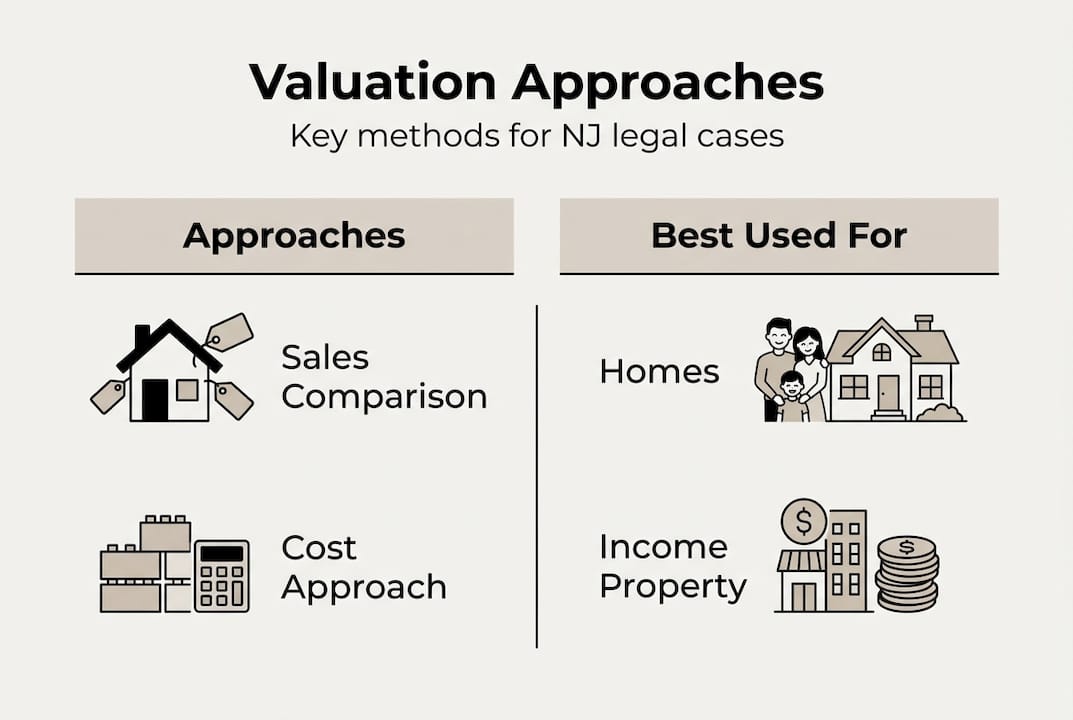
- Sales Comparison Approach: This is the most commonly used method for residential properties. The appraiser identifies recent sales of similar properties (called comparables or "comps") and adjusts for differences in size, condition, location, and features. Courts rely heavily on this approach for single-family homes.
- Cost Approach: This method estimates the land value separately, then adds the cost to rebuild the structure minus depreciation. It's most useful for newer properties, unique homes, or properties where few comparable sales exist.
- Income Approach: Used for rental and investment properties, this method capitalizes the income stream the property generates. It's the standard for multi-family buildings, commercial properties, and mixed-use assets.
Here's a quick reference for how each method applies in NJ legal settings:
| Approach | Best used for | Legal context |
|---|---|---|
| Sales Comparison | Residential homes | Divorce, estate, tax appeal |
| Cost Approach | New or unique properties | Estate, insurance, litigation |
| Income Approach | Rental or commercial | Divorce, estate, tax appeal |
As outlined in a 2025 NJ Tax Court opinion, standard methodologies include Sales Comparison, Cost Approach, and Income Approach, and NJ courts require reconciliation based on property type. Reconciliation means the appraiser explains which method carries the most weight and why.
For a deeper breakdown, the NJ appraisal methods guide covers how adjustments are made and how courts evaluate them. You can also explore the types of real estate appraisals to understand which report format fits your situation.
Pro Tip: Ask your appraiser upfront which approach they plan to emphasize and why. If the answer is vague or they can't explain their adjustment process clearly, that's a red flag for court readiness.
The property valuation methods overview provides additional context on how these approaches are applied across different property types and legal settings.
Dealing with complex or unique NJ property valuation scenarios
Of course, not all properties are straightforward. New Jersey has a wide range of property types, from historic Victorian homes in Cape May to mixed-use buildings in Newark to large rural parcels in Hunterdon County. Each presents its own valuation challenges.

When comparable sales are limited, appraisers must lean more heavily on the Cost or Income Approach and apply detailed market adjustments. Courts expect these adjustments to be well-supported, not estimated. As noted in the guide to dividing real estate in a high-net-worth NJ divorce, complex cases involving unique estates, business or investment property, commingling of assets, and stepped-up basis require careful, nuanced valuation.
Here's how common complex scenarios break down:
| Scenario | Challenge | Preferred approach |
|---|---|---|
| Historic property | Few true comparables | Cost with detailed adjustments |
| Mixed-use building | Residential and commercial blend | Income plus Sales Comparison |
| Large rural land | Sparse market data | Cost and paired sales analysis |
| Inherited investment property | Stepped-up basis required | Retrospective date-of-death value |
Some additional factors that complicate NJ valuations:
- Commingled assets: In divorce, one spouse may have owned property before marriage. Determining the marital portion requires a retrospective appraisal at the date of marriage.
- Capital gains exposure: Inherited property is valued at the stepped-up basis, meaning the value at the date of death, not the original purchase price. This can significantly reduce capital gains taxes when the property is sold.
- Court challenges: NJ courts have rejected appraisals that rely on "net opinions," meaning conclusions without factual support. Every adjustment must be grounded in market data.
For land-specific situations, the land appraisal types guide for NJ legal and estate matters explains how vacant land and partial interests are handled in legal proceedings.
Pro Tip: If your property has unusual features like a guest house, in-law suite, or commercial zoning, tell your appraiser before the inspection. Disclosing these details upfront leads to a more accurate and defensible report.
Best practices for securing credible, court-ready valuations in New Jersey
So, how do you ensure your valuation stands up in court or with the IRS? The steps below apply whether you're an attorney preparing for litigation, an executor managing an estate, or a homeowner navigating a divorce or tax appeal.
- Hire a state-certified appraiser with NJ court experience. Not all appraisers are qualified to testify or produce litigation-grade reports. Look for someone with a Certified General or Certified Residential license and a track record in court settings.
- Insist on a USPAP-compliant report. This isn't optional in legal matters. The report must follow USPAP standards and include a complete description of the methodology, data sources, and adjustments.
- Act quickly on valuation dates. Courts and the IRS often require valuations as of a specific date, such as the date of separation or date of death. Waiting too long can make it harder to find valid comparables from that period.
- Keep records of all property improvements and disputes. Renovations, permits, and any known defects all affect value. Providing this information to your appraiser strengthens the report.
- Review the report before submitting it. Check that adjustments are explained, comparables are truly similar, and the appraiser's credentials are documented.
The following mistakes can undermine your case:
- Submitting an appraisal with unsupported adjustments
- Using an appraiser unfamiliar with the specific NJ county or property type
- Relying on a desktop or automated valuation for legal purposes
- Failing to disclose material facts to the appraiser
As a 2025 NJ Tax Court ruling confirms, courts weigh the credibility of appraisers and reject unsupported net opinions. The appraiser's ability to explain and defend their methodology matters as much as the final value.
"The strength of an appraisal report is measured not by the number it reaches, but by the quality of the evidence behind it."
For practical guidance, the real estate valuation tips for NJ homeowners and the NJ property appraisal process overview are useful starting points.
A seasoned appraiser's perspective: What New Jersey clients often overlook
After more than 26 years of appraising properties across New Jersey, one pattern stands out. Clients, whether attorneys or homeowners, tend to focus on whether the value is high or low. Courts focus on something different: whether the report is credible.
We've seen well-intentioned appraisals rejected not because the value was wrong, but because the adjustments weren't explained or the comparable sales were too different from the subject property. A small, unsupported adjustment on a single line item can give opposing counsel enough to challenge the entire report.
The most effective appraisals we produce share a few traits. They disclose all relevant property details. They use comparables that are genuinely similar. And they explain every adjustment in plain language that a judge can follow.
One thing clients rarely consider: being transparent with your appraiser is just as important as hiring a qualified one. If you know about a boundary dispute, an unpermitted addition, or a recent renovation, say so. That information shapes the analysis. Withholding it creates gaps that appraisal credibility in court simply cannot survive.
Get court-ready, credible real estate valuations in New Jersey
When the stakes involve a divorce settlement, an estate filing, or a tax appeal, you need more than a number. You need a report that holds up.

At New Jersey Real Estate Appraisal Group, we deliver USPAP-compliant appraisals built specifically for legal and financial scrutiny. Whether you need estate and date of death appraisals, support for property tax appeal appraisals, or a credible report for divorce appraisals in NJ, our team has the experience and credentials to deliver. We work directly with attorneys, executors, and property owners across New Jersey. Contact us today for a confidential consultation and a fast quote.
Frequently asked questions
What's the difference between fair market value and assessed value in NJ?
Fair market value is what a willing buyer would pay a willing seller in an open market, while assessed value is set by the municipality for property tax purposes and often differs from actual market value. These two numbers can vary significantly depending on when the last reassessment occurred in your town.
Can I use a Zillow or online estimate for a court or IRS filing in New Jersey?
No. New Jersey courts and the IRS require a certified appraisal report from a qualified, licensed appraiser for any legal or tax filing. Automated estimates don't meet USPAP standards and will not be accepted.
How do appraisers handle unique or one-of-a-kind properties in NJ?
Appraisers use multiple valuation methods, giving extra weight to the Cost or Income Approach and applying detailed market adjustments when comparable sales are limited. The appraiser must clearly explain and support every adjustment to withstand court review.
What does it mean for an NJ appraisal to be "USPAP-compliant"?
USPAP-compliant means the appraisal follows the Uniform Standards of Professional Appraisal Practice, the national standard required for court and legal credibility. Without USPAP compliance, the report will not be accepted in NJ courts or by the IRS.