

When a land appraisal is tied to a divorce settlement, estate filing, tax appeal, or court case, the method your appraiser uses is not a formality. It is the foundation of your entire legal position. Choose the wrong approach, and even an accurate number can be challenged, dismissed, or overturned. In New Jersey, where property values vary sharply by municipality, zoning classification, and development potential, selecting the right appraisal type can determine whether your valuation holds up under cross-examination, IRS review, or a tax board hearing. This guide walks you through each major method, when to use it, and how to choose confidently.
Table of Contents
- What makes a land appraisal legally reliable in New Jersey?
- Sales comparison approach: The gold standard for most land appraisals
- Income approach: When land can (or could) generate revenue-generate-revenue)
- Cost approach: When replacement value becomes relevant
- Reconciling appraisal methods: Choosing the most defensible value
- What most legal professionals miss about land appraisals in New Jersey
- Get court-ready land appraisals and expert support in New Jersey
- Frequently asked questions
Key Takeaways
| Point | Details |
|---|---|
| Sales comparison approach | This is the most widely accepted method for vacant land appraisals in New Jersey legal matters. |
| USPAP standards required | All appraisals for divorce, estate, tax, or litigation must meet USPAP guidelines to be valid and defensible. |
| Income and cost approaches | Use these methods when land generates revenue or involves replacement value, but always justify their relevance for the case. |
| Hybrid and reconciliation | For complex parcels, appraisers may blend results and must defend their logic in court or tax appeals. |
What makes a land appraisal legally reliable in New Jersey?
Not every appraisal is built to survive legal scrutiny. In New Jersey, courts, the IRS, and tax appeal boards expect appraisals to follow the Uniform Standards of Professional Appraisal Practice, commonly known as USPAP. These are the nationally recognized rules that govern how appraisers collect data, apply methods, and document their conclusions. USPAP-compliant appraisals are required for divorce, estate, tax appeals, and litigation in NJ, and any report that falls short of this standard risks being excluded or challenged.
The legal scenarios that most commonly require a formal land appraisal in New Jersey include equitable distribution in divorce, date of death valuations for estate settlement, property tax appeal appraisals before county boards, and expert testimony in civil litigation. Each scenario has its own evidentiary requirements, but all share one demand: the appraisal must be transparent, well-supported, and replicable.
For land appraisals in New Jersey, courts and reviewing agencies pay close attention to three things: whether the appraiser used local comparable sales, whether the methodology is clearly explained, and whether a highest and best use (HBU) analysis was performed. HBU analysis determines the most legally permissible, physically possible, and financially feasible use of the land, which directly affects value.
Before hiring or submitting an appraisal, attorneys and executors should verify the following:
- The appraiser holds a New Jersey state certification
- The report explicitly states USPAP compliance
- Comparable sales are drawn from the same or similar NJ markets
- A highest and best use analysis is included
- Every adjustment to comparable sales is documented and explained
"The sales comparison approach is the most defensible method for vacant land in legal proceedings because it reflects actual market behavior, not projections."
Sales comparison approach: The gold standard for most land appraisals
Now that you know what makes an appraisal legally solid, let's focus on the leading method used in New Jersey. The sales comparison approach analyzes recent sales of similar land parcels, adjusting for legal and physical differences to arrive at a supportable market value. It is the most widely accepted method for vacant land, particularly in divorce, estate, and litigation contexts.
The process works in a logical sequence:
- Identify recent sales of comparable land parcels in the same or nearby NJ markets
- Confirm each sale was arm's length, meaning no unusual pressure or relationship between buyer and seller
- Analyze differences between each comparable and the subject property
- Apply dollar or percentage adjustments for each difference
- Reconcile the adjusted sale prices into a final value conclusion
Typical adjustments in a New Jersey land appraisal include zoning classification, road access and frontage, parcel size and shape, topography and drainage, environmental conditions or restrictions, and availability of utilities. Each adjustment must be supported by market data, not guesswork. This is especially important in legal settings where the opposing party or their expert may challenge every line.
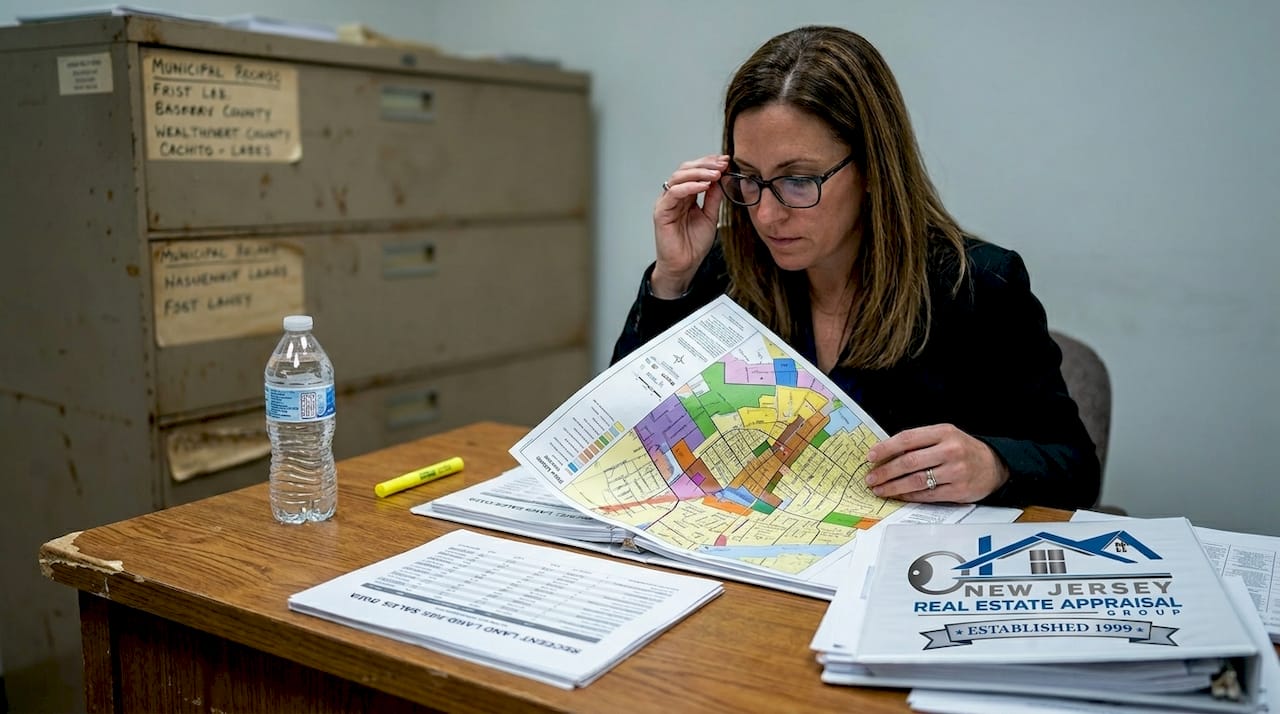
The land valuation process for divorce cases follows the same methodology but adds a layer of scrutiny because both parties may retain separate appraisers. When land appraisals for divorce are submitted to the court, the appraiser may be called to testify and defend every adjustment under cross-examination.
A highest and best use analysis is a required component of any credible land appraisal and directly shapes which comparables are selected.
Pro Tip: Insist on an appraiser who can document and defend every adjustment in writing. In court or at a tax appeal hearing, vague adjustments are easy targets for opposing counsel.
Income approach: When land can (or could) generate revenue
While sales comps dominate, some land's potential comes from future revenue, and that is where the income approach becomes relevant. This method estimates value based on the income the land produces or could reasonably produce. It is most appropriate when the land has an active or identifiable revenue stream.
Common applications in New Jersey include:
- Leased farmland or agricultural parcels
- Land with billboard or cell tower leases
- Commercial sites with ground lease potential
- Mixed-use or redevelopment parcels with projected future income
- Industrial land awaiting development
The mechanics rely on either a direct capitalization formula (net operating income divided by a market cap rate) or a discounted cash flow (DCF) model that forecasts revenues over time and discounts them to present value. The income approach capitalizes potential income using a cap rate or DCF and is best suited for commercial or agricultural uses.
| Land use | Income source | Method suitability |
|---|---|---|
| Leased farmland | Annual rent | Direct capitalization |
| Billboard site | Monthly lease | Direct capitalization |
| Mixed-use development | Projected rents | Discounted cash flow |
| Ground lease commercial | Long-term lease | Direct capitalization |
| Redevelopment parcel | Future sale proceeds | Discounted cash flow |
For attorneys handling commercial land disputes or estate matters involving income-producing property, always request the backup calculations. Cap rates used in the analysis should be supported by market benchmarks and comparable investment data, not assumed. A cap rate that is too low inflates value; one that is too high deflates it. Both can be challenged.
For commercial land appraisals, the income approach is often the primary or supporting method. For divorce and estate cases involving vacant residential land, it is rarely the right fit.
Cost approach: When replacement value becomes relevant
The income approach is not always suitable, so what about estimating replacement value? That is where the cost approach applies. This method estimates value by calculating what it would cost to replace any improvements on the land at today's prices, then subtracting depreciation and adding the land's underlying value.
For vacant land with no improvements, the cost approach is rarely the right tool. Its cost approach mechanics estimate replacement cost of improvements minus depreciation plus land value, and for vacant land, it is rarely applicable unless a specific development scenario justifies it.
The cost approach has genuine strengths in specific situations: newly constructed buildings, special-use properties like schools or religious facilities, and insurance valuation assignments. In these cases, market sales may be scarce and the cost to rebuild is the most meaningful measure of value.
| Approach | Best for | Limitations |
|---|---|---|
| Sales comparison | Vacant land, most legal uses | Requires sufficient comparable sales |
| Income | Revenue-generating or development land | Requires reliable income data |
| Cost | New construction, special-use properties | Rarely valid for vacant or older land |
For pre-listing appraisals involving improved properties, the cost approach may serve as a secondary check. But in legal matters involving vacant land, its use should be questioned. Common appraisal errors often involve misapplying the cost approach where market data exists.
Pro Tip: If a cost approach result is presented as the primary value conclusion for vacant land in a legal proceeding, ask the appraiser to explain why sales comparison was not sufficient. The answer will tell you a lot about the report's credibility.
Reconciling appraisal methods: Choosing the most defensible value
You have seen the strengths and drawbacks of each core method. Now, how does an expert or a judge actually decide what value to trust? USPAP requires appraisers to reconcile their findings, meaning they must weigh the reliability and applicability of each method used and explain why one result is more credible than another.
Courts and the IRS do not simply accept the highest or lowest number. They look for the method most consistent with how buyers and sellers actually behave in the market for that type of land. When methods yield divergent values, reconciliation per USPAP is required, and the appraiser must justify the final conclusion in writing.
Development land is where this gets complicated. A parcel zoned for mixed-use development in northern New Jersey might show a sales comparison value of $800,000 but an income-based value of $1.1 million when future development potential is modeled. Value swings of 20 to 50 percent are possible on parcels where environmental conditions, zoning changes, or use assumptions differ. That gap is not an error. It reflects genuine uncertainty about the land's future, and both sides in a legal dispute will exploit it.
For choosing an appraiser in a complex case, and understanding the full land valuation process, ask these questions before accepting any final value conclusion:
- Which methods were considered and which were excluded, and why?
- How were conflicting results reconciled?
- What assumptions drive the highest and best use conclusion?
- Are the comparable sales truly similar in zoning, size, and location?
- Has the appraiser testified in NJ court or before a tax board before?
The reconciliation process is where an appraiser's judgment and experience become visible. A well-reconciled report is harder to attack.
What most legal professionals miss about land appraisals in New Jersey
After working through hundreds of legal, estate, and tax appeal assignments across New Jersey, one pattern stands out clearly: attorneys and executors often focus on getting the highest appraised value, when they should be focused on getting the most defensible one.
A high number that cannot be explained under cross-examination is a liability. A well-supported value that is slightly lower but backed by clear comparable sales, documented adjustments, and a thorough HBU analysis will outperform a stretched number every time in court or before a tax board.
USPAP-caliber documentation matters far more than which method theoretically yields the best result. The appraisers who win in NJ legal proceedings are not the ones with the boldest conclusions. They are the ones who can walk a judge or hearing officer through every assumption, every adjustment, and every alternative they considered.
For accurate divorce appraisals, this principle is especially important because both parties scrutinize every line. Ask for every assumption, adjustment, and alternative considered. Your adversary will.
Get court-ready land appraisals and expert support in New Jersey
Whether the sales, income, or cost approach fits your case, you still need a partner who can execute defensible valuations that hold up in court, before the IRS, or at a tax appeal board.

New Jersey Real Estate Appraisal Group brings over 26 years of experience delivering USPAP-compliant land appraisals across New Jersey for attorneys, executors, and homeowners. Our appraisers know local markets, build court-ready reports, and can support your case from initial valuation through testimony. See all appraisal services we offer, including divorce appraisals and property tax appeal appraisals. Contact us today to schedule a consultation or request a fast quote.
Frequently asked questions
Which appraisal method is most accepted by NJ courts for vacant land?
New Jersey courts most often favor the sales comparison approach for vacant land because of its direct market evidence and legal defensibility in divorce, estate, tax, and litigation contexts.
Can different land appraisal types lead to different values?
Yes, appraisals using income, sales, or cost methods may arrive at different numbers, especially for development or income-producing sites. USPAP requires reconciliation of the most reliable result.
Is the cost approach ever used for vacant land in NJ?
The cost approach is rarely applied to vacant land in New Jersey unless a specific development scenario justifies its use over the sales comparison method.
What makes an appraisal USPAP-compliant in New Jersey?
USPAP compliance requires transparent methods, reliable data, and clear documentation, and is mandatory for legal and tax cases in New Jersey.
Who pays for a land appraisal in a divorce or estate matter?
Typically, the party requesting the appraisal pays the fee, but cost allocation can be negotiated between counsel or ordered by the court depending on the circumstances.