

Many homeowners believe their county tax assessment equals their property's true market value, but this misconception can cost thousands in estate settlements and divorce cases. Estate appraisals in New Jersey follow strict legal standards that differ significantly from routine valuations, requiring USPAP compliance and specialized expertise. Whether you're settling an estate, navigating divorce proceedings, or representing clients as an attorney, understanding what estate appraisals entail protects your legal and financial interests. This guide explains the regulatory framework, valuation methods, and compliance requirements specific to New Jersey estate appraisals, helping you make informed decisions during critical life transitions.
Table of Contents
- Understanding estate appraisals in New Jersey: definitions and regulations
- Estate appraisal process and methods for New Jersey properties
- Legal standards and compliance: USPAP and report requirements
- Special considerations for estate appraisals in divorce and settlement cases
- Get professional estate appraisals in New Jersey with NJREAG
- Frequently asked questions
Key takeaways
| Point | Details |
|---|---|
| Legal compliance matters | Estate appraisals must follow strict New Jersey regulations and USPAP standards for court acceptance. |
| Sales Comparison dominates | The Sales Comparison Approach is the primary method used due to abundant comparable data in NJ markets. |
| Discounts apply strategically | Valuations consider marketability and minority interest discounts for partial ownership scenarios. |
| Certification is mandatory | Only state-certified appraisers can produce legally defensible reports for estate and divorce cases. |
| Timeline varies by complexity | Typical estate appraisals take 7 to 14 days depending on property type and data availability. |
Understanding estate appraisals in New Jersey: definitions and regulations
New Jersey's regulatory framework establishes precise standards for estate appraisals that differ from standard market valuations. The New Jersey Administrative Code defines key appraisal terms critical for legal compliance, creating a foundation that protects all parties in estate settlements and divorce proceedings. Understanding these definitions helps homeowners and attorneys verify they're working with qualified professionals.
The Appraisal Foundation serves as the congressionally authorized source of appraisal standards and appraiser qualifications. The Appraiser Qualifications Board (AQB) within this foundation establishes minimum education, experience, and examination requirements for state-certified appraisers. In New Jersey, the State Real Estate Appraiser Board oversees licensing and ensures practitioners meet these rigorous standards before they can legally perform estate appraisals.
State certification requirements protect consumers by ensuring appraisers possess verified competency. New Jersey requires certified residential appraisers to complete 200 hours of qualifying education, 2,500 hours of experience over at least 24 months, and pass a comprehensive examination. Certified general appraisers face even higher standards, with 300 education hours and 3,000 experience hours required. These credentials matter significantly when courts evaluate appraisal reports during contested estate or divorce proceedings.
Regulatory compliance extends beyond credentials to ongoing professional development and ethical standards. Every certified appraiser must complete continuing education every two years to maintain their license. This ensures they stay current with evolving market conditions, legal requirements, and valuation methodologies. For estate appraisals specifically, compliance creates defensible valuations that withstand legal scrutiny and satisfy IRS requirements for estate tax purposes.
Key terms homeowners and attorneys should recognize include:
- Market value: the most probable price a property should bring in a competitive market under fair conditions
- Date of value: the specific point in time for which the appraisal determines property worth, typically the date of death for estates
- Highest and best use: the legally permissible, physically possible, financially feasible use that yields the highest property value
- Reconciliation: the appraiser's analysis weighing different valuation approaches to reach a final value conclusion
Understanding these regulatory foundations helps you evaluate whether your appraiser meets New Jersey's legal standards. When selecting professionals for home appraisals in New Jersey, verify their certification status directly with the state board to ensure compliance and avoid costly delays in estate settlement or divorce proceedings.
Estate appraisal process and methods for New Jersey properties
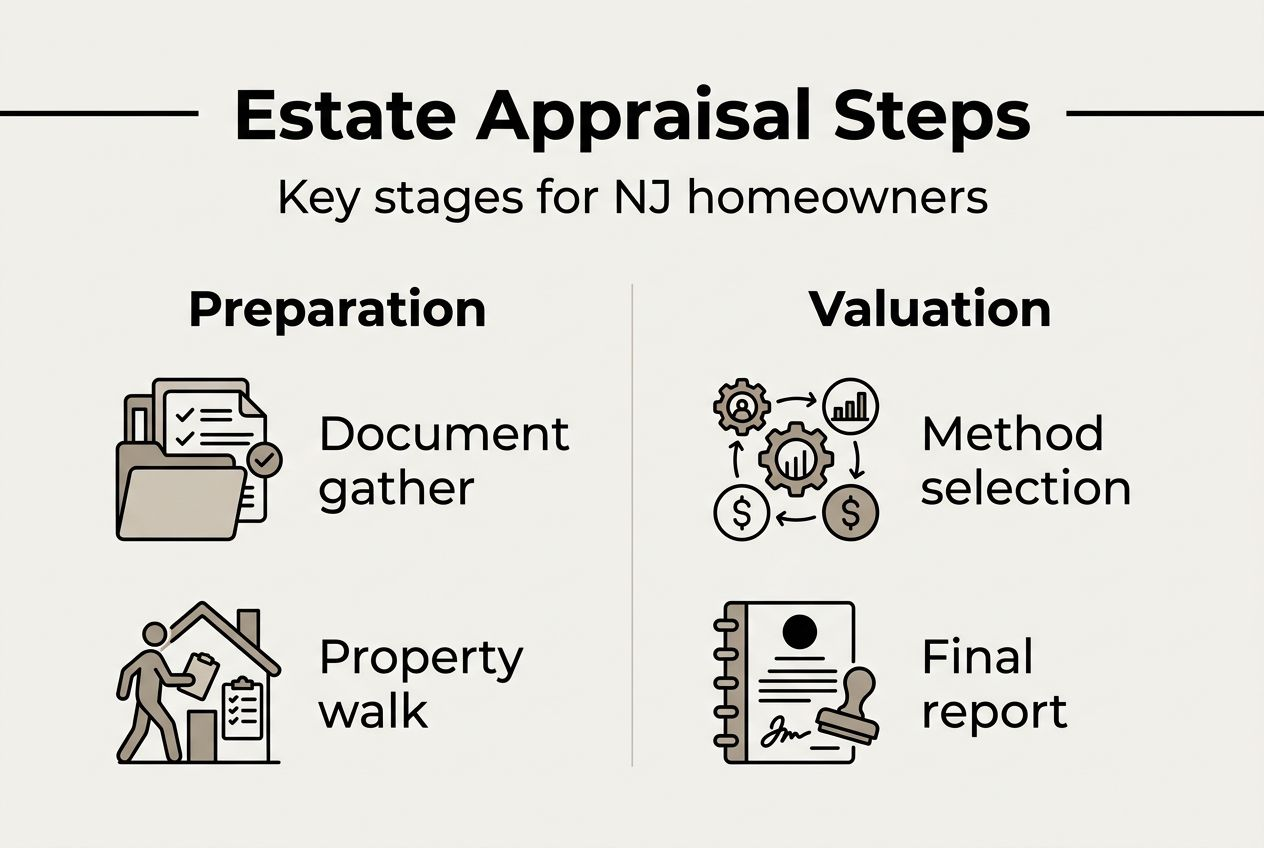
The estate appraisal process follows a systematic workflow designed to produce accurate, defensible valuations. Understanding this process helps homeowners and attorneys set realistic expectations and prepare necessary documentation. The typical sequence begins with engagement, progresses through inspection and analysis, and concludes with a comprehensive written report.
Here's the standard estate appraisal workflow:
- Initial consultation establishes the appraisal scope, purpose, and date of value specific to the estate or divorce case
- Property inspection documents physical characteristics, condition, improvements, and any factors affecting marketability
- Market research identifies comparable sales, analyzes current market conditions, and reviews relevant zoning or legal restrictions
- Data analysis applies appropriate valuation methods and adjusts comparables for differences in features, location, and timing
- Reconciliation weighs the reliability of different approaches to reach a final value conclusion
- Report preparation documents findings, methodology, and supporting evidence in a format meeting USPAP and legal requirements
- Delivery and potential testimony provides the completed report and makes the appraiser available for court testimony if needed
The Sales Comparison Approach is prioritized due to abundant comparable sales data in NJ, making it the most reliable method for residential estate appraisals. This approach analyzes recent sales of similar properties, adjusting for differences in size, condition, location, and features. For example, if a comparable property sold for $450,000 but has an additional bathroom worth $15,000, the appraiser subtracts that amount to better match the subject property.
The Cost Approach estimates value by calculating replacement cost minus depreciation, plus land value. This method proves most useful for newer properties, unique improvements, or situations where comparable sales are scarce. The Income Approach capitalizes rental income to determine value, primarily used for investment properties within estates. While less common for residential estate appraisals, it provides supporting evidence when properties generate rental income.
Appraisers analyze comparables through detailed adjustment grids that account for every significant difference. Location adjustments reflect neighborhood desirability and proximity to amenities. Physical adjustments address size differences, bedroom and bathroom counts, garage spaces, and lot dimensions. Condition adjustments recognize varying maintenance levels and needed repairs. Time adjustments account for market appreciation or depreciation between the comparable sale date and the estate's valuation date.

| Valuation Method | Primary Use | Strengths | Limitations | | --- | --- | --- | | Sales Comparison | Residential properties | Reflects actual market behavior | Requires sufficient comparable data | | Cost Approach | New construction, unique properties | Useful when sales data is limited | Difficult to estimate depreciation accurately | | Income Approach | Rental or investment properties | Directly relates to income potential | Not applicable to owner-occupied homes |
Pro Tip: Request that your appraiser use multiple data sources beyond the local MLS, including public records, private databases, and direct market participant interviews, to ensure the most comprehensive comparable analysis possible.
When preparing for home appraisals in NJ, gather documentation of recent improvements, maintenance records, and any property surveys. This information helps appraisers make accurate adjustments and can prevent undervaluation that affects estate distributions or divorce settlements.
Legal standards and compliance: USPAP and report requirements
The Uniform Standards of Professional Appraisal Practice (USPAP) establishes mandatory ethical and performance standards for all federally related appraisals, including estate valuations. USPAP compliance is legally required and critical for appraisal defensibility in New Jersey courts and IRS proceedings. These standards ensure consistency, objectivity, and transparency across all professional appraisals, regardless of the appraiser or property type.
USPAP requires appraisers to maintain independence and objectivity, avoiding conflicts of interest that could bias valuations. They must competently perform assignments, declining work outside their expertise or geographic competence. The standards mandate clear communication of findings, proper methodology application, and adequate documentation supporting every conclusion. Violations can result in license suspension, legal liability, and report rejection by courts or financial institutions.
Legally compliant estate appraisal reports must include specific elements to satisfy New Jersey court requirements and IRS standards. These comprehensive documents typically span 30 to 50 pages, providing detailed evidence supporting the appraiser's value conclusion. Missing or inadequate report components can lead to challenges during estate settlement, costly delays, or unfavorable tax consequences.
Critical appraisal report contents required by law:
- Client and intended use identification, specifying the estate or divorce purpose
- Property identification with legal description, address, and parcel information
- Date of value, typically the decedent's date of death for estate appraisals
- Scope of work describing the extent of research and analysis performed
- Neighborhood and market analysis establishing context for the valuation
- Property description documenting improvements, condition, and functional utility
- Highest and best use analysis justifying the valuation premise
- Valuation methodology explanation detailing approaches used and reconciliation logic
- Comparable sales data with detailed adjustment grids and supporting photographs
- Final value conclusion with effective date and any limiting conditions
- Appraiser certification and signature confirming USPAP compliance
"USPAP compliance transforms an opinion of value into a legally defensible document that withstands scrutiny from opposing counsel, tax authorities, and probate courts. Without this foundation, even accurate valuations may be rejected, forcing costly reappraisals and delaying estate settlements."
Non-compliant appraisals create significant legal risks in estate and divorce proceedings. Courts may exclude improperly prepared reports, leaving parties without credible valuation evidence. The IRS can challenge estate tax returns based on deficient appraisals, triggering audits and potential penalties. In divorce cases, non-compliant valuations may be deemed inadmissible, forcing settlements based on less reliable valuation methods or requiring expensive expert witness battles.
Compliance supports acceptance by courts and financial institutions because it demonstrates the appraiser followed recognized professional standards. Judges understand USPAP requirements and expect expert witnesses to meet these benchmarks. Executors and trustees rely on compliant appraisals to fulfill their fiduciary duties and defend their actions if beneficiaries challenge distributions. When selecting professionals for divorce appraisals in New Jersey, verify their commitment to USPAP standards and request sample reports demonstrating comprehensive documentation.
Special considerations for estate appraisals in divorce and settlement cases
Estate valuations for divorce and settlement purposes involve unique factors that distinguish them from standard market appraisals. Marketability discounts and minority interest adjustments can significantly impact final valuations, affecting how assets are distributed among heirs or divided between divorcing spouses. Understanding these considerations helps homeowners and attorneys anticipate valuation outcomes and negotiate fair settlements.
Discounts for lack of marketability or minority interest must be considered in estate settlements where multiple parties hold fractional ownership. Marketability discounts reflect the difficulty of selling partial interests in real estate compared to whole properties. If three siblings inherit equal shares of a family home, each owns a 33% interest that's harder to sell than a 100% interest, justifying a discount typically ranging from 10% to 35% depending on specific circumstances.
Minority interest discounts apply when an heir receives less than controlling interest in a property. A 25% owner cannot unilaterally decide to sell, refinance, or make major improvements, reducing their interest's value compared to a proportional share of the whole property value. Courts and the IRS recognize these discounts as legitimate valuation adjustments when properly supported by market evidence and economic analysis.
Valuations for whole estates differ from partial interests in both methodology and outcome. When an estate owns a property outright before distribution, appraisers value it at full market value without discounts. After distribution, if heirs hold fractional interests, separate valuations may apply discounts reflecting each heir's limited control and marketability. This distinction matters significantly for estate tax calculations and equitable distribution in divorce cases.
| Scenario | Valuation Basis | Typical Adjustments | Primary Use |
|---|---|---|---|
| Estate settlement (whole property) | Full market value | None, standard market conditions | Estate tax returns, initial probate |
| Fractional heir interests | Discounted value | Marketability and minority discounts | Individual heir tax basis, buyout negotiations |
| Divorce marital property | Full market value | None, equitable distribution focus | Property division, settlement agreements |
| Divorce with retained co-ownership | Potentially discounted | Case-specific based on agreement terms | Post-divorce ownership arrangements |
Pro Tip: If you're an heir or divorcing spouse, request that appraisers clearly disclose any discounts applied and provide detailed supporting analysis. Understanding whether discounts are appropriate for your situation prevents accepting undervalued settlements or triggering IRS scrutiny.
These considerations matter profoundly for legal fairness and taxation. In divorce cases, applying inappropriate discounts can result in one spouse receiving less than their equitable share of marital assets. In estate settlements, failing to apply legitimate discounts may result in overpayment of estate taxes, reducing distributions to beneficiaries. Conversely, aggressive discounting without proper support can trigger IRS challenges and penalties.
Attorneys representing clients in divorce settlement appraisals in NJ should engage appraisers experienced in applying these specialized adjustments. The complexity requires both valuation expertise and understanding of New Jersey case law governing property division. Similarly, executors managing estate distributions benefit from appraisers who can justify discount applications with market data and economic theory that withstands IRS examination.
Marketability and control issues also affect timing strategies. In some cases, selling the property before distribution and dividing proceeds eliminates discount questions entirely. In others, one heir buying out others' interests at full value avoids discount disputes while providing liquidity. Understanding why divorce settlements in New Jersey require accurate home appraisals helps parties evaluate these strategic options and make informed decisions about property disposition.
Get professional estate appraisals in New Jersey with NJREAG
Navigating estate settlements and divorce proceedings requires appraisers who understand New Jersey's unique legal landscape and deliver USPAP-compliant reports that withstand court scrutiny. New Jersey Real Estate Appraisal Group (NJREAG) brings over 26 years of specialized experience to complex valuation assignments, serving homeowners, attorneys, executors, and financial institutions across the state.

Our state-certified appraisers handle estate and divorce appraisals throughout New Jersey's diverse markets, from coastal properties in Atlantic County to suburban homes in Union County. We deliver comprehensive reports documenting every adjustment, supporting every conclusion with market evidence, and meeting the strict standards courts and the IRS demand. Our expertise ensures your appraisal withstands challenges, protects your legal position, and facilitates fair, efficient settlements. Explore our full range of NJ appraisal services to find the right solution for your estate or divorce valuation needs.
Frequently asked questions
What qualifies an appraiser for estate appraisals in New Jersey?
Appraisers must hold New Jersey state certification as either certified residential or certified general appraisers, depending on property type and value. They need specific experience with estate valuations, USPAP compliance, and familiarity with IRS and court requirements. Verify credentials directly with the New Jersey Real Estate Appraiser Board before engagement.
How long does a typical estate appraisal take?
Most estate appraisals require 7 to 14 days from property inspection to report delivery, depending on property complexity and comparable data availability. Rush services may be available for urgent court deadlines or estate settlement timelines. Complex properties with unique features or limited comparables may require additional time for thorough analysis.
Can estate appraisal values differ from market sale prices?
Yes, estate appraisals reflect value on a specific date, typically the date of death, while actual sale prices depend on market conditions at the time of sale, which may be months or years later. Market fluctuations, property condition changes, and negotiation factors can create differences. Estate appraisals establish baseline value for legal and tax purposes, not predictions of future sale prices.
What happens if an appraisal is challenged during estate settlement?
Challenged appraisals typically require the appraiser to defend their methodology, provide additional supporting documentation, or potentially testify in court. If the challenge succeeds, a new appraisal from a different certified appraiser may be ordered. USPAP-compliant reports with comprehensive documentation rarely face successful challenges, which is why compliance matters so critically.
Are estate appraisals required for all probate cases?
New Jersey law requires appraisals for estate tax purposes when estates exceed federal or state exemption thresholds. Even when not legally mandated, appraisals provide essential documentation for equitable distribution among heirs and protect executors from liability claims. Many attorneys recommend probate property appraisals in NJ regardless of estate size to establish clear, defensible values and prevent future disputes among beneficiaries.