
Getting your land valuation wrong in New Jersey can cost you thousands in overpaid taxes, derail a sale, or weaken your position in a legal dispute. Whether you're a homeowner preparing to sell, an attorney handling an estate, or a developer assessing a parcel's potential, understanding exactly how land is valued under New Jersey law gives you a real advantage. This guide walks you through every stage of the process, from core legal definitions to appeals, so you can move forward with confidence and clarity.
Table of Contents
- Understanding the basics of land valuation in New Jersey
- What you need before starting: Requirements, standards, and preparation
- Step-by-step: The land valuation process in New Jersey
- Special cases and expert considerations in New Jersey land valuation
- Verifying, appealing, and understanding your valuation result
- Expert help for your land valuation needs
- Frequently asked questions
Key Takeaways
| Point | Details |
|---|---|
| Understand true value | True value drives New Jersey land valuation and directly impacts taxes and legal outcomes. |
| Prepare key documents | Gather deeds, comps, and maps before starting the valuation process for smoother results. |
| Choose the right method | Sales, cost, and income approaches are weighted based on land type and purpose in New Jersey. |
| Know special cases | Farmland, contamination, or highest and best use analysis bring extra rules and risks. |
| Appeals are an option | If you suspect an error, Chapter 123 provides a clear path for appealing your land assessment. |
Understanding the basics of land valuation in New Jersey
Before you can navigate the valuation process, you need to understand what New Jersey law actually requires. The state uses a standard called "true value", which is the price a property would sell for in a fair, arm's-length transaction between a willing buyer and seller. This is essentially market value, and it forms the legal foundation for property tax assessments across all 21 counties.
One thing that surprises many property owners is that land and improvements (buildings, structures) are valued separately. This matters because land rarely depreciates the way a building does. Municipal assessors handle most valuations, typically on a revaluation cycle that varies by municipality. Some towns revalue every few years; others go decades without a full revaluation.
Here are the primary uses of land valuation in New Jersey:
- Property tax assessment (the most common trigger)
- Pre-sale or pre-listing pricing for accurate market positioning
- Legal disputes, including divorce, estate settlement, and condemnation
- Development feasibility and zoning analysis
- Tax appeals when an assessment seems out of line
For a broader look at how valuation affects your decisions as an owner or investor, the NJ valuation tips resource covers practical strategies worth reviewing. If you're specifically dealing with a parcel of land, land appraisals in New Jersey outlines what a certified appraisal involves.
| Term | Definition | NJ standard |
|---|---|---|
| True value | Price in a fair open-market sale | October 1 pretax year |
| Market value | Most probable sale price | Basis for assessments |
| Equalization ratio | Assessed value divided by true value | Set annually by county |
| COD | Coefficient of deviation, measures uniformity | Lower is more accurate |
What you need before starting: Requirements, standards, and preparation
Gathering the right documents before a valuation saves time and prevents disputes later. Assessors and certified appraisers rely on specific data to produce a defensible result, and missing information can lead to errors that are costly to correct.
Here's a checklist of what you should have ready:
- Deed showing legal description and ownership history
- Recent comparable sales (ideally within 12 months and within the same market area)
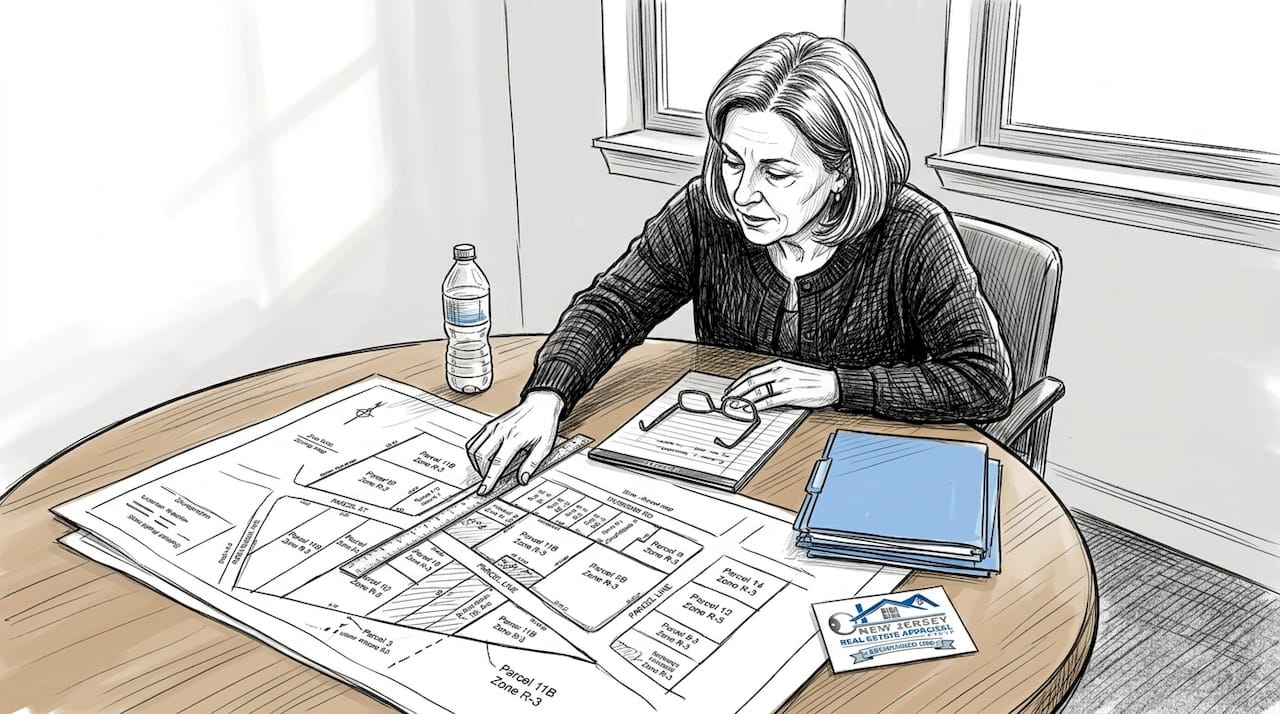
- Tax maps and survey documents showing lot dimensions and boundaries
- Zoning certificate confirming permitted uses
- Prior appraisal reports, if any exist
- Environmental reports for any land with potential contamination issues
New Jersey assessors use the NJ Appraisal Manual along with annual cost conversion factors to standardize how improvements are valued. These factors are updated each year and reflect changes in construction costs statewide. Physical inspections are also required, and you should expect the assessor or appraiser to walk the property, note its condition, and verify lot characteristics.
County and state oversight adds another layer of consistency. The Division of Taxation monitors assessment ratios to ensure municipalities stay within acceptable ranges. If a town's ratio drifts too far from true value, a mandatory revaluation can be ordered.
For a detailed walkthrough of what each stage involves, the land appraisal process steps guide is a useful reference. You can also review appraisal methods in New Jersey to understand which approach fits your situation.
Pro Tip: Pull at least three to five comparable sales before your appraisal appointment. Verify that each comp is genuinely similar in size, zoning, and location. Errors in comparable selection are one of the most common reasons assessments get challenged successfully.
Step-by-step: The land valuation process in New Jersey
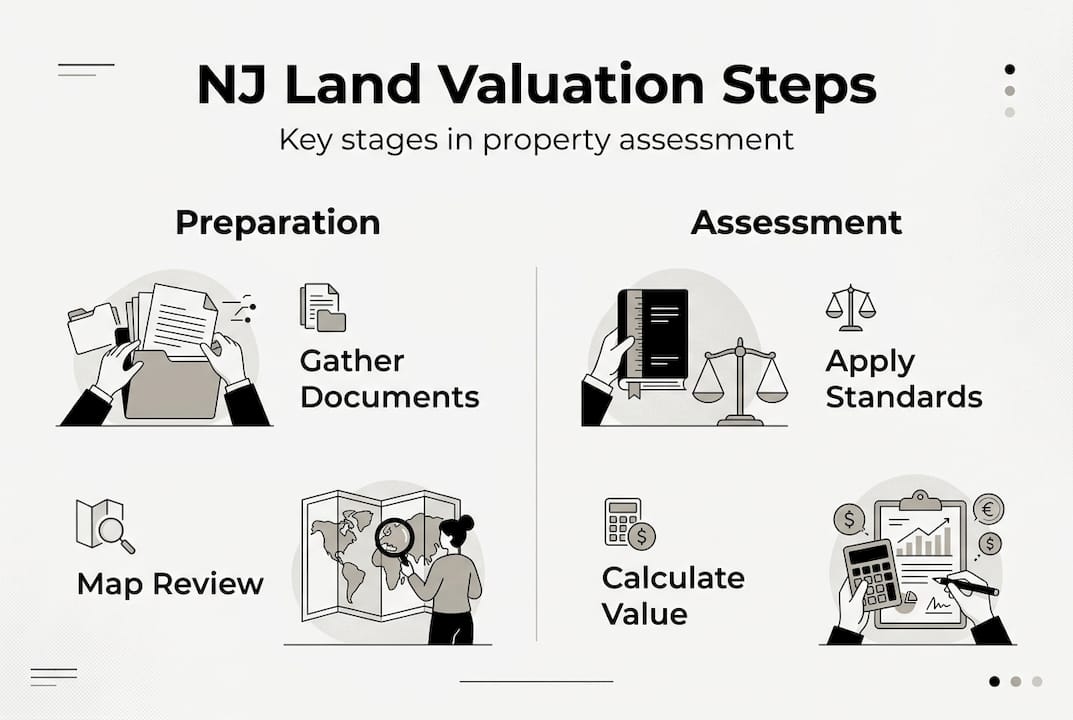
New Jersey recognizes three primary appraisal methodologies for determining property value. Each serves a different purpose, and knowing which one applies to your situation is critical.
- Inspection. The appraiser or assessor physically visits the property to document size, topography, access, utilities, and any improvements.
- Research. Market data is gathered, including recent sales, income data (if applicable), and cost estimates for improvements.
- Methodology selection. The appraiser chooses the most appropriate approach based on property type.
- Calculation. Value is estimated using the selected method, with adjustments made for differences between the subject property and comparables.
- Review and reconciliation. Results from multiple methods may be weighted and reconciled into a final value opinion.
| Approach | Best used for | Pros | Cons |
|---|---|---|---|
| Sales comparison | Vacant land, residential | Reflects actual market | Requires good comp data |
| Replacement cost | Improved properties | Useful when sales are scarce | Depreciation estimates vary |
| Income approach | Income-producing properties | Captures investment value | Complex; needs rental data |
For valuation tips specific to your property type, reviewing examples of each method in practice helps clarify which one your appraiser should prioritize. The NJ appraisal approaches breakdown goes deeper into how each method is applied.
Pro Tip: For vacant land valuations, the sales comparison approach is almost always the most reliable method. Income and replacement cost approaches are better suited to improved or income-generating properties. If your appraiser leads with cost approach on raw land, ask why.
Special cases and expert considerations in New Jersey land valuation
Not all land is valued the same way. Several categories require specialized knowledge, and getting these wrong can have serious financial or legal consequences.
Farmland assessments are one of the most significant exceptions. Under New Jersey's Farmland Assessment Act, qualifying land is valued based on its agricultural productivity rather than its open-market price. To qualify, a parcel must meet minimum acreage requirements and generate at least $1,000 in annual agricultural income. Farmhouses and residential structures on the same parcel are excluded from the farmland assessment and valued separately at full market value.
Development potential is another area where disputes arise. If you believe your land has higher value based on future development, you need documented proof. Courts require that any highest-and-best-use claim be legally permissible, physically possible, financially feasible, and maximally productive.
Contaminated or deed-restricted land presents its own challenges. As established in New Jersey Supreme Court case law, contamination or deed restrictions directly reduce market value, and any highest-and-best-use analysis must account for legal permissibility first.
"Contamination or deed-restriction limits market value; highest and best use analysis requires legal permissibility."
Key situations where expert appraisal is especially important:
- Land appraisal for divorce proceedings where both parties need an independent, defensible value
- Probate appraisal in New Jersey when an estate includes land with complex use or ownership history
- Tax appeals where the municipality's assessment appears to reflect the wrong use category
Verifying, appealing, and understanding your valuation result
Once you receive a valuation, your job isn't done. Reviewing the result carefully can reveal errors that are worth challenging.
Start by comparing your assessed value to the county equalization ratio. New Jersey publishes the equalized valuations table annually, and it shows the ratio of assessed value to true value for every municipality. If your assessment divided by the ratio produces a number significantly higher than what comparable properties are selling for, that's a red flag.
Signs your assessment may be off:
- Your implied true value is well above recent comparable sales
- The assessor used the wrong zoning or use category
- Comparable properties in your area have lower assessments for similar land
- Your land was assessed as developable when it carries deed restrictions or environmental limitations
New Jersey's Chapter 123 law sets a common level range for appeals. If your assessment falls outside 15% above or below the county ratio, you may have grounds to appeal. The appeal process starts with the county tax board and can escalate to the Tax Court of New Jersey.
On the value side, NJ land averages around $196,000 per acre statewide, but that number varies enormously. Rural parcels in Salem County may trade at $10,000 per acre, while urban infill lots in Hudson County can exceed $1.5 million per acre. Knowing where your land falls in that range is essential before you accept any assessed value.
For a certified review of your land's value, certified land appraisals from a licensed New Jersey appraiser give you a USPAP-compliant report you can use in court, at closing, or in an appeal.
Expert help for your land valuation needs
If your situation involves a legal dispute, a pending sale, farmland classification, or a tax appeal, a certified appraisal is not optional. It's the document that protects your position.

At New Jersey Real Estate Appraisal Group, we've spent over 26 years producing court-ready, USPAP-compliant valuations for homeowners, attorneys, developers, and real estate professionals across the state. Our certified land appraisals cover agricultural, residential, and commercial parcels, and we regularly serve as expert witnesses in Tax Court proceedings. Whether you need a straightforward pre-sale opinion or a complex highest-and-best-use analysis, our real estate appraisal services are built to deliver accurate, defensible results. Reach out today to get a fast quote and take the first step toward a valuation you can rely on.
Frequently asked questions
What is 'true value' in New Jersey land valuation?
True value is the price a property would sell for in a fair, open-market transaction, assessed as of October 1 of the pretax year. It serves as the legal standard for all property tax assessments in New Jersey.
What documents do I need for a land valuation in New Jersey?
You'll need your deed, recent comparable sales, tax maps, a zoning certificate, and any prior appraisal reports. Environmental reports are also important if contamination is a possibility.
Can I appeal my land assessment if I think it's too high?
Yes. If your assessment falls outside the Chapter 123 common level range, you can file an appeal with your county tax board. You'll need evidence, typically a certified appraisal, to support your claim.
How is farmland valued differently from other land in New Jersey?
Under the Farmland Assessment Act, qualifying land is valued based on agricultural productivity rather than market price. The parcel must meet minimum acreage and income thresholds to qualify.
What is the average cost per acre of land in New Jersey?
NJ land averages around $196,000 per acre statewide, but values range from roughly $10,000 per acre in rural areas to over $1.5 million per acre in dense urban markets.