
Many New Jersey homeowners assume their tax assessment or a quick online estimate tells them what their home is actually worth. That assumption can cost you thousands of dollars in a sale, a refinancing deal, or a legal proceeding. A certified appraisal is an unbiased, professional opinion of market value prepared by a licensed appraiser following USPAP standards, and it is the only number that lenders, courts, and tax boards in New Jersey will fully accept. This guide walks you through what a property appraisal is, how the process works step by step, which valuation methods appraisers use, and what to do once you have your report in hand.
Table of Contents
- What is a property appraisal and why is it required?
- Step-by-step: The property appraisal process in New Jersey
- Three main approaches to valuing a property
- Challenges, edge cases, and special scenarios in New Jersey appraisals
- After the appraisal: Next steps and maximizing your benefits
- Get expert-certified appraisal support in New Jersey
- Frequently asked questions
Key Takeaways
| Point | Details |
|---|---|
| Certified appraisals are required | A licensed NJ appraiser is essential for sales, refinancing, taxes, and legal needs. |
| Three core valuation methods | Appraisers use the sales comparison, cost, and income approaches for different property types. |
| Special scenarios affect value | Unique properties, mass appraisals, and low-data areas require expert adjustment. |
| Preparation helps your outcome | Organize documents, maintain the property, and understand your rights to appeal. |
| Choose local certified experts | NJ appraisers ensure compliance, accuracy, and a smoother process for property owners. |
What is a property appraisal and why is it required?
A property appraisal is an independent, professional market valuation performed by a state-licensed or state-certified appraiser. It is not a guess, and it is not the same number your town uses to calculate your property tax bill. The USPAP standards require appraisers to remain impartial, meaning they cannot have a financial interest in the outcome of the report. The Dodd-Frank Act adds another layer of protection by prohibiting lenders from pressuring appraisers to hit a target value.
Understanding what an appraisal is not helps just as much. A tax assessment is a mass-produced estimate used by municipalities for billing purposes. A broker price opinion (BPO) is an informal estimate from a real estate agent. An automated valuation model (AVM), like the estimates you see on popular real estate websites, relies on algorithms with no physical inspection. None of these meet the legal or lending standards that a USPAP-compliant appraisal satisfies.
Here are the most common situations in New Jersey where a certified appraisal is required or strongly recommended:
- Property sales: Confirms a fair listing or offer price for buyers and sellers
- Mortgage refinancing: Required by virtually every lender before approving a new loan
- Estate and probate settlements: Establishes fair market value for asset distribution
- Divorce proceedings: Provides a neutral valuation both parties can rely on in court
- NJ tax appeal appraisals: Supports your case when your assessed value is too high
- Land appraisal in NJ: Required for vacant lot sales, subdivisions, and development decisions
- Eminent domain and right-of-way cases: Legally mandated for fair compensation
"An appraisal must be performed independently and without bias, following USPAP guidelines, to be accepted for lending, legal, or tax purposes in New Jersey."
Now that you know why a certified appraisal matters, let's look at how the process works in New Jersey.
Step-by-step: The property appraisal process in New Jersey
The appraisal process follows a structured sequence. Knowing each step helps you prepare and avoid delays. Valuation methods may diverge depending on property type and available data, so appraisers follow a disciplined workflow to reach a defensible conclusion.
- Order or instruction: A lender, attorney, homeowner, or court orders the appraisal. The appraiser receives the assignment details, including the intended use and the effective date of value.
- Research and comp gathering: The appraiser pulls recent comparable sales (comps) from the MLS and public records, reviews zoning, flood maps, and neighborhood trends specific to your New Jersey market.
- Property inspection: For a full appraisal, the appraiser visits the property in person. They measure the structure, note condition, photograph key features, and identify any improvements or deficiencies. Desktop or exterior-only appraisals exist but are less common for complex transactions.
- Analysis and valuation approaches: The appraiser applies one or more of the three recognized methods (explained in the next section) and adjusts for differences between your property and the comps.
- Report writing: The findings are compiled into a formal written report, typically on a standardized form for residential properties or a narrative report for commercial and complex assignments.
- Delivery and review: The completed report is delivered to the client. For lending purposes, the lender receives it directly. You have the right to a copy.
Documents that help speed up the process include your deed, prior appraisals, building plans, permits, a list of recent repairs or upgrades, and lease agreements if the property generates rental income. Review tips for preparing for your NJ home appraisal before your scheduled inspection. For vacant land, the NJ land appraisal steps differ slightly and involve additional zoning and utility research.
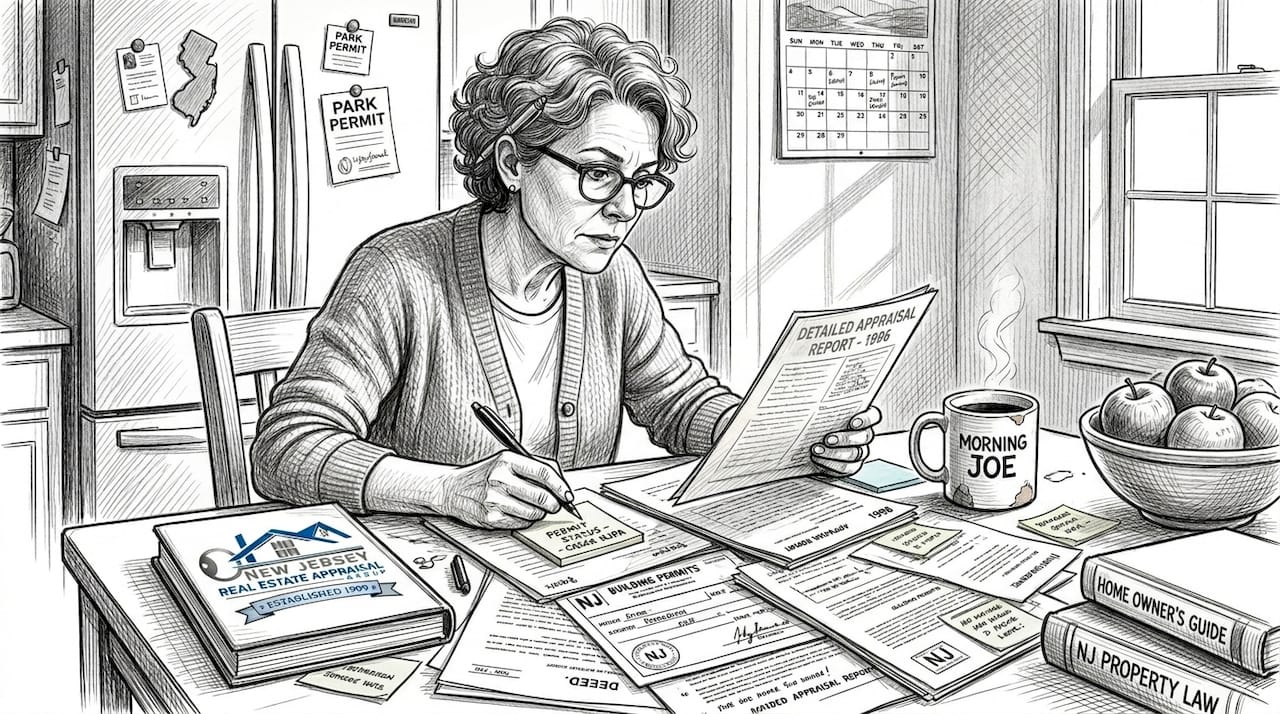
Pro Tip: Clean and declutter every room before the inspection. Appraisers note condition carefully, and a well-maintained appearance signals that the property has been cared for. Small repairs like fixing a leaky faucet or patching a wall can make a measurable difference in the condition rating.
With a clear view of the appraisal workflow, next we'll demystify the main valuation methods appraisers use in New Jersey.
Three main approaches to valuing a property
Appraisers do not pick a number out of thin air. They apply one or more of three recognized methodologies, then reconcile the results into a final opinion of value. The three primary valuation methods are the sales comparison approach, the cost approach, and the income approach.
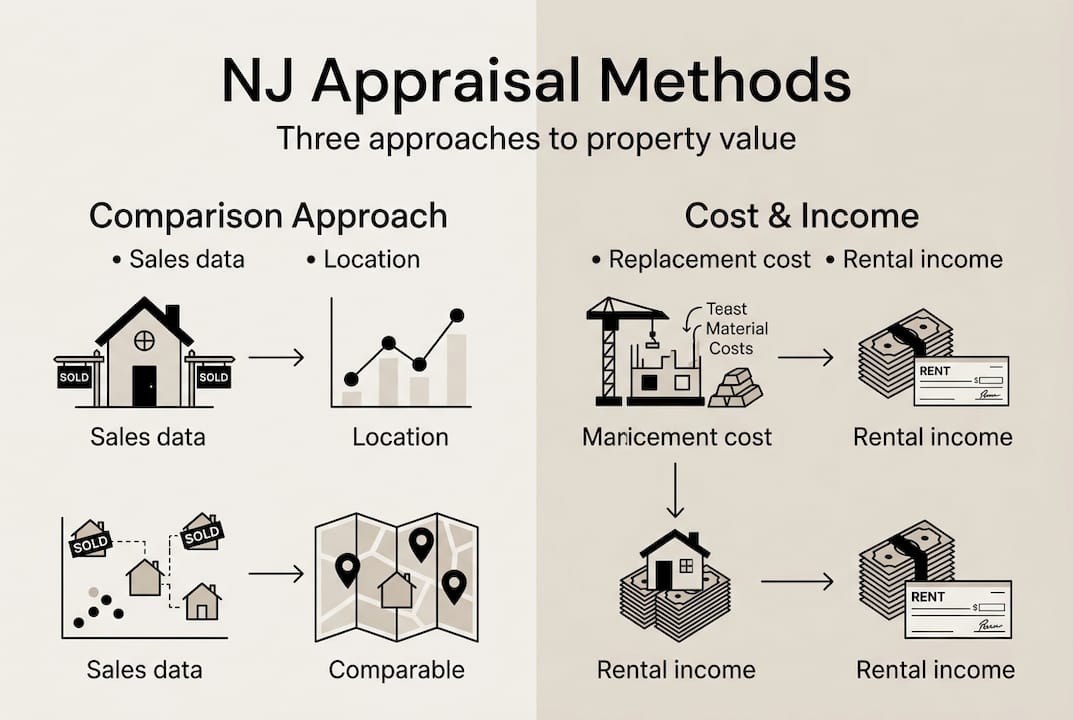
| Method | Best use case | How it works | Key consideration |
|---|---|---|---|
| Sales comparison | Residential homes | Adjusts recent comp sales for differences in size, condition, and features | Requires sufficient recent sales data in the area |
| Cost approach | New construction, special-use properties | Replacement cost minus depreciation, plus land value | Most reliable when the building is new or unique |
| Income approach | Rental and commercial properties | Net operating income divided by a market cap rate | Depends on accurate rent and expense data |
For most single-family homes in New Jersey, the sales comparison approach is the primary method. The appraiser finds three to five recent sales of similar homes nearby, then makes dollar adjustments for differences like an extra bathroom, a finished basement, or a larger lot.
The cost approach is used when comparable sales are scarce, such as with a newly built custom home or a special-use building like a church or school. For rental properties and commercial real estate, the income approach reflects how investors actually price those assets. Learn more about NJ appraisal methodology and how appraisers reconcile these approaches, or explore commercial property evaluation types if you own investment real estate.
Once you understand the methods, it's easier to see why appraisal results can vary. Let's look at some common challenges and special property types in New Jersey.
Challenges, edge cases, and special scenarios in New Jersey appraisals
Not every property fits neatly into a standard appraisal framework. New Jersey has a wide range of property types, from historic Victorian homes in Cape May to industrial warehouses in Newark, and each presents its own challenges.
Mass appraisals and tax revaluations are one of the most common sources of confusion for NJ homeowners. When a municipality conducts a town-wide revaluation, it uses statistical models to estimate values for thousands of properties at once. These models cannot account for your specific property's condition, recent renovations, or unique features. As a result, mass appraisals often overshoot individual market values, which is exactly why you have the right to appeal. A certified individual appraisal is your strongest tool in that appeal.
Here are other edge cases that require specialized appraisal approaches:
- Eminent domain and right-of-way: The government must compensate you fairly when it takes your property or a portion of it. These appraisals follow the Uniform Appraisal Standards for Federal Land Acquisitions (the Yellow Book) and use a before-and-after methodology.
- Unique or special-use properties: When there are no comparable sales, the cost approach becomes the primary method.
- Low-comp markets: In rural or thinly traded areas of New Jersey, appraisers may expand the geographic radius or extend the time frame for comparable sales to build a credible data set.
- New construction: The cost approach is often weighted more heavily because recent sales of identical new builds may not yet exist.
Pro Tip: Watch your mailbox every year around revaluation season. New Jersey municipalities are required to notify property owners of new assessments. If your new assessed value seems high compared to what you could realistically sell for, contact a certified appraiser right away. The appeal window is short, typically 45 days from the date of the notice.
For NJ commercial appraisals or property tax appeal appraisals, working with an appraiser who knows your specific county and property type is critical.
With an understanding of special situations, let's consider what you should do once you receive your appraisal results.
After the appraisal: Next steps and maximizing your benefits
Receiving your appraisal report is not the end of the process. It is the starting point for your next decision. Here is how to use it effectively.
- Read the report carefully: Check the property description for factual errors. Confirm the square footage, bedroom and bathroom count, lot size, and any listed improvements match reality.
- Review the comparable sales: Look at the comps the appraiser selected. If a comp is significantly different from your property in size or condition, note it. You have the right to question the selection.
- Check for missing upgrades: If you recently renovated a kitchen or added a deck and it is not reflected in the report, that is grounds for a reconsideration of value request.
- Request reconsideration if warranted: Submit a written request to the lender or appraiser with supporting evidence, such as a recent sale the appraiser missed or documentation of an upgrade. This is a formal process, not a negotiation.
- Use the report for your specific goal: For a sale, the appraisal helps you price competitively. For refinancing, it determines your loan-to-value ratio. For a tax appeal, it is your primary evidence. For divorce or estate matters, it provides the neutral number both sides need.
- Avoid relying on AVMs going forward: Online estimates are useful for a quick ballpark, but USPAP-compliant appraisals are the only option accepted by lenders, courts, and tax boards in New Jersey.
Familiarize yourself with common home appraisal mistakes so you can avoid them before your next appraisal. Being proactive saves time and protects your financial interests.
Get expert-certified appraisal support in New Jersey
Working with a local, state-certified appraiser in New Jersey is not just a formality. It is a financial decision that protects your interests whether you are selling, refinancing, appealing a tax bill, or navigating a legal matter. A certified appraiser who knows your county's market, comparable sales trends, and local zoning nuances will produce a report that holds up under scrutiny.

At newjerseyrealestateappraisal.com, our certified NJ appraisers bring over 26 years of experience to every assignment, from single-family homes and New Jersey land appraisals to commercial properties and court-ready legal reports. We serve clients across the state, including full Union County appraisal services and beyond. Contact us today to get a fast quote and make sure your next appraisal is accurate, compliant, and built to support your goals.
Frequently asked questions
Is appraisal value the same as assessed value for taxes in New Jersey?
No. Appraisal value reflects current market value for transactions, while assessed value is a municipal estimate used for tax billing and can differ substantially, especially after a mass revaluation that does not account for individual property conditions.
What happens if I disagree with my appraisal in New Jersey?
You can submit a reconsideration of value request with supporting evidence, such as missed comparable sales or undocumented upgrades. For tax-related appraisals, reval overshoots give you the right to file a formal appeal with the county tax board.
How long is a property appraisal valid for in NJ sales or refinancing?
Most NJ lenders accept appraisals for four to six months from the effective date, though requirements vary by lender type and loan program, so always confirm with your lender before ordering.
What documents should I prepare ahead of my NJ appraisal?
Gather your deed, prior appraisals, building plans, permits, a detailed list of recent repairs and upgrades, and any lease or income data if the property is a rental.
Are online value estimates or BPOs accepted in place of a full appraisal?
No. BPOs and AVMs are not compliant for lending, legal, or tax appeal purposes in New Jersey. Only a certified appraisal meeting USPAP and Dodd-Frank standards satisfies those requirements.