

Many commercial property owners mistakenly assume appraisals work like residential valuations, but the reality is far more nuanced. Commercial appraisals involve specialized methodologies, extensive market analysis, and regulatory compliance unique to investment properties. For New Jersey investors navigating complex local markets in 2026, understanding these processes is essential for making sound acquisition decisions, securing financing, and maintaining compliance. This guide breaks down everything you need to know about commercial property appraisals in New Jersey, from valuation methods to regulatory requirements and practical report interpretation.
Table of Contents
- What is a commercial property appraisal and why it matters in New Jersey
- Common methods of commercial property appraisal: understanding approaches and outcomes
- Interpreting commercial appraisal reports: key components and practical insights
- Navigating New Jersey commercial property appraisal regulations and compliance in 2026
- Explore professional appraisal services for New Jersey commercial properties
- What is involved in a commercial property appraisal?
- How frequently should a commercial property be appraised in New Jersey?
- Can I use a residential appraisal for my commercial property?
- What should I look for when choosing a commercial appraiser in New Jersey?
Key takeaways
| Point | Details |
|---|---|
| Multiple valuation approaches | Commercial appraisals use income, cost, and sales comparison methods tailored to property type and investment purpose. |
| New Jersey compliance matters | State certification and USPAP adherence ensure legally defensible valuations for financing and tax purposes. |
| Report literacy drives decisions | Understanding appraisal components helps investors validate assumptions and spot potential valuation issues. |
| Strategic timing optimizes value | Regular appraisals align with market changes, refinancing needs, and regulatory requirements for portfolio management. |
What is a commercial property appraisal and why it matters in New Jersey
A commercial property appraisal is an independent professional assessment that estimates the market value of income-producing or business-use real estate. Unlike residential appraisals that focus on comparable home sales, commercial appraisals analyze income potential, operating expenses, and market conditions specific to investment properties. These valuations serve multiple critical functions for property owners and investors throughout New Jersey.
Accurate appraisals support informed investment decisions by providing objective value benchmarks. Whether you're acquiring an office building in Newark, refinancing a retail center in Cherry Hill, or settling an estate with industrial property in Elizabeth, professional valuations establish credible market value. Lenders require appraisals to determine loan amounts and assess risk. Insurance companies use them to set appropriate coverage levels. Tax authorities rely on appraisals for assessment appeals and dispute resolution.
New Jersey's diverse commercial real estate markets add complexity to the appraisal process. Local zoning regulations, municipal tax structures, and regional economic factors significantly influence property values. Coastal properties face different considerations than inland locations. Urban centers command different capitalization rates than suburban markets. State-specific environmental regulations and disclosure requirements also impact valuation conclusions.
Commercial appraisals are typically required in these scenarios:
- Property acquisitions and sales transactions
- Commercial mortgage financing or refinancing
- Partnership dissolution or business restructuring
- Estate settlement and probate proceedings
- Tax assessment appeals and property tax challenges
- Litigation support for eminent domain or dispute resolution
- Insurance claims and coverage determination
Pro Tip: Engage a state-certified appraiser with demonstrated experience in your specific property type and New Jersey county. Local market knowledge dramatically improves valuation accuracy and credibility with lenders or courts.
Common methods of commercial property appraisal: understanding approaches and outcomes
Commercial appraisers employ three primary valuation methods, each suited to different property types and purposes. Understanding these approaches helps investors evaluate appraisal credibility and anticipate valuation outcomes for their New Jersey properties.

The income approach dominates commercial appraisals for investment properties. This method calculates value based on the property's ability to generate income. Appraisers analyze actual or projected rental income, subtract operating expenses to determine net operating income, then apply a capitalization rate reflecting market expectations and risk. A retail center generating $500,000 in NOI with a 7% cap rate would be valued at approximately $7.14 million. This approach works exceptionally well for stabilized income properties like office buildings, shopping centers, and multifamily complexes.
The cost approach estimates value by calculating what it would cost to replace the building today, then subtracting depreciation from physical deterioration, functional obsolescence, and external factors. Land value is added separately. This method proves most useful for new construction, special-use properties like manufacturing facilities, or unique buildings without comparable sales. A warehouse built in 2024 with $3 million in construction costs and minimal depreciation on land worth $800,000 might appraise near $3.8 million using this approach.
The sales comparison approach analyzes recent transactions of similar commercial properties, adjusting for differences in size, location, condition, and features. While straightforward in concept, finding truly comparable commercial sales can be challenging. A 20,000 square foot office building in Morristown might be compared to recent sales of similar buildings in nearby municipalities, with adjustments for parking, tenant quality, and lease terms. This method works best when sufficient market data exists for the property type.
| Method | Best For | Key Advantage | Primary Limitation |
|---|---|---|---|
| Income Approach | Stabilized income properties | Reflects investor expectations and market rates | Requires reliable income and expense data |
| Cost Approach | New construction, special use | Useful when comparables are scarce | Depreciation estimates can be subjective |
| Sales Comparison | Properties with active markets | Based on actual market transactions | Requires sufficient comparable sales data |
Appraisers select methods based on several factors:
- Property type and income-generating characteristics
- Availability and reliability of market data
- Intended use of the appraisal report
- Property age, condition, and unique features
- Client requirements and regulatory standards
Pro Tip: Request that your appraiser use multiple methods when possible. Convergence of value conclusions from different approaches strengthens credibility and provides validation, particularly for financing or litigation purposes.
Interpreting commercial appraisal reports: key components and practical insights
Commercial appraisal reports contain detailed analysis and technical information that investors must understand to make informed decisions. Knowing how to read these documents reveals not just the final value conclusion but the reasoning and assumptions behind it.
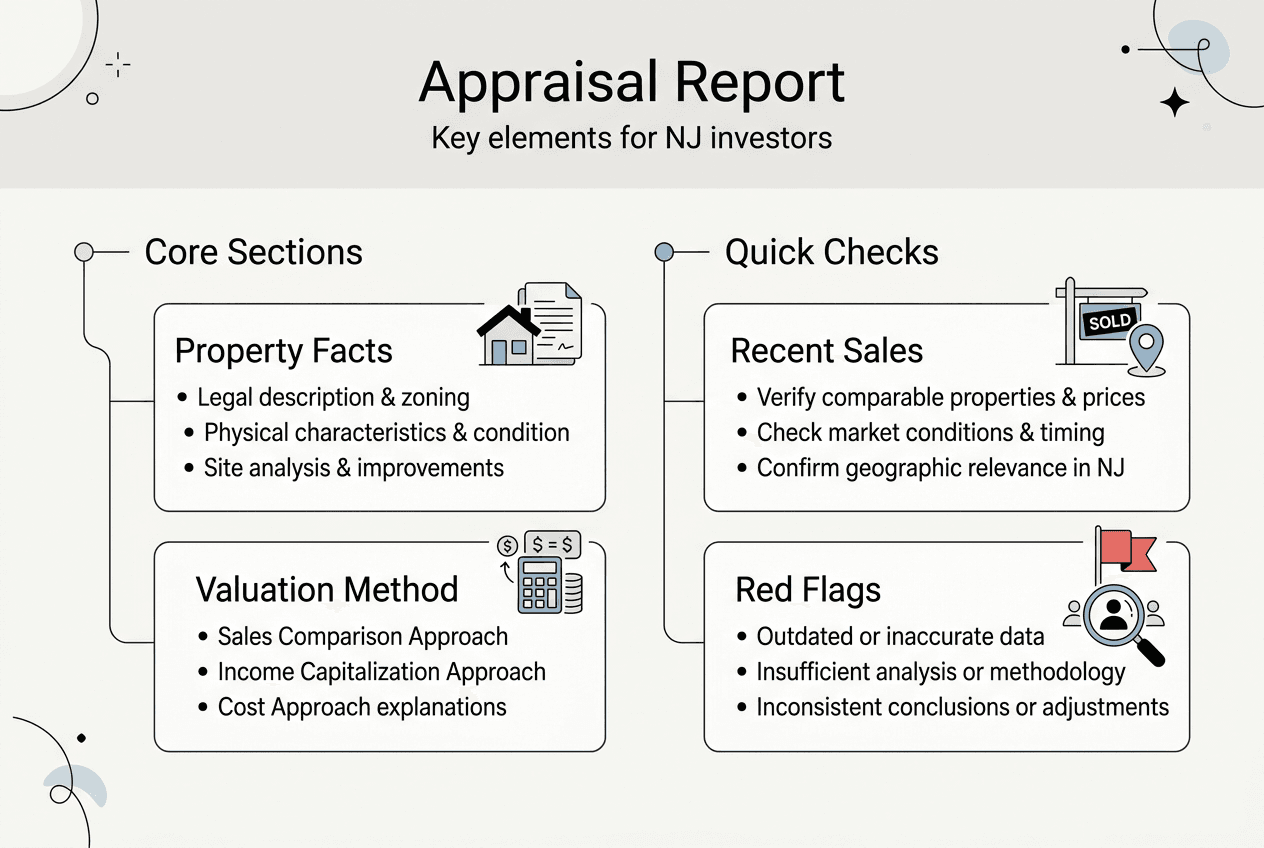
Every comprehensive appraisal report includes these essential components. The property description section details physical characteristics, including square footage, construction quality, age, condition, and site features. Market analysis examines local economic conditions, supply and demand factors, comparable properties, and trends affecting value. The valuation section presents the approaches used, calculations performed, and reconciliation of different value indications. Assumptions and limiting conditions disclose any restrictions on the appraisal's scope or reliability. The final value opinion states the appraiser's conclusion of market value as of a specific date.
Follow these steps to review and validate appraisal findings:
- Verify that property details match actual conditions and public records, checking square footage, zoning, and legal descriptions for accuracy.
- Examine comparable properties used in sales comparison or income approaches, confirming they are truly similar in location, size, and quality.
- Review income and expense figures against your actual operating statements, questioning any significant discrepancies or unexplained adjustments.
- Assess the capitalization rate or discount rate used, comparing it to published market surveys and recent transactions in your submarket.
- Check that assumptions are reasonable and clearly stated, particularly regarding market conditions, highest and best use, and property condition.
- Confirm the appraiser's credentials, certification, and experience with your property type and New Jersey market.
Watch for red flags that may indicate problems. Unusually high or low values compared to recent sales or your expectations warrant scrutiny. Insufficient comparable data or heavy reliance on properties outside your market area weakens conclusions. Vague or missing explanations for adjustments suggest incomplete analysis. Outdated market data or failure to consider recent economic changes reduces reliability.
Before accepting appraisal results, ask your appraiser these critical questions. How did you select the capitalization rate, and what market data supports it? What adjustments did you make to comparable properties, and why? How do current market conditions affect your value conclusion? What would change the value significantly, and by how much? Are there any factors that could limit the appraisal's use for my intended purpose?
Navigating New Jersey commercial property appraisal regulations and compliance in 2026
Regulatory compliance forms the foundation of credible commercial property appraisals in New Jersey. Understanding these requirements helps investors ensure their appraisals meet legal standards and withstand scrutiny from lenders, courts, or tax authorities.
New Jersey requires commercial appraisers to hold state certification demonstrating education, experience, and examination competency. The New Jersey Real Estate Appraiser Board oversees licensing and enforces professional standards. Certified General appraisers can value all property types without restriction, while Certified Residential appraisers face limitations on commercial work. Always verify your appraiser holds appropriate credentials for your property type and transaction value.
All appraisers must follow the Uniform Standards of Professional Appraisal Practice established by The Appraisal Foundation. USPAP sets ethical obligations, competency requirements, and reporting standards ensuring consistency and credibility. These standards mandate independence, requiring appraisers to remain unbiased and free from conflicts of interest. They also require clear documentation of methods, data sources, and reasoning supporting value conclusions.
Local regulations significantly impact commercial appraisals throughout New Jersey. Zoning ordinances determine permitted uses and development potential, directly affecting highest and best use analysis. Municipal tax assessment practices vary widely across the state's 565 municipalities, creating disparities that appraisers must consider. Environmental regulations governing contaminated sites, wetlands, and coastal zones can dramatically reduce or enhance property values. Historic preservation requirements in designated districts may restrict renovations and affect marketability.
Follow these compliance best practices as a commercial property owner or investor:
- Hire only state-certified appraisers with verifiable credentials and active licenses in good standing.
- Request USPAP-compliant reports appropriate for your intended use, whether financing, litigation, or tax appeals.
- Maintain detailed property records including leases, operating statements, and capital improvements to support accurate valuations.
- Understand local zoning and land use regulations that may affect your property's value or development potential.
- Schedule appraisals well in advance of deadlines to allow time for thorough analysis and potential revisions.
- Keep appraisal reports confidential and use them only for stated purposes to maintain their legal defensibility.
Non-compliance or inaccurate appraisals carry serious consequences. Lenders may reject loan applications or require costly re-appraisals. Tax appeal boards dismiss challenges based on non-compliant valuations. Courts exclude appraisal testimony that fails to meet professional standards. Investors face financial losses from decisions based on flawed value conclusions. In extreme cases, fraudulent appraisals trigger criminal prosecution and civil liability.
Explore professional appraisal services for New Jersey commercial properties
Navigating commercial property appraisals requires specialized expertise and deep understanding of New Jersey's diverse real estate markets. Whether you're evaluating an acquisition in Atlantic County, refinancing properties in Union County, or managing a portfolio across multiple municipalities, working with experienced state-certified appraisers ensures accurate, defensible valuations.

Professional appraisal services deliver benefits that extend beyond basic compliance. State-certified appraisers bring over 26 years of local market knowledge, understanding regional nuances that impact commercial property values. USPAP-compliant reports withstand lender scrutiny and legal challenges. Court-ready documentation supports litigation, tax appeals, and dispute resolution. Customized analysis addresses your specific investment objectives and decision-making needs.
Pro Tip: Schedule appraisals at regular intervals aligned with your investment strategy, typically every three to five years for stable properties or more frequently during periods of significant market change. This practice maintains accurate portfolio valuations and positions you to act quickly on financing or disposition opportunities.
What is involved in a commercial property appraisal?
How does the commercial appraisal process work from start to finish?
The process begins with property inspection where the appraiser examines physical characteristics, condition, and functional utility. Data collection follows, gathering information on comparable sales, rental rates, operating expenses, and market conditions. Market analysis synthesizes this data to identify trends and value indicators. Valuation applies appropriate methods to estimate market value. Finally, report preparation documents findings, analysis, and conclusions in a comprehensive written report meeting USPAP standards.
What makes commercial appraisals different from residential ones?
Commercial appraisals focus on income potential and investment returns rather than personal use value. They require analysis of complex financial data including operating statements, lease agreements, and market capitalization rates. Commercial valuations demand specialized knowledge of property types, investment markets, and business operations that residential appraisers typically lack.
How do commercial appraisals affect financing decisions?
Lenders use appraisals to determine maximum loan amounts, typically lending 65% to 80% of appraised value depending on property type and borrower strength. Higher valuations enable larger loans and better terms. Appraisals also help lenders assess risk by evaluating income stability, market conditions, and property quality. Accurate valuations protect both lenders and borrowers from overleveraging or missed opportunities.
How frequently should a commercial property be appraised in New Jersey?
Appraisal frequency depends on your investment strategy and market dynamics. Properties held for long-term cash flow may only need appraisals every three to five years unless significant market shifts occur. Active investors pursuing refinancing or disposition should obtain updated valuations every two to three years to capitalize on appreciation. Properties in rapidly changing markets benefit from more frequent appraisals to track value trends and inform strategic decisions. Lender requirements often mandate appraisals for refinancing regardless of timing since last valuation.
Can I use a residential appraisal for my commercial property?
No, residential appraisals are inappropriate for commercial properties due to fundamental differences in valuation methodology and complexity. Residential appraisals rely primarily on comparable sales of similar homes, while commercial valuations require income analysis, market capitalization rates, and investment return calculations. Commercial properties demand appraisers with specialized training, certification, and experience that residential appraisers lack. Using residential appraisals for commercial properties will result in rejection by lenders, courts, and regulatory agencies.
What should I look for when choosing a commercial appraiser in New Jersey?
Verify the appraiser holds active Certified General credentials from the New Jersey Real Estate Appraiser Board, enabling them to value all commercial property types. Confirm experience with your specific property category, whether office, retail, industrial, or multifamily. Review sample reports to assess thoroughness, clarity, and compliance with USPAP standards. Check references from previous clients, particularly those with similar appraisal needs. Ensure the appraiser demonstrates knowledge of your local New Jersey market, including recent transactions, economic trends, and regulatory factors. State-certified appraisers with established reputations provide the credibility and expertise necessary for complex commercial valuations.