

Many New Jersey property owners mistakenly believe commercial appraisals are just fancy estimates, but this misconception can cost thousands in failed tax appeals or poor investment decisions. A professional court-ready commercial appraisal follows strict standards and provides legally defensible market value evidence. This guide clarifies what commercial appraisals truly involve, the methods appraisers use, and how to leverage them for sales, refinancing, and legal matters in New Jersey's complex real estate market.
Table of Contents
- What is a commercial appraisal? Definition and purpose
- Three main commercial appraisal approaches explained
- Nuances and challenges in New Jersey commercial appraisals
- Qualification and education requirements for commercial appraisers in New Jersey
- How to apply a commercial appraisal in New Jersey: practical uses and tips
- Explore our court-ready commercial appraisal services in New Jersey
Key takeaways
| Point | Details |
|---|---|
| Three valuation methods | Commercial appraisals use Sales Comparison, Income Capitalization, and Cost approaches depending on property type and available data. |
| USPAP compliance required | New Jersey appraisals must follow Uniform Standards of Professional Appraisal Practice for legal and lending acceptance. |
| Comparable data matters | Accurate sales comparables and income analysis are essential for credible valuations and successful tax appeals. |
| Certification pathway | Trainee appraisers need 79 hours of AQB-approved education and supervision to become certified in New Jersey. |
| Hire experienced professionals | Qualified local appraisers prevent common pitfalls and deliver court-ready reports that support your financial decisions. |
What is a commercial appraisal? Definition and purpose
A commercial appraisal estimates the market value of income-producing real estate through systematic analysis conducted by a certified professional. Unlike quick online estimates or broker opinions, these appraisals follow the Uniform Standards of Professional Appraisal Practice (USPAP), ensuring ethical compliance and credible methodology. This standardized approach makes appraisals legally defensible in court proceedings and acceptable to lenders nationwide.
Property owners rely on commercial appraisals to understand true market value backed by verifiable data rather than guesswork. Appraisers analyze comparable sales, income generation potential, replacement costs, and local market conditions to arrive at supportable conclusions. The process involves thorough property inspection, extensive market research, and detailed documentation of all findings and adjustments.
Commercial appraisals serve critical roles in New Jersey real estate transactions. They guide purchase and sale negotiations with objective value evidence. Lenders require them for loan underwriting and refinancing decisions. Courts depend on them in divorce proceedings, estate settlements, and property disputes. Tax appeal cases hinge on professional appraisals demonstrating assessment inaccuracies.
Key purposes commercial appraisal serves for New Jersey property owners:
- Property sale price determination
- Loan underwriting and refinancing
- Divorce and estate proceedings
- Property tax assessment appeals
- Investment analysis
- Insurance purposes
The appraisal report documents the appraiser's methodology, data sources, and reasoning process. This transparency allows clients, lenders, and courts to evaluate the credibility of the value conclusion. USPAP mandates thorough data collection and clear explanation of how the appraiser reached their final opinion. Without this professional rigor, value opinions lack the credibility needed for financial and legal decisions.
Three main commercial appraisal approaches explained
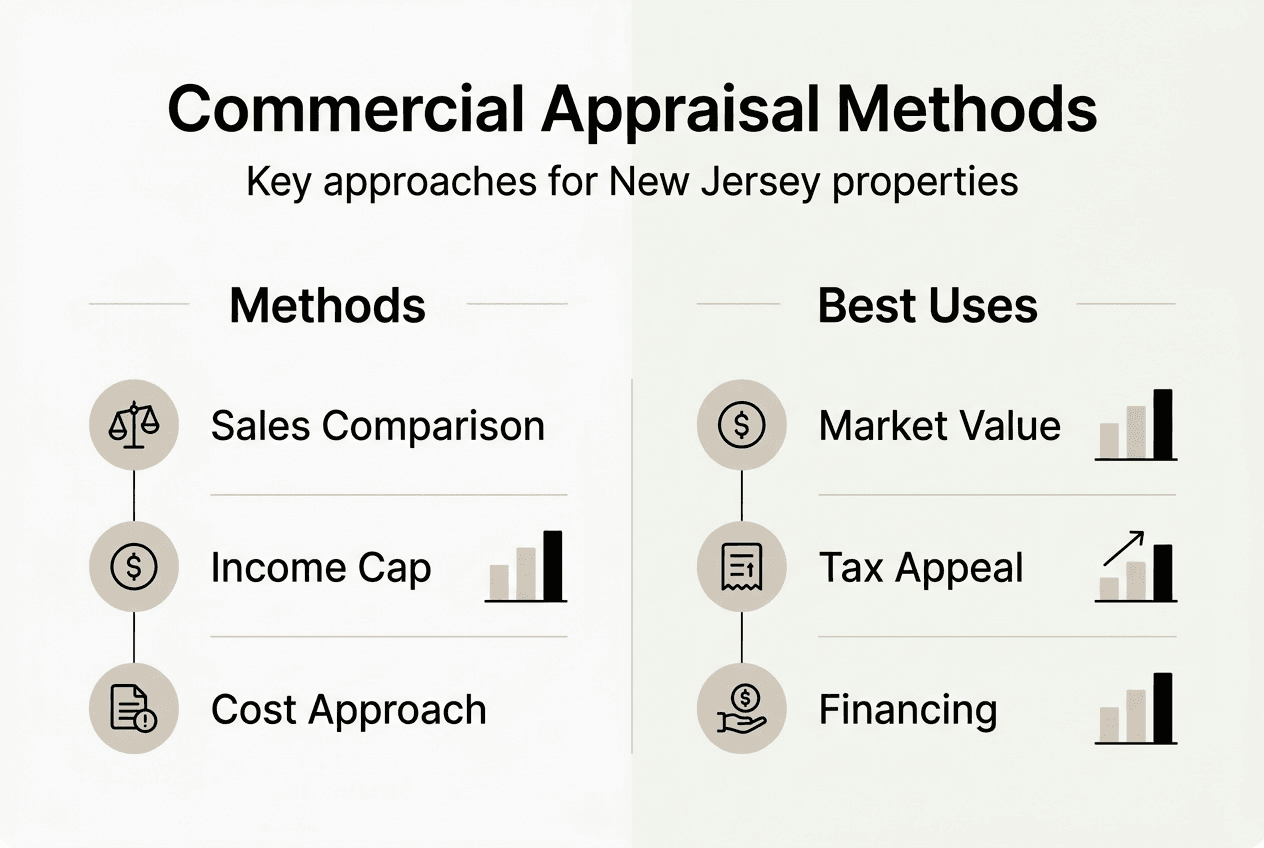
Commercial property appraisals utilize three primary valuation approaches: Sales Comparison, Income Capitalization, and Cost Approach. Each method suits different property types and market conditions. Understanding these approaches helps property owners recognize how appraisers develop credible value opinions and why certain methods apply to their specific situation.
The Sales Comparison Approach analyzes recent sales of similar properties, making adjustments for differences in size, location, condition, and features. This method works best for owner-user properties and land where sufficient comparable sales exist. Appraisers identify truly comparable properties, then adjust sale prices to account for variations. A larger building might warrant an upward adjustment, while inferior location requires a downward adjustment.
Key adjustment factors include property size, age and condition, location quality, parking availability, building improvements, and market conditions at sale date. The appraiser reconciles adjusted comparable values to estimate the subject property's market value. This approach mirrors how buyers and sellers actually think about value in the marketplace.
The Income Capitalization Approach ties value directly to income generation, analyzing net operating income and capitalization rates. This method dominates for apartment buildings, office complexes, retail centers, and other investment properties. Appraisers project stabilized annual income, subtract operating expenses to calculate NOI, then divide by an appropriate cap rate derived from market sales.
Cap rates reflect investor return expectations and risk perceptions in the current market. A property generating $100,000 NOI in a market with 7% cap rates would indicate approximately $1,428,571 value. This approach directly connects value to financial performance, making it essential for income properties.

The Cost Approach calculates replacement cost minus depreciation plus land value. This method suits new construction, special-purpose buildings, and properties with limited sales data. Appraisers estimate current construction costs for an equivalent building, subtract depreciation from physical deterioration and functional obsolescence, then add land value based on comparable land sales.
Special-use properties like churches, schools, or unique industrial facilities often require this approach because few comparable sales exist. The method also provides a value ceiling, since rational buyers won't pay more than replacement cost for similar utility.
| Approach | Best For | Key Strength | Main Limitation |
|---|---|---|---|
| Sales Comparison | Owner-user properties, land | Reflects actual market behavior | Requires sufficient comparable sales |
| Income Capitalization | Investment properties | Ties value to income generation | Depends on accurate income/expense data |
| Cost Approach | New or special-purpose buildings | Works with limited market data | Difficult to estimate depreciation accurately |
Pro Tip: Experienced appraisers typically apply multiple approaches when possible, then reconcile the results to arrive at a final value opinion. This triangulation provides greater confidence than relying on a single method, especially in complex or transitional markets.
Now that we know these approaches, let's examine the unique challenges they face in New Jersey's commercial real estate environment.
Nuances and challenges in New Jersey commercial appraisals
New Jersey's property tax system creates unique appraisal challenges. Property assessment appeals are governed by N.J.S.A. 54:3 et seq. and N.J.A.C. 18:12A et seq., establishing specific procedures and evidence requirements. Property owners must understand that taxes cannot be appealed, as they result from the municipal budget process. Only assessments, the underlying value determinations, are subject to challenge.
Successful appeals require overcoming the presumption of correctness that New Jersey law grants to municipal assessments. The property owner appealing the assessment must, through sufficient evidence, overcome the presumption of correctness. Professional appraisals provide this evidence by demonstrating market value below the assessed value through systematic analysis and comparable data.
Common pitfalls threaten appraisal credibility and appeal success. Inaccurate comparable sales data or incorrect capitalization rates can undermine even well-intentioned appraisals. Unreliable comparables might include distressed sales, non-arm's length transactions, or properties with significant differences inadequately adjusted. Incorrect depreciation estimates in the Cost Approach often result from subjective judgments without market support.
Market challenges compound these technical issues. Distressed market conditions make finding truly comparable sales difficult, as motivated sellers and desperate buyers create outlier transactions. Unique property characteristics like specialized improvements or unusual locations limit comparable availability. Complex income properties with multiple revenue streams require sophisticated analysis that inexperienced appraisers may oversimplify.
Essential legal and procedural points for New Jersey property owners:
- File appeals by April 1st or within 45 days of bulk mailing notice
- Provide competent evidence of true market value
- Understand the assessment represents value as of October 1st of the pretax year
- Recognize that improvements or market changes after the valuation date don't affect current appeals
- Prepare for potential municipal counter-appraisals
Pro Tip: Hiring experienced local appraisers familiar with tax appeal appraisals in New Jersey minimizes these errors and strengthens appeal cases. Local expertise means better comparable selection, accurate market condition adjustments, and reports that address county board expectations. Appraisers who regularly testify understand evidentiary requirements and can defend their conclusions under cross-examination.
The regulatory framework also affects commercial appraisals beyond tax appeals. Lenders require commercial appraisal standards in New Jersey that meet both USPAP and their internal guidelines. Environmental concerns, zoning restrictions, and flood zone designations all impact value and require proper analysis. Appraisers must identify these factors and reflect their market impact appropriately.
Qualification and education requirements for commercial appraisers in New Jersey
Becoming a credible commercial appraiser requires substantial education and training. To become a Trainee Appraiser in New Jersey, candidates must complete 79 hours of qualifying education including AQB-approved courses. This curriculum ensures appraisers understand fundamental principles, ethical standards, and technical procedures before practicing independently.
The step-by-step process to become a Trainee Appraiser:
- Complete 79 hours of qualifying education covering Basic Appraisal Principles, Basic Appraisal Procedures, USPAP, and the Supervisor/Trainee Course
- Pass the Trainee Appraiser examination
- Submit application to the New Jersey Real Estate Appraiser Board
- Obtain errors and omissions insurance
- Find a certified supervisory appraiser willing to oversee your training
- Begin supervised appraisal experience hours
Both Trainee and Supervisory appraisers must complete courses meeting AQB specifications, ensuring consistency in professional standards. Supervisory appraisers bear responsibility for trainee work quality and must review reports before signature. This mentorship structure protects consumers while developing appraiser competency.
Core curriculum topics include:
- Real estate characteristics and legal descriptions
- Economic principles affecting property value
- Data collection and verification methods
- Highest and best use analysis
- The three approaches to value and their application
- Report writing and USPAP compliance
- Ethics and professional responsibility
The certification pathway continues beyond trainee level. Certified Residential appraisers can value non-complex residential properties up to four units. Certified General appraisers can appraise all property types without restriction, including complex commercial properties. Each level requires additional education hours, examination, and experience requirements.
For commercial appraisals, hiring state-certified appraisers with General certification ensures they possess the training and authority to value your property type. Experience matters beyond credentials. Appraisers who regularly work in your market segment understand local nuances, typical buyer motivations, and appropriate adjustment factors. Their reports carry more weight with lenders, courts, and tax boards.
How to apply a commercial appraisal in New Jersey: practical uses and tips
Commercial appraisals support numerous real estate decisions in New Jersey. Property sales benefit from objective value opinions that facilitate negotiations between buyers and sellers. Refinancing requires lender-acceptable appraisals demonstrating sufficient collateral value. Tax appeals depend on professional appraisals to challenge excessive assessments. Legal cases involving partnership disputes, condemnation, or estate matters need credible value evidence.
Steps to prepare for obtaining a commercial appraisal:
- Gather property documents including deeds, surveys, rent rolls, and operating statements
- Compile recent capital improvement records and expense documentation
- Identify your specific appraisal purpose (sale, financing, appeal, litigation)
- Research appraiser qualifications and local market experience
- Discuss timeline requirements and report format needs
- Provide appraiser access to the property and all relevant information
Selecting qualified appraisers requires evaluating credentials and experience. Verify state certification and confirm the appraiser holds appropriate licensure for your property type. Ask about their experience with similar properties in your market area. Request sample reports to assess thoroughness and clarity. Check references from previous clients, especially those with similar appraisal purposes.
Always hire a qualified appraiser with experience in commercial properties in New Jersey to avoid pitfalls like inaccurate comparable sales data or incorrect capitalization rates. Local market knowledge proves invaluable for identifying truly comparable properties and understanding neighborhood trends. Appraisers unfamiliar with New Jersey's regulatory environment may miss critical factors affecting value or legal acceptance.
Pro Tip: Request a detailed report explaining methodology and data sources used to support your case or transaction. Narrative reports provide transparency that summary formats lack, making them more defensible in appeals or litigation. The appraiser should clearly explain their reasoning, adjustment calculations, and final value reconciliation.
Using the appraisal effectively requires understanding its strengths and limitations. In negotiations, the appraisal provides objective support for your position but shouldn't be the only factor considered. Courts and tax boards evaluate appraisal credibility based on methodology, comparable quality, and appraiser qualifications. Present your appraisal alongside other supporting evidence for maximum impact.
Timing matters significantly. Property tax appeal appraisals must be completed before filing deadlines. Financing appraisals should align with loan application schedules. Allow adequate time for property inspection, research, analysis, and report preparation. Rush jobs increase error risk and may not meet your quality expectations.
Maintain communication with your appraiser throughout the process. Provide requested information promptly. Clarify any questions about property features or market conditions. Review the draft report carefully and ask about anything unclear. A collaborative approach produces better results than treating the appraisal as a black box transaction.
Explore our court-ready commercial appraisal services in New Jersey
Navigating commercial appraisals requires expertise you can trust. New Jersey Real Estate Appraisal Group delivers court-ready commercial appraisals backed by over 26 years of experience serving property owners, investors, attorneys, and lenders across the state. Our state-certified appraisers understand local market nuances from Atlantic County to Union County, ensuring accurate valuations that reflect true market conditions.

Every appraisal we produce complies fully with USPAP standards and New Jersey state regulations, giving you confidence in legal proceedings, financing applications, and tax appeals. Our detailed reports explain methodology clearly, document all data sources, and provide defensible value conclusions. Whether you're selling, refinancing, appealing taxes, or resolving legal matters, we deliver the professional appraisal support your situation demands. Contact us today for a consultation and discover how our local expertise strengthens your real estate decisions.
FAQ
What is the difference between commercial and residential appraisals?
Commercial appraisals focus on income-producing properties and typically employ Income Capitalization and Cost approaches alongside Sales Comparison. Residential appraisals primarily rely on Sales Comparison of similar homes in the neighborhood. Commercial appraisals require specialized knowledge of investment analysis, cap rates, operating expense ratios, and complex income streams that residential appraisers may not possess.
How does a commercial appraisal support a property tax appeal in New Jersey?
Appraisals provide the credible market value evidence required to challenge assessments in New Jersey. The property owner must present sufficient evidence of true market value to overcome the presumption of correctness granted to municipal assessments. Without a professional appraisal demonstrating value below the assessed amount through systematic analysis and comparable data, property tax appeal appraisals rarely succeed before county tax boards.
What qualifications should I look for in a commercial appraiser in New Jersey?
Look for state-certified appraisers who have completed 79 hours of AQB-approved education including Basic Principles, Procedures, USPAP, and specialized commercial courses. Certified General appraisers can value all property types without restriction. Experience matters significantly, so seek qualified commercial appraisers familiar with your property type and local New Jersey market conditions who regularly produce reports for your intended purpose.
Which valuation approach is best for my commercial property?
Income Capitalization suits income-generating holdings like apartments, offices, and retail centers where cash flow drives value. Sales Comparison works best for owner-user properties and land where sufficient comparable sales exist. Cost Approach fits new construction or special-use buildings with limited market data. Experienced appraisers often reconcile multiple methods for final valuation, providing greater confidence than relying on a single approach.