

TL;DR:
- Certified land appraisals in New Jersey are crucial for legal and financial cases like divorce, estate, and tax disputes.
- Appraisals must follow USPAP standards and be conducted by licensed professionals to ensure legality and accuracy.
- Site-specific factors such as zoning, access, utilities, and environmental constraints heavily influence land valuation.
Many people assume that pricing a piece of vacant land is simpler than valuing a home. After all, there are no kitchens to inspect or roofs to assess. That assumption can be costly. In New Jersey, land appraisals carry serious legal and financial weight, especially in divorce settlements, estate probate, and property tax disputes. Courts, attorneys, and tax boards do not accept rough estimates or online tools. They require certified, defensible valuations backed by a licensed professional. This guide explains what certified land appraisals involve, what genuinely drives value in New Jersey, and how to navigate the process when the stakes are high.
Table of Contents
- Why land appraisals matter in New Jersey legal and financial cases
- The core process: How certified land appraisals are conducted
- Expert insights: Key challenges and uncommon scenarios
- What to look for in a certified New Jersey land appraiser
- Our perspective: Why site-specific expertise beats formulas in NJ land appraisal
- Get certified land appraisal expertise for your New Jersey case
- Frequently asked questions
Key Takeaways
| Point | Details |
|---|---|
| Certified appraisals required | Legal matters like divorce and estates in NJ demand state-licensed, USPAP-compliant land valuations. |
| Sales comparison method | Land value relies on recent comparable sales, adjusted for location, zoning, and physical factors. |
| Expertise trumps automation | Only a certified appraiser’s site-specific analysis stands up in court and protects your interests. |
| Watch for special challenges | Scarce comparables, zoning, and environmental limits can complicate land value and require specialized approaches. |
Why land appraisals matter in New Jersey legal and financial cases
When land becomes part of a legal proceeding, its value is no longer just a number on paper. It is a figure that can determine how assets are split in a divorce, how an estate is taxed, or whether a property owner wins a tax appeal. Getting that number right matters enormously.
The three most common triggers for a certified land appraisal in New Jersey are divorce proceedings, probate and estate settlement, and property tax disputes. In each situation, the appraisal must hold up under scrutiny from attorneys, judges, and administrative boards. That means it must be prepared by a state-licensed appraiser who follows USPAP (Uniform Standards of Professional Appraisal Practice) and meets the standards set by the AQB (Appraisal Qualifications Board).
Using an unlicensed appraiser, relying on outdated sales data, or submitting a report that does not meet USPAP guidelines can derail a case entirely. We have seen situations where a poorly prepared appraisal extended a divorce proceeding by months, costing both parties significant legal fees. The land appraisal types for legal needs vary depending on the purpose, so matching the right appraisal type to your situation is the first step.
Here is what courts, estate planners, and tax boards typically require from a certified land appraisal:
- A report prepared by a state-certified appraiser in good standing
- Compliance with USPAP standards throughout the valuation process
- A clearly stated effective date, which is especially important for estate and retrospective appraisals
- Documented comparable sales with adjustments explained in writing
- A final opinion of value that is supported by market evidence, not assumptions
"Appraisals required for legal and financial transactions in New Jersey must meet state licensing and USPAP standards to be accepted in official proceedings." New Jersey Real Estate Appraisers
Skipping any of these requirements does not just weaken your case. It can invalidate the appraisal entirely.
The core process: How certified land appraisals are conducted
A certified land appraisal is not a Zillow estimate. It is a structured, documented analysis that follows a defined methodology. Understanding the process helps you know what to expect and how to prepare.
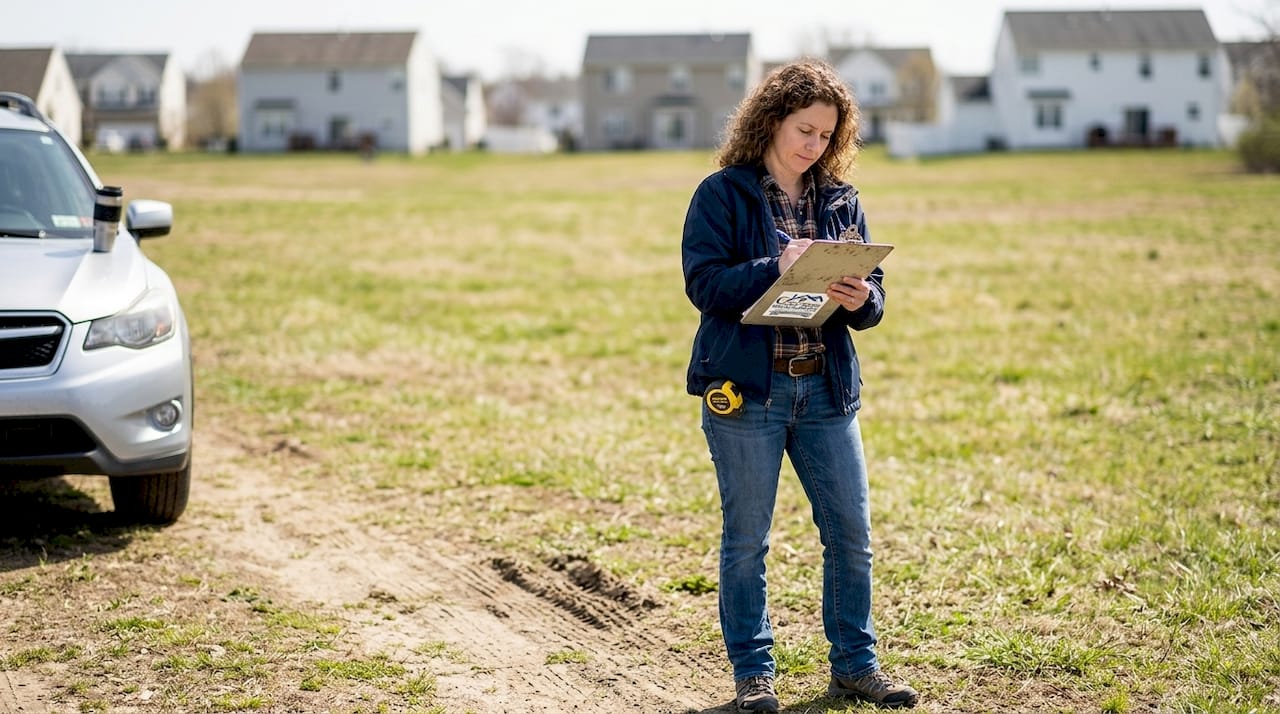
The sales comparison approach is the primary method used for land appraisals. Unlike improved properties, vacant land has no building to value, so the appraiser focuses entirely on the land itself. This means finding recent sales of comparable vacant parcels and making adjustments for differences in size, location, zoning, access, and other factors.
Here is what the land appraisal process steps typically look like from start to finish:
- Engagement and scope definition: The appraiser confirms the purpose of the appraisal, the effective date, and the intended users, such as a court, attorney, or estate executor.
- Site inspection: The appraiser visits the property to document its physical characteristics, including size, shape, topography, access points, and any visible environmental concerns.
- Research and data collection: Recent sales of comparable vacant land are identified through public records, MLS data, and other sources.
- Comparable selection and adjustment: Each comparable sale is analyzed and adjusted for differences relative to the subject property.
- Reconciliation and final value opinion: The appraiser weighs the adjusted sales and arrives at a final opinion of value, supported by written reasoning.
- Formal written report: The completed report is delivered in a format that meets USPAP requirements and is ready for legal or financial use.
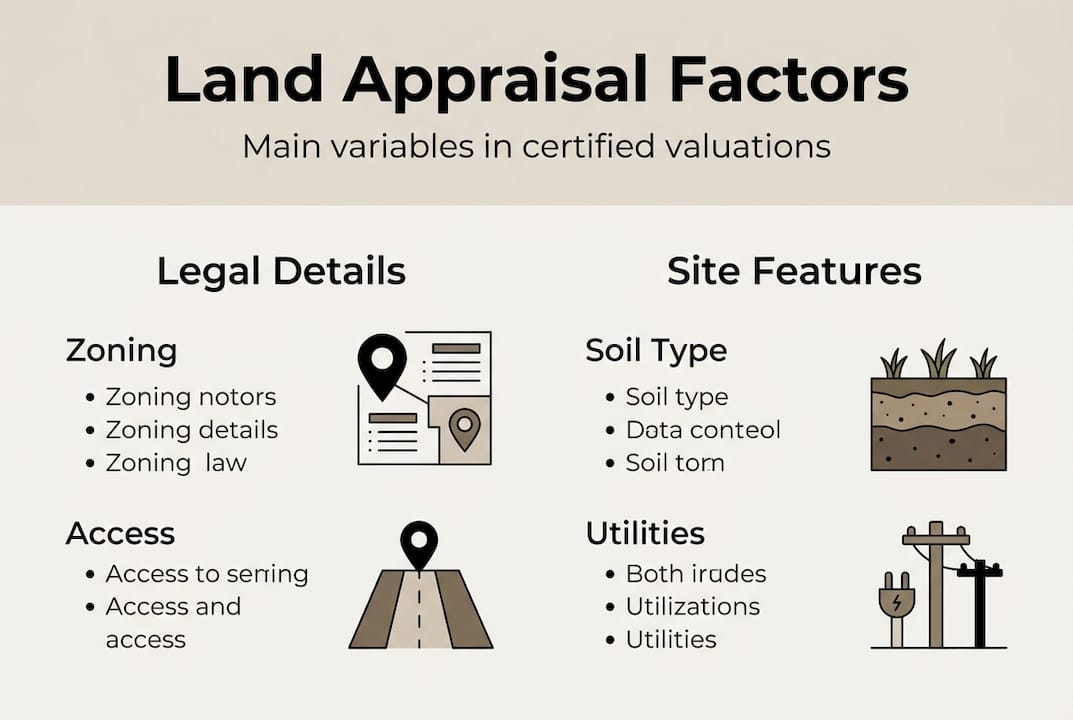
The step-by-step land valuation process accounts for many variables that automated tools simply cannot capture. The table below shows the key factors that influence land value in New Jersey:
| Factor | Why it matters |
|---|---|
| Zoning classification | Determines permitted uses and development potential |
| Lot size and shape | Affects usability and buildable area |
| Road frontage and access | Influences accessibility and marketability |
| Utilities availability | Water, sewer, and electric access affect value significantly |
| Soil quality and perc test results | Critical for septic system viability |
| Flood zone designation | FEMA flood zones can reduce value or limit development |
| Topography | Steep slopes or wetlands reduce buildable area |
| Proximity to amenities | Schools, highways, and commercial areas affect demand |
Pro Tip: When comparable vacant land sales are scarce, ask your appraiser whether they are using paired sales analysis or regression methods. These techniques extract land value from improved property sales and provide a more defensible conclusion when direct comps are limited.
Expert insights: Key challenges and uncommon scenarios
Not every land appraisal follows a clean, textbook path. Real-world cases in New Jersey often involve complications that require creative, well-documented solutions. Knowing what those challenges look like helps you ask better questions and set realistic expectations.
One of the most important distinctions to understand is the difference between a single-property appraisal and a mass tax assessment. Many property owners mistakenly believe their tax assessment reflects fair market value. It often does not.
| Feature | Single-property appraisal | Mass tax assessment |
|---|---|---|
| Methodology | Site-specific, USPAP-compliant analysis | Statistical models applied to large groups |
| Legal defensibility | Accepted in court and official proceedings | Not designed for individual legal use |
| Accuracy for unique parcels | High, accounts for site-specific factors | Lower, may miss environmental or access issues |
| Effective date | Defined and documented | Based on assessment date, often outdated |
| Best use | Divorce, estate, tax appeal, litigation | Municipal tax roll administration |
Environmental factors are another area where land appraisal edge cases become especially complex. Wetlands designations, failed perc tests, and FEMA flood zone classifications can dramatically reduce a parcel's development potential and, therefore, its value. These are not factors that a mass assessment or an online estimate will capture accurately.
When alternate valuation methods are needed due to limited comparable sales, appraisers may turn to:
- Abstracted land sales: Extracting the land value from sales of improved properties by subtracting the estimated value of the improvements
- Paired sales analysis: Comparing two similar sales that differ in one key factor to isolate the value contribution of that factor
- Regression analysis: Using statistical modeling to identify value trends across a broader set of sales data
Pro Tip: If you are pursuing a tax appeal, do not assume the assessed value is correct just because it came from the municipality. Mass assessments are built for efficiency, not precision. A site-specific appraisal often reveals meaningful differences, particularly for parcels with environmental constraints or unusual configurations.
What to look for in a certified New Jersey land appraiser
Choosing the right appraiser is one of the most consequential decisions you will make in a legal or financial case involving land. The wrong choice can mean a report that gets rejected, a case that drags on, or a value conclusion that does not hold up under cross-examination.
In New Jersey, appraisers must be state-licensed or certified, meeting both USPAP and AQB standards. There are two primary license levels relevant to land appraisals:
- State Certified General Appraiser: Authorized to appraise all types of real property, including commercial and complex land parcels. This is the credential you want for most legal cases.
- State Certified Residential Appraiser: Limited to residential properties and some non-complex land. May be appropriate for smaller residential lots.
Beyond credentials, here is what to look for when evaluating a potential appraiser:
- Verify active licensure and good standing through the NJ appraisal regulations and the NJ Division of Consumer Affairs
- Check for any discipline history, complaints, or license suspensions
- Ask specifically about experience with divorce, estate, or tax appeal appraisals, as these require familiarity with legal standards and court procedures
- Confirm the appraiser has experience with vacant land and understands local zoning, environmental regulations, and market conditions in your area of New Jersey
- Request a sample report or ask how they handle situations with limited comparable sales
Working with a certified New Jersey appraiser who has handled cases like yours before is not just a preference. In legal proceedings, it is a practical necessity. An appraiser who has testified in court or worked directly with attorneys understands what a defensible report requires.
Our perspective: Why site-specific expertise beats formulas in NJ land appraisal
After more than 26 years of appraising land across New Jersey, we have seen what happens when people rely on formulas instead of expertise. Automated valuation models and mass assessments are built for speed and scale. They are not built for accuracy on individual parcels where zoning overlaps, soil conditions vary, and flood designations shift from one side of a property line to the other.
The reality is that site-specific details over formulas are what drive defensible land values, and no two New Jersey parcels are truly identical. A parcel in Monmouth County with road frontage and public water is a fundamentally different asset than a similarly sized lot two miles away with wetland encroachments and no utility access. A formula cannot see that difference. A trained appraiser who walks the site can.
This matters most in legal settings. When a value is challenged in court or before a tax board, the appraiser must explain every adjustment and defend every conclusion. That requires judgment built from experience, not a calculation from an algorithm. Understanding the impact of site factors on land value is what separates a report that holds up from one that gets dismissed.
Get certified land appraisal expertise for your New Jersey case
If you are navigating a divorce, settling an estate, or preparing a tax appeal, you need a land appraisal that is accurate, well-supported, and ready for legal review.

At New Jersey Real Estate Appraisal Group, we provide certified, USPAP-compliant land appraisals across New Jersey for exactly these situations. Our team works directly with attorneys, executors, and property owners to deliver reports that stand up in court and before tax boards. Whether you need divorce appraisals in New Jersey, estate and date of death appraisals, or tax appeal appraisals, we are ready to help. Contact us today to request a quote and get the clarity your case requires.
Frequently asked questions
What factors most impact land appraisal value in New Jersey?
Zoning, size, access, utilities, soil quality, and flood risk are the most significant influences on a New Jersey land appraisal. Environmental constraints like wetlands or failed perc tests can substantially reduce a parcel's development potential and market value.
Are mass tax appraisals reliable for divorce or estate court cases?
No. Mass tax assessments are statistical tools designed for tax rolls and lack the USPAP defensibility required for individual legal cases. A certified single-property appraisal is required for court proceedings.
How do you verify a New Jersey appraiser's credentials?
Check the NJ appraiser board's website for active state certification, USPAP compliance, and any complaint or discipline history before hiring an appraiser for a legal matter.
What if there are no recent vacant land sales for comparison?
When direct comps are scarce, appraisers use paired sales or regression analysis to extract land value from improved property sales, providing a defensible conclusion even in thin markets.
Recommended
- Land appraisal types: NJ guide for legal and estate needs
- State-Certified Real Estate Appraisers in New Jersey | NJREAG
- Land appraisal process steps for New Jersey homeowners
- Land Appraisals in New Jersey | Certified Property Valuation – NJREAG
- Come valutare un immobile, superficie commerciale e valori di mercato - Primaimmobiliare.it