

TL;DR:
- Property valuation in New Jersey must follow USPAP standards and consider three main approaches.
- The choice of valuation method depends on the property type and legal context.
- Reconciliation of methods requires clear explanation to produce a court-defensible value.
Property valuation in New Jersey is not a simple calculation, and the stakes are especially high when the result will be reviewed by a judge, an attorney, or a tax board. Whether you are dividing marital assets, settling an estate, or challenging an over-assessed property, the method used to determine value matters as much as the number itself. NJ real property is assessed at true value, expressed as taxable value at the county-determined percentage, which means even the legal definition of "value" shifts depending on context. This guide explains the main valuation methods recognized in New Jersey, how appraisers reconcile them, and why the right approach can make or break your legal outcome.
Table of Contents
- Understanding property valuation standards in New Jersey
- Sales comparison, cost, and income: How the main methods work
- Reconciling values: How appraisers reach a defensible opinion
- Valuation in divorce, estate, and tax appeals: What accuracy means
- A seasoned appraiser's take: Why method matters more than most think
- Secure a court-defensible valuation with certified New Jersey appraisers
- Frequently asked questions
Key Takeaways
| Point | Details |
|---|---|
| USPAP standards required | New Jersey appraisals must be USPAP-compliant to withstand legal scrutiny. |
| Three main valuation methods | Sales comparison, cost, and income approaches are used depending on property and case context. |
| Legal accuracy is critical | Proper reconciliation and method selection ensure defensible valuations for divorce, estate, and tax appeals. |
| Unique properties need expert attention | Special-use or thin market assets may require cost or income methods for accurate values. |
| Documentation supports appeals | Detailed, evidence-backed appraisals give your case the best chance in court or tax appeals. |
Understanding property valuation standards in New Jersey
Before you can evaluate a property for legal purposes, you need to understand the framework that governs how value is determined in this state. New Jersey law is specific: NJ real property is assessed at true value, meaning the price a willing buyer would pay a willing seller in an arm's-length transaction. That definition sounds simple, but applying it accurately requires training, local knowledge, and strict methodology.
All appraisals used in legal matters must follow the Uniform Standards of Professional Appraisal Practice, commonly called USPAP. These are the nationally recognized ethical and performance standards that licensed appraisers must meet. Appraisals in New Jersey follow USPAP standards, requiring licensed appraisers to consider the three main approaches to value. Courts, attorneys, and tax boards expect USPAP-compliant reports, and a report that falls short of these standards can be challenged or dismissed entirely.
The three recognized approaches are:
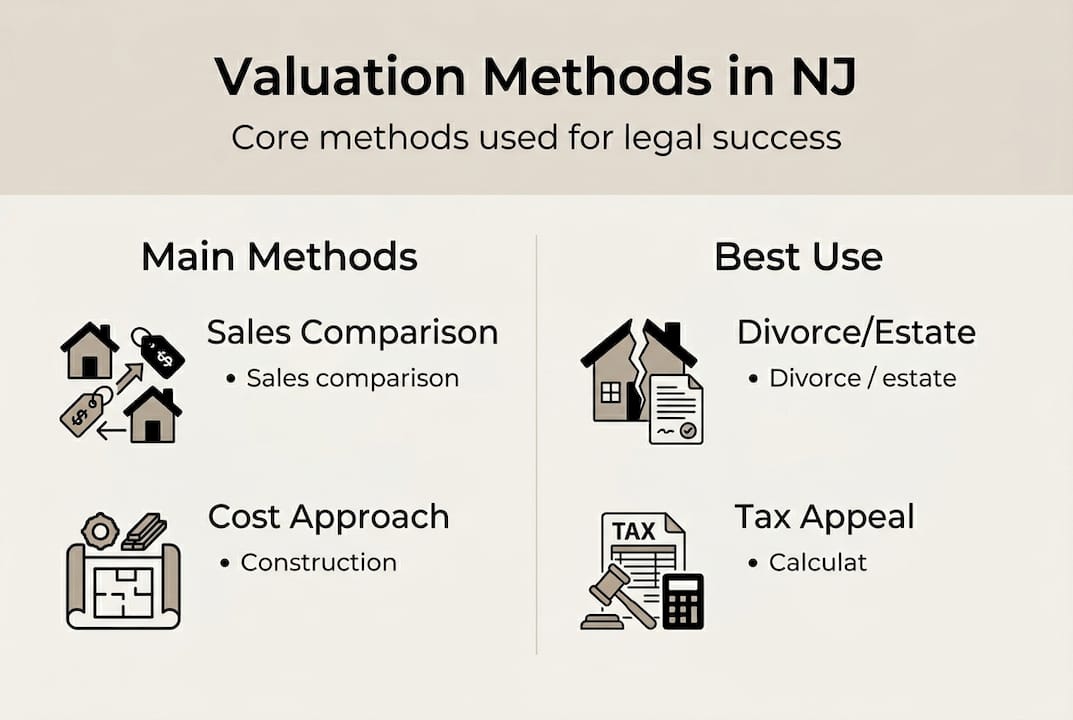
- Sales comparison approach: Compares the subject property to recent sales of similar properties, with adjustments for differences.
- Cost approach: Estimates what it would cost to replace the improvements, minus depreciation, plus land value.
- Income approach: Calculates value based on the income the property generates or could generate.
Not every method applies to every property or every legal situation. A single-family home in a divorce case typically relies on the sales comparison approach. A commercial building in a tax appeal may lean heavily on the income approach. Understanding which method carries the most weight in your situation is a critical first step. You can explore a detailed NJ appraisal standards breakdown to see how these methods apply to different property types.
| Legal context | Primary method used | Why it applies |
|---|---|---|
| Divorce settlement | Sales comparison | Reflects open-market FMV |
| Estate valuation | Sales comparison or cost | Depends on property type |
| Tax appeal | Cost and income | Challenges assessed value |
| Unique/special-use | Cost or income | Few comparable sales exist |
For NJ homeowners and investors navigating these situations, understanding this framework early saves time, money, and legal headaches. You can also review the broader NJ legal valuation guide for context on how courts interpret appraisal evidence.
Sales comparison, cost, and income: How the main methods work
Now that you understand the framework, let's look at how each method actually works in practice.
1. Sales comparison approach
This is the most widely used method for residential properties. The appraiser identifies recent sales of comparable properties (called "comps") and adjusts for differences in size, location, condition, age, and features. The sales comparison approach adjusts recent sales of comparable properties for differences in location, size, and condition. The quality of the comps matters enormously. Outdated sales, properties in different neighborhoods, or sales under unusual circumstances can all weaken the final value opinion.
2. Cost approach
The cost approach is most useful for newer properties, special-use buildings, or situations where comparable sales are scarce. The formula is straightforward: land value plus replacement cost of improvements minus depreciation. New Jersey's Division of Taxation publishes cost conversion factors that appraisers and assessors use as benchmarks. Depreciation is where judgment comes in, since physical wear, functional obsolescence, and external factors all reduce a building's value in different ways.
3. Income approach
For rental properties, multi-family buildings, and commercial real estate, the income approach is often the most reliable indicator. Value equals net operating income divided by the cap rate, and this result is sensitive to even small changes in the capitalization rate. A one-point shift in the cap rate can move a property's value by hundreds of thousands of dollars, which is why income approach appraisals require careful market research.

Here is a quick comparison of when each method is most reliable:
| Method | Best for | Key variable |
|---|---|---|
| Sales comparison | Residential, active markets | Quality of comps |
| Cost | New builds, unique properties | Depreciation accuracy |
| Income | Rentals, commercial | Cap rate selection |
Numbered steps for a reliable sales comparison:
- Select comps within 6 to 12 months and a reasonable geographic radius.
- Adjust for each measurable difference between the comp and the subject.
- Weight comps by similarity and reliability, not just recency.
- Reconcile the adjusted values into a single supportable conclusion.
Pro Tip: If you are dealing with a property in a thin market (few recent sales), ask your appraiser upfront how they plan to handle the limited data. A credible appraiser will expand the search area or time frame and explain the impact on reliability, rather than forcing weak comps into the analysis.
For a fuller picture of how these methods apply to New Jersey properties specifically, review the NJ appraisal process guide and the NJ homeowner valuation tips resource.
Reconciling values: How appraisers reach a defensible opinion
Using multiple valuation methods is only half the job. The other half is reconciliation, the process of weighing each method's result and arriving at a single, well-supported value opinion. This step is where many appraisals either gain or lose their legal credibility.
Reconciliation is not averaging. An appraiser does not simply add up the three method results and divide by three. Instead, they assess which method produced the most reliable indication given the property type, the available data, and the purpose of the appraisal. USPAP requires an explanation of weighting and omissions in the reconciliation section of every report. If one method is given more weight, the appraiser must explain why.
"Reconciliation requires the appraiser to weigh each value indication by data quality, quantity, and relevance to the subject property. A final opinion that cannot be explained and supported is not a defensible opinion."
Key factors that influence reconciliation:
- Data quality: Were the comps truly similar, or were significant adjustments required?
- Market activity: Is the local market active enough to support the sales comparison approach?
- Property type: Does the property generate income? If so, the income approach carries more weight.
- Legal purpose: Courts and tax boards may expect one method to dominate based on the type of case.
For tax appeals specifically, NJ uses cost tables and equalized valuations, and the burden falls on the property owner to prove the assessed value exceeds true market value. A well-reconciled appraisal report is the primary tool for meeting that burden.
Pro Tip: When reviewing an appraisal report for legal use, check the reconciliation section first. If it simply states a number without explaining why one method was weighted more heavily, the report may not hold up under cross-examination.
For more on building a defensible NJ appraisal and understanding the full NJ appraisal breakdown, those resources go deeper into what courts and tax boards actually look for.
Valuation in divorce, estate, and tax appeals: What accuracy means
Once a final value is reconciled, that number enters a legal process where accuracy has direct financial consequences. A value that is too high or too low in a divorce case can cost one spouse tens of thousands of dollars. An unsupported estate valuation can trigger IRS scrutiny. An imprecise tax appeal appraisal can mean years of overpaying property taxes.
Accurate fair market value via professional appraisal is essential in divorce and estate cases, because courts rely on comps, condition, and income analysis to evaluate competing claims. Judges do not accept informal estimates or automated valuation models as credible evidence. They need a USPAP-compliant report from a licensed appraiser who can explain and defend every conclusion.
Common pitfalls in legal valuation cases:
- Using comps that are more than 12 months old in an active market
- Failing to account for deferred maintenance or functional obsolescence
- Applying a single method when the property type calls for multiple approaches
- Ignoring local market trends that affect value at the specific date of the appraisal
- Relying on automated valuation tools that cannot account for property-specific conditions
For divorce appraisal accuracy, the date of value matters too. Courts may require a value as of the date of separation, the date of filing, or the date of trial, and each can produce a different number in a shifting market. Estate appraisals often require a retrospective value as of the date of death, which demands access to historical market data. For NJ estate appraisal and NJ tax appeal appraisals, the methodology must be airtight from the start.
Statistic callout: In New Jersey, property tax appeals must typically be filed by April 1st of the tax year. Missing that deadline means waiting another full year, regardless of how strong your appraisal evidence is.
A seasoned appraiser's take: Why method matters more than most think
After more than 26 years of providing appraisals for courts, attorneys, and executors across New Jersey, we have seen a consistent pattern: the cases that go sideways are almost never about the number. They are about the method.
Generic formulas fail in New Jersey's legal context because the state's markets are deeply local. A cap rate that works in one county may be completely wrong in another. A comp that looks similar on paper may have sold under conditions that disqualify it as a true market indicator. Thin markets require an expanded comp search, which reduces reliability and demands more explanation, not less.
Unique properties are the hardest cases. When there are no true comparables, the sales comparison approach becomes unreliable, and the appraiser must shift weight to cost or income methods. Subjective depreciation estimates in the cost approach can vary widely between appraisers, which is exactly why courts scrutinize them closely. For NJ divorce and estate appraisals, the appraiser's ability to explain and defend those judgment calls is what separates a credible report from one that gets torn apart in court.
Local expertise is not a marketing phrase. It is the difference between an appraisal that holds up and one that does not.
Secure a court-defensible valuation with certified New Jersey appraisers
If you are managing a divorce settlement, settling an estate, or preparing a tax appeal, the valuation method your appraiser chooses will shape the outcome. Educational resources can help you understand the process, but the actual report needs to come from a certified, experienced professional who knows New Jersey's legal standards inside and out.

At NJREAG, we deliver USPAP-compliant appraisal reports built to withstand review by courts, attorneys, and tax boards. Our NJ divorce appraisal services and NJ tax appeal appraisals are handled by certified NJ appraisers with over 26 years of local experience. Contact us today to request a fast quote and get the accurate, defensible valuation your situation requires.
Frequently asked questions
Which property valuation method is most accepted by New Jersey courts?
The sales comparison approach is typically favored by NJ courts for residential properties, but courts rely on comps, condition, and income analysis for unique or income-producing properties where comparable sales are limited.
How does the appraisal process for tax appeals differ from standard valuation?
Tax appeals in NJ require proof that the assessed value exceeds true market value, and NJ uses cost tables and equalized valuations as benchmarks that appraisers must account for in their analysis.
How are unique or special-use properties valued?
When comparable sales are scarce, unique properties favor cost or income approaches over the sales comparison method, since forcing weak comps into the analysis produces an unreliable result.
What documentation makes an appraisal legally defensible in NJ?
A legally defensible appraisal must follow USPAP, use well-supported comps or cost and income data, and include a reconciliation section that explains weighting and omissions clearly enough to withstand cross-examination.
What are common mistakes when using property valuation methods in legal cases?
The most frequent errors include using outdated comps, ignoring depreciation factors, and failing to reconcile different approaches with current market evidence, since approaches often diverge and must be explained, not just averaged.