

TL;DR:
- Land appraisals in New Jersey primarily rely on recent comparable sales for accurate valuation.
- Critical factors influencing land value include location, zoning, utilities, and highest and best use.
- Certified appraisers provide court-ready, USPAP-compliant reports suitable for legal, estate, or tax purposes.
When a divorce settlement, estate distribution, or tax appeal hinges on the value of a piece of land in New Jersey, the stakes are too high to rely on guesswork. Many property owners are surprised to learn that the county's tax assessment and a certified appraisal can differ by tens of thousands of dollars. Mass appraisals are built for efficiency, not accuracy on individual parcels. That gap creates real financial risk. This guide walks you through how land appraisals actually work, what drives value, and what you should demand from a certified appraiser when the number truly matters.
Table of Contents
- How land appraisal works: Key methods and New Jersey context
- Critical factors that influence land value
- The land appraisal process in New Jersey: Step by step
- Land appraisal pitfalls and nuance: What most guides miss
- Our perspective: What homeowners and attorneys should really demand from an appraisal
- Get a certified land appraisal: Defensible, accurate, and court-ready
- Frequently asked questions
Key Takeaways
| Point | Details |
|---|---|
| Sales comparison dominates | Most New Jersey land appraisals use sales comparison for accurate, court-ready values. |
| Legal context matters | Divorce, estate, and tax cases require USPAP-compliant appraisals for defensibility. |
| Key value factors | Location, zoning, size, access, and land use all impact market value. |
| Tax assessments aren’t final | Mass appraisals often misstate value—individual appraisal is crucial for appeals. |
| Choose local expertise | Certified NJ appraisers deliver reliable results for complex legal scenarios. |
How land appraisal works: Key methods and New Jersey context
To build clarity, let's break down what's actually considered when a professional values land, especially in the eyes of New Jersey courts or tax authorities.
Land appraisal is not the same as appraising a home. There is no structure to measure, no kitchen to compare, and no depreciation schedule to apply. Instead, appraisers rely on market evidence from similar vacant parcels. Sales comparison is the dominant method for vacant land appraisal, and it involves identifying recent sales of comparable properties, then adjusting for meaningful differences like size, location, zoning, and access.
Two other approaches exist but are used less frequently. The cost approach is rarely applicable to raw land since there is no improvement to value. The income approach applies only when land generates measurable revenue, such as farmland with lease income or a parking lot. USPAP requires consideration of all major approaches but allows omission with a written explanation when a method is not applicable. A credible appraiser will always document why an approach was excluded.
For land appraisals in New Jersey tied to legal proceedings, the sales comparison method carries the most weight because it reflects actual buyer and seller behavior in the current market. Courts and tax authorities want to see real transactions, not theoretical projections.
Here is a quick comparison of the three approaches:
| Approach | Best used for | Key limitation |
|---|---|---|
| Sales comparison | Vacant land, most parcels | Requires sufficient comparable sales |
| Cost approach | Improved properties | Rarely applies to raw land |
| Income approach | Revenue-generating land | Requires measurable income stream |
Understanding which approach applies to your situation is the first step. Explore the different land appraisal types in New Jersey to see how each one fits specific legal and financial scenarios.
Critical factors that influence land value
Understanding the framework is just the start. The next step is grasping what truly moves value in the local land market.
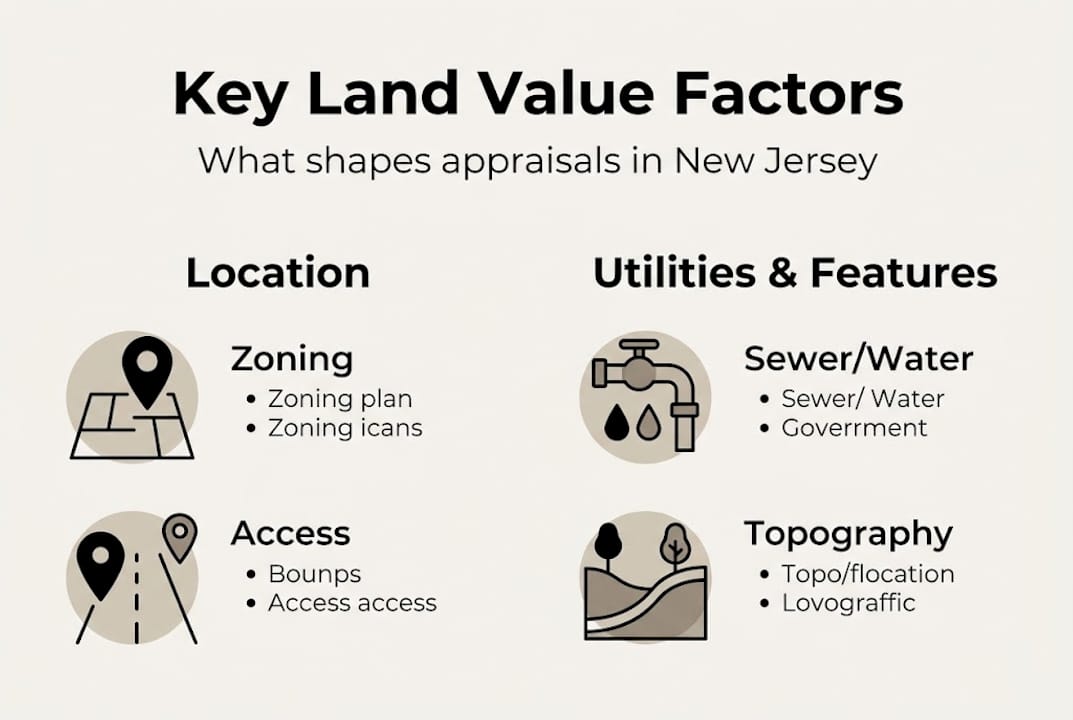
Appraisers do not simply measure acreage and call it a day. A thorough analysis considers a range of key land factors including location, zoning, size, shape, environmental constraints, and utilities. Each one can add or subtract significant value depending on the specific parcel and market conditions.
Here are the most common factors and how they typically affect value:
- Location: Proximity to roads, employment centers, and amenities drives demand and price.
- Zoning and land use: A parcel zoned for commercial use is often worth more than one zoned residential or agricultural.
- Size and shape: Irregular shapes or flag lots can limit development potential and reduce value.
- Topography: Steep slopes, wetlands, or flood zones restrict what can be built.
- Utilities: Access to public water and sewer significantly increases a parcel's development value.
- Environmental issues: Contamination, deed restrictions, or conservation easements can dramatically reduce value.
One concept that matters deeply in legal settings is highest and best use. This is the legally permissible, physically possible, financially feasible, and maximally productive use of the land. Even if a parcel sits vacant, its value is tied to what it could become, not just what it is today. In divorce settlement valuations or estate cases, this distinction can mean the difference between a fair outcome and a disputed one.
| Factor | Positive effect | Negative effect |
|---|---|---|
| Public sewer/water access | Increases value | Lack of utilities reduces value |
| Commercial zoning | Higher value potential | Restrictive zoning limits use |
| Flood zone designation | N/A | Reduces value, limits financing |
| Road frontage | Improves access and value | Landlocked parcels lose value |
Pro Tip: Do not overlook property records, old surveys, or legal easements before ordering an appraisal. Minor oversights in these documents often cause major valuation swings that are difficult to correct after the fact.
The land appraisal process in New Jersey: Step by step
To apply these valuation principles, here is what you will encounter, and should insist upon, during a legitimate land appraisal in New Jersey.

A well-executed appraisal follows a clear sequence. Skipping steps or cutting corners produces a report that will not hold up in court, before a tax board, or with the IRS. USPAP-compliant reports require clear assignment definition, thorough market data analysis, and a documented reconciliation of all approaches considered.
Here is what the process looks like from start to finish:
- Define the assignment. Establish the purpose (divorce, estate, tax appeal), the property rights being appraised, and the effective date of value. This step determines everything that follows.
- Inspect the property. The appraiser physically visits the site to document size, shape, topography, access, utilities, and any visible constraints.
- Research comparable sales. The appraiser pulls recent vacant land sales from MLS records, county deed transfers, and other data sources. This research is the backbone of the sales comparison approach.
- Analyze and adjust. Each comparable sale is reviewed and adjusted for differences relative to the subject property. Larger adjustments require stronger justification.
- Reconcile and report. The appraiser weighs the evidence, reconciles the value indicators, and produces a written report. Any omitted approach must be explained in writing.
Certified NJ appraisers provide court-ready reports for divorce, estates, and tax appeals that meet the evidentiary standards required by New Jersey courts and the Tax Court. If you are working through a legal matter, review what a proper appraisal for divorce or estate should include before you engage anyone.
Pro Tip: Always confirm the effective date and intended use on your appraisal order before work begins. Changing these details after the fact can require the appraiser to redo significant portions of the analysis, adding cost and delay to your case. Learn more about specific divorce appraisal requirements in New Jersey.
Land appraisal pitfalls and nuance: What most guides miss
Even with the right process, pitfalls and complications are common. Here is what often goes wrong and what to do about it.
One of the most frequent challenges in New Jersey land appraisal is a lack of comparable sales. Rural areas, unusual parcel types, or highly specific zoning categories may have very few recent transactions. When comps are scarce, appraisers must search more broadly, sometimes across county lines, and make larger adjustments. This is not a red flag if the appraiser explains the reasoning clearly. It becomes a problem when adjustments are made without support.
Mass appraisal is another major source of error. Tax assessments may overstate value by 10 to 20 percent, particularly right after a municipal reassessment. This happens because mass appraisal models apply broad assumptions across large groups of properties. Unique parcels with access issues, environmental constraints, or irregular shapes rarely fit those models well.
Retroactive effective dates add another layer of complexity. In estate cases, the appraisal must reflect value as of the date of death, which could be months or years in the past. Divorce cases may require a value as of the filing date or another agreed-upon date. Finding comparable sales from that specific time window requires extra research and careful documentation.
Here is what to watch for in any land appraisal used for legal or tax purposes:
- Comparable sales that are not truly similar in zoning, size, or location
- Missing explanation for omitted valuation approaches
- No mention of highest and best use analysis
- An effective date that does not match the legal requirement
- A report that lacks USPAP compliance language
No automatic reassessment occurs at inheritance in NJ, but overassessments can and should be appealed. For NJ tax appeal appraisals and estate and inheritance appraisals, having a certified appraiser in your corner makes the difference between a winning argument and an uphill fight.
Pro Tip: For any tax appeal or dispute, request a list of the comparable properties used by the assessor. Review them carefully for relevance. Assessors sometimes rely on sales that are years old or from different neighborhoods, and challenging those comps is often the fastest path to a reduction.
Our perspective: What homeowners and attorneys should really demand from an appraisal
Having explored the technicalities and pitfalls, here is the practical wisdom our team shares with every client.
After 26 years of working on land appraisals tied to divorces, estates, and tax appeals across New Jersey, we have seen one pattern repeat itself: the most costly disputes do not start with bad intentions. They start with treating land value as a simple number rather than a nuanced conclusion supported by evidence.
A tax assessment is not an appraisal. An online estimate is not an appraisal. Even a well-meaning but generalist appraiser who lacks experience with New Jersey's legal standards can produce a report that falls apart under cross-examination or review by a tax board.
What you should demand is an appraiser who knows the local market, understands the specific legal context of your case, and can defend every adjustment and conclusion in writing. That is not a luxury in contested matters. It is the baseline. Accurate divorce appraisals protect both parties from outcomes that neither intended.
The value of a credible appraisal is not just the number it produces. It is the documented reasoning that makes that number stand up when challenged.
Get a certified land appraisal: Defensible, accurate, and court-ready
If accuracy and legal credibility are the priorities, here is how to move forward confidently.
When a land appraisal needs to hold up in a New Jersey courtroom, before a tax board, or as part of an estate filing, working with a local state-certified appraiser is not optional. It is the only approach that consistently delivers defensible, well-documented results.

At NJREAG, our NJ land appraisal services cover residential parcels, multi-family lots, commercial land, and everything in between. Whether you need court-ready divorce appraisals or support for NJ tax appeal appraisals, we deliver USPAP-compliant reports that attorneys, courts, and the IRS recognize and accept. Contact us today for a confidential quote and let us put 26 years of New Jersey appraisal experience to work for your case.
Frequently asked questions
How do appraisers determine land value in New Jersey?
Sales comparison is the dominant method for vacant land appraisal, where the appraiser reviews recent sales of similar parcels and adjusts for meaningful differences like size, zoning, and location. The result is a market-based value conclusion supported by actual transaction data.
Can I appeal my property tax assessment using a land appraisal?
Yes. A professional appraisal using recent comparable sales is strong evidence for a New Jersey property tax appeal, especially when tax assessments overvalue land after a municipal reassessment. The appraisal gives you a credible, documented counter to the assessor's number.
What is the difference between mass appraisal and individual appraisal?
Mass appraisal assigns values to many properties at once using statistical models, primarily for tax purposes. Individual appraisal examines the specific details of one parcel and is far more accurate for legal or financial uses, as noted in common overassessment causes.
Which factors most affect vacant land value during a divorce or estate case?
Key land factors include location, zoning, size, access, utilities, environmental constraints, and the land's highest and best use. Any one of these can significantly shift the final value conclusion in a legal proceeding.
How retroactive are appraisals for divorce or estate purposes in New Jersey?
Appraisals can be performed with an effective date in the past, such as the date of death for an estate or the filing date for a divorce. Certified NJ appraisers experienced in retroactive valuations know how to research historical comparable sales and document findings to meet court standards.