

TL;DR:
- Misunderstanding market value can lead to costly legal and tax mistakes in New Jersey.
- Appraisers determine market value using sales comparison, cost, and income approaches per USPAP standards.
- Accurate, USPAP-compliant appraisals are essential for legal, estate, and tax matters to ensure fair outcomes.
When the legal definition of market value is misunderstood, the financial consequences can be significant. A property incorrectly valued in a divorce settlement, estate filing, or tax appeal can cost thousands of dollars and create legal complications that take years to resolve. Market value is the most probable price a property would bring under fair, open-market conditions, yet this definition is routinely confused with assessed value or an appraiser's opinion of value. This guide breaks down the core definition, the methodologies behind it, and how it applies directly to New Jersey divorce, estate, and property tax matters so you can make informed, defensible decisions.
Table of Contents
- Market value: Core definition and New Jersey legal standard
- How appraisers determine market value: Standard approaches
- Applying market value in divorce, estate, and property tax appeal
- Market value vs. assessed, appraised, and IRS fair market value
- Why most market value appraisals in NJ miss the mark: Lessons from the field
- Connect with New Jersey's market value appraisal experts
- Frequently asked questions
Key Takeaways
| Point | Details |
|---|---|
| Market value defined | Market value is the most probable price for a property in an open and fair market, critical for legal and tax processes in New Jersey. |
| Appraisal approaches | Appraisers use sales comparison, cost, and income approaches to determine market value, guided by USPAP standards. |
| Legal importance | Accurate market value appraisals are essential for fair divorce settlements, estate tax reporting, and property tax appeals. |
| Value distinctions | Market value differs from assessed and appraised values; understanding these is key to legal and tax success. |
| Expert strategies | Individual evidence-based appraisals help counter mass revaluation errors and secure favorable outcomes in New Jersey. |
Market value: Core definition and New Jersey legal standard
Understanding what market value actually means, both legally and practically, is the foundation for every appraisal decision you make in a legal or tax context. The term sounds straightforward, but the precision behind it matters enormously.
At its core, market value assumes a willing buyer and a willing seller, neither under pressure to complete the transaction, both with reasonable knowledge of the relevant facts, and a property exposed to the open market for a reasonable period. This is not the price a desperate seller accepts, nor the price an uninformed buyer overpays. It is the price that reflects genuine market conditions.
In New Jersey, the legal standard goes further. NJ law requires property to be assessed at 100% of its true value, which is legally synonymous with market value for tax purposes. This means every property tax bill in the state is supposed to reflect what your property would actually sell for in the open market. When it does not, you have grounds for an appeal.
Nationally, USPAP governs appraisal standards and defines how market value must be reported and supported. Any appraisal used in a New Jersey court, estate filing, or tax proceeding must comply with USPAP to be considered credible and defensible.
It helps to see these distinctions clearly:
| Term | Definition | Used For |
|---|---|---|
| Market value | Most probable open-market sale price | Legal, tax, appraisal |
| Assessed value | Value assigned by municipality for tax billing | Property tax calculation |
| Appraised value | An expert's concluded opinion of value | Lending, legal, estate |
| IRS Fair Market Value | Willing buyer/seller standard, no compulsion | Federal estate and gift tax |
For NJ appraisal in divorce and estate proceedings, the distinction between these terms is not academic. Using the wrong value type in a legal filing can result in tax penalties, inequitable property division, or a failed appeal.
Key takeaways on the NJ legal standard:
- Market value and true value are legally the same in New Jersey
- Assessed value should equal market value but often does not
- USPAP compliance is required for any appraisal used in legal proceedings
- Valuation dates matter: the date of value must match the legal requirement
- NJ valuation methods must be appropriate for the property type and purpose
"In New Jersey, the standard of value for property tax assessment is full and fair value, which is market value. Any deviation from this standard is the basis for a successful tax appeal."
How appraisers determine market value: Standard approaches
Knowing the definition of market value is one thing. Understanding how a qualified appraiser actually arrives at that number is what separates a credible report from one that falls apart under scrutiny.
USPAP requires appraisers to consider three primary approaches to value and reconcile them into a final opinion. Each approach is suited to different property types and circumstances.
The three primary appraisal approaches:
- Sales comparison approach: The appraiser identifies recent sales of similar properties, then adjusts for differences in size, condition, location, and features. This is the primary method for residential properties and the one most courts and attorneys are familiar with.
- Cost approach: The appraiser estimates what it would cost to rebuild the property from scratch, then subtracts depreciation and adds land value. This method is most useful when comparable sales are scarce, such as with unique or special-use properties.
- Income approach: Used primarily for investment and commercial properties, this method calculates net operating income (NOI) and applies a capitalization rate to arrive at value. It reflects what an investor would pay based on expected income.
| Approach | Best used for | Key limitation |
|---|---|---|
| Sales comparison | Residential homes | Requires active comparable sales |
| Cost approach | Unique or special-use properties | Depreciation estimates can vary |
| Income approach | Commercial and investment properties | Relies on income and cap rate accuracy |
For legal purposes, the how appraisers determine value process matters as much as the final number. A report that shows the appraiser considered and reconciled all three approaches carries far more weight in court than one that relied on a single method without explanation.
One area where this becomes critical is thin markets. When there are very few comparable sales, the sales comparison approach loses reliability. An experienced appraiser will shift weight toward the cost or income approach and document that reasoning clearly. A report that ignores this reality will not hold up under cross-examination.
For a detailed breakdown of NJ methods and how they apply to different property types, the methodology section is worth reviewing before engaging an appraiser for any legal matter.
Pro Tip: Always ask your appraiser which approach was given the most weight and why. If the answer is not clearly documented in the report, that report may not survive legal review.
Mass appraisals used in municipal tax revaluations apply these methods to entire neighborhoods at once using statistical models. This is efficient for municipalities but introduces error at the individual property level, which is exactly why individual appraisals are often needed for NJ appraisal process appeals.
Applying market value in divorce, estate, and property tax appeal
Market value is not just a theoretical concept. In New Jersey, it drives real financial outcomes in three of the most consequential legal situations a homeowner or attorney can face.
Divorce settlements: When a couple divorces, marital property must be divided equitably. Real estate is often the largest asset. Accurate appraisal in divorce ensures neither party receives an inflated or deflated share based on a flawed valuation. Courts require a USPAP-compliant appraisal from a state-certified appraiser, and the valuation date is typically the date of the complaint or the date of trial.

Estate and inheritance tax: When a property owner dies, the IRS requires that real estate be reported at fair market value as of the date of death. This value determines estate tax liability and the stepped-up basis for heirs. Getting this number wrong can trigger IRS scrutiny or result in heirs overpaying taxes on a future sale.
Property tax appeals: New Jersey homeowners and commercial property owners have the right to challenge their assessed value if it exceeds market value. IRS FMV relies on the same willing buyer and willing seller standard used in NJ law, so the two are aligned. A well-supported appraisal showing market value below the assessed value is the core evidence in a successful appeal.
Common pitfalls to avoid:
- Using assessed value as a proxy for market value in legal filings
- Relying on automated valuation models (AVMs) instead of certified appraisals
- Failing to match the valuation date to the legal requirement
- Ignoring property-specific conditions that affect value
- Not reviewing NJ homeowner valuation tips before engaging an appraiser
Pro Tip: For estate purposes, always confirm the required valuation date with the estate attorney before ordering the appraisal. A date-of-death appraisal completed after the fact is called a retrospective appraisal, and it requires an appraiser with specific experience in that methodology.
Market value vs. assessed, appraised, and IRS fair market value
One of the most persistent sources of confusion in New Jersey legal and tax matters is the assumption that these four terms are interchangeable. They are not, and the differences have real consequences.
Market value differs from assessed value in both purpose and method. Assessed value is assigned by a municipal tax assessor and is used to calculate your property tax bill. In theory, it should equal market value. In practice, it often does not, especially in rapidly appreciating markets where assessed values lag behind actual sales prices.
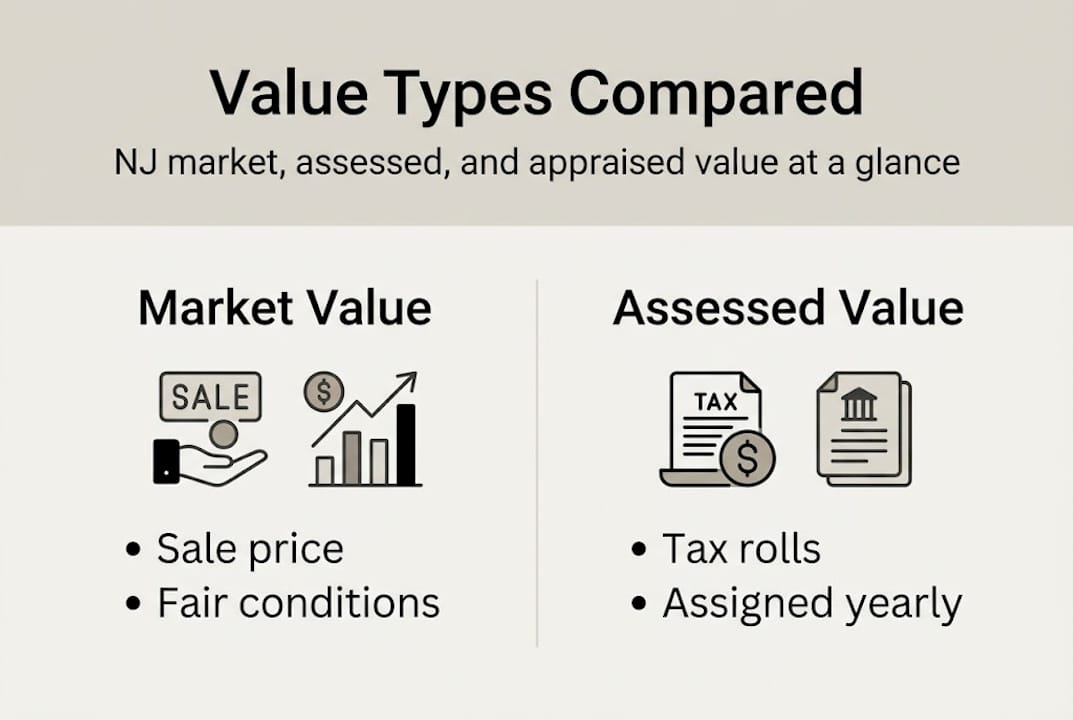
Appraised value is the conclusion of a single certified appraiser based on a specific methodology and a specific date. It represents a professional opinion, not a guaranteed sale price. Two appraisers can look at the same property and arrive at different numbers, which is why methodology and comparable selection matter so much in legal contexts.
IRS Fair Market Value (FMV) is the federal standard used for estate tax, gift tax, and charitable contribution purposes. The definition mirrors the NJ legal standard: a willing buyer and willing seller, both informed, neither compelled. For practical purposes, FMV and market value are legally identical.
Here is what this means in practice:
- A property assessed at $450,000 may have a market value of $390,000, supporting a tax appeal
- An appraised value of $500,000 may differ from a second appraiser's $480,000 opinion, both being valid
- IRS FMV for estate purposes must be supported by a qualified appraisal, not an AVM or tax record
- In hot markets, assessed values can be 10% to 20% below actual market value, which benefits the taxpayer
- In post-revaluation years, assessed values may overshoot market value, creating appeal opportunities
For NJ value distinctions in legal matters, the key is always to use the right value type for the right purpose, supported by a USPAP-compliant report.
Statistic to note: In New Jersey, municipalities are required to maintain an average ratio of assessed to true value within a specific range. When that ratio drifts, a countywide revaluation is triggered, often causing widespread assessment changes that affect thousands of property owners at once.
Why most market value appraisals in NJ miss the mark: Lessons from the field
After more than 26 years working on appraisals for legal, estate, and tax matters across New Jersey, one pattern stands out clearly: most valuation errors are not random. They are predictable.
Municipal mass revaluations are the biggest source of inaccuracy. They rely on sales data that may be 12 to 24 months old, applied to entire neighborhoods using statistical averages. Individual property conditions, recent renovations, or localized market shifts are often invisible to the model. The result is an assessed value that may be accurate for the average property but wrong for yours.
Attorneys and homeowners also frequently conflate assessed value with market value, especially when the numbers are close. That assumption can cost a client thousands in an inequitable divorce settlement or an unnecessary estate tax payment.
The most actionable strategy is simple: challenge mass revaluation results with an evidence-based individual appraisal. Follow NJ appraisal best practices and insist on a report that reconciles all three approaches, documents the comparable selection process, and clearly states the effective date of value. A well-prepared appraisal does not just support your position. It makes the opposing argument difficult to sustain.
Connect with New Jersey's market value appraisal experts
When market value needs to hold up in court, satisfy an IRS filing, or support a tax appeal, the quality of the appraisal report is everything. Generic valuations do not survive legal scrutiny. You need a state-certified appraiser with direct experience in the specific legal context you are navigating.

New Jersey Real Estate Appraisal Group provides USPAP-compliant appraisals for divorce, estate, and tax appeal matters across the state. Whether you need Atlantic County real estate appraisals, support for NJ property tax appeal appraisals, or specialized divorce appraisal expertise, our team delivers credible, defensible reports backed by over 26 years of New Jersey market experience. Get a fast quote today and put accurate market value on your side.
Frequently asked questions
How is market value determined for New Jersey property tax assessment?
NJ law establishes market value for tax assessment as 100% of true value, determined using appraisal methods applied to sales data as of October 1st of the pretax year. Assessors use recent comparable sales and property inspections to arrive at this figure.
What are the main approaches appraisers use to determine market value?
Appraisers use sales comparison, cost, and income approaches, with sales comparison typically prioritized for residential homes. USPAP requires appraisers to consider all three and reconcile them into a final, supported opinion of value.
How does market value differ from assessed or appraised value?
Market value is the most probable open-market sale price under fair conditions, while assessed value is a municipal figure used for tax billing and appraised value is a single expert's opinion. Market value and FMV are legally identical for tax and estate purposes, but assessed value often diverges significantly.
Why do property tax appeals in NJ often require individual appraisals?
Because mass appraisal methods overshoot market value due to lagging sales data and neighborhood-level averaging, individual appraisals provide property-specific evidence that mass models cannot replicate. This evidence is essential for a successful appeal before the New Jersey Tax Court.