

TL;DR:
- Appraisals in New Jersey must follow USPAP standards and specific state regulations for credibility.
- The three main valuation approaches are sales comparison, cost, and income capitalization, each suited to different properties.
- Early engagement and clear scope definition enhance legal strategies and strengthen appraisal defensibility.
Real estate appraisers do not simply pick a number. Yet in New Jersey divorce, estate, and litigation cases, attorneys frequently encounter appraisal reports that appear arbitrary, inconsistent, or legally vulnerable. A flawed valuation can shift a settlement by tens of thousands of dollars, delay probate, or undermine a tax appeal. Understanding how appraisers actually determine value, and what New Jersey's regulatory environment requires, gives you a sharper edge in every property dispute you handle. This guide walks through the core methods, state-specific compliance rules, and the red flags that signal a report may not hold up under scrutiny.
Table of Contents
- Understanding the foundation: What drives appraised value?
- The three approaches: Sales, cost, and income explained
- Unique New Jersey factors: Compliance, cost tables, and credible support
- Common pitfalls in legal appraisal: Bias, benchmarks, and defensible value
- Why effective value determination starts before the appraisal
- Get trusted appraisal support for your next New Jersey case
- Frequently asked questions
Key Takeaways
| Point | Details |
|---|---|
| Three core methods | Appraisers use Sales Comparison, Cost, and Income Approaches to value property in NJ legal cases. |
| State compliance is critical | NJ mandates USPAP standards and annual cost tables for credible, court-accepted appraisals. |
| Bias and errors matter | Understanding appraisal pitfalls helps attorneys proactively defend or challenge values in litigation. |
| Nuanced strategies win cases | Hybrid methods and early attorney input improve the defensibility of appraisals in complex situations. |
Understanding the foundation: What drives appraised value?
Now that we have addressed the stakes and common misconceptions, let us clarify the appraisal fundamentals used in every credible valuation. An appraisal is not an estimate or an opinion pulled from thin air. It is a structured, standards-driven analysis designed to produce a supportable conclusion of market value.
Understanding the appraisal's role in legal cases begins with recognizing that every USPAP-compliant report must consider three recognized approaches to value. USPAP, the Uniform Standards of Professional Appraisal Practice, is the national framework that governs how licensed and certified appraisers conduct their work. Courts and opposing counsel use USPAP compliance as a baseline test for admissibility and credibility.
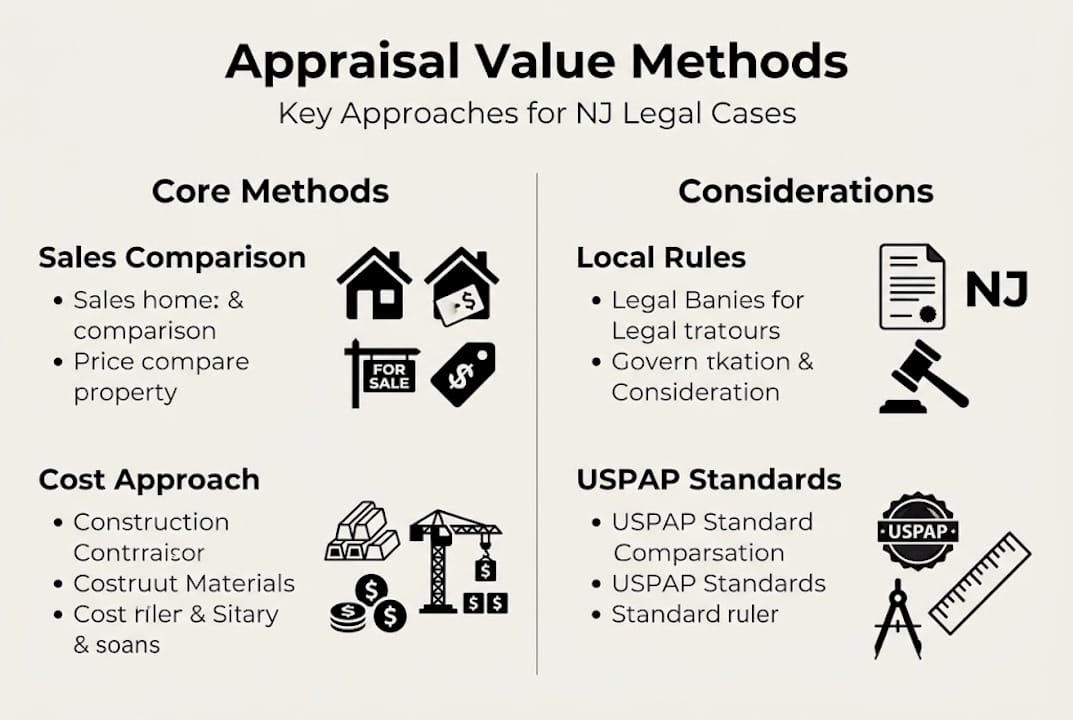
Appraisers determine value using three primary approaches: the Sales Comparison Approach, the Cost Approach, and the Income Capitalization Approach. Each method draws on different data sources and is better suited to certain property types and legal contexts.
Here is why this matters for your cases:
- Sales Comparison Approach (SCA): Relies on recent sales of similar properties, adjusted for differences. Most common for residential properties in divorce and estate matters.
- Cost Approach: Estimates value as land plus the depreciated replacement cost of improvements. Used for newer buildings, special-use properties, or when comparable sales are scarce.
- Income Capitalization Approach: Converts a property's income stream into a value indication. Essential for rental properties, multi-family buildings, and commercial assets.
A report that relies on only one approach without explaining why the others were excluded is a signal worth questioning. In contested NJ cases, that omission has been used effectively during cross-examination to challenge an appraiser's credibility.
For equitable distribution purposes, New Jersey courts expect appraisals to be thorough, well-supported, and clearly reasoned. An appraiser who cannot explain their methodology under oath creates real risk for the party relying on that report.
The three approaches: Sales, cost, and income explained
With the foundational context set, here is how these three core approaches translate to real cases attorneys encounter.
The breakdown of valuation methods shows that each approach has distinct strengths and weaknesses depending on the property type and legal purpose.

| Approach | Best used for | Key strength | Key limitation |
|---|---|---|---|
| Sales Comparison | Residential, divorce, estate | Market-driven, relatable | Requires recent, similar sales |
| Cost | New/special-use properties | Reliable when sales are scarce | Depreciation estimates vary |
| Income Capitalization | Rentals, commercial, investment | Reflects investor behavior | Dependent on income data quality |
Here is how each plays out in common NJ legal scenarios:
- Sales Comparison Approach: An appraiser selects three to six recent sales of comparable properties, then adjusts each for differences in size, condition, location, and features. In a divorce case involving a single-family home in Bergen County, this is almost always the primary method. The adjustments are where disputes arise. Opposing counsel should scrutinize whether adjustments are supported by market data or simply estimated.
- Cost Approach: If a marital estate includes a recently built custom home or a property with no comparable sales nearby, the Cost Approach fills the gap. The appraiser calculates what it would cost to replace the structure today, then subtracts depreciation. This method is also relevant in estate matters where a property has unique features.
- Income Capitalization Approach: When a marital or estate asset includes a rental property or commercial building, the appraiser analyzes net operating income and applies a capitalization rate to produce a value. In complex litigation, a discounted cash flow (DCF) analysis may be used instead, particularly for properties with irregular income streams.
Some assignments call for a hybrid approach, especially in high-net-worth divorce or contested estate matters where a single method may not capture the full picture. Ensuring USPAP compliance for appraisals means the appraiser must justify their approach selection in writing.
Pro Tip: During discovery, request the appraiser's workfile and ask specifically which approaches were considered and why any were excluded. A well-supported exclusion is acceptable. A blank space is not.
Unique New Jersey factors: Compliance, cost tables, and credible support
After breaking down the core methods, let us see what makes value determination in New Jersey especially demanding for legal professionals.
New Jersey is one of the more regulated appraisal environments in the country. The state publishes annual cost conversion factors that appraisers must use when applying the Cost Approach for tax and assessment purposes. These tables set standardized baselines for construction costs by property type and region. An appraisal that ignores these figures in a tax appeal context is immediately suspect.
For divorce and estate work, USPAP compliance remains the primary standard, but NJ-specific rules add layers. One area attorneys often overlook is the treatment of marital business interests. Under New Jersey divorce law, certain valuation discounts, such as minority interest discounts or lack of marketability discounts, are not applicable to marital business assets. An appraiser who applies these discounts without legal justification may produce a value that opposing counsel can challenge effectively.
The NJ appraisal process also requires attention to data sourcing. Appraisers should cite official MLS data, county assessment records, and state-published tables where applicable. Reports that rely on unverified online tools or outdated sales data are vulnerable.
Here is a checklist for reviewing any appraisal report in a NJ legal matter:
- Confirm the appraiser holds a NJ state certification (Certified Residential or Certified General)
- Verify USPAP compliance statement is present and current
- Check that the effective date aligns with the legal purpose (date of death, date of separation, current value)
- Review comparable sales for recency, proximity, and similarity
- Confirm cost tables are cited if the Cost Approach is used
- Look for a clear reconciliation section explaining the final value conclusion
Reviewing USPAP compliance steps in detail can help you identify gaps before they become problems in court.
| Report element | What to look for | Red flag |
|---|---|---|
| Effective date | Matches legal purpose | Missing or inconsistent |
| Comparable sales | Recent, nearby, similar | Outdated or dissimilar |
| Approach justification | Written explanation | No explanation provided |
| Cost table citation | State-published source | Absent in Cost Approach |
Common pitfalls in legal appraisal: Bias, benchmarks, and defensible value
Understanding state rules is only half the battle. Legal professionals must also navigate error, variability, and bias.
Appraisal errors are more common than most attorneys realize. Research from the FHFA shows appraisal errors occur with measurable frequency, including findings that low appraisals are 23% more likely in majority-Black neighborhoods and that upward bias appears in high loan-to-value transactions. These are not just equity concerns. In litigation, they are grounds for challenge.
For attorneys relying on legal-credible valuation methods, recognizing the signs of a weak report is essential. Here are the most common pitfalls:
- Unsupported adjustments: Adjustments in the Sales Comparison Approach that are round numbers with no market data support are a classic weakness.
- Stale comparables: Using sales from 18 months ago in a market that has shifted significantly will produce a distorted value.
- Ignoring income data: For rental properties, failing to analyze actual rent rolls or vacancy rates leads to conclusions that opposing experts can dismantle.
- Incomplete reconciliation: A final value conclusion that does not explain how the appraiser weighted each approach leaves the report exposed.
In contested NJ divorce and estate cases, the appraiser who cannot defend their adjustments on the stand is often the one whose value gets discounted by the court.
When you need to challenge an appraisal, focus on the workfile. USPAP requires appraisers to maintain documentation sufficient to support their conclusions. If the workfile is thin or the adjustments lack support, that is your opening.
Pro Tip: Ask for the paired sales analysis or regression data used to support dollar adjustments. If none exists, the adjustment is effectively an estimate, and that matters in cross-examination.
Why effective value determination starts before the appraisal
Now that you have a clear guide to appraisal methods, here is a perspective that could reshape your litigation approach.
Most attorneys treat the appraisal as something that happens to them. A report arrives, they review it, and then they react. After 26 years working with legal professionals across New Jersey, we have seen how much leverage is lost in that passive posture.
The attorneys who get the best outcomes engage early. They define the scope of the assignment in writing before the appraiser starts. They clarify the effective date, the intended use, and the property rights being valued. They ask whether a hybrid approach is warranted before the report is drafted, not after.
In high-net-worth divorce or contested estate matters, early forensic analysis or a hybrid income and sales approach can establish a valuation framework that shapes the entire negotiation. Appraisers are skilled professionals, but they work with the information and context you provide. A well-briefed appraiser produces a more defensible report.
The role of accuracy in divorce appraisals is not just about the final number. It is about building a foundation that holds up from the first mediation session through trial, if it comes to that.
Get trusted appraisal support for your next New Jersey case
With a smarter strategy for value determination, here is how you can secure expertise for your next case.
At New Jersey Real Estate Appraisal Group, we work directly with attorneys handling divorce, estate, and litigation matters across the state. Our appraisals are USPAP-compliant, court-ready, and built to withstand scrutiny from opposing counsel and judges alike.

Whether you need a residential valuation for equitable distribution, a retrospective date of death appraisal for probate, or a commercial opinion for a complex litigation matter, we deliver reports that support your legal strategy. Our Atlantic County appraisal services and statewide coverage mean we can respond quickly wherever your case is filed. Explore our divorce appraisal expertise or review our full-service appraisal solutions to find the right fit for your next assignment.
Frequently asked questions
What approach do New Jersey appraisers use most often in divorce cases?
The Sales Comparison Approach is the standard for residential properties in NJ divorce, but complex or income-producing assets often require income or hybrid methods to produce a defensible value.
How do NJ rules ensure appraisal credibility?
Appraisals must follow USPAP standards and, where applicable, incorporate annual state-published cost factors to meet compliance requirements for court acceptance in New Jersey.
What are the main risks of appraisal errors in legal cases?
Appraisal errors and bias can produce undervalued or overvalued conclusions that distort settlements, expose reports to challenge, and create liability for the parties relying on them.
How can attorneys strengthen a challenged appraisal in New Jersey?
Request the appraiser's full workfile, verify that NJ cost tables were used where required, and consider retaining an independent certified appraiser to review the methodology and provide a rebuttal opinion.