
TL;DR:
- USPAP compliance ensures appraisal reports are credible and withstand court scrutiny in New Jersey.
- Key standards include proper development, reporting, and clear disclosures of assumptions and scope.
- Non-compliance risks report exclusion, weakening legal cases involving property valuation.
Not every appraisal report is created equal, and New Jersey courts have little patience for reports that fall short. Attorneys handling divorce, estate, or litigation matters often assume that any licensed appraiser will produce a court-ready report. That assumption can cost your client dearly. USPAP compliance is the legal and professional standard that separates a defensible valuation from one that gets challenged or excluded entirely. This guide breaks down what USPAP requires, which rules matter most in legal proceedings, what causes reports to fail, and how you can ensure every appraisal you submit holds up under scrutiny.
Table of Contents
- What is USPAP and why does it matter in New Jersey legal cases?
- The core USPAP rules that define a compliant appraisal
- Common USPAP pitfalls: What causes appraisals to fail in court
- How to ensure USPAP-compliant appraisals for divorce, estate, and litigation in New Jersey
- A seasoned appraiser's perspective: What attorneys in New Jersey often miss
- Get certified, USPAP-compliant appraisals for New Jersey legal matters
- Frequently asked questions
Key Takeaways
| Point | Details |
|---|---|
| USPAP ensures court credibility | Only USPAP-compliant appraisals withstand legal scrutiny for New Jersey divorce, estate, and litigation cases. |
| Know the core standards | Familiarity with Standards 1 and 2 helps you vet appraisal reports for completeness and accuracy. |
| Avoid common compliance pitfalls | Be alert to issues like undisclosed assumptions, contingency fees, and vague scope—these can derail your case. |
| Vetting saves time and cost | Careful appraisal vetting prevents costly legal setbacks and ensures smoother proceedings. |
What is USPAP and why does it matter in New Jersey legal cases?
USPAP stands for Uniform Standards of Professional Appraisal Practice. Developed and maintained by the Appraisal Standards Board of The Appraisal Foundation, USPAP sets the ethical and performance requirements for appraisers across the United States. In New Jersey, state law requires that all certified appraisers follow USPAP, making it the baseline standard for any real estate appraisal for legal cases.
For attorneys, this matters because a report that does not meet USPAP requirements can be challenged on procedural grounds alone, before opposing counsel even questions the numbers. Courts rely on USPAP compliance as a threshold test of credibility. A non-compliant report may be dismissed outright or significantly weakened during cross-examination.
Here is what USPAP governs at a high level:
- Ethics Rule: Requires impartiality and prohibits contingency fees tied to the outcome of the appraisal
- Competency Rule: The appraiser must have the knowledge and experience to complete the assignment, or must disclose and remedy any gaps
- Scope of Work Rule: The appraiser must do enough work to produce credible results for the intended use
- Record Keeping Rule: All work files must be retained and available for review
As USPAP key mechanics outline, these rules form the backbone of every compliant appraisal report. Each rule addresses a specific risk area that courts and opposing counsel will scrutinize.
Consider three common legal scenarios. In a divorce appraisal in NJ, both parties need confidence that the property value is impartial. In an estate matter, the date of death value must be precisely documented and defensible. In litigation, the appraiser may be called to testify, making the report's foundation critical.
"A USPAP-compliant report is not just a formality. It is the foundation that allows courts, attorneys, and opposing experts to evaluate the credibility of a valuation without questioning the process itself."
Understanding these fundamentals is the first step. The next is knowing exactly which standards apply to real property appraisals used in legal proceedings.
The core USPAP rules that define a compliant appraisal
When it comes to real property, two USPAP standards do the heavy lifting. Standard 1 governs how an appraisal is developed, and Standard 2 governs how it is reported. Both must be satisfied for a report to be considered compliant.
As outlined in the property appraisal process, Standard 1 requires the appraiser to identify the problem, define the scope of work, collect and verify data, analyze that data, and reconcile the results into a final value opinion. Standard 2 requires that the report clearly communicates those findings without being misleading, and that all assumptions and limiting conditions are disclosed.

Here is a quick reference table for the core standards:
| USPAP Standard | What it covers | Why it matters in legal cases |
|---|---|---|
| Standard 1 | Development of the appraisal | Ensures the value opinion is built on verified data and sound methodology |
| Standard 2 | Reporting the appraisal | Ensures the report is clear, complete, and not misleading |
| Ethics Rule | Conduct and impartiality | Prevents bias or financial conflicts that could invalidate the report |
| Competency Rule | Appraiser qualifications | Confirms the appraiser is qualified for the specific assignment |
| Scope of Work Rule | Extent of research and analysis | Ensures enough work was done to produce credible results |
In practice, a compliant NJ legal appraisal follows this sequence:
- Define the assignment: Identify the property, the client, the intended use, and the effective date of value
- Establish scope: Determine what research, inspections, and analysis are required
- Collect and verify data: Pull comparable sales, confirm property details, and document sources
- Analyze and reconcile: Apply appropriate valuation methods and explain the reasoning
- Report clearly: Present findings with all assumptions, conditions, and certifications disclosed
For estate appraisal matters, the effective date of value is often a past date, which adds complexity to data collection and verification. A legal-grade property valuation must account for this precisely.
Pro Tip: Before submitting an appraisal report to the court, review the certification page. A compliant report will include an explicit statement that the appraisal was prepared in conformance with USPAP. If that language is absent, request a revised report before filing.
Common USPAP pitfalls: What causes appraisals to fail in court
Even experienced appraisers can produce non-compliant reports, and the consequences for your case can be severe. Knowing what to look for protects your client and your credibility as counsel.
The most frequent USPAP violations include:
- Contingency fee arrangements: Any agreement where the appraiser's fee depends on the outcome violates the Ethics Rule and renders the report inadmissible
- Inadequate scope of work: Cutting corners on comparable sales research or skipping a physical inspection without justification undermines credibility
- Undisclosed assumptions: Failing to state limiting conditions or extraordinary assumptions leaves the report open to challenge
- Misleading omissions: Selectively presenting data that supports a predetermined value is a direct USPAP violation
- Using depreciated asset registers for personal property: Particularly relevant in estate cases where personal and real property must be clearly separated
As documented in common appraisal errors, these violations are more common than most attorneys realize, and they frequently surface during opposing expert review.
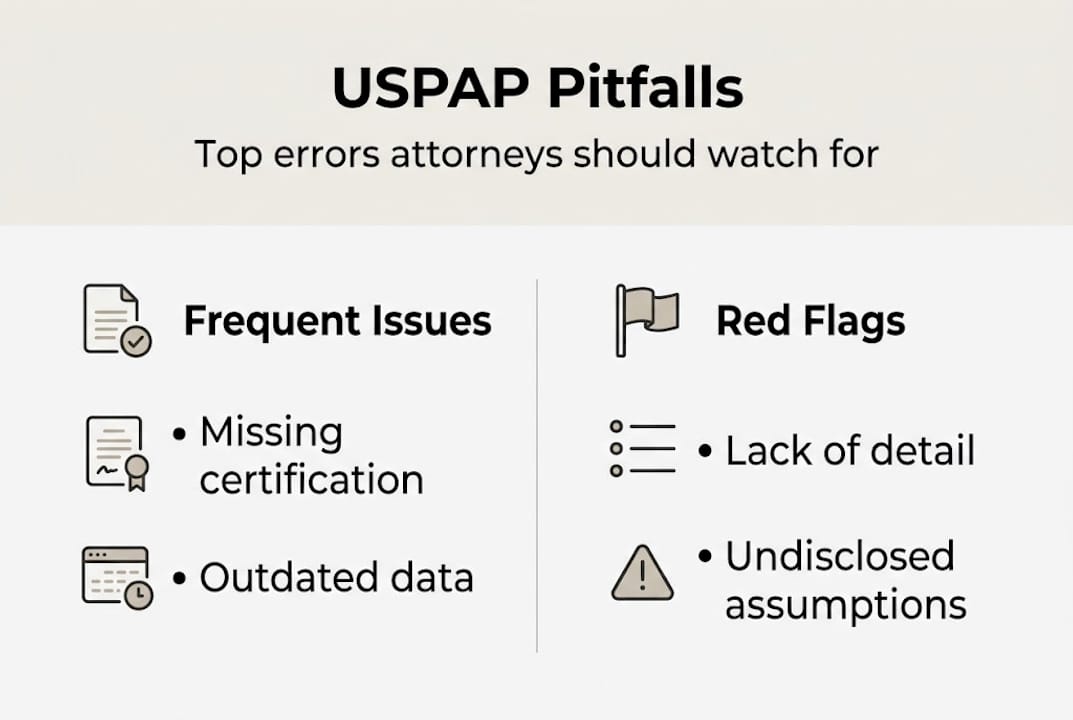
Here is a side-by-side comparison of compliant versus non-compliant report elements:
| Report element | Compliant | Non-compliant |
|---|---|---|
| Fee arrangement | Flat or hourly fee | Contingency on value outcome |
| Scope of work | Clearly defined and sufficient | Vague or insufficient for intended use |
| Assumptions | All disclosed and explained | Undisclosed or buried in boilerplate |
| Data sources | Verified and documented | Unverified or missing |
| Certification | Explicit USPAP compliance statement | Missing or incomplete |
In New Jersey divorce and estate proceedings, reports with these deficiencies are regularly challenged. Opposing counsel will target the scope of work section and the certification page first. If either is deficient, the entire valuation may be called into question, even if the underlying number is reasonable.
"Due diligence on an appraisal report is not optional. Attorneys who treat the report as a formality rather than a legal document often find themselves defending the appraiser's methodology instead of the client's position."
Understanding why accuracy matters in divorce appraisals goes beyond the numbers. It starts with the process that produced them.
How to ensure USPAP-compliant appraisals for divorce, estate, and litigation in New Jersey
The good news is that verifying USPAP compliance is straightforward when you know what to check. Here is a practical process you can follow before submitting any appraisal in a legal matter.
- Verify appraiser credentials: Confirm the appraiser holds a current New Jersey state certification, not just a license. Certified General or Certified Residential designations are required for most legal assignments.
- Request an explicit compliance statement: The report must contain a signed certification stating it was prepared in conformance with USPAP. This is non-negotiable.
- Review the scope of work section: It should clearly describe what the appraiser did, what data was used, and why the scope is appropriate for the intended use.
- Check all assumptions and limiting conditions: Every extraordinary assumption must be identified and its impact on value explained.
- Confirm the effective date of value: This is especially critical in estate and retrospective appraisals where the date must match legal requirements.
- Look for impartial language throughout: The report should present balanced analysis, not advocacy for a particular value.
For fair property division appraisals in divorce cases, impartiality is particularly important. Both parties and the court need confidence that the appraiser had no incentive to favor either side.
When reading reports for USPAP compliance, focus on the certification, scope of work, and addenda. These sections reveal the most about whether the appraiser followed proper procedure.
As USPAP guidance for attorneys confirms, appraisers with litigation experience and an explicit compliance statement are your strongest option for court-ready valuations in divorce, estate, and litigation matters.
Pro Tip: In estate cases, always clarify upfront whether the assignment involves real property only or includes personal property as well. The valuation methodology and USPAP standards that apply differ significantly, and mixing them without clear disclosure is a common source of challenges.
- Ask whether the appraiser has testified as an expert witness in New Jersey courts
- Request a sample report to evaluate format and disclosure practices before engagement
- Document your due diligence in writing in case the report is challenged later
A seasoned appraiser's perspective: What attorneys in New Jersey often miss
After working with New Jersey attorneys for over 26 years, one pattern stands out. Many legal professionals assume that a current state certification automatically means an appraiser is litigation-ready. It does not. Certification confirms technical training. Courtroom credibility comes from experience, precise report language, and the ability to defend every conclusion under cross-examination.
The real value of a USPAP-compliant report is not that it checks the right boxes. It is that it holds together when opposing counsel tries to pull it apart. That requires an appraiser who asks the right questions before the assignment begins, not after the report is filed.
Subtle issues sink cases more often than obvious errors. The distinction between real and personal property in an estate, the choice of effective date in a retrospective valuation, and the way an extraordinary assumption is worded can all determine whether a report survives challenge. Reviewing valuation methods for legal success with your appraiser before engagement is time well spent. The strongest appraisals are built on clear communication between the appraiser and the attorney from day one.
Get certified, USPAP-compliant appraisals for New Jersey legal matters
When a property valuation needs to hold up in court, the quality of the appraisal report is not a detail. It is the foundation of your case.

New Jersey Real Estate Appraisal Group delivers state-certified, USPAP-compliant appraisal reports specifically designed for divorce, estate, and litigation use. With over 26 years of experience working alongside New Jersey attorneys, we understand what courts expect and how to produce reports that withstand scrutiny. Whether you need divorce appraisals in NJ or certified valuations across Union County and beyond, our team is ready to support your legal matter with credible, defensible valuations. Contact us today to request a quote.
Frequently asked questions
What happens if an appraisal is not USPAP-compliant in New Jersey court?
A non-compliant report may be excluded or challenged by the court, which can seriously undermine your client's legal position and delay resolution of the case.
Is USPAP compliance required for all types of property appraisals?
Yes. USPAP applies to both real and personal property appraisals, and both property types must meet compliance standards when used in divorce, estate, or litigation proceedings.
What documentation should an attorney request to verify USPAP compliance?
Request an explicit USPAP compliance statement in the certification section, and confirm the report discloses all assumptions and meets the reporting requirements of Standard 2.
Are there common red flags in reports that indicate non-compliance?
Yes. Missing disclosures, contingency fee arrangements, and vague scope descriptions are among the most frequent signs of violations that opposing counsel will target.