

TL;DR:
- Appraisal reports for legal cases must be comprehensive, documenting methodology and comparables to withstand scrutiny.
- Key elements include correct effective date, similar comparables, explained adjustments, and proper legal and IRS language.
- Proper initial engagement and clear specifications prevent common errors that could challenge appraisal validity.
When you receive an appraisal report for a divorce or estate matter, it's easy to flip straight to the final number. Most homeowners do exactly that. But in New Jersey divorce and estate cases, the value on page one is only the beginning. Courts, attorneys, and the IRS scrutinize every section of that report, from the effective date to how the appraiser selected and adjusted comparable sales. A misunderstood or poorly prepared report can delay your settlement, trigger a legal challenge, or result in a costly IRS dispute. This guide walks you through every key section so you know exactly what to look for and why it matters.
Table of Contents
- Why appraisal reports matter in divorce and estate cases
- Breaking down the sections of your appraisal report
- Understanding retrospective (date-of-death) and divorce appraisals-and-divorce-appraisals)
- Common pitfalls and how to validate your report
- Our take: Why most appraisal report problems start before you read them
- Get expert help with NJ divorce or estate appraisals
- Frequently asked questions
Key Takeaways
| Point | Details |
|---|---|
| Check effective date | Always confirm the report’s value date matches your legal scenario—especially for divorce or date-of-death cases. |
| Review comparable sales | Comp selection and explanations must bracket the assignment date and reflect market realities at that time. |
| Ensure court/IRS compliance | Your appraisal should detail methodology, be labeled as court or IRS-ready, and follow qualified appraisal requirements. |
| Spot and address errors | Missing details or vague language should prompt owner follow-up—minor report issues can lead to major legal consequences if ignored. |
| Ask early, ask often | Asking clear questions before and after ordering your appraisal delivers better, more defensible results. |
Why appraisal reports matter in divorce and estate cases
Most people think of an appraisal as a simple value letter. In reality, for divorce and estate cases, it is a legal document that must hold up under professional scrutiny. The stakes are different here. A refinance appraisal just needs to satisfy a lender. A report used for equitable distribution or estate tax must satisfy a judge, an opposing attorney, or the IRS.
For estate matters, the IRS requires what it calls a "qualified appraisal" with defensible methodology, meaning the appraiser must document how they arrived at value, not just state it. This standard applies to IRS Form 706, which is used for federal estate tax filings, and to most probate proceedings in New Jersey.
For divorce, accurate divorce appraisals follow a similar standard. The report must be defensible if the other party's attorney challenges it. That means the comparable sales must be well chosen, adjustments must be explained, and the effective date must match the court-ordered valuation date.
A report that simply states a value without supporting it is not useful in court. The methodology is what makes a report credible.
Here is what separates a court-ready report from a standard one:
- Effective date: Must match the agreed divorce date or exact date of death, not the inspection date.
- Comparable selection: Comps must bracket the subject property in size, condition, and sale date.
- Adjustment explanations: Every dollar adjustment to a comparable must be explained.
- Scope of work statement: The appraiser must describe what they did and why.
- Certification and limiting conditions: Required language for legal and IRS use.
For appraisals in estate settlements, retrospective reports are especially challenging in volatile markets because the appraiser must find comparable sales that occurred near the date of death, which may have been months or years ago. The retrospective appraisals require bracketing comps and time adjustments to account for how the market moved.
Pro Tip: Always verify your report cites the correct effective date. For estate cases, this is the date of death. For divorce, it is the date agreed upon by the court or both parties. A wrong effective date can invalidate the entire report.
With the importance of every detail in mind, let's explore what you'll actually find inside the report.
Breaking down the sections of your appraisal report
A standard residential appraisal report in New Jersey follows a structured format. Knowing what each section contains helps you confirm the appraiser did their job correctly, and it helps you catch errors before they become expensive problems.

Residential appraisal report sections follow a consistent layout, which makes it easier to review once you know what to look for. Appraisal reports for divorce and estates must clearly document methodology and comparable selection surrounding the assignment date.
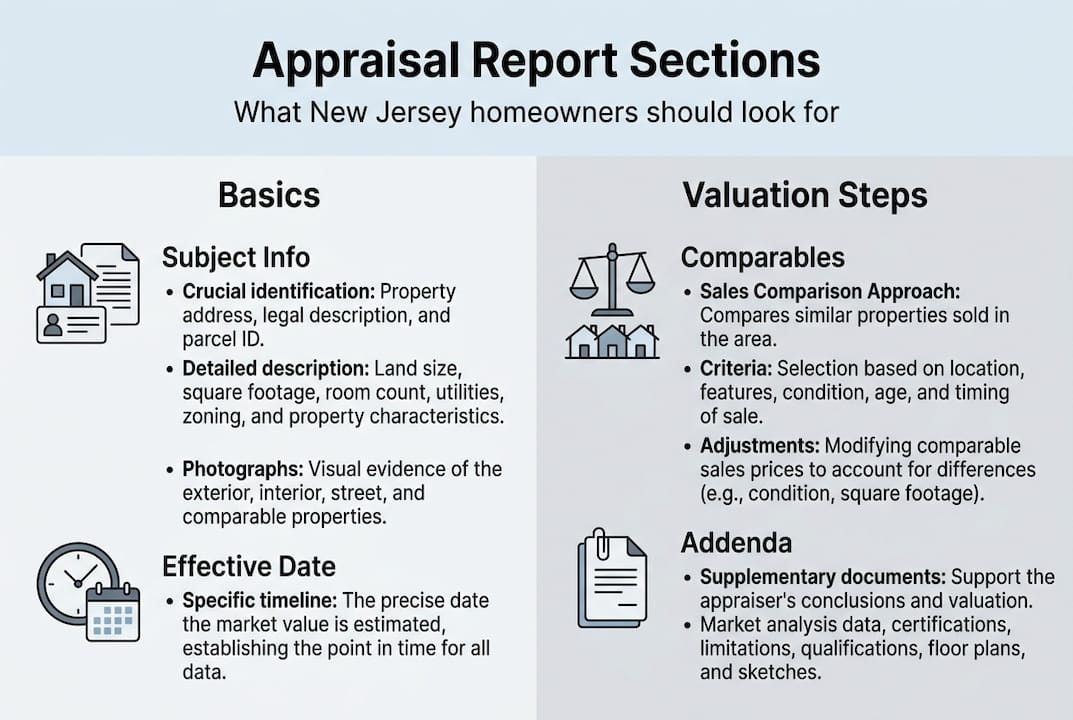
| Section | What it contains | What to check |
|---|---|---|
| Cover page | Property address, effective date, client name | Confirm address and effective date are correct |
| Subject property details | Size, condition, zoning, legal description | Verify square footage and condition rating match reality |
| Approaches to value | Sales comparison, cost, income approaches | Confirm the primary approach is appropriate for your property type |
| Comparable sales grid | 3 to 6 recent sales with adjustments | Check that comps are similar in size, location, and condition |
| Reconciliation | Final value conclusion with reasoning | Look for clear explanation of how the appraiser weighted each approach |
| Addenda | Photos, maps, certifications, limiting conditions | Confirm required legal language is present for court or IRS use |
Here is a step-by-step process to review your report for accuracy:
- Check the cover page first. Confirm the property address, your name as client, and the effective date.
- Read the scope of work. This tells you what the appraiser was asked to do and how they approached it.
- Review subject property details. Compare the described square footage, bedroom count, and condition to what you know about the property.
- Examine each comparable sale. Look at the address, sale date, and adjustments. Ask yourself whether each comp is genuinely similar.
- Read the reconciliation section. The appraiser should explain why they weighted certain approaches more than others.
- Review the addenda carefully. For estate and divorce cases, confirm that certifications, limiting conditions, and any required court or IRS language are included.
The appraisal report process is more involved than most homeowners expect, and the addenda section is often where critical legal language lives.
Pro Tip: Cross-check the effective date against the inspection date. For retrospective work, these two dates will be different. The effective date reflects when value applies; the inspection date is when the appraiser physically viewed the property. Both should be clearly stated.
Knowing why each piece matters, here's how to actually interpret all those pages:
Understanding retrospective (date-of-death) and divorce appraisals
Beyond the report structure, the type of assignment dramatically affects what you should find and how to verify its accuracy.
A standard appraisal values a property as of today. A retrospective appraisal values it as of a past date. For estate cases, that past date is the exact date of death. For some divorce cases, it may be the date of separation or a court-specified date. This distinction changes everything about how the appraiser must work.
Date-of-death appraisals use historical comparable sales bracketing the date of death, and require time adjustments to account for market change. If property values in your NJ neighborhood rose or fell significantly between the date of death and today, the appraiser must document and quantify that shift.
Here is how the three main report types compare:
| Feature | Divorce appraisal | Date-of-death appraisal | Standard appraisal |
|---|---|---|---|
| Effective date | Court-ordered or agreed date | Exact date of death | Inspection date |
| Comparable timeframe | Near the agreed date | Near the date of death | Recent (within 6 to 12 months) |
| Legal standard | Court-defensible | IRS "qualified appraisal" | Lender or market standard |
| Time adjustments | Sometimes required | Almost always required | Rarely required |
| Retrospective | Possibly | Always | No |
For the date-of-death appraisal process in New Jersey, the appraiser must find sales that occurred close to the date of death, which can be difficult if the estate has taken time to settle. NJ estate appraisal guidance emphasizes that volatile market conditions make this even more critical.
Common errors homeowners make when reviewing these reports:
- Assuming the inspection date is the effective date. These are often different for retrospective work.
- Not checking that comps are dated near the assignment date, not near the inspection date.
- Missing required IRS or court language in the certification or limiting conditions sections.
- Overlooking time adjustments when the market shifted between the effective date and the inspection date.
Common pitfalls and how to validate your report
Mistakes in the fine print of reports can have major consequences. Here's what to watch for:
Even a well-intentioned appraiser can produce a report with gaps that create problems in court or with the IRS. Knowing the red flags puts you in a position to ask the right questions before the report is submitted to an attorney or estate filing.
An IRS and court-defensible report requires precise comparable selection and a clear explanation of methodology. Without these, the report can be challenged and the entire valuation disputed.
Watch for these red flags:
- Missing or incorrect effective date. This is the most common and most serious error.
- Comparable sales that are too different from the subject in size, condition, or location.
- Adjustments with no explanation. If the appraiser added or subtracted value from a comp, they must explain why.
- Boilerplate language that does not reflect the specific property or local market conditions.
- No mention of time adjustments in a retrospective report where the market clearly moved.
- Missing addenda such as the appraiser's license, certification statement, or required court/IRS language.
Here is a simple validation checklist you can use:
- Confirm the effective date matches your court order or date of death.
- Review every comparable for similarity to the subject property.
- Check that all adjustments are explained in the addenda or within the grid.
- Inspect the addenda for required legal and IRS language.
- Confirm the appraiser's license number and certification are included.
For guidance on appraisal mistakes to avoid, reviewing these elements before the report is submitted can save you from a costly dispute.
Pro Tip: For high-stakes divorce or estate cases, ask your appraiser directly whether their report meets "qualified appraisal" standards as defined by the IRS. A confident, specific answer is a good sign. Hesitation is a warning.
If you spot discrepancies or the opposing party challenges the report, do not wait. Contact your appraiser, document your concerns in writing, and consider seeking a second opinion from another certified appraiser.
Our take: Why most appraisal report problems start before you read them
After 26 years of working on divorce and estate appraisals across New Jersey, we have noticed a consistent pattern. Most report problems do not start with a careless appraiser. They start with an unclear engagement.
When a homeowner or attorney orders an appraisal without specifying the effective date, the intended use, or the required legal standard, the appraiser fills in those blanks themselves. Sometimes they get it right. Sometimes they do not, and you only find out when the report is challenged.
The steps in the appraisal process include an engagement letter or order confirmation. That document should spell out the effective date, the purpose of the appraisal, and whether it needs to meet IRS or court standards. If it does not, ask for it to be updated before the appraiser starts work.
Educated clients consistently receive better reports. When you ask specific questions up front, the appraiser knows you are paying attention. That alone tends to produce more careful, better-documented work. Prevention is always less expensive than correction.
Get expert help with NJ divorce or estate appraisals
If you are navigating a divorce settlement or need a retrospective appraisal for an estate or probate matter, working with a certified New Jersey specialist makes a real difference.

NJREAG's certified appraisers have over 26 years of experience delivering USPAP-compliant reports for estate appraisals in NJ and divorce appraisals in NJ that are built to withstand court and IRS review. We walk you through the process, answer your questions before and after the report is delivered, and make sure every critical detail is documented correctly. Visit NJREAG to request a quote and get the accurate, defensible report your case requires.
Frequently asked questions
What is an effective date in an appraisal report?
The effective date is the exact date to which the value conclusion applies. For estate cases, this is the date of death; for divorce cases, it is typically the filing date or a date agreed upon by both parties or ordered by the court.
How do I know if my appraisal report will satisfy court or IRS requirements?
The report must state its intended use, document the valuation methodology, include comparable sales bracketing the assignment date, and meet "qualified appraisal" standards as defined by the IRS, including appraiser credentials and a detailed methodology statement.
What is a retrospective appraisal and when do I need one?
A retrospective appraisal assigns value to a property as of a past date rather than today. You need one for estate tax purposes (date of death), and sometimes for divorce cases where the agreed valuation date is in the past.
What if I find mistakes in my appraisal report?
Contact your appraiser immediately, put your concerns in writing, and document every specific error you identified. If the appraisal is challenged or legal and financial outcomes are at risk, seek a second opinion from another state-certified appraiser.