

TL;DR:
- A valuation report is a USPAP-compliant, detailed legal document prepared by a licensed appraiser.
- Different types of reports serve specific purposes, with full appraisal reports needed for legal and tax matters.
- Proper review and using qualified Jersey appraisers ensure credible, defensible property valuations.
Most New Jersey homeowners assume a valuation report is just a number someone puts on their home. The reality is very different. A real estate appraisal report is a detailed written document prepared by a licensed appraiser that provides an unbiased opinion of your property's fair market value as of a specific effective date, fully compliant with USPAP standards. Whether you're going through a divorce, settling an estate, or challenging your property taxes, this report can directly shape the financial outcome. Understanding what it is, how it works, and what to watch for can save you from costly mistakes.
Table of Contents
- What is a valuation report and why does it matter?
- Types of valuation reports used in New Jersey
- How valuation reports are created: core methods and process
- What to check and common mistakes with valuation reports
- Most homeowners misunderstand valuation reports—here's what actually matters
- Get the right valuation report—work with certified New Jersey experts
- Frequently asked questions
Key Takeaways
| Point | Details |
|---|---|
| Formal definition matters | Valuation reports in NJ must meet legal standards and are not the same as online estimates or informal opinions. |
| Types serve your situation | Choose the right report format—full, restricted, or specific forms—based on your legal or financial needs. |
| Core methods are crucial | Appraisers use sales comparison, cost, and income approaches to ensure credible, supportable values. |
| Review for accuracy | Homeowners should check appraiser credentials, report compliance, and all numbers before relying on a valuation report. |
| Expert advice pays off | Using NJ-certified appraisal experts prevents costly mistakes in divorce, estate, or property tax scenarios. |
What is a valuation report and why does it matter?
A valuation report is not a quick estimate. It is a formal, written document that a state-licensed appraiser prepares following strict professional standards known as USPAP, the Uniform Standards of Professional Appraisal Practice. Every claim, adjustment, and conclusion in the report must be supported with data and logic that can hold up to scrutiny.
For New Jersey homeowners, this matters more than most people realize. Courts, the IRS, tax boards, and financial institutions will not accept an online estimate or a real estate agent's comparative market analysis as evidence of value. They require a report prepared by a licensed professional. If you're dividing marital assets, filing an estate return, or appealing your property tax assessment, a formal valuation report is not optional.
Here's what makes a valuation report legally defensible:
- Prepared by a New Jersey state-licensed or certified appraiser
- Compliant with USPAP standards
- Includes a specific effective date tied to the purpose of the report
- Supported by market data, comparable sales, and documented adjustments
- Signed and certified by the appraiser
The financial stakes are real. Consider a homeowner whose property is assessed at $50,000 more than its actual market value. A successful tax appeal using an accurate appraisal can reduce your tax burden by more than $1,100 per year. Over five years, that's over $5,500 in savings. The cost of the appraisal itself, typically between $350 and $800, pays for itself quickly.
In divorce cases, the stakes are even higher. A difference of $30,000 in a home's appraised value can shift the entire settlement. Understanding NJ residential appraisal basics before you enter any legal process gives you a real advantage.
Key takeaway: A valuation report is a legal document with financial consequences. Treat it that way from the start.
Types of valuation reports used in New Jersey
Not all valuation reports are created equal, and using the wrong type for your situation can get your report rejected entirely. Understanding the differences before you order one saves time, money, and frustration.
The two primary formats under USPAP are the Appraisal Report and the Restricted Appraisal Report. Here's how they compare:
| Report type | Level of detail | Intended use | Court/legal use |
|---|---|---|---|
| Appraisal Report | Full disclosure | Courts, IRS, lenders, attorneys | Yes |
| Restricted Appraisal Report | Limited | Personal use only | No |
For most New Jersey homeowners dealing with divorce, estate matters, or tax appeals, you need a full Appraisal Report. Residential properties are typically appraised using the URAR form, which stands for Uniform Residential Appraisal Report. This is the standard format accepted by courts and financial institutions.

In business and asset valuation contexts, three report categories exist: a calculation of value (uses a single method, no formal opinion), a summary conclusion, and a detailed conclusion. These are more common in divorce cases involving business interests or investment properties.
What makes a report "court-ready" goes beyond format. It includes:
- Clear identification of the property and effective date
- Documented comparable sales with explained adjustments
- A reconciliation of value approaches
- The appraiser's signed certification
- Compliance with USPAP and any applicable New Jersey standards
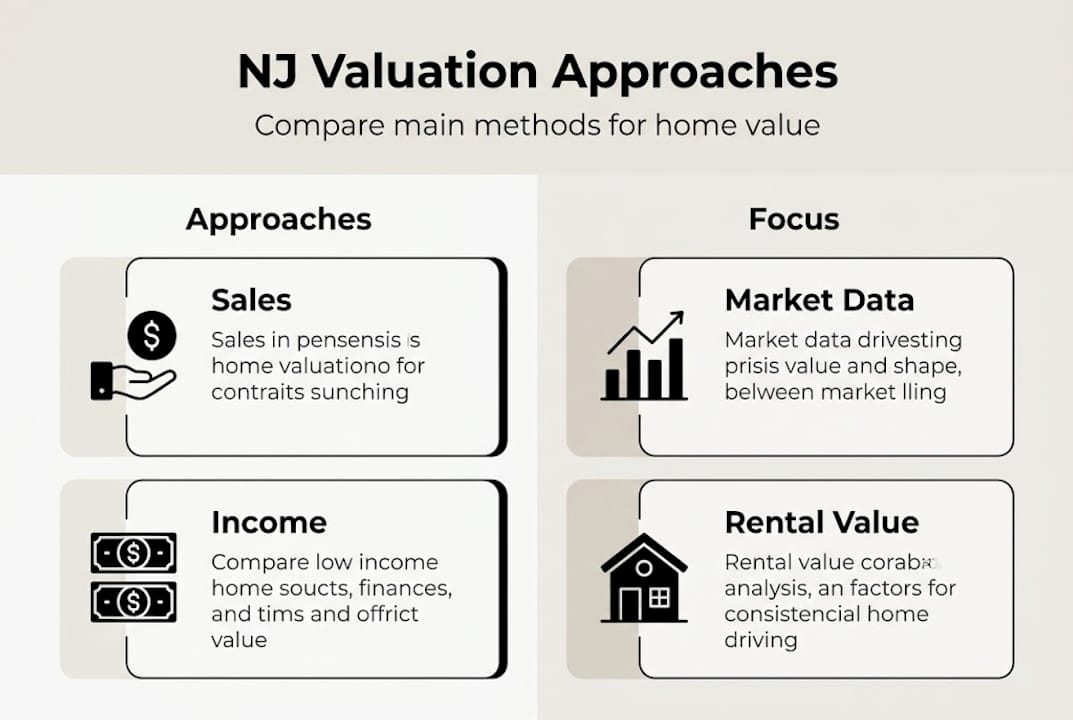
You can review a comparison of NJ valuation approaches to understand how different methods affect the final number.
Pro Tip: Always tell your appraiser the specific purpose of the report before they begin. A Restricted Appraisal Report costs less but cannot be used in court, before the IRS, or for tax appeal hearings. Getting the wrong format means starting over.
How valuation reports are created: core methods and process
Appraisers don't guess. They follow a structured process using recognized valuation methods, and the approach they choose depends on your property type and the purpose of the report.
The three core methodologies are:
- Sales Comparison Approach: The most common method for residential homes. The appraiser identifies recent sales of similar properties and adjusts for differences in size, condition, location, and features.
- Cost Approach: Estimates land value separately, then adds the replacement cost of the structure minus depreciation. Used for newer homes, unique properties, or when comparable sales are limited.
- Income Approach: Based on the property's ability to generate rental income. Used for multi-family properties and investment real estate. The formula is net operating income divided by a capitalization rate.
Here's how the process typically unfolds:
| Step | What happens |
|---|---|
| 1. Inspection | Appraiser visits the property, measures, photographs, and notes condition |
| 2. Data research | Pulls comparable sales, public records, and market trends |
| 3. Adjustments | Applies dollar or percentage adjustments for differences between comps and subject |
| 4. Reconciliation | Weighs the approaches and arrives at a final value opinion |
| 5. Report writing | Documents all findings in a USPAP-compliant format |
A common misunderstanding is that Zillow's Zestimate or a Realtor's CMA follows a similar process. They don't. Those tools use algorithms or informal comparisons that are not reviewed, certified, or held to any legal standard. Learn more about the property appraisal process in NJ and the detailed appraisal steps involved.
Pro Tip: If your property is a two or three-family home, ask your appraiser whether the Income Approach will be included. For legal purposes, omitting it when relevant can weaken the report's credibility.
"The appraiser's job is not to hit a number. It's to support a conclusion with evidence that can withstand challenge."
What to check and common mistakes with valuation reports
Once you receive your valuation report, your job isn't done. Reviewing it carefully before you submit it to a court, attorney, or tax board is critical. Errors in appraisal reports are more common than most people expect, and catching them early can protect your outcome.
Here's a practical checklist for reviewing your NJ valuation report:
- Confirm the appraiser holds a valid New Jersey license or certification
- Verify the report is labeled as a full Appraisal Report, not a Restricted Report
- Check that the effective date matches your legal or financial requirement
- Review the comparable sales: are they recent, local, and genuinely similar?
- Look at the adjustments: are they explained and reasonable?
- Confirm the property description is accurate, including square footage and room count
- Make sure the appraiser's signature and certification are present
Common mistakes New Jersey homeowners make include submitting a CMA from their real estate agent to a tax appeal board, using an online estimate in divorce proceedings, or ordering a report with the wrong effective date for an estate filing. These errors can delay your case or result in a rejected submission.
Appraisal costs in New Jersey typically range from $350 to $800, with court-ready or complex reports at the higher end. That investment is minor compared to what's at stake in a divorce settlement or a multi-year tax appeal.
Pro Tip: New Jersey tax appeal deadlines are strict. For most counties, the filing deadline is April 1st. Your appraisal must reflect the value as of October 1st of the prior year. Ordering a report with the wrong effective date means it cannot be used as evidence.
Review our tips for appraisal preparation to make sure your property is ready before the appraiser arrives.
Most homeowners misunderstand valuation reports—here's what actually matters
After more than 26 years working on complex appraisal assignments across New Jersey, we've noticed a consistent pattern. Homeowners focus almost entirely on the final number in the report. Courts, tax boards, and opposing attorneys focus on something else entirely: the quality of the support behind that number.
A report that arrives at $450,000 with weak comparable selection, unexplained adjustments, or an appraiser unfamiliar with the local market is far less valuable than one that arrives at $420,000 with solid, well-documented reasoning. The number matters, but the credibility of the methodology matters more in high-stakes situations.
We've also seen cases where homeowners submitted broker price opinions or CMAs in tax appeal hearings, only to have them dismissed immediately. A BPO is not an appraisal. It carries no legal weight in New Jersey proceedings.
The most important thing you can do is engage a qualified, locally experienced appraiser early, before the legal process begins. Understand appraisal truths in NJ so you're not surprised when the other side challenges the report. A defensible valuation report isn't just a document. It's your evidence.
Get the right valuation report—work with certified New Jersey experts
Now that you understand what makes a valuation report accurate, defensible, and legally accepted, the next step is making sure you work with the right people to get one.

At New Jersey Real Estate Appraisal Group, we've delivered USPAP-compliant appraisal reports for divorce, estate, and tax appeal cases across the state for over 26 years. Our reports are built to hold up under review by courts, attorneys, and tax boards. Whether you need Atlantic County appraisal services, support for NJ property tax appeal appraisals, or a full estate valuation, our certified NJ appraiser team is ready to help. Contact us today to get a fast quote and protect your financial interests with a report you can rely on.
Frequently asked questions
What is included in a typical New Jersey valuation report?
A typical NJ valuation report includes the home's description, photos and comparable sales, the value methods used, and the licensed appraiser's signed opinion of market value.
How much does a real estate valuation report cost in New Jersey?
Most NJ home valuation reports cost between $350 and $800, with complex or court-ready reports typically falling at the higher end of that range.
What is the difference between an online estimate and a formal valuation report?
Online estimates use algorithms and are not legally defensible; a formal valuation report is completed by a licensed NJ appraiser and meets USPAP standards required by courts and the IRS.
How long does it take to get a valuation report in NJ?
Appraisers typically deliver completed reports within 2 to 7 days, depending on the complexity of the property and any deadline requirements.
Are valuation reports required for New Jersey divorce, estate, or tax appeals?
Yes. Courts and tax authorities require USPAP-compliant reports from licensed appraisers for all major legal and financial situations in New Jersey, including divorce settlements, estate filings, and tax appeal hearings.