

TL;DR:
- Ensuring a USPAP-compliant appraisal grounded in fair market value is crucial for smooth estate settlement in New Jersey. Such an appraisal must include detailed documentation, accurate effective dates, and independent, qualified appraisers to withstand legal or IRS review. Proper preparation and partnering with experienced appraisers protect executors from costly legal complications and ensure valid property valuations.
When a loved one passes away, the last thing you want is for the estate settlement process to unravel over a property valuation dispute. Yet that is exactly what happens when executors rely on informal estimates, online tools, or unlicensed opinions of value. New Jersey courts, the IRS, and estate attorneys require something far more rigorous: a written, USPAP-compliant appraisal report grounded in fair market value. Understanding what that actually means, and why it matters so much, is the difference between a smooth probate process and months of costly legal complications.
Table of Contents
- What makes an estate appraisal 'defensible' in New Jersey
- Fair market value: IRS definition and practical application
- Common valuation approaches: comparable sales, adjustments, and reconciliation
- New Jersey-specific considerations for estate appraisals
- Why most estate appraisals fail under scrutiny—and how to avoid costly mistakes
- Next steps: Partner with expert appraisers for reliable estate settlement
- Frequently asked questions
Key Takeaways
| Point | Details |
|---|---|
| USPAP sets the standard | Every defensible NJ estate appraisal must meet USPAP national guidelines for ethics and performance. |
| FMV is essential | Fair market value, per IRS rules, is the benchmark for estate and probate reporting. |
| Comparable sales matter | Using well-adjusted comparable sales is key for accurate, defensible estate valuations. |
| NJ rules shape the process | Local legal requirements and timelines affect how estate appraisals are prepared and reviewed. |
| Avoid common pitfalls | Failure to use compliant appraisers or proper documentation can cause costly delays and legal challenges. |
What makes an estate appraisal 'defensible' in New Jersey
The word "defensible" comes up often in estate appraisal work, and for good reason. A defensible appraisal is one that can hold up under review by a court, an IRS agent, or an opposing attorney without falling apart on a procedural or factual basis. That requires more than just a number. It requires documentation, methodology, and compliance with recognized professional standards.
USPAP Standards, which stands for the Uniform Standards of Professional Appraisal Practice, sets the national framework for ethical and competent real estate appraisals. When we say an appraisal is USPAP-compliant, we mean it was completed according to these standards, which cover everything from how the appraiser gathers data to how they communicate conclusions in the report. Courts and the IRS treat USPAP compliance as the baseline requirement. Without it, a report may be dismissed entirely.
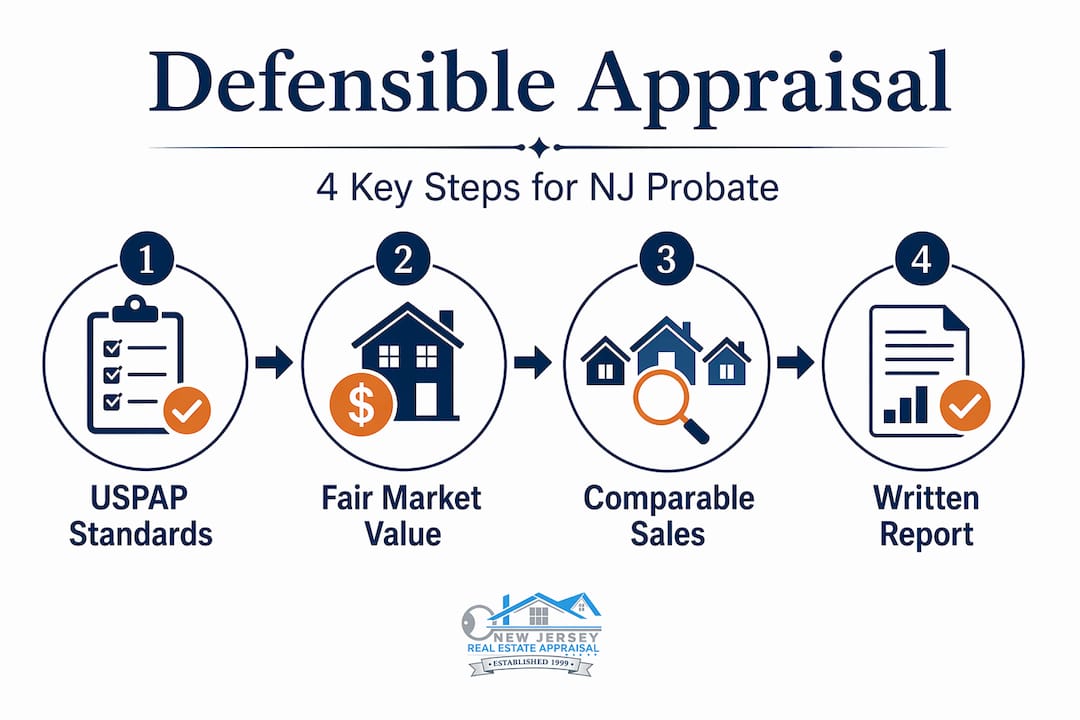
For estate matters in New Jersey, the estate tax appraisal requirements are specific. The appraisal must establish fair market value as of a particular date, typically the date of death or an alternate valuation date. It must be performed by a state-certified appraiser, not a licensed real estate agent or an automated valuation model.
Here is what separates a defensible appraisal from an informal estimate:
- A written report that documents all data sources and methodology
- A clear effective date tied to the estate's legal requirements
- Identification of the property rights being appraised
- A reconciled final value supported by market evidence
- Certification by a state-certified appraiser with demonstrated competency
- Full compliance with USPAP reporting standards
"A probate/executor appraisal report that is defensible for courts and tax purposes is typically expected to be USPAP-compliant and grounded in fair market value (FMV) concepts."
Understanding what is estate appraisal at a foundational level will help you ask the right questions when hiring an appraiser. If a firm cannot confirm they produce USPAP-compliant written reports with clear FMV conclusions, look elsewhere.
Pro Tip: Always ask your appraiser to confirm in writing that the report will be USPAP-compliant and will identify fair market value as of the required effective date. This protects you before the work begins.
Fair market value: IRS definition and practical application
Fair market value, often abbreviated as FMV, is not just an industry phrase. It is a legal standard that the IRS defines precisely, and that definition shapes how every estate appraisal must be structured. Getting it wrong, or misunderstanding it, leads to reports that the IRS rejects during estate tax review.
According to the IRS, FMV for estate filings means the price at which the property would change hands between a willing buyer and a willing seller, neither being under any compulsion to buy or to sell, and both having reasonable knowledge of relevant facts. Every word of that definition matters.
"For IRS purposes, FMV generally means the price property would sell for on the open market between a willing buyer and willing seller, neither under compulsion, with reasonable knowledge of relevant facts; valuations must consider factors affecting value."
The "no compulsion" element is especially important in estate situations. A forced sale or a distressed transaction does not reflect FMV. Neither does a sale between family members at a discount. The appraiser must simulate what a real, open-market sale would look like between informed, independent parties.
Here are the primary factors that influence FMV in New Jersey estate appraisals:
- Location and neighborhood trends — Proximity to transit, school ratings, and local demand all directly affect value.
- Physical condition of the property — Deferred maintenance, structural issues, or recent renovations are all relevant.
- Comparable sales activity — Recent arm's-length sales of similar properties in the same market provide the strongest evidence.
- Legal constraints and zoning — Easements, deed restrictions, or environmental designations can reduce or alter value significantly.
- Market conditions on the effective date — Interest rates, inventory levels, and buyer demand on the specific date of death matter greatly, not today's market.
- Property size, configuration, and improvements — Lot size, square footage, bedroom and bathroom count, and accessory structures all factor into value.
You can learn more about navigating this process in our probate appraisal guide, which walks through each stage from engagement to final report delivery.
Pro Tip: The IRS closely scrutinizes appraisals that ignore significant property characteristics or that treat "list price" as equivalent to FMV. An appraiser who relies on listing prices rather than closed sales is setting you up for a challenge.
Working with a certified appraiser for legal-grade valuation ensures that every factor the IRS examines is addressed in the report, reducing your exposure to costly audits or estate tax disputes.

Common valuation approaches: comparable sales, adjustments, and reconciliation
A USPAP-compliant appraisal does not just pull a number from thin air. It applies one or more recognized valuation approaches to the evidence gathered, then reconciles those approaches into a single, well-supported final value. Knowing how this works helps you evaluate whether an appraisal report is thorough enough to defend.
As noted in IRS Publication 561, valuation approaches in defensible estate reports often reconcile multiple evidence types, commonly comparable sales for real property, then arrive at a final indicated value.
| Valuation approach | Best used for | Strengths in NJ estate work | Limitations |
|---|---|---|---|
| Sales comparison | Residential, most NJ properties | Strong market evidence, easy to understand | Requires recent, similar sales nearby |
| Cost approach | New construction, unique properties | Useful when sales data is limited | May not reflect market sentiment |
| Income approach | Multi-family, commercial | Reflects investor behavior accurately | Requires rent and expense data |
For most New Jersey residential estate appraisals, the sales comparison approach carries the most weight. It relies on recent arm's-length sales of comparable properties, with systematic adjustments made for differences between the subject property and each comparable.
For example, if the estate property has three bedrooms and the best available comparable has four, the appraiser will subtract a market-supported adjustment for that bedroom difference. If the comparable sold eight months before the effective date and the market was rising, a time adjustment is applied. These adjustments are not guesses. They are derived from paired sales analysis and market data.
You can read more about NJ appraisal methods and tips to better understand how appraisers develop and apply these adjustments in practice.
Reconciliation is the final step in the process. Here is what it involves:
- Reviewing the value indications from each approach applied
- Weighting each approach based on the quality and quantity of supporting data
- Identifying and resolving any significant discrepancies between approaches
- Arriving at a single final value opinion that is credible and supported
For properties involving unique characteristics such as large land parcels, you may want to review our content on NJ land appraisal types, which covers how vacant or semi-improved land is valued in estate contexts. Executors managing inherited properties should also consider what happens after valuation, including selling inherited property and how appraisal values influence those decisions.
Understanding real estate valuation in NJ for legal matters goes beyond just the methodology. It includes understanding who reviews these reports and what they are looking for when they do.
New Jersey-specific considerations for estate appraisals
New Jersey has its own probate rules, its own tax structure, and its own real estate market dynamics. What works in another state may not satisfy NJ courts or the New Jersey Division of Taxation. Executors who treat estate appraisals as generic assignments often discover this the hard way.
One important distinction in New Jersey is the state estate tax, which was repealed in 2018, but the New Jersey Inheritance Tax remains in place. Depending on the relationship between the decedent and the beneficiary, inheritance tax obligations may apply, and accurate FMV documentation is required to calculate the correct liability. An appraisal that understates value may appear advantageous at first, but it creates real legal risk if the discrepancy is discovered during review.
Here are the state-specific factors that most frequently affect NJ estate appraisal accuracy:
- Title issues and encumbrances — Liens, easements, or ownership disputes must be identified and noted in the report
- Local market anomalies — NJ markets vary dramatically between Bergen County, Cape May, and urban Essex County properties
- Timing and probate deadlines — NJ probate courts may set expectations for when valuations must be completed
- Estate disputes between beneficiaries — Contested valuations require even more rigorous documentation and may require a second appraisal
- Multi-property estates — When an estate holds more than one property, each must be appraised independently
| Required item | Purpose | Timing |
|---|---|---|
| Property deed | Confirms ownership and legal description | Before appraisal engagement |
| Prior appraisal reports | Provides historical value context | Before appraisal engagement |
| Tax assessment records | Supports market data and property details | Before appraisal engagement |
| Estate attorney instructions | Clarifies effective date and intended use | At engagement |
| Inspection access | Allows interior and exterior condition review | During appraisal process |
| Comparable sales data | Supports FMV conclusion | During appraisal process |
Understanding how to manage these requirements starts with knowing how to initiate the process correctly. Our guide on requesting appraisal reports in New Jersey walks you through what to prepare and how to communicate your needs clearly to the appraiser. Proper USPAP compliance throughout documentation and reporting is not optional in NJ estate cases. It is the foundation that makes everything else hold together.
Why most estate appraisals fail under scrutiny—and how to avoid costly mistakes
After reviewing hundreds of estate appraisals over more than two decades in New Jersey, we have seen the same patterns cause the same problems. Most failures are not random. They follow predictable, avoidable paths that executors and their advisors can learn to recognize before the damage is done.
The single most common reason an estate appraisal fails is inadequate market support. An appraiser selects comparables that are too dissimilar, too old, or drawn from an entirely different market area. The adjustments are either missing or unsupported. When an IRS agent or opposing attorney looks at those comparables, they immediately see the weakness. The entire value conclusion becomes suspect.
The second most common failure is non-compliance with USPAP standards. USPAP is recognized as the national baseline for defensible reporting across all real property appraisal disciplines. A report that does not meet these standards gives courts and the IRS grounds to reject it outright, regardless of whether the final number is accurate. Accuracy alone is not enough without the documentation to prove it.
The third failure we see often is an incorrect effective date. In estate work, the effective date is typically the date of death, which may be months or even years before the appraisal is actually ordered. An appraiser who values the property as of today instead of the correct retrospective date produces a number that is legally meaningless for that estate filing.
Here is what we recommend to every executor before engaging an appraiser:
- Confirm the appraiser is state-certified, not just licensed
- Verify the report will be explicitly USPAP-compliant
- Ensure the effective date matches the estate's legal requirements
- Ask how the appraiser will support adjustments with market data
- Review estate appraisal requirements before signing any engagement letter
Preparation matters more than most executors realize. The time you invest upfront in selecting the right appraiser and providing complete documentation will save you significantly more time and money if the valuation is challenged later.
Next steps: Partner with expert appraisers for reliable estate settlement
Settling an estate in New Jersey involves real legal stakes, and the appraisal you choose either protects you or exposes you. If the work we have covered here makes one thing clear, it is that the quality of your appraisal directly determines how confidently you can move forward.

At New Jersey Real Estate Appraisal Group, we have delivered USPAP-compliant, court-ready estate appraisals across New Jersey for over 26 years. Whether you need estate settlement support in Atlantic County or a defensible date-of-death valuation in Union County, our certified appraisers deliver reports that hold up under review. We work directly with executors, estate attorneys, and heirs to make the valuation process straightforward and stress-free. Get a Fast Quote today and give your estate settlement the solid foundation it deserves.
Frequently asked questions
What is a USPAP-compliant appraisal report for estate settlement?
A USPAP-compliant report follows national ethical and performance standards required for legal and IRS review, ensuring valuations are fully documented and defensible before courts and tax authorities.
Why is fair market value used for estate appraisals in New Jersey?
FMV reflects the price a property would sell for between willing, uncompelled parties and is the required standard for IRS estate filings and NJ probate court proceedings.
What documents are needed for a New Jersey probate appraisal?
You should gather the property deed, prior appraisal reports, tax assessment records, and written instructions from the estate attorney to ensure the appraiser has everything needed to produce an accurate, compliant report.
What happens if the appraisal is not USPAP-compliant?
Non-compliant appraisals risk rejection by the IRS or NJ courts, and a defensible estate report requires full USPAP compliance to avoid delays, disputes, and additional legal costs that fall back on the executor.
How are comparable sales selected and adjusted in estate appraisals?
Appraisers identify recent, arm's-length sales of similar properties and apply market-supported adjustments for differences in size, condition, and date, ensuring the final value indication accurately reflects fair market value as of the effective date.