

TL;DR:
- Accurate property valuation is essential for fair divorce and estate settlements in New Jersey.
- Valuation purpose, date, and documentation quality significantly impact legal and IRS outcomes.
- Only licensed appraisers following USPAP and IRS guidelines can produce court-acceptance reports.
When a New Jersey family faces divorce or the loss of a loved one, property is often the largest asset on the table. Getting the valuation wrong, even slightly, can trigger costly legal disputes, unequal asset splits, or IRS penalties that follow you for years. New Jersey has specific legal standards under N.J.S.A. 2A:34-23.1 for divorce and strict IRS and USPAP requirements for estates, making accuracy non-negotiable. This guide walks you through every step, from gathering documents to receiving a court-ready report, so you can move forward with confidence.
Table of Contents
- Understand the context: Divorce vs. estate valuation in New Jersey
- What you need before starting: Documents and preparation
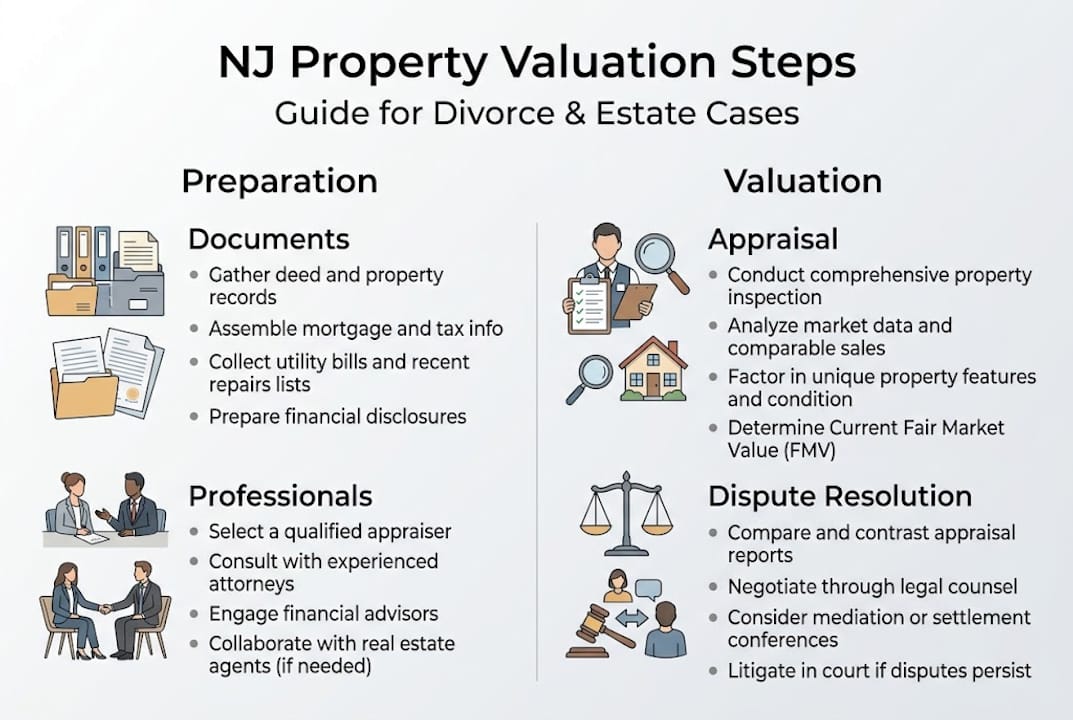
- Step-by-step property valuation process for New Jersey divorce or estate
- Resolving disputes and edge cases: What if you disagree with the valuation?
- The surprising truth about property valuation in New Jersey settlements
- Get expert New Jersey property appraisals for your divorce or estate
- Frequently asked questions
Key Takeaways
| Point | Details |
|---|---|
| Divorce vs. estate processes | Property valuation rules and legal standards differ depending on whether it’s a divorce or estate settlement in New Jersey. |
| Documentation is critical | Gathering and organizing all relevant documents upfront makes the appraisal more defensible and speeds up the process. |
| Licensed appraisers required | Court- or IRS-ready appraisals must be conducted by licensed, USPAP-compliant professionals for full legal protection. |
| Disagreements have solutions | If valuations are contested, consider second appraisals, mediation, or clear documentation to resolve disputes. |
| Valuation date matters | Choosing the correct valuation date can significantly affect equity, taxes, and the ultimate division of property. |
Understand the context: Divorce vs. estate valuation in New Jersey
Not all property appraisals are created equal. The purpose behind your valuation shapes everything: the date used, the legal standard applied, and who ultimately reviews the report.
In a New Jersey divorce, property is divided through equitable distribution, a legal process governed by N.J.S.A. 2A:34-23.1 considering 16 factors such as the length of the marriage, each spouse's income, and contributions to the marital home. Fair market value (FMV), meaning the price a willing buyer would pay a willing seller in an open market, is used to determine equity. Equity is calculated by subtracting outstanding debts from the property's FMV. You can read more about the divorce appraisal process in NJ to understand how this plays out in practice.
For estates, the process is different. A date-of-death retrospective appraisal establishes FMV as of the owner's passing using the sales comparison approach. The IRS requires licensed appraisers and full USPAP compliance for estate tax filings, and errors can trigger audits or penalties.
Equitable does not mean equal in property division. Courts weigh many factors before deciding how assets are split.
Here is a quick comparison to keep both scenarios clear:
| Factor | Divorce appraisal | Estate appraisal |
|---|---|---|
| Purpose | Equitable distribution | Estate tax, probate |
| Valuation date | Filing, separation, or settlement date | Date of death or alternate date |
| Who hires appraiser | Either spouse or court | Executor or estate attorney |
| Legal standard | N.J.S.A. 2A:34-23.1, USPAP | IRS guidelines, USPAP |
Key terms you will encounter in both processes:
- Fair market value (FMV): The price a property would sell for between informed, willing parties
- Equity: Property value minus outstanding debt
- Commingling: Mixing separate (premarital) assets with marital assets, which can complicate division
- Alternate valuation date: An IRS-permitted estate valuation date six months after death, used when it reduces tax liability
Understanding these distinctions matters because the wrong approach for your situation can produce a report that courts or the IRS will reject. For a broader view of how real estate valuation for legal matters works across different case types, that resource is worth reviewing before you proceed.
What you need before starting: Documents and preparation
Before you request a formal appraisal, preparation is everything. Missing documents slow the process down and can weaken the credibility of the final report.

Gathering the right materials upfront protects you. Professional retrospective appraisals are defensible in court and before the IRS in ways that tax assessments or comparative market analyses (CMAs) simply are not. Document everything thoroughly in case of audits or future disputes.
Here is what you need and why it matters:
| Document | Why it matters |
|---|---|
| Property deed | Confirms ownership and legal description |
| Mortgage statement | Needed to calculate current equity |
| Property tax records | Background context for the appraiser |
| Improvement receipts | Supports value adjustments for renovations |
| Prior appraisals | Provides historical value reference |
| Marital property records | Helps separate marital from nonmarital assets |
| Asset and debt disclosures | Required for equitable distribution filings |
Beyond documents, you need the right professionals involved. A licensed NJ appraiser is the core of your team. For complex divorce cases, your attorney will guide the legal strategy, and a forensic accountant may be needed if commingled assets or business interests are involved.
Common preparation challenges include properties with significant renovations that were never permitted, rural or high-value homes with few comparable sales, and assets where marital and nonmarital funds were mixed over time. Identifying these issues early lets your appraiser plan accordingly.
Pro Tip: Scan and organize all documents into clearly labeled folders before your first meeting with the appraiser. This alone can shorten the appraisal timeline and reduce back-and-forth requests.
For more detail on what executors and estate administrators specifically need, the NJ probate appraisal requirements guide covers that ground thoroughly. If land is part of the estate, reviewing land valuation steps for New Jersey is also useful.
Step-by-step property valuation process for New Jersey divorce or estate
With your documents organized and your team in place, here is how the valuation process actually unfolds.
-
Select a qualified appraiser. Choose a state-licensed appraiser with specific experience in divorce or estate work. Court-ready appraisals must be performed by licensed professionals in NJ and comply with statutory and IRS requirements. Generic residential appraisers may not have the litigation experience your case demands.
-
Provide your documents. Hand over everything you gathered in the preparation phase. The more complete your file, the faster and more accurate the appraisal will be.
-
Property inspection. The appraiser visits the property to assess condition, size, features, and any improvements. For retrospective estate appraisals, the inspection is paired with historical market research to reconstruct value at the date of death.
-
Research comparable sales. The appraiser identifies recent sales of similar properties in the area, adjusting for differences in size, condition, and location. Tax assessments are unreliable for current fair market value, so professional comparable analysis is essential.
-
Prepare and deliver the report. The final report includes the appraiser's methodology, comparable sales data, adjustments, and a supported value conclusion. For divorce, this report must hold up to attorney review and potential court scrutiny. For estates, it must satisfy IRS standards.
Special considerations arise with unique homes, luxury properties, or situations involving commingled assets. In those cases, the appraiser may need to expand the comparable search area or apply additional adjustments. If an alternate valuation date applies for estate purposes, the appraiser will research market conditions at that specific point in time.
Pro Tip: If both parties in a divorce can agree on a single neutral appraiser, you reduce costs and the risk of dueling appraisals that courts find frustrating. Review your NJ valuation methods options with your attorney before deciding. You can also learn more about retrospective appraisals if your case involves a past valuation date.
Resolving disputes and edge cases: What if you disagree with the valuation?
Sometimes, parties clash over values. Here is how to handle those challenging cases with confidence.
Disagreements over appraised value are common, especially in high-asset divorces or estates with unusual properties. The good news is that there are structured ways to resolve them without letting the dispute derail your entire settlement.
When commingling, unique property, or dual appraisals are involved, the path forward requires strategy, not just a second opinion. Here are your options:
- Order a second appraisal. Either party can commission their own appraisal from a different licensed appraiser.
- Request a neutral third appraisal. Courts sometimes appoint a neutral appraiser when two reports conflict significantly.
- Use mediation. A mediator can help both parties reach agreement on value without full litigation.
- Court review. A judge can weigh competing appraisals and make a binding determination.
- Strategic offsets. One spouse may accept a lower property value in exchange for other assets, making an exact valuation less critical.
Equitable distribution does not mean an equal split. NJ courts weigh multiple factors including marriage duration, each spouse's income, and the contributions each party made to the home.
Luxury homes and properties with business components present added complexity. A home that doubles as a short-term rental, for example, may require an income approach in addition to the standard sales comparison method.
Documentation remains your best protection throughout any dispute. Keep every receipt, record, and communication related to the property. If the case goes to court or triggers an IRS audit, a well-documented file is far more valuable than a high appraisal number. For a deeper look at why accuracy matters so much in these situations, accurate appraisals for NJ divorce explains the consequences of getting it wrong. If you are navigating life after a settlement, rebuilding after divorce resources may also be helpful.
The surprising truth about property valuation in New Jersey settlements
Most people assume the hardest part of a property valuation is the number itself. In our experience, that is rarely where cases fall apart.
What actually derails settlements is the valuation date. Choosing the wrong date can shift net equity by tens of thousands of dollars. In divorce, the date can be the filing date, the separation date, or the settlement date, and each produces a different value in a fluctuating market. For estates, the valuation date is the date of death, though an alternate date six months later is sometimes permitted when it reduces the tax burden. That single decision carries real financial weight.
The second overlooked factor is documentation quality. Clients often spend weeks arguing over whether a property is worth $620,000 or $635,000, while ignoring the fact that their improvement records are incomplete or their commingled asset history is undocumented. A well-supported $620,000 appraisal will hold up in court. An unsupported $635,000 one will not. Learn more about how importance of valuation timing affects outcomes across different legal scenarios.
The right timing and thorough documentation are worth more than squeezing value at the margins.
Focus on process, not just the number. That shift in thinking consistently produces better outcomes.
Get expert New Jersey property appraisals for your divorce or estate
A defensible, court-ready appraisal does not happen by accident. It takes a licensed professional with deep knowledge of New Jersey law, IRS requirements, and local market conditions. Understanding why accurate appraisals matter in divorce settlements is a strong first step.

At New Jersey Real Estate Appraisal Group, we have spent over 26 years delivering USPAP-compliant reports for divorce, estate, tax appeal, and litigation cases across every county in the state. Whether you need a divorce appraisal or an estate valuation, we provide reports that attorneys, courts, and the IRS accept without question. If you are located in southern New Jersey, our Atlantic County appraisal services are available now. Get a fast quote today and take the first step toward a fair, well-supported resolution.
Frequently asked questions
Who can perform a property valuation for divorce or estate in NJ?
Only a licensed appraiser with knowledge of New Jersey law and USPAP and IRS guidelines should perform these valuations. General real estate agents or online estimates do not meet the legal standard.
What documents do I need for a property valuation?
You will need your deed, mortgage statements, improvement records, prior appraisals, and any asset or debt disclosures relevant to the property. Document everything thoroughly to protect yourself in audits or future disputes.
Can I use my property tax assessment as FMV?
No. Tax assessments are unreliable for current fair market value and will not hold up in divorce proceedings or estate filings. A professional appraisal is required.
How is property divided in a New Jersey divorce?
New Jersey uses equitable distribution under N.J.S.A. 2A:34-23.1, meaning courts divide assets fairly based on 16 factors, not necessarily in a 50/50 split.
What is a date-of-death appraisal and when do I need one?
A date-of-death retrospective appraisal establishes a property's fair market value as of the owner's passing and is required for estate tax filings and probate proceedings in New Jersey.
Recommended
- Land appraisal in divorce: fair property division guide NJ
- Why real estate appraisal matters for NJ divorce or estate
- NJ property valuation methods for legal success in 2026
- Property appraisal for probate in New Jersey: 2026 guide
- Divorce Property Cold Calling Practice — AI Roleplay for Real Estate Investors & Wholesalers