

TL;DR:
- Accurate NJ commercial property valuation relies on understanding local assessment rules and market conditions.
- Gathering comprehensive, verified data is essential to produce defensible appraisals in legal cases.
- Local expertise is critical to ensure valuations are precise, credible, and withstand legal or tax challenges.
When commercial real estate is at the center of a divorce, estate settlement, or tax appeal in New Jersey, the stakes are high. A valuation that is off by even a small percentage can shift thousands of dollars in tax liability, disrupt equitable distribution, or undermine a legal case entirely. New Jersey's property tax rules and local market conditions add layers of complexity that national formulas simply cannot account for. This guide walks you through the full process, from understanding what drives value in NJ to gathering the right data, running the numbers, and making sure your appraisal will hold up under scrutiny.
Table of Contents
- Understanding the basics: What drives commercial real estate value in New Jersey
- Preparation: Gathering the right data and documents
- Execution: Step-by-step process to value commercial real estate
- Verification and dealing with disputes: Ensuring accuracy and defensibility
- What most miss about appraising commercial real estate in New Jersey
- Connect with New Jersey's trusted commercial real estate appraisers
- Frequently asked questions
Key Takeaways
| Point | Details |
|---|---|
| Prepare essential documents | Have leases, income reports, and recent sales ready for your appraisal. |
| Choose the right valuation method | Match the approach—income, sales, or cost—to your property’s characteristics and market data. |
| Check local benchmarks | Use current NJ cap rates and cost factors for a realistic value. |
| Verify and defend your value | Review results for errors and consult an NJ-certified appraiser before legal or tax proceedings. |
Understanding the basics: What drives commercial real estate value in New Jersey
Before you can value a commercial property accurately, you need to understand the rules that govern how value is measured in New Jersey. The state requires that property be assessed at 100% of true market value using uniform rules, and Cost Conversion Factors are provided annually to help assessors apply consistent standards across different property types and construction materials. These factors directly affect how tax assessments are calculated, and they matter for anyone involved in a tax appeal.
New Jersey also conducts periodic revaluations at the municipal level. These revaluations are designed to bring assessed values in line with current market conditions. Post-revaluation data shows that effective tax rates often decline after a reval, because assessed values rise to match market value while the tax levy stays relatively flat. If your property was recently revalued, that context is critical when interpreting your assessment.
Several core factors drive commercial value in New Jersey:
- Location and zoning: Proximity to transit corridors, population centers, and permitted uses significantly affect demand.
- Income potential: For income-producing properties, net operating income (NOI) is often the primary value driver.
- Physical condition and age: Deferred maintenance or obsolescence can reduce value substantially.
- Market comparables: Recent sales of similar properties in the same submarket set the baseline.
- Lease structure: Long-term leases with creditworthy tenants add stability and can increase value.
Understanding the importance of appraisals in divorce and estate cases makes this foundational knowledge even more critical. When a commercial property is part of a legal proceeding, every factor that influences value becomes a potential point of dispute.
"Accurate commercial valuations in New Jersey require a clear understanding of local assessment rules, income dynamics, and market conditions. Shortcuts lead to challenges that cost far more than the appraisal itself."
For properties that include land as a significant component, land appraisal for divorce cases adds another layer of analysis that must be handled carefully.
Preparation: Gathering the right data and documents
Now that foundational principles are clear, the next step is assembling the information needed for a defensible valuation. Missing or incomplete data is one of the most common reasons appraisals get challenged, especially in legal settings.
For divorce and estate settlements, accurate appraisals rely on thorough market analysis and a complete picture of income streams. Incomplete lease records or outdated financials can create gaps that opposing counsel will exploit.
Here is a practical checklist organized by document type:
- Lease agreements: Collect all current leases, including rent rolls, escalation clauses, and expiration dates.
- Income and expense statements: Gather at least two to three years of operating statements, including actual and stabilized figures.
- Property tax bills: Include the most recent tax bill and any notices of assessment change.
- Property description: Obtain the legal description, survey, site plan, and any environmental reports.
- Recent comparable sales: Pull verified sales of similar commercial properties in the same market area.
- Capital improvement records: Document any major renovations or upgrades with dates and costs.
- Zoning and permit history: Confirm current zoning classification and any variances or special permits.
The following table compares what is typically required by property type:
| Document | Office/Retail | Industrial | Mixed-Use |
|---|---|---|---|
| Rent roll | Required | Required | Required |
| Operating statements | Required | Required | Required |
| Lease agreements | Required | Required | Required |
| Environmental report | Recommended | Often required | Recommended |
| Capital improvement log | Recommended | Recommended | Required |
Common mistakes include submitting leases without addenda, using income statements that exclude vacancy allowances, and relying on outdated asset rosters for cost approach valuations. Each of these gaps can undermine the credibility of your report.
Pro Tip: For complex or unique properties, engage an experienced NJ-licensed appraiser early in the process. They can identify data gaps before they become problems, especially when the valuation will be reviewed by a court or opposing expert. Reviewing valuation approaches in NJ ahead of time helps you understand what the appraiser will need and why.
For a broader look at how to position your property before an appraisal, valuation tips for NJ real estate offers practical guidance that applies to commercial situations as well.
Execution: Step-by-step process to value commercial real estate
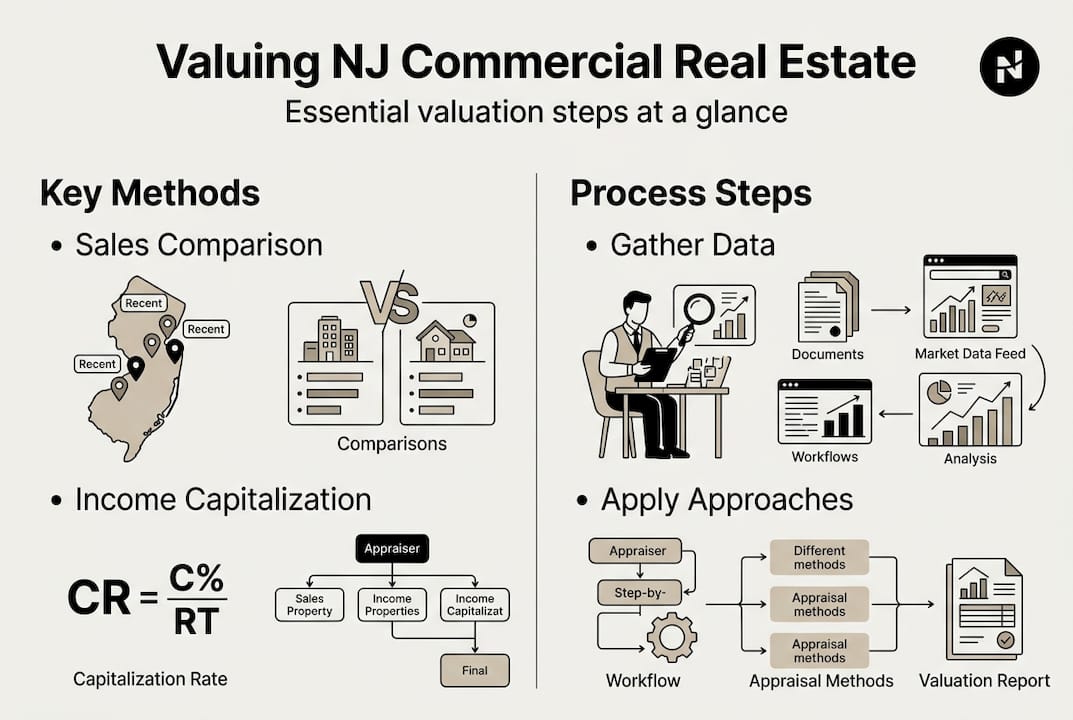
With your data in hand, it is time to follow the step-by-step valuation process and select the right approach for your situation. There are three primary methods used in New Jersey commercial appraisals, and knowing when to apply each one is essential.

Step 1: Sales comparison approach This method identifies recent sales of comparable properties and adjusts for differences in size, location, condition, and lease terms. It works best when there are enough recent, verifiable sales in the same submarket. For retail strips or small office buildings, this is often the starting point.
Step 2: Income capitalization approach This is the most widely used method for income-producing commercial properties. You calculate the property's NOI (gross income minus operating expenses) and divide it by the market capitalization rate (cap rate) to arrive at value.
Direct capitalization works well for stabilized assets with predictable income. Discounted cash flow (DCF) analysis is better suited for properties with volatile or changing income streams, because it models each year's cash flow individually and discounts them back to present value. Multiple methods should be reconciled for edge cases, with DCF preferred for volatile income and direct cap for stable situations.
Step 3: Cost approach This method estimates the value of the land plus the depreciated replacement cost of the improvements. It is most useful for newer buildings, special-use properties, or situations where market data is scarce.
Current NJ market benchmarks matter here. Cap rates stabilized in 2025, with Northern NJ Class A industrial properties ranging from approximately 5.25% to 6.75% and office assets running higher at around 8%. These figures directly affect income-based valuations.
- Determine which approach or combination of approaches fits your property type.
- Collect and verify all income, expense, and comparable data.
- Apply the selected method with current NJ market benchmarks.
- Reconcile results if using more than one approach.
- Document your reasoning and data sources clearly.
Pro Tip: For high-stakes cases like divorce or estate litigation, always reconcile at least two approaches. A single method leaves your value exposed to challenge. Reviewing common valuation methods and understanding capitalization rates in NJ will help you evaluate whether your appraiser's conclusions are well-supported.
Verification and dealing with disputes: Ensuring accuracy and defensibility
Completing the numbers is not the final step. Vetting and validation are essential to withstand legal or tax challenges. An appraisal that looks solid on paper can still fall apart under cross-examination if the data is outdated or the assumptions are unrealistic.
For divorce and estate cases, neutral experts help prevent disputes by providing an objective, well-supported value that neither party can easily dismiss. Tax implications and unique property challenges also need to be addressed directly in the report.
Here is a review checklist to apply before relying on any commercial appraisal:
- Comparable sales are recent and relevant: Sales should ideally be within the past 12 to 24 months and in the same submarket.
- Income data is verified: Rent rolls and operating statements should match lease terms and actual receipts.
- Cap rate selection is justified: The appraiser should explain why the chosen cap rate reflects current market conditions.
- Adjustments are logical and supported: Each adjustment to a comparable sale should have a clear, data-backed rationale.
- The effective date is correct: For estate or retrospective appraisals, the value date must match the required legal date exactly.
- USPAP compliance is confirmed: The report must follow Uniform Standards of Professional Appraisal Practice.
Red flags to watch for include comparable sales from outside the relevant market area, income projections that exceed actual lease terms, and cost approach estimates that ignore functional obsolescence.
"A defensible appraisal is not just about the final number. It is about the quality and transparency of the evidence behind it."
When disputes arise, a third-party review appraiser can evaluate the original report independently. This is common in contested divorce proceedings and tax appeals. For guidance on handling unique commercial properties, understanding the review process is just as important as the initial valuation. If you need a court-ready appraisal that can withstand legal review, the documentation standard is higher than a standard lending appraisal.
What most miss about appraising commercial real estate in New Jersey
After working through the technical process, it is worth reflecting on what separates a robust, defensible appraisal from one that falls short in high-stakes situations. In our experience, the biggest gap is not methodology. It is local knowledge.
National averages and generic cap rate databases do not capture the nuances of New Jersey's municipal tax structures, its highly variable zoning environments, or the specific dynamics of individual submarkets. An appraiser who relies on regional benchmarks without verifying local conditions can produce a value that looks reasonable but misses critical factors.
We have seen tax appeals hinge on a single comparable sale that was misclassified. We have seen divorce cases delayed because an appraiser used a cap rate that opposing counsel could credibly challenge with local data. These are not rare exceptions. They are predictable outcomes when the appraiser does not have deep, current knowledge of the specific New Jersey market.
The critical appraisal insights that matter most in legal settings are often the ones that require the most local context. Do not underestimate how much the right local expertise changes the outcome.
Connect with New Jersey's trusted commercial real estate appraisers
If you want your valuation to stand up in court or during appeal, local expertise makes the difference. At NJREAG, we have spent over 26 years delivering USPAP-compliant commercial appraisals across New Jersey for divorce, estate, and tax appeal cases.

Our appraisers work directly with attorneys, executors, and financial professionals to produce reports that are accurate, well-supported, and ready for legal review. We cover the full state, including Atlantic County appraisal services and Union County NJ appraisals. If you are facing a tax challenge, our NJ tax appeal appraisals are built specifically to meet the evidentiary standards required by the New Jersey Tax Court. Contact us today to request a confidential consultation.
Frequently asked questions
What documents are essential for a New Jersey commercial real estate appraisal?
Key documents include current leases, income and expense statements, property tax bills, and recent comparable sales. For divorce and estate matters, accurate appraisals require a complete picture of all income streams and market data to support equitable distribution.
How do cap rates affect value in the current NJ commercial market?
Higher cap rates mean lower property values and reflect greater perceived risk. Cap rates stabilized in 2025, ranging from approximately 5.25% to 6.75% for Northern NJ Class A industrial and around 8% for office assets.
When should you use the cost approach versus the income approach in NJ?
Use the cost approach for unique or newly constructed buildings where market data is limited. For properties with stable rental income, the income approach is more reliable. Multiple methods should be reconciled when data is mixed or the property type is unusual.
Why are court-ready appraisals important for tax appeals, divorce, or estates in NJ?
Court-ready appraisals are built to withstand cross-examination and legal scrutiny. Neutral experts prevent disputes by providing an objective, well-documented value that holds up when tax implications and unique property challenges are in play.
Recommended
- Commercial property evaluation types for NJ investors 2026
- Land valuation process in NJ: step-by-step guide
- Real estate valuation tips for New Jersey homeowners
- Commercial appraisal guide for New Jersey property owners
- Commercial Real Estate Auctions Speed Up Sales | Blog | Insights on Asset Liquidation and Auction Trends