
TL;DR:
- Accurate, certified trust appraisals are crucial for fair divorce and estate outcomes in New Jersey.
- Appraisals must follow USPAP standards, include detailed reports, and be performed by certified appraisers.
- Families should avoid low-cost summaries and out-of-state appraisers to prevent legal or tax complications.
When real estate held in a trust becomes part of a New Jersey divorce or estate matter, families quickly realize how much depends on getting the property value exactly right. Courts, the IRS, and opposing attorneys will all scrutinize the appraisal method, the appraiser's credentials, and the report format. A mistake at any of these points can invite tax penalties, legal delays, or deeply unfair outcomes for the people involved. This guide walks you through what trust appraisals in New Jersey require, how they affect divorce and estate results, and what steps you can take to protect your financial interests from the start.
Table of Contents
- What is a trust appraisal in New Jersey?
- How trust appraisals affect divorce and estate outcomes
- What makes a trust appraisal court- and IRS-compliant?
- Special situations and common pitfalls in NJ trust appraisals
- What most families overlook in NJ trust appraisals
- Get certified trust appraisal support anywhere in New Jersey
- Frequently asked questions
Key Takeaways
| Point | Details |
|---|---|
| Certified appraisals required | Only NJ-certified, USPAP-compliant appraisals are valid in court or IRS cases. |
| Accuracy affects division | The right appraisal can mean fairer asset division in both divorce and estate matters. |
| Nuances matter | Special rules about commingling, partial interests, and property type can dramatically impact outcomes. |
| Avoid common pitfalls | Mistakes like using uncertified reports or unclear valuation dates often lead to disputes and higher costs. |
What is a trust appraisal in New Jersey?
A trust appraisal is a certified, written determination of a property's fair market value when that property is held inside a legal trust. In New Jersey, these appraisals are most often needed when life changes force a formal accounting of what the trust actually owns. NJ trust appraisals for divorce and estates refer specifically to certified real estate appraisals of trust-held properties, valued either for equitable distribution during divorce or as of the date of death for estate purposes.
Think about what triggers these appraisals in practice. Divorce proceedings require courts to assign dollar values to every significant marital asset, and real property inside a trust is no exception. Estate administration requires an accurate property value to satisfy IRS filing requirements, calculate estate taxes, and divide assets fairly among beneficiaries. Beyond these two common situations, trust appraisals also arise in charitable trust sales, refinancing held within a trust, and annual tax reporting obligations.
Situations that commonly require a trust appraisal include:
- Divorce and equitable distribution proceedings
- Estate administration and probate filings
- Date-of-death valuations for IRS estate tax returns
- Charitable trust property sales
- Trust administration or dissolution
- Property tax appeal filings involving trust-held real estate
The appraisal impact on NJ divorce and estate outcomes is significant because an uncertified or incomplete appraisal can be rejected outright by a judge or flagged during an IRS audit. Courts require appraisers to follow USPAP, the Uniform Standards of Professional Appraisal Practice, which sets national minimum standards for methodology and reporting. For estate date of death appraisals, the IRS expects a detailed written report, not a brief summary.
Pro Tip: Always request a detailed appraisal report, not a summary report. Detailed reports include full market analysis, comparable sales data, and complete methodology explanations that hold up under court and IRS review.
How trust appraisals affect divorce and estate outcomes
The accuracy and timing of a trust appraisal can directly change what each party receives in a settlement. In divorce cases, New Jersey follows equitable distribution rules. Marital assets divided fairly are not always split 50/50, and separate property such as pre-marital assets or inherited property is excluded unless it was commingled with marital funds. The date the divorce complaint was filed often anchors the valuation.
"The complaint filing date is often the anchor for valuation in NJ divorces."
This matters enormously for trust property. If a spouse contributed marital funds to maintain or improve a trust-held property, a portion of that property's appreciation could be reclassified as marital. Courts look closely at these details, and so does the IRS when reviewing estate filings. Collaborative divorce valuation guidance from New Jersey CPAs confirms that unique properties, properties with few comparable sales, and those with partial interest ownership lead to the most contested disputes.
For estate matters, the date-of-death value becomes the foundation for everything that follows. It sets the tax basis for beneficiaries, determines estate tax obligations, and controls how assets are divided. A value that is too high increases the tax burden. A value that is too low can trigger an IRS challenge later.
| Factor | Divorce appraisal | Estate appraisal |
|---|---|---|
| Valuation date | Complaint filing date | Date of death |
| Primary purpose | Equitable distribution | IRS filing, probate |
| Key risk | Commingling classification | Tax underreporting |
| Disputed issues | Partial interests, unique property | Historical market reconstruction |
| Report recipient | Court, attorneys | IRS, probate court, beneficiaries |
Common disputes in both types of cases include:
- Delayed appraisals that force retroactive valuation
- Challenges to comparable sales used by the appraiser
- Disputes over fractional or partial interest discounts
- Disagreements on unique or custom properties with few comparables
- Commingling of separate and marital funds that converts trust property status
For fair property division appraisals and estate distributions, the credibility of the report depends on how well it addresses these potential challenges before they become formal disputes. Accurate valuations in divorce are not simply a formality. They are the financial foundation that protects both parties from future disputes. And when high-net-worth divorce property division is involved, courts apply additional scrutiny to every number in the record.
What makes a trust appraisal court- and IRS-compliant?
Not every appraisal meets the standard required by New Jersey courts or federal tax authorities. Court- and IRS-compliant appraisals must be performed by certified appraisers with local New Jersey expertise, following USPAP standards and delivering a full written report that can withstand independent review.
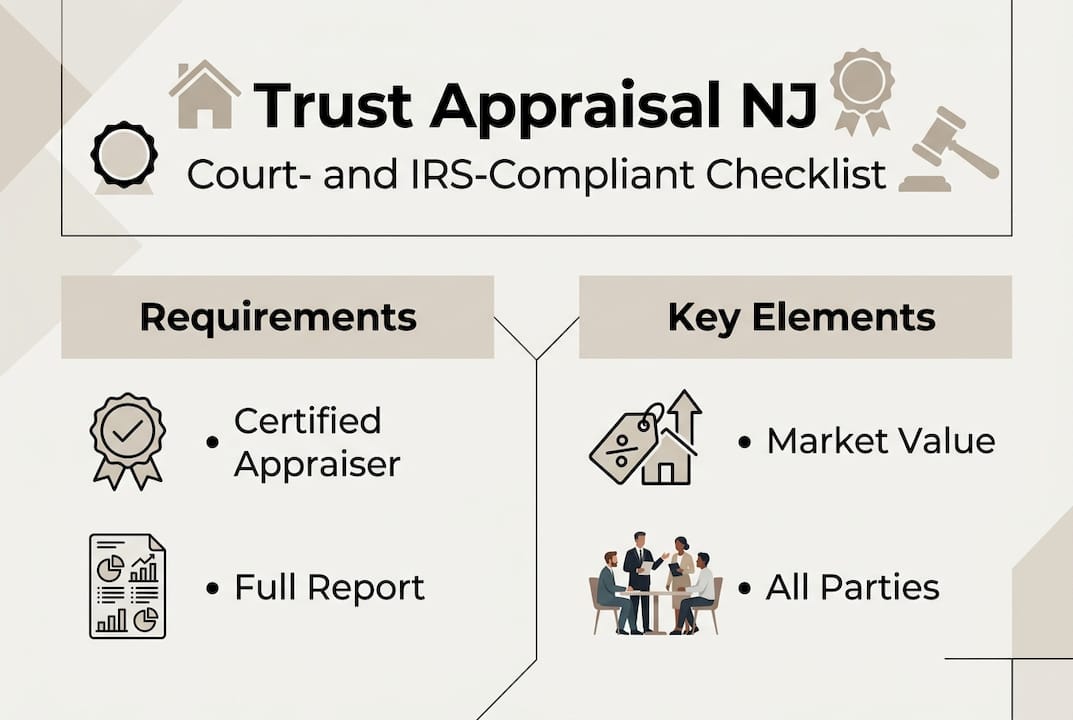
Here are the core features of a compliant trust appraisal report:
| Report component | Why it matters |
|---|---|
| Appraiser's state certification | Required by NJ courts and IRS; validates credentials |
| USPAP compliance statement | Confirms methodology meets national standards |
| Detailed comparable sales analysis | Supports the concluded value with market evidence |
| Clearly stated effective date | Establishes the valuation anchor for legal use |
| Purpose and intended use disclosure | Prevents claims of bias or improper scope |
| Property inspection documentation | Validates condition and characteristics |
You can see more about what certified appraiser requirements look like in New Jersey and why state certification differs from a basic real estate license. Certification means the appraiser has completed specific coursework, passed state exams, and maintains continuing education. That matters when a report enters a courtroom.
Steps to request a compliant trust appraisal in New Jersey:
- Find a state-certified appraiser with experience in your county and property type.
- Clearly state the purpose of the appraisal (divorce, estate, tax) before the engagement begins.
- Specify the effective date required, especially for retroactive or date-of-death valuations.
- Request a detailed written report, not a summary or letter of opinion.
- Verify that the appraiser's report will include a USPAP compliance statement.
Pro Tip: Disclose all legal parties involved in the matter upfront. When all parties are identified from the beginning, it protects the appraiser's independence and prevents later claims of bias that could disqualify the report. NJ certified appraisers who specialize in litigation-related assignments understand how to structure disclosures properly.
Special situations and common pitfalls in NJ trust appraisals
Even when families follow the basic steps correctly, complex circumstances can create serious credibility problems. Complex NJ divorce appraisals involving historic estates, rural properties, or custom-built homes present a real challenge because there may be very few comparable sales in the area. When comparables are scarce, the appraiser must rely more heavily on judgment, and that judgment is what opposing counsel will attack.
In contested divorce or estate matters, each party often retains their own appraiser. This can produce two very different concluded values for the same property. Courts typically try to reconcile the two reports, but if one appraiser used a summary format or lacked the right credentials, that report loses ground fast. Divorce appraisal nuances matter precisely because these details determine which report a judge finds credible.
Retrospective or date-of-death appraisals add another layer of complexity. The appraiser must reconstruct what the market looked like at a past date, using only data that was available at that time. This requires access to historical sales records, market trend data, and careful documentation. High-Net-Worth Asset Protection in NJ Divorces guidance notes that forensic accountants are sometimes brought in when trust assets include business interests or complex investment portfolios alongside real property.
For unusual property types such as land with development potential, the land appraisal in divorce process requires specific expertise that general residential appraisers may not have.
Top 5 mistakes families make with trust appraisals in New Jersey:
- Hiring an uncertified or out-of-state appraiser who lacks NJ credentials.
- Failing to specify the effective date, leaving the valuation anchor open to challenge.
- Accepting a summary report when a detailed report is what courts and the IRS require.
- Not disclosing all legal parties, which opens the door to conflict-of-interest claims.
- Ignoring partial interest issues, where a fractional ownership stake reduces the property's market value.
Additional valuations in divorce context also show that income, asset, and market approaches sometimes produce different conclusions, and the appraiser must reconcile and justify the final number clearly.
Pro Tip: Watch for hidden value shifts. When marital funds are used to pay a mortgage, maintain, or improve a trust property, even unintentionally, courts may reclassify a portion of that property's appreciation as a marital asset subject to division.
What most families overlook in NJ trust appraisals
After reviewing the technical requirements, here is what most guides will not tell you directly. Courts and the IRS do not just review the number at the bottom of the appraisal page. They review the methodology, the comparable selection, the appraiser's credentials, and the format of the entire report, sometimes years after the original transaction.
Families who cut costs by choosing cheaper, summary, or out-of-state appraisals often pay far more in legal fees, tax penalties, or renegotiated settlements later. We have seen reports rejected because the appraiser held only a state license rather than certification, or because a summary format omitted the market analysis a judge needed to assess credibility.
A local, detailed, certified appraisal is not just a procedural box to check. It is a financial safeguard. It protects you from challenges that can surface long after the paperwork is signed. The real estate appraisal importance in NJ divorce and estate planning is something families tend to underestimate until a dispute makes the cost of that mistake very clear.
Pro Tip: Keep a certified copy of every trust appraisal report you commission. Store it with your legal and estate documents so it is accessible if questions arise years down the road.
Get certified trust appraisal support anywhere in New Jersey
When the stakes are this high, you need appraisal support from a firm that understands both the legal requirements and the local market conditions across New Jersey.

New Jersey Real Estate Appraisal Group delivers divorce-focused appraisals and estate valuations across all 16 New Jersey counties, with over 26 years of experience serving families, attorneys, and executors in complex situations. Every report is USPAP-compliant, prepared by state-certified appraisers, and built to hold up in court or before the IRS. Whether you need a current market value for equitable distribution or a retroactive date-of-death valuation for an estate filing, certified NJ appraisers at NJREAG are ready to help. Coverage includes Atlantic County appraisal services and every other county statewide. Get a Fast Quote today and protect your financial interests with a report you can rely on.
Frequently asked questions
Who can perform a trust appraisal in New Jersey?
Only a state-certified real estate appraiser with local NJ expertise should perform trust appraisals for divorce or estate purposes. USPAP-compliant appraisals require certified credentials, not just a real estate license.
What is the typical cost range for a trust appraisal in NJ?
Fees generally range from several hundred to several thousand dollars depending on property complexity and report type. There are no fixed benchmarks for trust appraisal pricing across New Jersey.
How is trust property divided in a NJ divorce?
Trust assets are included in equitable distribution only if they were commingled with marital funds. Marital assets divided fairly in New Jersey does not automatically mean a 50/50 split.
Are trust appraisals needed if the property is not being sold?
Yes. Courts and the IRS require a certified appraisal for equitable distribution or estate tax purposes even when the property is not sold. NJ trust appraisals serve legal and tax functions regardless of whether a sale occurs.
What is a retroactive or date-of-death appraisal?
A retroactive appraisal establishes a property's value as of a specific past date for estate tax or probate purposes. This requires historical market reconstruction using only data available at that point in time.
Recommended
- Divorce Settlement Appraisals NJ | Fair Property Division – NJREAG
- NJ property valuation guide for divorce & estates: 5 steps
- Why real estate appraisal matters for NJ divorce or estate
- Court-Ready Divorce Appraisals in New Jersey | NJREAG
- The Importance of Authenticity: Certificates and Appraisals – Malibu Vibes Jewelry