

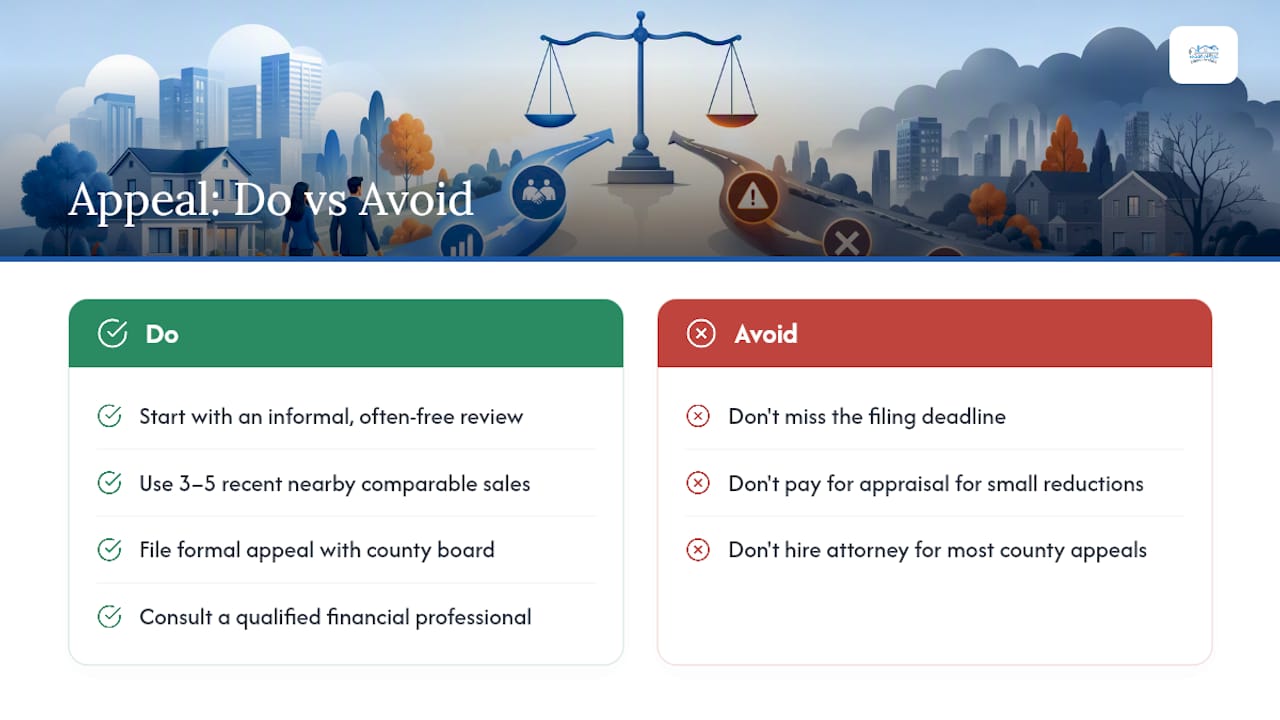
Start with an informal review with your county assessor. Most factual errors get fixed here within a short period. If that fails, file a formal appeal with your county board of review before the deadline, typically 30 to 90 days from your notice. Only bring in a state-certified appraiser or attorney once potential savings clearly outweigh the cost.
Here's what to do in the first 72 hours after your assessment notice arrives:
- Pull your property record card and check it for factual errors (square footage, bedroom count, condition rating).
- Mark your formal appeal deadline on your calendar immediately, even if you plan to try the informal route first.
- Call or email your county assessor's office to request an informal review.
- Start collecting three to five comparable sales from the past 12 months near your property.
- Note whether your case might need a USPAP-compliant appraisal or an attorney, based on the dollar amount at stake.
Key Takeaways
A successful tax assessment negotiation workflow starts with an informal assessor review, escalates to a formal appeal only when needed, and brings in professional help once savings justify the cost.
| Point | Details |
|---|---|
| Start informal | Request an assessor review first; most factual-error fixes happen here within a few weeks. |
| Track your deadline | Formal appeal windows typically run 30 to 90 days from your notice date. |
| Build a comps grid | Use 3 to 5 recent, nearby comparable sales adjusted for size and condition differences. |
| Know the burden of proof | You must show the assessed value is excessive or unequal, backed by documented evidence. |
| Get certified support | Newjerseyrealestateappraisal provides state-certified, USPAP-compliant appraisals for NJ tax appeals when the stakes justify the cost. |
Table of Contents
- The Tax Assessment Negotiation Workflow, Step By Step
- What Evidence Do You Need to Win an Appeal?
- How Do You Build a Defensible Comparable-Sales Analysis?
- What Should You Say at an Assessment Hearing?
- How Long Does Each Stage of the Appeal Take?
- When Should You Hire a State-Certified Appraiser or Attorney?
- Common Mistakes That Weaken a Tax Appeal
- What Do Boards of Review Actually Weigh?
- What Will an Appeal Actually Cost You?
- Get a State-Certified Appraisal Built for Your Tax Appeal
- Frequently Asked Questions
- Sources
The Tax Assessment Negotiation Workflow, Step By Step
Every successful appeal follows the same basic sequence. Skipping steps or jumping straight to a formal complaint rarely helps, and it often costs you the cheaper, faster fix.
1. Triage the notice. Read your assessment notice the day it arrives. Confirm the assessed value, the filing deadline, and which office handles appeals in your county.
2. Request an informal review. Contact the assessor's office and ask what's needed to reopen the file. This step often resolves clerical mistakes, like an incorrect bedroom count, without any formal filing at all.
3. Decide: accept or escalate. If the assessor corrects an obvious error and the new number looks fair, accept it. If they push back or the adjustment feels short, move to a formal appeal.
4. Compile your evidence. Gather your property record card, comparable sales, photos, and, if the stakes justify it, a certified appraisal.
5. File the formal appeal. Submit your written complaint to the county board of review, following the exact form and copy requirements listed on your county's filing instructions.
6. Attend the hearing and negotiate. Present your evidence, answer questions, and stay open to a settlement offer before or during the hearing.
7. Accept, settle, or escalate further. If the board's decision still seems wrong and the numbers justify it, look at state-level appeal or court options.
Pro Tip: Before your informal meeting, bring your property record card with errors circled, three recent comps printed on one page, and a one-sentence ask ("I'm requesting the assessed value be reduced from $X to $Y based on these three comparable sales"). Assessors respond better to a specific number than a general complaint.
Most homeowners never get past step 3, and that's fine. The informal conference is where most successful early fixes happen because they're correcting factual data, not arguing about market judgment.
What Evidence Do You Need to Win an Appeal?
Boards don't reward passion. They reward paperwork. Here's what to gather before you file anything formal:
- Property record card from the assessor's office, with any factual errors highlighted.
- Three to five comparable sales within a mile of your property, sold in the last 12 months.
- A USPAP-compliant appraisal, when the appeal involves a meaningful dollar amount.
- Deeds and transfer documents, especially if you bought the property recently below the assessed value.
- Building permits or their absence, since unpermitted work can cut both ways.
- Photos showing condition issues the assessor's file doesn't reflect.
- Repair estimates for anything that reduces market value (roof, foundation, mechanical systems).
- Closing statements from a recent purchase or refinance.
Check your county's website for the exact protest or appeal form name. You'll typically see something called a "complaint," "protest," or "petition" form, and most boards want the assessed value challenged, not the tax rate. Bring three copies unless your county specifies otherwise: one for the board, one for the assessor's office, one for yourself.
Pro Tip: Build a tabbed binder with an index page that matches each document to the specific claim it supports. A board member who can find your comps in five seconds is far more likely to actually read them.
How Do You Build a Defensible Comparable-Sales Analysis?
A strong comps packet isn't a random pile of listings. It's a structured argument.
Start by defining a search radius, usually a half mile to a mile, and a timeframe, usually 12 months. Screen out anything that doesn't roughly match your property's size, bed and bath count, and condition. Then calculate price per square foot for each sale and adjust for real differences, like a finished basement or an updated kitchen.

Build a simple grid for yourself with these columns: address, sale date, sale price, square footage, price per square foot, and a one-line note on why it's comparable. This is the same logic assessors use, and presenting it in their own language makes your case easier to accept.
If the dollar amount at stake is small, a clean comps packet from public records is often enough. If it's significant, a defensible, USPAP-compliant appraisal carries more weight because it's a structured, third-party opinion rather than a homeowner's selection of favorable sales.
What Should You Say at an Assessment Hearing?
Words matter here. Boards see hundreds of appeals a year, and the ones that stick to facts move faster and land better outcomes.
Informal call script: "I reviewed my property record card and found the square footage is listed as 2,400 when my deed and appraisal show 2,100. I'd like to request a review based on this discrepancy."
Pre-hearing settlement exchange: "Based on these three comparable sales, we believe a fair assessed value is $X. We're open to a settlement at that number before the hearing, which would save both sides time."
In-hearing opening remarks: "I'm appealing the assessed value of $X to $Y, based on the attached comparable sales and appraisal. I'll walk through each exhibit briefly."
At the hearing itself, expect this order: check-in and exhibit submission, presentation of your key comps, questions from the board, then either an immediate decision or a deliberation period.
- Check in early and confirm your exhibits are logged.
- Submit your evidence packet before you start speaking.
- Present your strongest two or three comps first, not all of them.
- Answer questions directly; don't volunteer extra arguments.
- Ask whether the board will rule immediately or take the matter under advisement.
Pro Tip: If you're offered a settlement, ask whether accepting it waives your right to a further appeal that year. Some settlements are conditional and preserve your appeal rights; others close the door completely. Read that clause before you sign anything.
How Long Does Each Stage of the Appeal Take?
Deadlines vary by state, and missing one usually means your appeal is dismissed outright, no matter how strong your evidence is. Track these dates the moment your notice arrives.
| Stage | Typical Window |
|---|---|
| Informal review response | 2 weeks |
| Formal appeal filing deadline | 30 to 90 days from notice date |
| Board protest filing (some states) | Fixed dates like May 15 or a 30-day window |
| County board decision | Often 4 weeks after hearing |
| State-level appeal deadline | Varies; often 30 days after county decision |
Some counties run tighter, stranger windows than you'd expect. One state requires protests filed between June 1 and June 30, with board decisions due by early August. Missing that window by a single day can forfeit your appeal for the entire year.
Pro Tip: Send anything you mail via certified mail with return receipt, and set two calendar reminders, one a week before each deadline and one the day of. A missed deadline is the single most preventable way to lose an appeal.
When Should You Hire a State-Certified Appraiser or Attorney?
Not every appeal needs outside help. But some clearly do, and knowing the difference protects your time and your wallet.
Hire a state-certified appraiser when your potential annual tax savings, or the stakes in an estate or divorce-related valuation, exceed the appraisal fee by a healthy margin. A well-prepared USPAP-compliant report often carries more weight than owner-assembled comps because it comes from a licensed, disinterested third party.
Hire an attorney when the appeal moves beyond the county board, when the property is high-value, or when the procedure gets complicated (multiple owners, estate disputes, or an appeal heading to state court or a formal administrative hearing). If your appeal involves an estate or probate matter affected by property condition or occupancy, consider professional assistance like Bereavement Cleanout Services — Compassionate Estate & Home Cleanouts in New Jersey to help manage physical estate preparation that may influence valuation.
Before hiring an appraiser, ask three questions:
- Are you USPAP-compliant, and can you show me a sample report?
- Have you testified at a board hearing before, and are you available for mine?
- What's your experience with properties like mine in this specific county?
Pro Tip: If you submit an appraisal as evidence but the appraiser can't attend the hearing, some boards will exclude it entirely. Confirm testimony availability before you commission the report, not after.
Common Mistakes That Weaken a Tax Appeal
Most losing appeals fail for the same handful of reasons, and nearly all of them are avoidable.
- Arguing the tax rate instead of the assessed value. Boards can't change local levies; they can only adjust your property's value.
- Missing the filing deadline. No amount of good evidence fixes a late submission.
- Relying on outdated or distant comps. Sales from 18 months ago or three miles away carry little weight.
- Showing up without documents. Bring copies. Assume nothing will be provided for you.
- Making emotional arguments. "I can't afford this" doesn't move a board; "the assessed value is $50,000 above comparable sales" does.
If an assessor's site visit turns up unpermitted work, address it honestly. Trying to hide it usually backfires and can trigger a reassessment in the wrong direction.
What Do Boards of Review Actually Weigh?
Boards operate on a simple standard: you need to show the assessor's value is excessive or unequal compared to similar properties, and you carry that burden of proof.
Evidence gets weighed roughly in this order of persuasiveness:
- Sworn, USPAP-compliant appraisals with an appraiser available to testify.
- Comparable sales with clear documentation (deeds, MLS listings, closing statements).
- Documented factual errors on the property record card.
- Photos showing condition problems not reflected in the assessor's file.
- General statements without supporting documents, which typically carry the least weight.
Boards can adjust your assessed value, but they generally can't touch tax rates or local levies.
Pro Tip: Favor sworn, dated, and documented evidence over verbal claims. A board member weighing two competing stories will almost always side with the one backed by paper.
What Will an Appeal Actually Cost You?
Costs scale with how far you take the appeal, and so do the odds of a meaningful reduction.
- Informal review: Usually free, aside from your own time.
- Formal county appeal: Often free or a small filing fee, sometimes under $50.
- USPAP-compliant appraisal: Typically several hundred dollars, depending on property type and complexity.
- State-level appeal or court filing: May require a deposit, plus attorney fees if you hire one.
- Consultants working on contingency: Some take a percentage of your first-year savings instead of a flat fee.
Informal reviews often fix clear errors within weeks. Formal county board reductions can take a few months. State-level reversals take the longest and cost the most, but they matter for high-value properties.
Pro Tip: Multiply your likely annual savings by the number of years before your next reassessment cycle, then compare that total to the appraisal or attorney cost. If the savings clear the cost by a wide margin, professional help usually pays for itself.
What We See Win Tax Appeals
Over 26-plus years appraising property across all 21 New Jersey counties, we've watched the same pattern repeat: appeals backed by a defensible, USPAP-compliant report hold up far better under questioning than a stack of printed listings. Boards trust numbers they can trace back to a licensed, disinterested source.
We've seen assessed values move meaningfully once a board could see a structured comps grid and adjustments instead of a homeowner's gut feeling. If you're weighing whether your case needs that level of support, the next section walks through how we can help.
Get a State-Certified Appraisal Built for Your Tax Appeal
A homeowner-built comps packet can work for a small, clear-cut correction. But once real money is on the line, a state-certified, USPAP-compliant appraisal gives your appeal a level of credibility a printed spreadsheet can't match, and it's the single biggest lever Newjerseyrealestateappraisal puts in your hands.

We've prepared tax-appeal appraisals across all 21 New Jersey counties for over 26 years, and our reports are built to hold up under questioning, not just look good on paper. Every report follows USPAP standards, and we prepare our appraisers to testify at hearings when a case calls for it. Whether you're in Atlantic County or Union County, we know how local boards weigh evidence and what they expect to see in a submission.
If your property's assessed value looks out of line with the market, request a certified tax-appeal appraisal and let us build the evidence package your hearing actually needs. Call us at (908) 517-3913 to talk through your specific county and timeline before your filing deadline passes.
Frequently Asked Questions
Do I need a lawyer to negotiate a property tax assessment? Not for most informal or county-level appeals. You typically only need an attorney when the case moves beyond the county board, involves high property value, or requires procedural expertise for state-level appeals.
What's the difference between an informal review and a formal appeal? An informal review is a direct conversation with your assessor, often free and fast. A formal appeal is a written complaint filed with the county board of review, following specific forms and deadlines.
How many comparable sales do I need for a tax appeal? Three to five recent, nearby sales are usually enough to build a credible case, as long as they closely match your property's size, condition, and age.
Is it worth paying for a state-certified appraisal for a small tax reduction? Usually not. Appraisal costs make more sense when the potential annual savings, over multiple years until reassessment, clearly exceed the appraisal fee.
What happens if I miss my appeal filing deadline? Your appeal is typically dismissed for that tax year regardless of the strength of your evidence, since most jurisdictions enforce strict filing windows.
This article is general information, not a substitute for advice from a qualified financial advisor. Consult a qualified financial professional about your own circumstances before acting on anything here.
Sources
- Appeals and reviews — Montana Department of Revenue
- Assessment appeals - Illinois Department of Revenue
- Property tax appeal process | NCDOR
- Protests and appeals | Texas Comptroller of Public Accounts
- Real property valuation protest info guide — Nebraska Department of Revenue (PDF)