
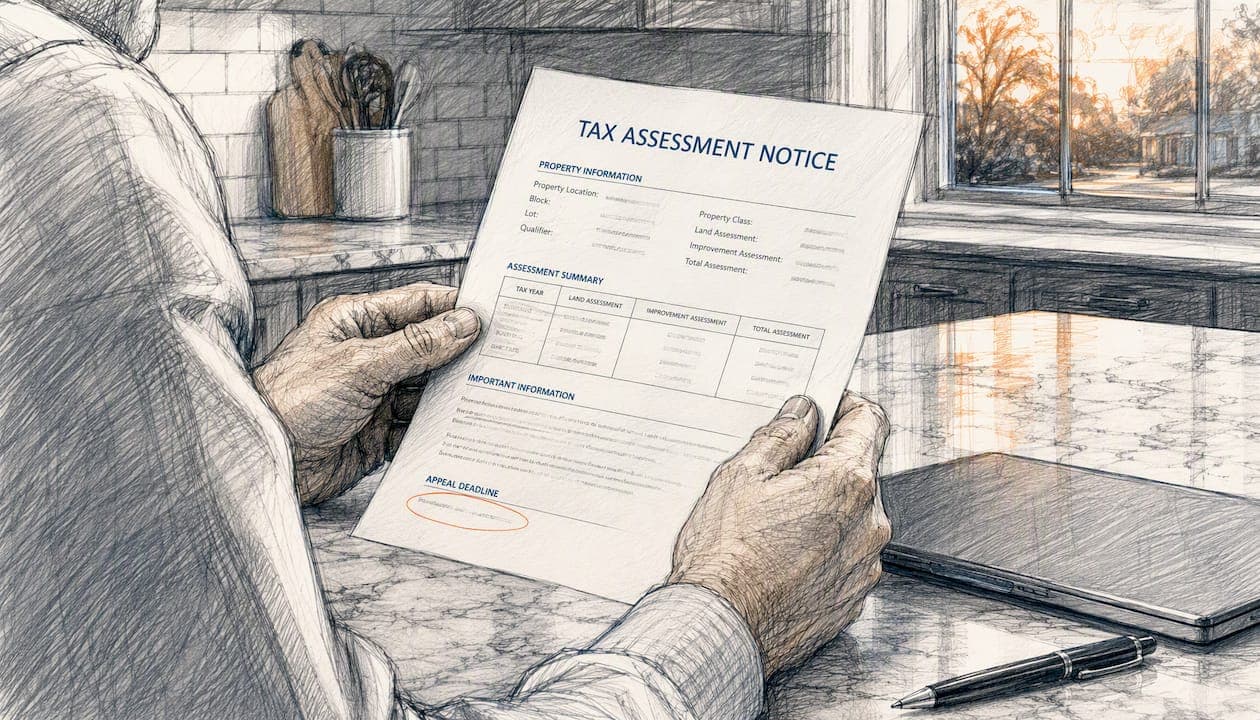
The moment you get a tax assessment notice, do three things before anything else: confirm whether it's a local property assessment or an IRS notice, check the date printed on it, and find the deadline for responding. That single step determines every move that follows, and missing it is the most common reason property owners lose appeal rights they never knew they had.
A step by step tax assessment review isn't complicated, but it is time-sensitive. Property tax notices in New Jersey carry hard county filing deadlines. IRS notices carry federal statutory windows that can be as short as 30 days or as long as three years. Confuse the two, and you can burn through a deadline while thinking you still have time.
Here's your immediate checklist:
- Verify the notice type. Look at the letterhead. A county board of taxation or municipal tax assessor issued a property notice; the IRS issued a federal one.
- Check the notice date. This starts the clock on every deadline that follows.
- Confirm the assessed amount. Compare it against your prior bill or last year's return.
- Look for exemptions or credits. Missing a senior, veteran, or disability exemption is a common, fixable error.
- Note the contact information. Write down the assessor's office number or the IRS phone number listed, plus any case or notice number.
Pro Tip: Photograph or scan the notice the day it arrives. Deadlines are calculated from the notice date, and a lost original has cost more than one property owner their appeal window.
The stakes are real on the federal side. The IRS generally has three years from the date you filed to assess additional tax, and if you receive a notice of deficiency, you typically have 90 days to petition the U.S. Tax Court before that assessment becomes final (150 days if you're outside the country). On the property side, New Jersey county boards enforce an April 1 filing deadline, or May 1 following a municipal revaluation, with no grace period for a late petition.
Key Takeaways
A defensible tax assessment review starts with identifying the notice type correctly, tracking every deadline precisely, and backing any appeal with verified, USPAP-compliant evidence.
| Point | Details |
|---|---|
| Identify the notice first | Confirm whether you have a property assessment or an IRS notice before doing anything else. |
| Deadlines don't bend | New Jersey county appeals close April 1 or May 1; IRS deficiency notices give 90 days to petition Tax Court. |
| Evidence timing matters | Comparable sales and appraisal reports generally must be served at least seven days before a hearing. |
| Documentation wins cases | Property record cards, comps, and income schedules build the foundation for any appeal. |
| Hire a state-certified appraiser for real disputes | Newjerseyrealestateappraisal prepares USPAP-compliant, court-ready reports for property tax appeals across all 21 New Jersey counties. |
Table of Contents
- Is Your Notice a Property Assessment or an IRS Assessment?
- How to Review a Property Tax Assessment Notice
- How to Review an IRS Notice or Proposed Adjustment
- Essential Documents Checklist for Your Tax Assessment Review
- Should You Appeal? Weighing Cost, Time, and Odds
- What Makes an Appraisal Defensible in a Tax Appeal
- How the Appeal Process Actually Unfolds
- Mistakes That Sink an Otherwise Strong Case
- Need a Defensible Appraisal for Your Tax Appeal?
- Tax Assessment Review FAQs
- Sources
Is Your Notice a Property Assessment or an IRS Assessment?
The two systems look nothing alike once you know what to check, but they're easy to confuse at a glance, especially if you've never received either before.
A property tax assessment comes from your municipal tax assessor or county board of taxation. It references your block and lot number, an assessed value, and a tax rate or ratio. The letterhead says something like "Township of ___" or "County Board of Taxation." There's no mention of your income, filing status, or federal return.
An IRS notice references a tax year, a form number (1040, Schedule C, and so on), and specific line items from your return. It carries a notice number in the corner, something like CP2000, CP3219A, or a letter designation. The letterhead says "Department of the Treasury, Internal Revenue Service."
Confusing the two carries real consequences. Treat an IRS deficiency notice like a routine property tax bill and let 90 days pass, and you lose your right to petition Tax Court before the assessment sticks. Treat a property assessment like something you can sort out anytime and miss the county's April 1 deadline, and your appeal gets dismissed regardless of how wrong the valuation is.
Pro Tip: When in doubt, call before you act. For property notices, call your municipal assessor's office directly. For anything with IRS letterhead, call the number printed on the notice itself, not a general IRS line, since it routes you to the unit actually handling your case. Either way, keep a written log of who you spoke with and when.
How to Review a Property Tax Assessment Notice
Reviewing a property assessment is a methodical exercise, not a guessing game. Work through it in this order.
- Confirm the property description. Check the block, lot, square footage, and lot size against your deed. Clerical errors, like an extra bathroom or bedroom that doesn't exist, are more common than you'd think and inflate value for no reason.
- Check the assessment date. Most New Jersey municipalities assess value as of October 1 of the pretax year, meaning your 2026 assessment reflects market conditions from October 1, 2025.
- Verify the assessed value and taxable value. Confirm any exemptions (veteran, senior, disabled) were applied before the taxable value was calculated.
- Pull the property record card from the assessor's office. This document lists the data used to calculate your assessment, and it often reveals the exact error you're looking for.
- Run a quick comparable-sales check. Find three to five recent, genuinely similar sales nearby and compare per-square-foot pricing against your assessment.
- Gather supporting evidence. This means comparable sales, any prior appraisal, dated photographs, and, for rental property, income and expense schedules.
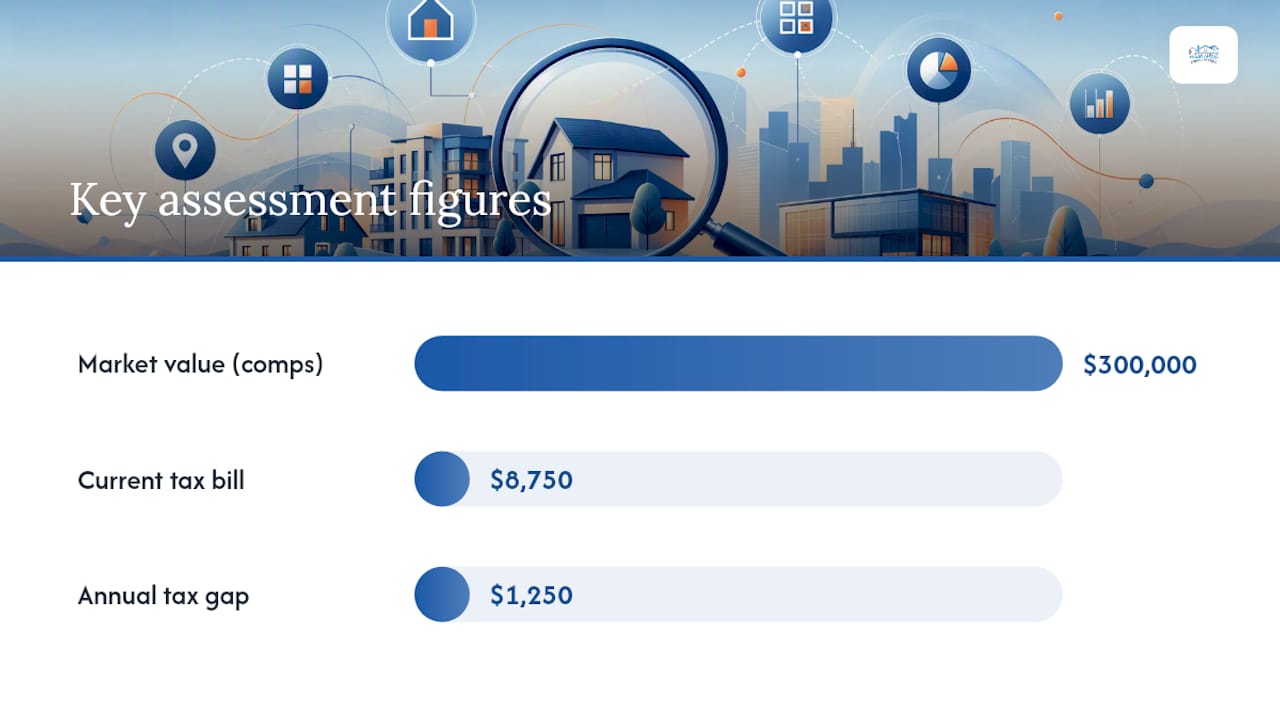
Here's how the math actually works. Your bill comes to $8,750. If comparable sales suggest your true market value is closer to $300,000, that's a $1,250 annual gap between what you're assessed and what you might actually owe if the appeal succeeds. Multiply that over several years, and the incentive to review your notice carefully becomes obvious.
Timing matters as much as the numbers. County boards require appeal petitions on or before April 1, or May 1 if your municipality completed a revaluation that year. Some counties run on different calendars entirely. If you're submitting comparable sales or an appraisal report as evidence, county rules generally require serving that evidence well in advance of your hearing. Show up with evidence the board hasn't seen and it can be excluded on the spot.
Pro Tip: Keep a dated log of every call and letter to the assessor's office, including who you spoke with. If your case ends up in front of a county board, that paper trail shows you acted in good faith and on time.
How to Review an IRS Notice or Proposed Adjustment
IRS review follows a different sequence, built around federal notice types rather than local calendars.
- Identify the exact notice type. A CP2000 flags a mismatch between your return and third-party reporting (W-2s, 1099s). A notice of deficiency, sometimes called a 90-day letter, proposes a specific tax increase and starts your Tax Court clock.
- Confirm the tax year and filing date. This tells you where you stand relative to the assessment statute.
- Match each proposed adjustment to your own records. Line up every flagged item against your original return, supporting schedules, and receipts.
- Pull your documentation. W-2s, 1099s, bank statements, receipts, and mileage logs, organized by the specific line item in question.
- Decide your response path. Straightforward math or reporting errors can often be resolved through informal correspondence. Larger disputes may call for a formal protest or an Appeals Office conference.
- Preserve your appeal rights. Respond in writing, keep copies of everything, and don't sign a waiver of your appeal rights without understanding exactly what you're giving up.
Federal timelines run on strict clocks, and missing one closes a door that doesn't reopen.
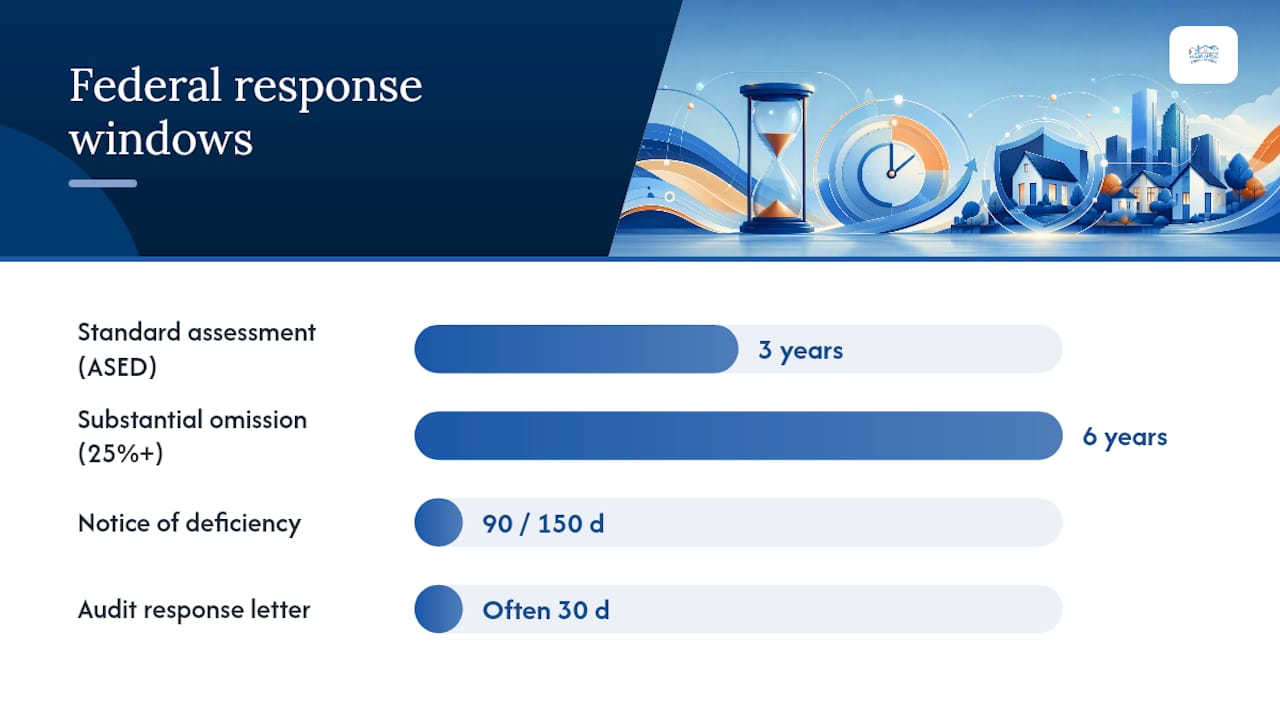
| Notice or Situation | Typical Response Window | What Happens if You Miss It |
|---|---|---|
| Standard assessment statute (ASED) | 3 years from filing or due date | IRS can generally no longer assess additional tax for that year |
| Substantial income omission (25%+) | 6 years | Extended assessment window applies |
| Fraudulent or unfiled return | No limit | IRS can assess at any time |
| Audit response letter | Often 30 days | Case may proceed without your input |
| Notice of deficiency (90-day letter) | 90 days (150 if outside the U.S.) | Lose the right to petition Tax Court before assessment |
| Assessment after Tax Court decision | Generally varies depending on notice type | IRS may "tack" remaining ASED time onto this window |
Federal procedure is a self-assessment system at its core, which means the burden generally sits with you to show your return was correct. When the IRS proposes an adjustment, you're ordinarily entitled to specific appeal rights, including referral to the Appeals Office before the matter ever reaches Tax Court. Informal correspondence, a simple letter responding to a CP2000, differs sharply from a formal protest, which is a structured written argument citing the specific facts and law supporting your position. Save the formal route for disputes where the informal explanation didn't resolve things.
Pro Tip: Never sign a waiver extending the assessment statute without understanding what you're agreeing to. If a revenue agent asks you to extend the ASED, that's a conversation worth having with a CPA or tax attorney first, not something to sign on the spot.
Essential Documents Checklist for Your Tax Assessment Review
Gathering the right paperwork before you start saves you from scrambling later. Here's what each track requires.
| Document | Why It Matters | Where to Get It |
|---|---|---|
| Prior tax bill | Baseline for comparing assessed value changes | Municipal tax collector |
| Property deed | Confirms legal description, lot size, ownership | County clerk's office |
| Assessment notice | Starting point for the review, shows the deadline | Mailed directly to you |
| Property record card | Shows the data the assessor used | Municipal assessor's office |
| Comparable sales data | Establishes market value for a property appeal | County records or a licensed appraiser |
| Recent appraisal report | Independent, defensible valuation evidence | State-certified appraiser |
| W-2s and 1099s | Verifies income reported to the IRS | Employer or payer records |
| Bank and expense records | Supports deductions or disputed income items | Your own financial records |
For a property appeal, three to five genuinely comparable sales is typical, though county rules generally cap submissions at five comparables per hearing. One independent appraisal report usually carries more weight than a stack of loosely comparable listings pulled from a real estate website.
Keep originals in a dedicated folder, physical or digital, and make certified copies of anything you submit to a county board or the IRS. Losing your only copy of a deed or appraisal mid-appeal creates delays you don't need.
Should You Appeal? Weighing Cost, Time, and Odds
Not every flawed assessment is worth a full appeal. Match your response to the size of the error and the strength of your evidence.
| Path | Typical Cost | Timeline | Evidence Burden |
|---|---|---|---|
| Informal assessor inquiry | Free | Days to a few weeks | Low; a phone call or letter often resolves clerical errors |
| County board appeal | Filing fee plus appraisal cost | Several months to a hearing date | Moderate to high; comparables or appraisal required |
| Tax Court petition | Filing fee, attorney and appraisal fees | Can extend a year or more | High; formal evidence and legal argument |
| IRS Appeals Office conference | Possible CPA or attorney fees | Months | Moderate to high; organized documentation and legal position |
County filing fees are typically modest, often under $50 for lower-valued properties, while appraisal fees and attorney or CPA fees vary widely depending on complexity. Ask any professional you're considering for a written fee estimate before you commit.
Estimate your odds honestly before you file. A wide gap between your assessed value and genuine comparable sales strengthens your case. A narrow gap, or comparables that aren't truly similar, weakens it considerably.
Pro Tip: Before committing to a full appraisal, get an informal read from the assessor's office or a broker's opinion of value. It's a low-cost way to gauge whether your case has real substance before you spend money on a formal appraisal report.
What Makes an Appraisal Defensible in a Tax Appeal
A property tax appeal lives or dies on evidence, and the single strongest piece of evidence a county board or Tax Court sees is a defensible, professionally prepared appraisal.
State-certified appraisers approach a tax appeal differently than a quick market estimate. They analyze true comparable sales, reconcile multiple valuation approaches (sales comparison, cost, and sometimes income), and prepare the report under the Uniform Standards of Professional Appraisal Practice, known as USPAP. That distinction shows up the moment a hearing officer or assessor's attorney starts asking questions about methodology.
We've seen cases where a homeowner's own comparable sales, pulled from a real estate listing site, got dismissed outright because the properties weren't genuinely similar in condition or location. A USPAP-compliant appraisal report, backed by verified comparables and a documented reconciliation, carries weight that a printout from a listing site never will.
At Newjerseyrealestateappraisal, we've built our tax appeal appraisal work around exactly this kind of evidence, drawing on more than 26 years of combined experience across all 21 New Jersey counties. Property tax appeals are, at their core, valuation exercises, not tax rate disputes, so the report needs to prove fair market value as of the statutory assessment date, not argue about what your bill should be.
When you engage an appraiser for a tax appeal, request a written engagement letter specifying:
- The scope of work and valuation approaches used
- The effective date of value (matching the statutory assessment date)
- The intended use, stated explicitly as a property tax appeal
- Turnaround time and the format of the final report
| Point | Details |
|---|---|
| USPAP compliance | Confirms the report follows recognized professional appraisal standards |
| State certification | Verifies the appraiser holds an active New Jersey certification |
| Effective date accuracy | Report value must match the statutory assessment date, not the report date |
| County experience | An appraiser familiar with your county's board practices anticipates likely objections |
Pro Tip: Ask any appraiser you're considering how many tax appeal reports they've prepared for your specific county in the past year. Local board familiarity often matters as much as the appraisal credential itself.
How the Appeal Process Actually Unfolds
Filing an appeal sets a specific sequence in motion, and knowing each step ahead of time keeps you from missing something along the way.
For a New Jersey property appeal:
- File the Petition of Appeal, Form A-1, with your county board of taxation by the April 1 (or May 1) deadline.
- Serve a copy on the municipal assessor and clerk as required.
- Submit your comparable sales or appraisal report at least seven calendar days before the scheduled hearing.
- Attend the hearing and present your evidence to the board.
- Receive the board's written decision, called a Judgment.
- If you disagree with the outcome, file a complaint with the New Jersey Tax Court within the statutory window following the Judgment.
For an IRS dispute:
- Respond to the audit report or proposed adjustment in writing.
- Request an Appeals Office conference if the initial response doesn't resolve the matter.
- If you receive a notice of deficiency, petition the U.S. Tax Court within 90 days.
- Understand how a Collection Due Process (CDP) hearing interacts with any collection action already underway.
Property appeals typically run from filing in early spring to a hearing sometime over the summer, with a written Judgment following weeks later. IRS Appeals cases often take several months from the initial request to a resolution, longer if the case proceeds to Tax Court.
Track every filing, phone call, and hearing date in one place, a simple spreadsheet works fine, noting the date, who you spoke with, and what was said or decided. That record becomes invaluable if your case escalates or if a decision gets questioned later.
Mistakes That Sink an Otherwise Strong Case
Even a genuinely undervalued or over-assessed property can lose an appeal over process, not substance.
- Missing the filing deadline. County boards don't grant extensions for a late petition, no matter how strong the underlying case is.
- Serving evidence too late. Comparable sales or appraisal reports submitted after the seven-day window can be excluded from the hearing entirely.
- Using non-comparable sales. A sale down the street with a different lot size, condition, or renovation history won't hold up under scrutiny.
- Relying on your tax bill instead of market data. The tax bill reflects the assessment you're disputing, not independent evidence of value.
- Poor income documentation on rental properties. Missing or inconsistent income and expense records undermine an income-approach valuation.
County-specific deadline traps catch more property owners than any other single mistake. Burlington, Monmouth, and Gloucester Counties operate on alternate calendars, sometimes with a January 15 deadline instead of the standard April 1. Assume the standard date applies statewide, and you can miss your window by nearly three months without realizing it.
Before you file anything, run a final self-check: Is your petition complete and signed? Are your comparables genuinely similar in size, condition, and location? Have you served evidence within the required window? Does your documentation match the specific claims you're making? A few minutes spent on this review catches the errors that would otherwise sink a strong case at the hearing.
Publisher perspective: what we recommend first
Most property owners overthink the first step. You don't need to hire an appraiser the same day a notice arrives. You need to verify the basics, the property description, the assessment date, the deadline, before spending a dollar on anything else.
Where we do push clients toward a formal appraisal early is when the gap between assessed value and likely market value looks substantial, or when the property is unusual enough that comparable sales alone won't tell a convincing story, think a home with a finished basement apartment, a mixed-use property, or something with a genuinely unique layout. In those cases, an informal inquiry rarely moves the needle, and waiting until close to the filing deadline to commission an appraisal puts you in a time crunch you don't need.
Our practical suggestion: call your municipal assessor's office first if the issue looks like a simple factual error. If the gap is real and the numbers matter, call us. On that call, we'll ask about your property type, your county, and your filing deadline, then tell you honestly whether a full appraisal makes sense for your situation.
Reach us at (908) 517-3913 when you're ready to talk through your specific case.
Need a Defensible Appraisal for Your Tax Appeal?
If the numbers on your assessment notice don't line up with what your property is actually worth, a state-certified appraisal is the strongest evidence you can bring to a county board or Tax Court. Unlike a broker's opinion or a stack of listing printouts, a USPAP-compliant report from Newjerseyrealestateappraisal holds up because it's built on verified comparables and a documented valuation methodology, not a quick estimate.

We've handled tax appeal appraisals across all 21 New Jersey counties for over 26 years, and we know what county boards expect to see in a submission. When you work with us, you get a clear scope of work, an effective date matched to your statutory assessment date, and a court-ready report delivered on a defined turnaround.
Our services relevant to a tax assessment review include:
- Certified tax appeal appraisals built for county board and Tax Court submission
- Retrospective valuations for prior assessment years
- Court-ready reports for divorce, estate, and litigation matters that intersect with property valuation
Call (908) 517-3913 or request your appraisal directly through our tax appeal appraisal page to get a scope and timeline for your specific property.
Tax Assessment Review FAQs
How long does a property tax appeal take in New Jersey? Most county board appeals run from the April 1 filing deadline to a hearing over the summer, with a written Judgment following within a few weeks. A Tax Court appeal, if you pursue one after the county board decision, can extend the timeline by a year or more.
What's the difference between an informal inquiry and a formal appeal? An informal inquiry is a direct conversation or letter to your assessor's office asking them to review a specific error, often free and resolved in days or weeks. A formal appeal is a filed petition with a county board or the IRS Appeals Office, requiring documented evidence and a scheduled hearing.
Do I need an appraisal to appeal my property taxes? Not always. Simple factual errors, like a wrong lot size or missing exemption, can often be resolved informally. But if you're disputing the assessed value itself, a state-certified, USPAP-compliant appraisal is generally the strongest evidence you can present.
What happens if I miss the IRS notice of deficiency deadline? If you don't petition Tax Court within 90 days (150 if you're outside the United States), the IRS can proceed with the proposed assessment. You may still have collection due process rights, but you lose the ability to contest the deficiency in Tax Court before it's finalized.
Can I submit any comparable sale as evidence in a property tax appeal? No. County boards expect genuinely similar properties in location, size, and condition, and evidence must generally be served on the assessor and opposing parties at least seven days before the hearing. Non-comparable sales or late-submitted evidence are common reasons appeals get dismissed or discounted.
This article is general information, not a substitute for advice from a qualified financial advisor. Consult a qualified financial professional about your own circumstances before acting on anything here.
Sources
- 26 CFR § 601.103 - Summary of general tax procedure. | Electronic Code of Federal Regulations (e-CFR) | US Law | LII / Legal Information Institute
- Assessment procedures and timing (IRS IRM excerpt) | IRS
- Assessment and Appeals | NJ Division of Taxation
Always check with your specific county board of taxation before filing. Burlington, Monmouth, and Gloucester Counties, in particular, follow deadline calendars that differ from the statewide standard, and confirming your county's exact date is the single easiest way to avoid an automatic dismissal.
This article provides general information about the tax assessment review process and isn't a substitute for advice from a licensed attorney, CPA, or your local tax assessor's office regarding your specific situation.