
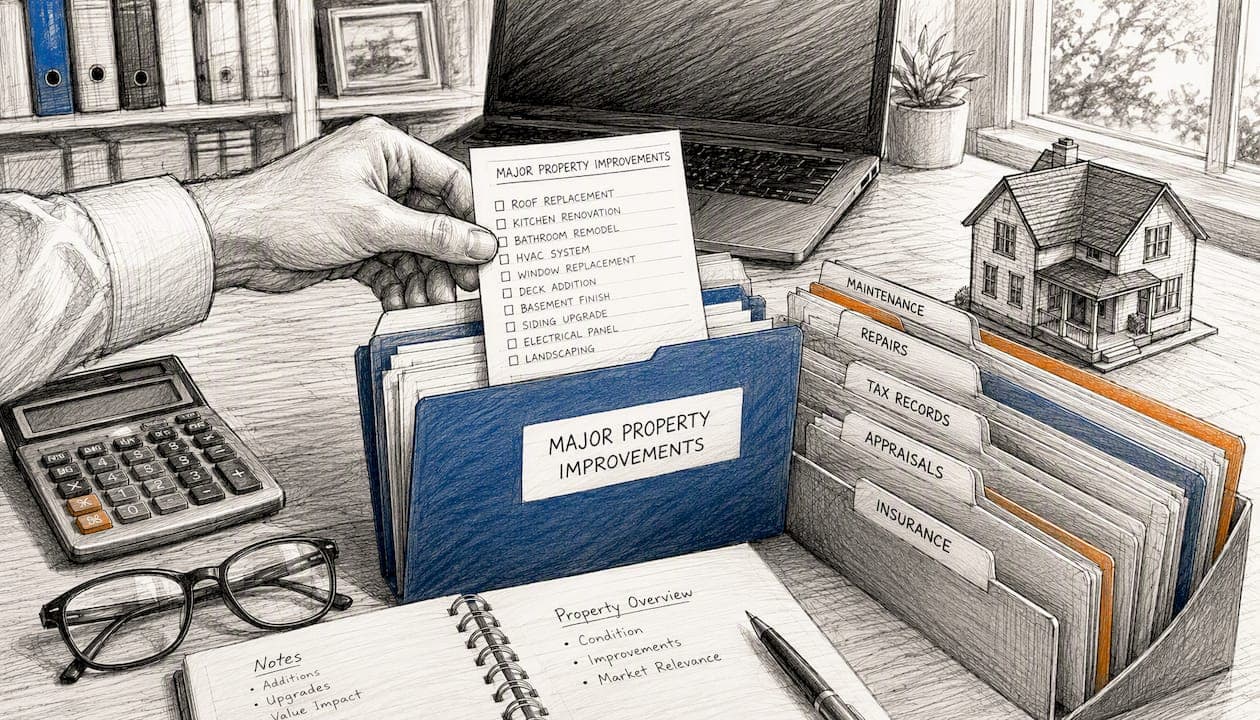
Use a six-step system to organize your home valuation paperwork: gather every relevant document into one place, build a checklist sorted by category, sort files into labeled folders, choose secure storage, apply a consistent file-naming convention, and set a maintenance routine. Start today with three actions: pull your deed, most recent property tax bill, and any permits into a single folder; draft a one-page upgrades summary listing each improvement's date, cost, and permit number; and confirm your appraiser holds a state-certified license and delivers a USPAP-compliant report. In New Jersey, county-level permit records and tax assessment deadlines affect what an appraiser can verify, so having those documents ready before the visit matters.
Key Takeaways
A complete, organized appraisal packet built around permit-backed improvements, current tax records, and a one-page upgrades summary gives a state-certified appraiser the verifiable evidence needed for a defensible, USPAP-compliant report.
| Point | Details |
|---|---|
| Start with three documents | Pull your deed, most recent tax bill, and all permits into one folder before anything else. |
| Front-load verifiable evidence | Permits, paid invoices, and inspection sign-offs carry the most weight; put them first in the packet. |
| Use consistent file naming | Name every file with year, project, and document type (e.g., 2025_RoofReplacement_Permit.pdf) for fast retrieval. |
| Retain key records long-term | Keep ownership and improvement documents for the life of ownership plus 7 years after sale per IRS guidance. |
| Newjerseyrealestateappraisal | NJREAG delivers state-certified, USPAP-compliant reports across all 21 NJ counties for estate, divorce, tax appeal, and pre-listing assignments. |
Table of Contents
- How do you organize home valuation paperwork from scratch?
- What documents does an appraiser actually need from you?
- How should you sort and prioritize your appraisal documents?
- Which storage method keeps your documents safe and accessible?
- What file-naming convention should you use for appraisal documents?
- How long should you keep home valuation and tax documents?
- How do you keep your appraisal file current without a big scramble later?
- How do you prepare your home and documents for the appraiser's visit?
- What do state-certified appraisers check first in your packet?
- How do you verify that your documents are authentic and accurate?
- How do you protect sensitive personal information in your paperwork?
- How do you update your files after improvements or legal changes?
- Which digital tools help you manage home valuation documents?
- What do you do when key documents are missing?
- What we see most often: common mistakes and quick fixes
- Ready for a state-certified appraisal across New Jersey?
- Selected resources for recordkeeping, IRS guidance, and appraisal standards
- Sources
How do you organize home valuation paperwork from scratch?
Start by pulling the documents that appraisers rely on most. Your deed or closing statement proves ownership and legal description. Your last property tax bill confirms the assessed value and tax ID. Prior appraisals, permits, contractor invoices, inspection reports, and major-system receipts (HVAC, roof, water heater) give the appraiser verifiable evidence of condition and improvements.
- Deed or closing statement — county clerk or closing agent
- Most recent property tax bill — your county tax office or online portal
- Prior appraisal reports — your mortgage file or lender
- Building permits — your municipality's permit office or online records system
- Contractor invoices and paid receipts — your email archive or contractor contact
- Inspection reports — your home inspector or real estate agent file
- Major-system receipts (HVAC, roof, water heater) — contractor or manufacturer records
- HOA documents and meeting minutes — your HOA management company
- Survey or plot plan — title company or county records
Create a physical inbox (a labeled banker's box) or a single digital folder called HOME_APPRAISAL_[ADDRESS]. Add a second list titled "To Track Down" for anything missing. Keeping an index of where each document lives cuts retrieval time significantly when an appraiser or lender requests a specific item on short notice.
Pro Tip: Call your municipality's permit office before the appraisal. Many NJ counties have online permit lookup tools. Pulling the permit history yourself lets you catch any open or expired permits before the appraiser does.
What documents does an appraiser actually need from you?
Appraisers credit only what they can verify. The table below groups documents by purpose so you can hand the packet to an appraiser in a logical order.
| Category | Documents | Why It Matters | Where to Get It |
|---|---|---|---|
| Ownership | Deed, title report, closing disclosure | Confirms legal ownership and property description | County clerk, closing agent |
| Improvement verification | Permits, contractor invoices, paid receipts | Verifiable proof of scope and cost | Municipal permit office, contractor |
| Condition and systems | Inspection reports, service records, warranties | Supports condition rating and remaining useful life | Inspector, contractor, manufacturer |
| Financial and tax | Property tax bills, assessment notices | Confirms tax ID, assessed value, and tax history | County tax office |
| Legal and assignment-specific | Court orders, estate documents, divorce decree | Required for estate, divorce, or tax-appeal appraisals | Attorney, probate court |
| Neighborhood and market | HOA docs, condo bylaws, CC&Rs | Affects comparability and market conditions | HOA management company |
| Photos and floor plans | Labeled before/after photos, floor plan sketch | Supports condition and GLA (gross living area) claims | Your own files, prior appraisal |
Place a one-page upgrades summary at the front of the packet. List each project with: project name, completion date, total cost, permit number, contractor name and phone, and one sentence explaining the value reason. Industry professionals recommend this format specifically because it speeds appraiser verification and reduces "subject to" conditions in the final report. The 2026 URAR/UAD updates raise documentation expectations further, making a complete, organized packet more important for defensible conclusions.
How should you sort and prioritize your appraisal documents?
A clear folder structure lets an appraiser or lender find any document in under two minutes. Use these top-level categories:
- Ownership — deed, title, closing disclosure
- Improvements and Permits — sorted by project, most recent first
- Systems and Service Records — HVAC, roof, plumbing, electrical
- Inspections and Surveys — full reports and sign-offs
- Financial and Tax — tax bills, assessment notices, mortgage statements
- Legal and Assignment — estate, divorce, tax-appeal documents
- Photos and Floor Plans — labeled by room and project
- HOA and Condo Docs — bylaws, budgets, meeting minutes
Priority rule: put permit-backed improvements and tax/ownership records on top. Verified documents — permits, invoices, tax records — carry the most weight with appraisers; homeowner notes or verbal descriptions carry almost none. Add a simple status label to each item: Verified, Needs Follow-Up, or Reference Only. A cover sheet listing the top five high-value items by folder name and tab number saves the appraiser time and signals that you're organized.
Which storage method keeps your documents safe and accessible?
You have three options: physical binders, local digital folders, or a cloud-based hybrid. Each has real trade-offs.
- Physical binders — durable, no tech required, easy to hand to an appraiser in person; vulnerable to fire, flood, and loss; hard to share remotely
- Local digital folders — fast access, no subscription cost; at risk if your hard drive fails or your home is damaged
- Cloud storage (Google Drive, Dropbox, OneDrive) — accessible anywhere, shareable via link, version history available; requires strong passwords and two-factor authentication
For most homeowners, a hybrid works best: scan everything to a cloud folder and keep originals in a fireproof box or binder. FEMA recommends documenting ownership and occupancy for disaster claims, and a cloud backup is the fastest way to prove ownership when physical records are destroyed.
Minimum security checklist:
- Strong, unique password for your cloud account
- Two-factor authentication enabled
- Share documents via time-limited links, not open public folders
- Local encrypted backup on an external drive, stored off-site or in a fireproof safe
- Run a recovery test once a year: download a file from backup and confirm it opens
Pro Tip: When sharing documents with an appraiser or lender, use a folder-level share link with view-only access. Never email unencrypted PDFs of documents containing your Social Security number or full financial account details.
What file-naming convention should you use for appraisal documents?
Consistent file names make every document instantly identifiable. Use this template:
YYYY_ProjectOrCategory_DocType_Source
Examples:
2025_KitchenRemodel_Permit_TownshipOfMapleShade.pdf2024_RoofReplacement_ContractorInvoice_ACMERoofing.pdf2023_PropertyTaxBill_AtlanticCounty.pdf2026_HomeInspection_Report_ABCInspections.pdf
For appliances or systems, add the model or serial number when it's relevant to condition or warranty: 2022_HVACReplacement_Warranty_CarrierModelXYZ123.pdf.
Version documents when you receive updates: use _v1, _v2, or a date stamp (_20260115) rather than overwriting the original. Keep archived copies in a subfolder called _Archive within the relevant project folder. Digital appraisal workflows reward clear filenames and project-based folders over large, disorganized binders, particularly as appraisers shift to digital review platforms.
Pro Tip: Permit numbers belong in the file name when you have them. An appraiser cross-referencing county records can match your file to the public record in seconds, which removes doubt about whether work was properly authorized.
How long should you keep home valuation and tax documents?
Retention periods vary by document type and how the property was used. The table below reflects general U.S. guidance; consult a tax professional for your specific situation.
| Document Type | Minimum Retention | Notes |
|---|---|---|
| Deed and title documents | Permanently | Keep as long as you own the property, plus 7 years after sale |
| Closing disclosure and HUD-1 | Permanently while owned | Needed to calculate cost basis for capital gains |
| Property tax bills | 7 years | IRS Publication 530 guides tax-related recordkeeping |
| Improvement permits and invoices | Life of ownership + 7 years | Adds to cost basis; needed for capital gains calculation |
| Major-system receipts and warranties | Life of the system | Supports condition rating and remaining useful life |
| Inspection reports | Life of ownership | Useful for future appraisals and disclosure requirements |
| Insurance claims and FEMA documentation | 7 years minimum | Supports disaster recovery and ownership proof |
| Estate, divorce, or tax-appeal appraisals | Permanently or per court order | Court-ready copies may be required; consult your attorney |
For estate and divorce appraisals, keep court-ready copies indefinitely or until the matter is fully resolved. NJ property tax appeals have specific filing deadlines (typically April 1 of the tax year), so retaining assessment notices and prior appraisals is critical for a timely tax appeal filing.
How do you keep your appraisal file current without a big scramble later?
A small, consistent habit beats a once-a-decade panic. Build this routine:
- After every project closes: Scan the final invoice, permit sign-off, and warranty. File them immediately using the naming convention above. Add a one-line note to your upgrades summary.
- Monthly: Spend five minutes triaging your physical inbox. Scan any new receipts, service records, or correspondence. Move them to the correct folder.
- Annually (January works well): Run a full file audit. Confirm your cloud backup is current, test one recovery download, and update the one-page upgrades summary with anything completed in the prior year.
- When a major system is serviced: Log the service date, technician name, and any parts replaced in a short lifecycle note stored with that system's folder. Include: install date, last service date, next recommended service date.
- Before any appraisal or sale: Pull the top-priority documents to the front of the packet, refresh the one-page summary, and confirm all permits show as closed in your municipality's records.
Automate where you can. Set a calendar reminder for your annual audit. Enable automatic sync on your cloud folder so new scans upload without manual steps. A small, ongoing documentation habit prevents the large record gaps that cost homeowners credibility during an appraisal.
How do you prepare your home and documents for the appraiser's visit?
The appraiser needs physical access and clear documentation. On the day of the inspection:
- Clear access to the attic hatch, crawl space entry, mechanical room, electrical panel, and HVAC unit. Appraisers are required to inspect these areas; blocked access can trigger a "subject to" condition in the report.
- Have your one-page upgrades summary and the top 10 verification documents (permits, invoices, photo pairs, system labels) in a labeled folder at the front door or kitchen counter.
- Label before/after photo pairs by project and date. For online or desktop appraisals, organized labeled photos reduce delays and support condition conclusions when the appraiser cannot visit in person.
- If the appraiser allows it, attend the walkthrough. A pre-appraisal checklist from industry professionals recommends presenting organized documentation and pointing out permitted improvements during the walkthrough rather than after.
For NJ-specific preparation tips, see our expert home appraisal preparation guide.
Pro Tip: Print a one-page index listing each folder tab and its top three documents. Hand it to the appraiser at the start of the visit. It takes 10 minutes to make and signals immediately that your documentation is complete and organized.
What do state-certified appraisers check first in your packet?
When we review a homeowner's packet at Newjerseyrealestateappraisal, three things determine how quickly we can complete a defensible report.
- License and credential verification: Always confirm your appraiser holds a current state-certified license. USPAP-compliant appraisals are the industry standard; for legal, estate, or tax-appeal assignments, the credential level matters for report admissibility.
- Permit-backed improvements: We look for permits first. An improvement without a permit is difficult to credit in a URAR/UAD report. The 2026 URAR updates increase inline commentary requirements, so a permit number tied to a specific line item in the report is more important than ever.
- Ownership and tax documentation: Deed, tax bills, and assessment history confirm the property's legal identity and tax burden, both of which affect comparable selection and final value conclusions.
For estate, divorce, or litigation assignments, court-ready documentation means originals or certified copies, not scanned versions of scanned versions. We also check that USPAP compliance is maintained throughout the assignment, which starts with the homeowner providing independently verifiable evidence rather than self-reported estimates.
How do you verify that your documents are authentic and accurate?
Cross-reference every key document against a public record. Your deed should match the legal description in the county's property records. Permit numbers on contractor invoices should appear in your municipality's online permit database. Tax bill amounts should align with your county assessor's records.
For prior appraisals, confirm the appraiser's license was active on the effective date of the report. The Appraisal Foundation's appraiser registry and your state's licensing board both allow public license lookups. If a contractor invoice lacks a license number, request a copy of the contractor's license and insurance certificate and attach it to the invoice.
Watch for inconsistencies in dates, addresses, or property descriptions across documents. A deed that lists a different lot size than the survey is a red flag that needs resolution before the appraisal, not during it.
How do you protect sensitive personal information in your paperwork?
Your appraisal packet contains Social Security numbers, account numbers, legal descriptions, and financial data. Treat it accordingly.
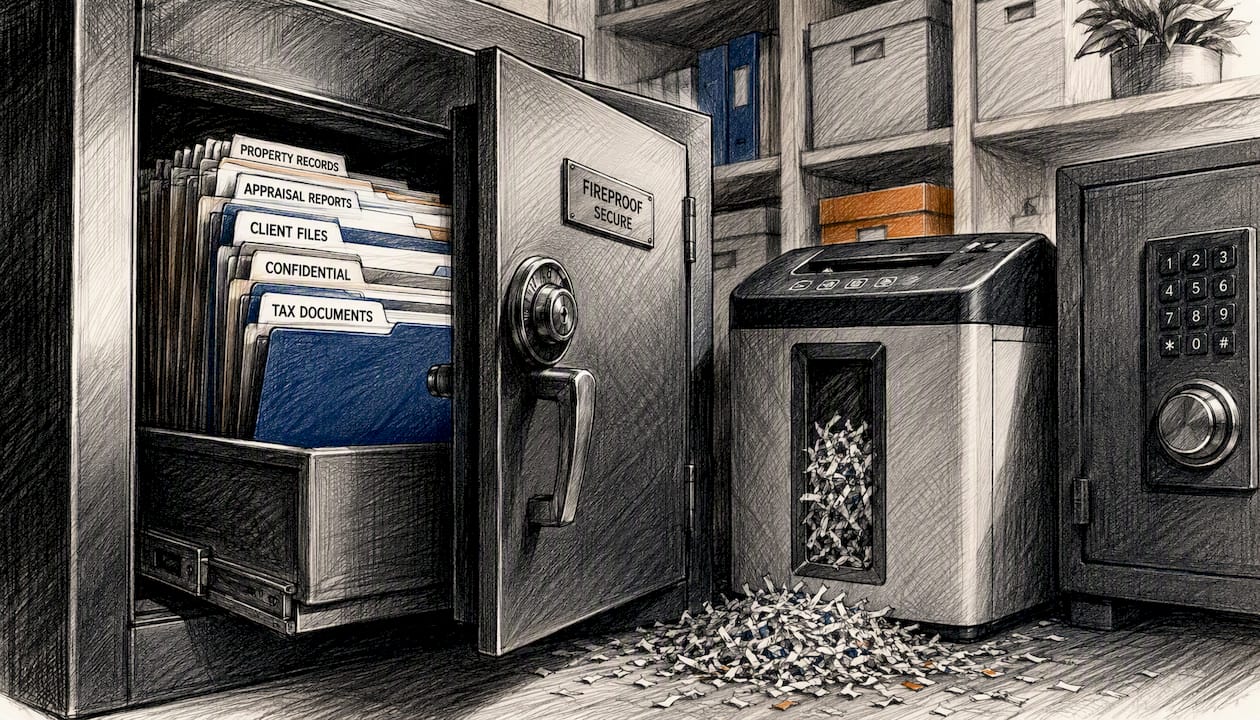
Redact your full Social Security number from any document before sharing it with an appraiser or lender. Most appraisal assignments don't require it. Use the last four digits only if an identifier is needed. Store documents containing full financial account numbers in a password-protected folder separate from the general appraisal packet.
For physical documents, use a locked filing cabinet or fireproof safe. Shred superseded versions of sensitive documents rather than discarding them. For digital files, avoid storing unencrypted sensitive documents in shared folders or email drafts. A cloud folder with two-factor authentication and view-only share links is significantly safer than an email attachment chain.
How do you update your files after improvements or legal changes?
Every completed improvement and every legal event affecting the property should trigger an immediate file update. When a project closes, add the final invoice, permit sign-off, and any warranty to the relevant project folder within 48 hours. Update the one-page upgrades summary the same day.
For legal changes — a refinance, a title transfer, a court order in a divorce or estate matter — file the new document in the Legal and Assignment folder and note the effective date on the cover sheet. If a prior appraisal is superseded by a new one, move the old report to an _Archive subfolder rather than deleting it. Archived appraisals are useful for tax appeals, estate matters, and capital gains calculations.
Property improvements that change the gross living area (an addition, a finished basement, a converted garage) require updating your floor plan sketch and notifying your insurer. An outdated floor plan in your packet can lead to a lower GLA estimate in the appraisal report.
Which digital tools help you manage home valuation documents?
Several widely available tools handle the core tasks well. Google Drive and Microsoft OneDrive both offer version history, folder sharing with permission controls, and mobile scanning via their companion apps. Dropbox adds granular audit logs that show who accessed a file and when, which is useful for legal assignments.
For scanning physical documents, Adobe Scan and Apple's built-in document scanner (iOS Notes app) produce clean, searchable PDFs. Name the file immediately after scanning using the convention above; renaming later is where most homeowners lose consistency.
For property-specific organization, some homeowners use platforms built around property preparation and valuation documentation that offer project-based folder templates and condition-tracking features. The key criterion for any tool is whether it supports folder-level sharing with view-only access, version history, and export to PDF — those three features cover everything an appraiser or lender needs.
What do you do when key documents are missing?
Missing documents are common, and most can be recovered. Start with the most authoritative source for each type.
A missing deed can be obtained from your county clerk's office or through a title search. Most NJ counties offer online deed lookup through their official property records portal. A missing permit can be pulled from your municipality's building department; many NJ towns have digitized permit records going back 10–15 years. Missing contractor invoices can often be reconstructed by contacting the contractor directly and requesting a copy of the original work order and payment record.
If a permit genuinely doesn't exist for completed work, document what you can: photos with metadata timestamps, contractor statements, and material receipts. An appraiser can note the improvement as observed but unverified, which is better than no documentation at all. For estate or divorce appraisals where a key document is missing, consult your attorney before the appraisal visit. Some assignments allow for a retrospective approach using available evidence.
What we see most often: common mistakes and quick fixes
The most damaging documentation mistake we see at Newjerseyrealestateappraisal is unpermitted work presented without any supporting evidence. A homeowner who added a bathroom without a permit and has no contractor invoice, no photos, and no material receipts gives us nothing to credit in the report. The improvement may be visible, but without verifiable evidence, it carries minimal weight in a USPAP-compliant analysis.
The second most common issue is poor photo labeling. A folder of 200 photos named IMG_4521.jpg through IMG_4720.jpg is nearly useless. Rename photos by project and date: 2024_KitchenRemodel_Before_01.jpg, 2024_KitchenRemodel_After_01.jpg. That takes 20 minutes and makes a real difference in how quickly an appraiser can confirm what was done.
A third issue: homeowners bury their strongest evidence deep in a disorganized folder. We've reviewed packets where the permit for a $40,000 addition was on page 47 of an unsorted PDF. Front-load your best evidence. Put the one-page summary, the deed, the most recent tax bill, and the top three permits on top.
Quick fixes you can do today: create the one-page upgrades summary, label your three highest-value project folders, and pull the deed and tax bill to the front of the packet. Those three steps take under an hour and materially improve what we can do with your documentation.
Ready for a state-certified appraisal across New Jersey?
Newjerseyrealestateappraisal delivers USPAP-compliant, state-certified appraisal reports for estate, divorce, tax appeal, and pre-listing assignments across all 21 NJ counties, including estate and date-of-death valuations and certified tax appeal appraisals. With over 26 years of combined experience, we know exactly what documentation supports a defensible conclusion and what leaves value on the table.

Before you call, attach your one-page upgrades summary and your top documents (deed, tax bill, permits) to your inquiry. Include the county and the purpose of the appraisal (estate, divorce, pre-listing, tax appeal). That gives us everything we need to scope the assignment accurately and get started without delays. Request your appraisal at Newjerseyrealestateappraisal or call (908) 517-3913.
This article provides general information about document organization and is not legal, tax, or financial advice. Consult a qualified professional for guidance specific to your situation.
Selected resources for recordkeeping, IRS guidance, and appraisal standards
- IRS Publication 530 — Authoritative U.S. guidance on tax-related recordkeeping for homeowners, including retention of improvement and cost-basis records.
- The Appraisal Foundation — The source for USPAP standards and appraiser credential verification; use the public registry to confirm your appraiser's license is current.
- FEMA: How to Document Home Ownership and Occupancy — Federal guidance on ownership documentation for disaster claims and evidentiary records.
- Oklahoma State Extension: Getting Your Records in Order — Practical household-records organization guide with index and category recommendations.
- Homeowners — Checklist for digital appraisal preparation including file naming, photo labeling, and one-page summary format.
- Top Property Valuation Documents: 2026 Complete Guide — NJ Appraisal Insights — NJ-specific guidance on 2026 URAR/UAD documentation expectations and what appraisers need in a complete packet.
- NJ Property Tax Appeal Appraisals — NJREAG — State-certified appraisal services for NJ tax appeals, including documentation requirements and county-specific deadlines.
Sources
- The Appraisal Foundation
- IRS Publication 530
- Getting your records in order — Oklahoma State Extension
- How to document home ownership and occupancy — FEMA
- Homeowners
- Top property valuation documents: 2026 complete guide — NJ Appraisal Insights