

If you own or manage multiple properties in New Jersey and need one defensible number (or a set of them) for court, a lender, or the IRS, here's the short version: define your scope of value first, gather verified property-level data, apply the income, sales-comparison, and cost approaches per asset, then reconcile everything into a single audit-ready report. Skip any step and the report won't hold up under cross-examination or lender review.
- Define scope: value type, date of value, intended use
- Collect and verify property-level and market data
- Apply the relevant valuation approaches per asset
- Aggregate, reconcile, and stress-test the numbers
- Deliver a USPAP-compliant, quality-controlled report
Verdict: if the outcome affects a court case, a tax appeal, a loan, or an estate, you need a state-certified appraisal that follows USPAP (2024 edition), the standard maintained by The Appraisal Foundation. New Jersey Real Estate Appraisal Group (NJREAG) builds every portfolio assignment around this exact framework.
Pro Tip: Before you request quotes, write down your intended use in one sentence. "For equitable distribution in a divorce filing" and "for a refinance application" require different scopes of work and, sometimes, different value definitions.
Key Takeaways
A defensible portfolio valuation requires a defined scope of value, verified property-level data, method-appropriate valuation per asset, and a reconciled, USPAP-compliant report.
| Point | Details |
|---|---|
| Scope comes first | Lock in value definition, date of value, and intended use before any data collection starts. |
| Verify every data source | Cross-check leases, income, and comps against owner records and public filings, not assumptions. |
| Match method to asset | Use income approach for cash-flowing assets, sales comparison broadly, cost approach for special-purpose properties. |
| Sampling has limits | Full appraisals are typically required for litigation, estate, and high-stakes lending decisions. |
| NJREAG delivers certified reports | State-certified appraisers with 26+ years across all 21 NJ counties, specializing in divorce, estate, and tax appeal portfolios. |
Table of Contents
- Step 1: Define the Scope of Your Portfolio Valuation
- How Do You Collect and Verify Data for a Property Portfolio?
- Which Valuation Approach Fits Each Property Type?
- How Do You Aggregate Multiple Property Values?
- Reconciling Value Indications Into a Final Report
- What Does a Portfolio Appraisal Cost and How Long Does It Take?
- When Do You Actually Need a State-Certified Appraiser?
- Get a State-Certified Portfolio Appraisal From NJREAG
- Frequently Asked Questions
- Sources
Step 1: Define the Scope of Your Portfolio Valuation
Every defensible appraisal starts with a clear scope. Skip this and you'll get a report that doesn't match what your attorney, lender, or the tax court actually needs.
Start with the value definition. Market value, disposition value, and liquidation value produce different numbers for the same property, and courts and lenders expect the right one for the situation. A tax appeal needs market value as of October 1 of the pretax year under most New Jersey assessment cycles. A date-of-death estate appraisal needs value as of the decedent's date of death, not the report date.
Your engagement letter should nail down:
- The type of value and its legal or financial basis
- Effective date of value versus the date the report is issued
- Intended use and intended users (court, lender, IRS, opposing counsel)
- Any extraordinary assumptions or hypothetical conditions
- Scope-of-work limitations agreed upon upfront
Ambiguity in the intended use is one of the most common reasons appraisal reports get challenged in litigation or kicked back by underwriters. Nail this down before any data collection begins.
Pro Tip: Ask your appraiser these questions before signing an engagement letter: What value definition applies to my situation? What's my effective date, and does it align with my court or filing deadline? Will this report meet USPAP-compliant reporting standards for my intended user?
How Do You Collect and Verify Data for a Property Portfolio?
Once scope is locked, the appraiser needs source documents, not just guesses. Weak data collection is where portfolio appraisals fall apart under scrutiny.
For each property, gather:
- Deed and title history
- Current leases and rent rolls
- Operating statements and expense ledgers
- Capital improvement records
- Zoning classification and any variances
- Recent site surveys or floor plans
- Verify leases and income against owner records, not just tenant claims.
- Cross-check third-party listing data and public sale records for material discrepancies.
- Confirm zoning and permitted use hasn't changed since acquisition.
- Pull submarket data: recent comparable sales, cap-rate trends, vacancy, and rent growth.
- Document every source with a date and origin so a reviewer can trace the trail later.
Appraisers who follow Appraisal Institute guide notes select comparable sales that reflect actual market participant behavior, adjusting for concessions or atypical motivations rather than taking a listing price at face value. That discipline is what separates a defensible comp set from a sloppy one, and our guide on evaluating comparable properties walks through the adjustment process in more detail.
Which Valuation Approach Fits Each Property Type?
Most credible appraisals weigh all three recognized approaches to value: income, sales comparison, and cost. But the weight each approach carries depends on the asset.
Income approach. For multifamily and commercial income properties, this usually drives the conclusion. Direct capitalization works when cash flow is stable; a discounted cash flow (DCF) model is better when rents are stepping up, leases are rolling over on different schedules, or vacancy is trending. Required inputs include net operating income (NOI), a market-supported cap rate, vacancy and collection loss, and reversion assumptions.
Sales comparison approach. Selecting comps that share physical, locational, and use characteristics with the subject matters more than volume. Every material adjustment needs a documented basis, not a rounded guess.
Cost approach. Reserve this for new construction or special-purpose properties (churches, self-storage, certain industrial buildings) where market data is thin. It requires an accurate replacement cost estimate and a defensible accrued depreciation calculation.
- Determine which approach best fits each asset type before pulling comps.
- Source cap rates from recent closed transactions, not asking prices.
- Build a DCF only where cash flow volatility justifies the added complexity.
- Cross-check cost approach conclusions against sales comparison where data allows.
For NJ multifamily, cap rates and expense ratios vary meaningfully between counties. Our income approach guide breaks down typical NOI and cap-rate inputs by property type.
Pro Tip: Never accept a cap rate pulled from a national survey without checking it against local, closed transactions in the same submarket. A cap rate that's off by half a point can swing a portfolio value by six figures.
How Do You Aggregate Multiple Property Values?
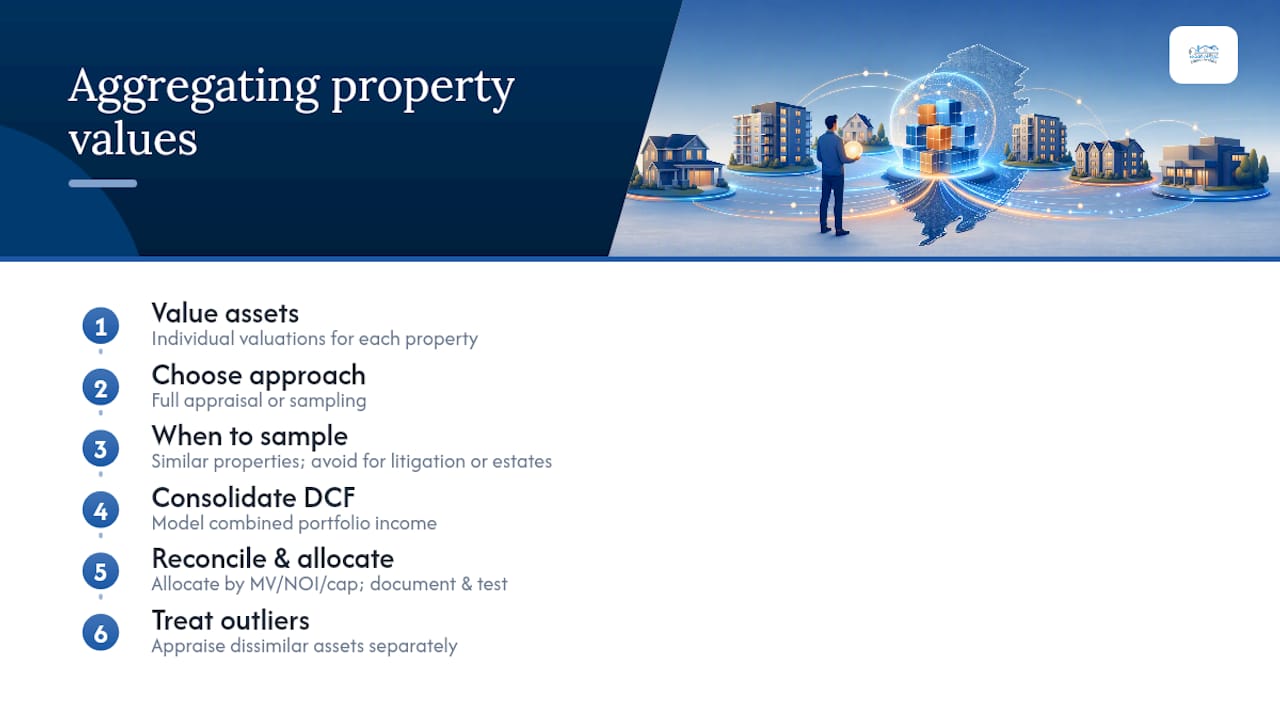
Once individual properties are valued, you face a decision: full appraisal on every asset, or a sampling approach across a homogeneous portfolio.
Sampling can be defensible when properties are similar in construction, age, and use, and when the stakes are lower, internal planning, budget-driven refinancing analysis, or a preliminary review. It's rarely appropriate for litigation, estate, or high-stakes lending decisions, where every asset typically needs its own supported conclusion.
For larger portfolios financed or reported as a single unit, a consolidated DCF models the whole income stream together, then gets reconciled against the sum of individual asset values. When the two don't match, that gap is your portfolio premium or discount.
Allocating that premium or discount across assets usually follows one of three methods: pro rata by market value, pro rata by NOI, or by adjusting individual cap rates. Whichever method you pick needs documentation and sensitivity testing against changes in vacancy, rent growth, and discount rate.
Pro Tip: If your portfolio includes even one materially different asset, a mixed-use building among otherwise pure multifamily, don't let sampling logic pull it into a group average. Value it on its own.
Reconciling Value Indications Into a Final Report
Reconciliation isn't averaging. It's weighing which approach best reflects reliable market behavior for that specific asset, then documenting why.
Best practice reconciles intra-approach first (adjusted comp values against each other), then cross-approach, explaining what weight each method carried and why. A USPAP-compliant report includes a signed certification statement, scope-of-work disclosure, and stated assumptions and limiting conditions.
- Recalculate figures independently before finalizing
- Trace every comp and cap rate back to its source
- Run sensitivity tests on cap rates and cash-flow assumptions
- Confirm the certification language matches the intended use
Pro Tip: Ask for the source trail behind every comp and cap rate in your report. If your appraiser can't produce it on request, that report probably won't survive a deposition.
What Does a Portfolio Appraisal Cost and How Long Does It Take?
Timelines and fees scale with scope, not just property count; following maximizing investment strategies in real estate can help plan effectively.
| Portfolio Scope | Typical Completion Window |
|---|---|
| Sampling, small homogeneous portfolio | 1 to 2 weeks |
| Full interior inspections, mid-size portfolio | 3 to 5 weeks |
| Full DCF, complex income streams, court-ready | 5 weeks |
Fee drivers include property count, inspection depth, how spread out the assets are across NJ counties, income complexity, and whether court-ready certification is required.
- Expect asset-level conclusions plus a consolidated portfolio summary
- Assumptions and limiting conditions documented in writing
- Supporting exhibits: comps, rent rolls, cap-rate data, photos
When Do You Actually Need a State-Certified Appraiser?
Court matters, estate and date-of-death valuations, property tax appeals, mortgage lending, and divorce settlements all require a state-certified, USPAP-compliant appraisal. Judges, assessors, and underwriters routinely reject internal estimates or automated valuation models (AVMs) for these purposes because they lack the documented methodology and certification a formal report provides.
An AVM or internal spreadsheet might be fine for annual portfolio monitoring or a rough refinance check. It is not fine when your name is on a court filing or a tax appeal petition.
NJREAG appraisers are state-certified and have handled portfolio and multi-property assignments across all New Jersey counties for many years, with particular depth in divorce, estate, and tax appeal work. Attorneys can review our USPAP compliance guide for NJ counsel for what makes a report credible in front of a judge.
Pro Tip: If a valuation will be cited in any legal filing, tax appeal, or loan application, confirm your appraiser is state-certified in New Jersey before you sign anything. Ask for their license number and verify it directly with the state board.
How we approach portfolio appraisals across New Jersey
With over 26 years of combined experience across all 21 counties, we build every portfolio assignment around consistency: the same rigor applied to each asset, transparent assumptions documented in plain language, and a reconciliation process that holds up whether it's reviewed by a lender, an assessor, or opposing counsel in a divorce case.
Get a State-Certified Portfolio Appraisal From NJREAG
Handling a divorce settlement with three rental properties, an estate with a mixed portfolio across two counties, or a tax appeal on a commercial building? A generic online estimate won't get you through probate court, a lender's underwriting desk, or a tax appeal hearing. NJREAG builds each report around the exact intended use, whether that's estate and date-of-death valuation, a property tax appeal, or a multi-property investor review.

Our portfolio and multi-property appraisal service covers residential, multifamily, commercial, and land assets statewide. On your first call, we'll walk through your intended use, confirm your effective date, and give you a realistic timeline and fee estimate before you commit to anything.
Call us at (908) 517-3913 or request a scope discussion through our portfolio appraisal page to get your assignment started.
Frequently Asked Questions
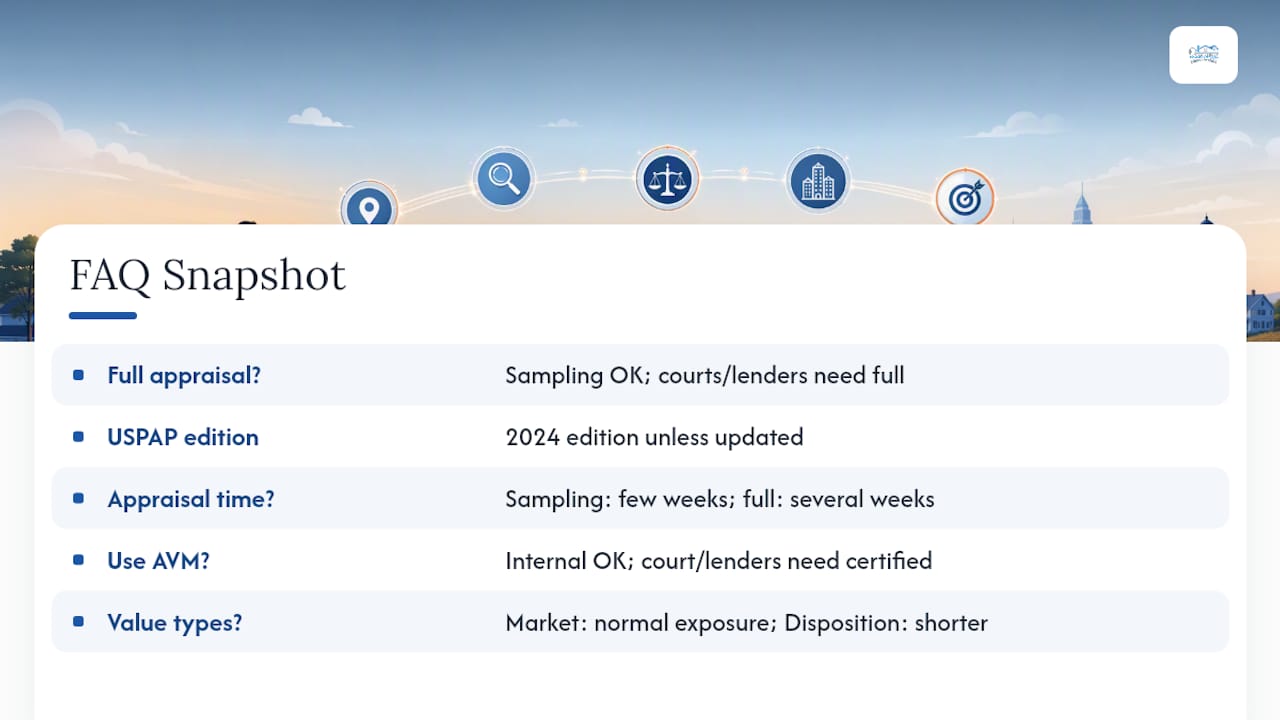
Does every property in a portfolio need a full appraisal? Not always. Sampling can work for homogeneous, lower-stakes portfolios, but litigation, estate, and lending decisions typically require a full appraisal on each asset.
What edition of USPAP applies to a 2026 appraisal? Appraisers currently reference the 2024 edition of USPAP, maintained by The Appraisal Foundation, unless a newer edition has been formally adopted.
How long does a portfolio appraisal take in New Jersey? Sampling-based reviews generally take a few weeks. Full inspections with a consolidated DCF for court-ready reporting can take several weeks depending on property count and geographic spread.
Can I use an automated valuation model instead of a certified appraisal? For internal monitoring, possibly. For court filings, tax appeals, estate matters, or loan applications, lenders and courts generally require a state-certified, USPAP-compliant report.
What's the difference between market value and disposition value? Market value assumes a reasonable exposure period and typical marketing conditions. Disposition value assumes a shorter timeframe, often relevant in forced-sale or estate settlement contexts. Getting this wrong can undermine an otherwise solid report.
This article provides general information and is not a substitute for professional legal, tax, or financial advice specific to your situation.
Sources
- Guide notes and standards of professional practice - Appraisal Institute
- Real Estate Valuation Methods: Income, Sales & Cost - Virtue CPAs