

Every USPAP-compliant appraisal report must make its disclosures clear, accurate, and conspicuous — covering client identity, intended users, scope of work, assumptions, conflicts of interest, and a signed certification. The Appraisal Foundation and Appraisal Institute set these requirements, and Newjerseyrealestateappraisal follows them on every assignment across all 21 New Jersey counties. Getting the disclosure process in real estate valuation right isn't optional — it's what separates a defensible report from one that collapses under cross-examination.
Mandatory disclosure checklist (Standards Rule 2-1 and SR C-2):
- Client identity (or documented anonymity handling)
- Intended users, named or described by type
- Intended use of the appraisal
- Property identification and interest appraised
- Type and definition of value, with source citation
- Effective date and date of report
- Scope of work, including methods used and any excluded approaches
- Extraordinary assumptions and hypothetical conditions, with impact statement
- Present or prospective interests and prior services within three years
- Significant appraisal assistance disclosure
- Confidentiality limits and authorized recipients
- Signed certification statement
- Workfile retention notice
Key Takeaways
USPAP-compliant disclosure requires identifying intended users, stating all assumptions conspicuously, disclosing interests and prior services, signing the certification, and retaining a complete workfile for at least five years.
| Point | Details |
|---|---|
| Name intended users explicitly | Receiving a copy does not make a party an intended user; name them in the engagement letter. |
| Make assumptions conspicuous | Bold headings and standalone paragraphs prevent the "buried boilerplate" challenge in litigation. |
| Disclose prior services | Any services on the subject property within three years must appear in the certification. |
| Retain the workfile | USPAP requires retention for at least five years or two years after litigation disposition, whichever is later. |
| Use Newjerseyrealestateappraisal | NJREAG delivers state-certified, court-ready reports with tailored disclosures for estate, divorce, and tax appeal assignments across all 21 NJ counties. |
Table of Contents
- What USPAP rules actually govern the disclosure process in real estate valuation?
- What do "clear," "accurate," and "conspicuous" actually mean in a report?
- A step-by-step checklist of mandatory disclosures with sample wording
- Common disclosure failures that invite successful challenges
- When to confirm disclosures and how they affect your timeline and cost
- How Newjerseyrealestateappraisal implements disclosures in practice
- Why conspicuous disclosures protect you more than any other report element
- NJREAG delivers court-ready, USPAP-compliant appraisals across New Jersey
- Sources
What USPAP rules actually govern the disclosure process in real estate valuation?
The controlling authority is the Uniform Standards of Professional Appraisal Practice, published by the Appraisal Standards Board (ASB) of the Appraisal Foundation. Standards Rule 2-1 sets three foundational requirements: the report must not be misleading, must contain sufficient information for intended users, and must disclose all assumptions and limiting conditions.
SR C-2 and the Appraisal Institute Professional Practices Booklet enumerate the specific written-report content required in an Appraisal Report, including signed certification, client and intended-user identification, intended use, scope of work, methods and techniques, and conspicuous disclosure of assumptions and hypothetical conditions. Standards 2, 4, 6, 8, and 10 extend these requirements across real property, personal property, business, and mass appraisal disciplines.
| Standard / Rule | Disclosure Required |
|---|---|
| SR 2-1 (a) | Report must not be misleading; set forth the appraisal clearly and accurately |
| SR 2-1 (b) | Sufficient information for intended users to understand the report |
| SR 2-1 (c) | All assumptions, extraordinary assumptions, hypothetical conditions, and limiting conditions |
| SR C-2 | Signed certification; client and intended users; intended use; scope of work; methods used |
| Scope of Work Rule | Summarize scope performed; state reasons for excluding valuation approaches |
| Workfile Rule | Retain workfile at least five years or two years after litigation disposition, whichever is later |
The 2024 USPAP makes clear that a form is not a report — substantive content determines compliance, not the template used.
What do "clear," "accurate," and "conspicuous" actually mean in a report?
USPAP Standards 2, 4, 6, 8, and 10 define conspicuous as obvious and unavoidably noticeable to intended users. That's a higher bar than most appraisers realize.
Clear means the disclosure is written in plain language that a non-appraiser intended user — an attorney, executor, or lender — can understand without decoding jargon. Accurate means the stated assumption or condition actually reflects the assignment. Conspicuous means placement and formatting that prevents the reader from missing it.
Two formatting patterns that satisfy the conspicuous standard:
- A dedicated "Assumptions, Hypothetical Conditions, and Limiting Conditions" page placed immediately before the certification, with each item numbered and bolded.
- A highlighted or boxed paragraph at the top of the addenda section with the heading "EXTRAORDINARY ASSUMPTION — READ BEFORE RELYING ON THIS REPORT."
What fails the standard: a single paragraph of boilerplate buried in a 40-page addendum, using font size identical to surrounding text, with no visual separation. Here's the contrast:
Noncompliant: "This appraisal is subject to the usual assumptions and limiting conditions for appraisals of this type."
Compliant: "EXTRAORDINARY ASSUMPTION: This appraisal assumes the subject property's foundation is structurally sound, based on the owner's representation. No engineering inspection was performed. If this assumption proves false, the appraiser's value conclusion may be materially affected."
Pro Tip: Place extraordinary assumptions in a standalone bolded section with a header that includes the word "EXTRAORDINARY" in all caps. Reviewers and opposing counsel scan for these — make it impossible to miss.
A step-by-step checklist of mandatory disclosures with sample wording
Use these clauses as starting points. Tailor each one to the specific assignment.
- Client identity. "The client for this assignment is [Name], [Title/Organization]. The client's identity is not disclosed in this report per the client's written instruction; documentation is retained in the workfile."
- Intended users. "The intended users of this report are [Client Name] and [Attorney/Lender Name]. No other party is an intended user."
- Intended use. "The intended use is to assist the client in [estate settlement / equitable distribution / tax appeal / lending decision]."
- Property identification. "The subject property is located at [address], Block [X], Lot [Y], [County] County, New Jersey."
- Interest appraised. "The interest appraised is the fee simple interest."
- Type and definition of value. "The value sought is Market Value as defined by [source, e.g., Fannie Mae Selling Guide / USPAP Advisory Opinion 22]."
- Effective date and report date. "The effective date of this appraisal is [date]. The date of this report is [date]."
- Scope of work. "The scope of work included a physical inspection of the interior and exterior, review of public records, MLS data, and analysis of [X] comparable sales. The income approach was excluded because the property is owner-occupied residential and market participants do not rely on income analysis for this property type."
- Significant assistance. "[Name] provided significant real property appraisal assistance by [task]. [He/She] did not sign this certification."
- Present/prospective interests and prior services. "The appraiser has no present or prospective interest in the subject property or the parties involved. The appraiser [has / has not] performed services regarding this property within the three-year period prior to this engagement. [If yes: describe prior service and date.]"
- Extraordinary assumptions. "EXTRAORDINARY ASSUMPTION: [State assumption]. The use of this extraordinary assumption may have affected the assignment results."
- Hypothetical conditions. "HYPOTHETICAL CONDITION: This appraisal is made as if [condition contrary to fact]. This hypothetical condition may have affected the assignment results."
- Limiting conditions. "Standard limiting conditions apply as listed in the attached addendum. No additional limiting conditions affect this assignment."
- Confidentiality. "This report is confidential. It may be shared with intended users identified above. Disclosure to other parties requires written authorization from the client, except as required by law or professional standards."
- Signed certification. Per SR C-2, the certification must be signed by the appraiser and must include the required statements about personal inspection, independence, prior services, and compliance with USPAP.
- Workfile retention. "A workfile supporting this report is retained and will be maintained for at least five years from the date of this report, or two years after final disposition of any related judicial proceeding, whichever is later."
Prior services disclosure matters more than most appraisers acknowledge. USPAP requires disclosure of any services performed on the subject property within the three years before the new assignment. Missing this disclosure is one of the most common grounds for a successful challenge in New Jersey tax appeals and divorce proceedings.
Pro Tip: For retrospective, litigation, or proposed-improvement assignments, replace generic boilerplate with assignment-specific language. A retrospective valuation requires explicit disclosure that the effective date differs from the inspection date and that the appraiser relied on historical data available as of that earlier date.
Common disclosure failures that invite successful challenges
Reviewers and opposing counsel know exactly where to look. These are the most frequently attacked weak points:
- Vague assumptions: "Standard assumptions apply" without listing them. Fix: enumerate every assumption by name and state its potential impact on value.
- Buried hypothetical conditions: Hypothetical conditions placed in boilerplate addenda with no visual distinction. Fix: bold heading, standalone paragraph, explicit impact statement.
- Unnamed intended users: Listing only "the client" when attorneys, lenders, or courts also rely on the report. Fix: name each intended user or describe them by type at engagement.
- Undisclosed prior interest or services: No mention of prior assignments on the same property within three years. Fix: affirmative statement in the certification — either confirming no prior services or describing them.
- Inadequate scope disclosure: No explanation for why an approach to value was excluded. Fix: one sentence per excluded approach stating the reason.
- Missing or incomplete certification: Unsigned report, or certification missing required USPAP statements. Fix: use a USPAP-compliant certification template and confirm signature before transmittal.
- Thin workfile: No support for adjustments, no copies of comparable data, no engagement letter. Fix: retain all data, correspondence, and working notes.
Appraisal reviewers focus on vague or easily overlooked disclosures — especially assumptions and limiting conditions — because these are the most common areas where a valuation's credibility is successfully challenged in litigation or tax appeals.
For a practical breakdown of common appraisal errors and how to correct them, see common home appraisal mistakes.
When to confirm disclosures and how they affect your timeline and cost
Disclosure decisions aren't just a report-writing task. They start at engagement and run through workfile retention.
- Pre-engagement: Confirm intended users, intended use, and any prior services on the property. Capture this in the engagement letter with client signature before inspection begins.
- Engagement letter: Document client identity, authorized recipients, permissions for third-party access, and any known extraordinary assumptions or hypothetical conditions.
- Mid-assignment discovery: If inspection or research reveals a condition that triggers a new extraordinary assumption or hypothetical condition, update the scope and notify the client in writing before completing the report.
- Report completion: Verify all 16 checklist items above are present, conspicuously placed, and accurately worded. Confirm the certification is signed.
- Transmittal: Deliver only to identified intended users. Document delivery method and date in the workfile.
- Post-transmittal workfile: Retain the complete workfile for at least five years, or two years after final disposition of related litigation, per 2024 USPAP workfile requirements.
Timeline and cost expand when assignments involve retrospective effective dates, proposed improvements, or complex hypothetical conditions — each requires additional research, documentation, and tailored disclosure language. In New Jersey, county tax appeal deadlines (typically April 1 for most counties) and court scheduling orders in divorce or estate matters can compress delivery windows significantly. Build disclosure review time into your schedule, not just appraisal time.
How Newjerseyrealestateappraisal implements disclosures in practice
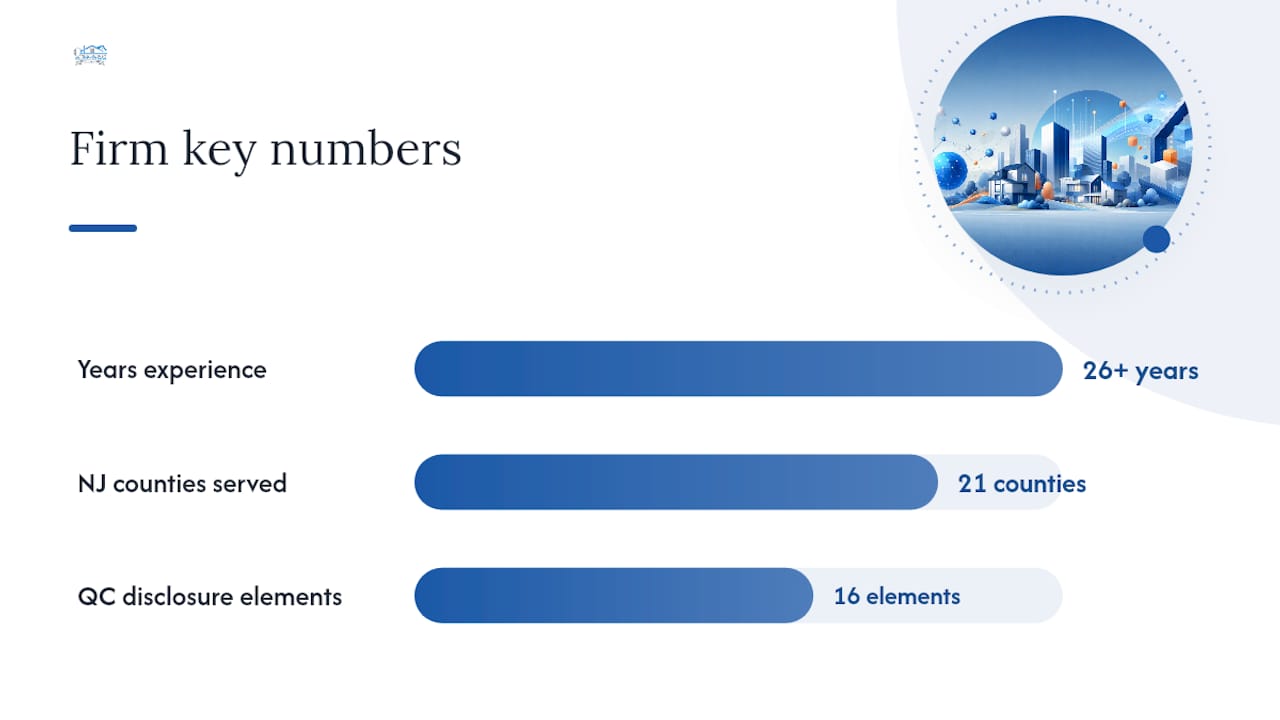
Newjerseyrealestateappraisal is a state-certified appraisal firm with 26+ years of experience across all 21 New Jersey counties, specializing in divorce, estate, date of death, retrospective, tax appeal, and litigation support assignments. Every report we deliver is built around defensible, conspicuous disclosures from the first page.
Sample report excerpts we use:
Present/Prospective Interest Disclosure: "The appraiser has no present or prospective interest in the subject property and no personal interest with respect to the parties involved. This disclosure is made at the time of agreement and confirmed at the time of report preparation."
Extraordinary Assumption (proposed improvements): "EXTRAORDINARY ASSUMPTION: This appraisal assumes the proposed renovation described in the attached plans has been completed in a workmanlike manner consistent with the specifications provided. The use of this extraordinary assumption may have affected the appraiser's opinions and conclusions."
Intended Users (restricted use): "The intended user of this Restricted Appraisal Report is [Client Name] only. This report may not be relied upon by any other party for any purpose."
Pre-transmittal QC checklist:
- Senior appraiser confirms all 16 disclosure elements are present and conspicuously placed
- Scope-of-work statement reviewed for completeness, including excluded approaches
- Certification signed and dated; significant assistance disclosed if applicable
- Workfile confirmed complete: engagement letter, inspection notes, comparable data, correspondence
- Intended users verified against engagement letter before delivery
Boilerplate certifications often satisfy general requirements but cannot replace tailored disclosures for complex assignments. Relying solely on generic certification language is a litigation vulnerability that our QC process is specifically designed to prevent.
Why conspicuous disclosures protect you more than any other report element
Most appraisers treat disclosures as administrative. That's a mistake. A disclosure that's technically present but practically invisible carries the same litigation risk as one that's missing entirely — because the standard isn't presence, it's conspicuousness.
We've seen tax appeal challenges and divorce proceedings hinge entirely on whether an extraordinary assumption was clearly labeled or buried in boilerplate. When the disclosure is obvious, the opposing party has to argue the substance of the assumption. When it's buried, they argue the report itself is defective — and that's a much easier argument to win.
State-certified appraisers working across 21 NJ counties see this pattern repeatedly. The reports that hold up in court aren't necessarily the ones with the most sophisticated analysis. They're the ones where every disclosure is impossible to miss, every assumption is named and explained, and every intended user is identified before the first inspection.
NJREAG delivers court-ready, USPAP-compliant appraisals across New Jersey
When your case depends on a defensible valuation, the disclosure framework has to be right from day one. Newjerseyrealestateappraisal provides state-certified, USPAP-compliant appraisal reports for estate and date of death valuations, divorce and equitable distribution, tax appeal appraisals, and litigation support assignments throughout New Jersey.

Every report includes the full disclosure framework described in this guide — tailored to your assignment, not copied from a generic form. When you commission an appraisal, ask us for sample certification language and our pre-engagement disclosure checklist. We'll walk you through exactly what will appear in your report and why.
Call us at (908) 517-3913 or request a quote at Newjerseyrealestateappraisal.
This article provides general information about USPAP disclosure requirements and is not a substitute for legal or professional appraisal advice. Confirm current standards with the Appraisal Foundation or a qualified appraiser for your specific assignment.
Sources
- The Appraisal Foundation
- Appraisal Institute Professional Practices Booklet
- The 3 Basic Requirements for Real Property Appraisal Reports
Keep PDF copies of the current USPAP edition and the Appraisal Institute Professional Practices Booklet in your workfile for every complex assignment. When defensibility is at stake, include exact citation lines in your report appendix — not just a general reference to "USPAP."