
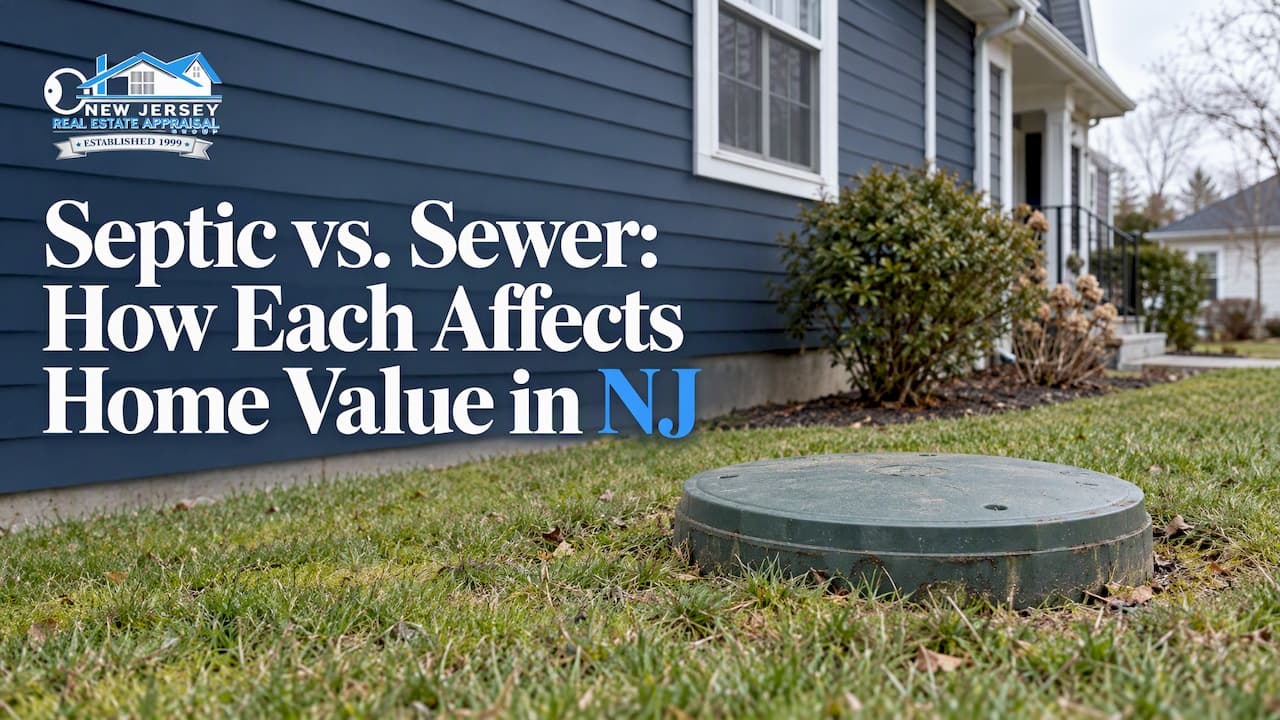
A septic system does not automatically lower what your New Jersey home is worth, and a sewer connection does not automatically raise it. What moves the number is the condition of the system, what it allows you to do with the property, and what a buyer will have to spend after closing. This guide explains how an appraiser weighs those factors, and when the difference matters enough to put in writing, such as in a divorce, an estate, a tax appeal or a sale.
TL;DR
- Septic is not a built-in discount. A well-maintained, recently inspected system usually keeps a home marketable, while a failing one becomes a cost-to-cure item in the appraisal.
- Capacity matters as much as condition. If the system limits a bedroom addition or other expansion, that limit can weigh more on value than the tank itself.
- A mandatory sewer connection can be a large liability. Cost estimates from South Florida run $30,000 to $40,000, and local rules and costs in New Jersey vary by town.
- In divorce, estate and tax matters, an unverified septic assumption can skew the number everyone relies on. A certified appraisal should state what it assumed and why.
Table of Contents
- What buyers and appraisers actually compare
- Does septic lower a home's value?
- How an appraiser treats a septic system
- New Jersey septic rules that shape value
- Condition, age and the cost to cure
- When septic capacity limits what you can do
- Does switching from septic to sewer add value?
- Where the septic question changes the number
- What to gather before you order an appraisal
- Our perspective
- Get a value you can rely on
- FAQ
- Sources
What buyers and appraisers actually compare
With public sewer, you pay a sewer charge to the municipality or utility authority, and someone else owns and maintains the main lines. With a septic system, you own the treatment tank and the disposal field, and you pay for pumping, inspection and eventual repair or replacement. New Jersey's technical guidance for onsite system inspections describes the major components: a treatment tank and a disposal area, along with the other parts that make up the system.
Buyers rarely compare the technology. They compare risk and cost. Sewer looks predictable, with a recurring bill. Septic looks like a possible five-figure surprise. A reasonable appraiser tests that perception against local sales instead of assuming it.
| Factor | Public sewer | Septic system |
|---|---|---|
| Ongoing cost | Recurring sewer charge | Pumping and inspections, no sewer bill |
| Who maintains the lines | Municipality or authority | You, for the whole system |
| Main value risk | Rate increases | Failure, undersized system, replacement cost |
| Effect on additions | Usually not a limit | Can cap bedrooms or building footprint |
| What an appraiser needs | Confirmation of connection | System type, age, inspection, capacity, comparable sales |
Does septic lower a home's value?
Not by default. A Florida International University working paper on Miami-Dade County found a price premium of about 3.1% for septic-served homes in some of its analysis, which the research ties to lower user costs than rising municipal sewer fees. That is one county in Florida with its own conditions, not a New Jersey rule. It does show that the assumption "septic always means a discount" does not hold everywhere.
In practice the outcome depends on the local market. In a New Jersey town where most homes are on septic, a septic home is simply a normal home, and the comparable sales reflect that. In a neighborhood where nearly every house is on sewer, a septic home stands out, and buyers may ask for a price concession or a recent inspection report.
Three questions usually decide it:
- Is the system documented and working? Pumping records and a recent inspection turn an unknown into a known.
- Is it sized for the house? A system designed for three bedrooms and a home that now has four is a problem buyers and lenders notice.
- Is sewer available, or coming? The answer changes both the downside risk and the upside.
How an appraiser treats a septic system
For many mortgage-financed sales, lender guidelines set the baseline. The Fannie Mae Selling Guide says utilities must meet community standards. Where public sewer is not available, the appraiser has to comment on private systems, including any adverse conditions, market resistance or hazards. If a system is known to be failing or improperly sited, that has to be reflected in the report, and the appraisal is typically made subject to inspection by a qualified professional.
Outside lending, the same logic applies in a different form. When we value a home for a divorce, an estate or a tax appeal, we are asking what a typical buyer would pay for the property as it actually is. For a septic home, that means:
- Identifying the system. Conventional tank and field, or an advanced onsite system, and what is documented about it.
- Reading the evidence. Inspection reports, pumping records, permits and any department of health correspondence.
- Finding comparable sales. Septic sales in the same market, not sewer sales adjusted by a guess.
- Separating condition from category. A system that needs work is a cost-to-cure item. A sound system is just a feature of the property.
This is also why a generic online estimate falls short. Automated valuation tools usually cannot see the septic's age, its capacity or what the last inspection found. For background on how we build a conclusion, see our overview of appraisal methods in New Jersey.
New Jersey septic rules that shape value
Septic systems in New Jersey are governed by N.J.A.C. 7:9A. According to a guide to NJ septic inspections at sale, no statewide rule requires an inspection every time a property changes hands. The same guide says N.J.A.C. 7:9A-12.6 governs how an inspection must be done when one is carried out in connection with a possible transfer. Local requirements can be stricter. The guide gives Hopewell Township in Mercer County as an example, where it says a third-party inspection and a township review are required for any transfer.
That patchwork has a practical consequence. Before you list, buy, divide or value a septic property, check with the municipality or county health department, because the inspection requirement may depend on the town. The state's homeowner guidance on septic systems is a good place to start for the basics.
Also keep in mind that a general home inspection does not necessarily cover the septic system. A buyer's inspection checklist for systems like heating and cooling, such as this HVAC inspection guide for homebuyers, is a useful reminder that each major system deserves its own specialist. Septic is one more system in that category, and it needs an inspector who works to the New Jersey protocol.
Condition, age and the cost to cure
An older system that passes today is not a guarantee. Sellers sometimes assume a passing inspection means the system will last indefinitely. Buyers sometimes overlook that a system can pass now and still fail after a household's water use increases.
When a system fails or is clearly near the end of its life, an appraiser does not simply label the house "septic, therefore lower." The appraiser weighs the cost of repair or replacement against what the market would accept. Replacement can run into thousands of dollars, and that cost flows straight into the as-is value used in a divorce buyout or an estate distribution.
A worked example, with made-up numbers for illustration only. Suppose comparable sound homes in a neighborhood sell for $600,000. Your home matches them in size and condition, but the septic system has failed its inspection and needs replacing. The as-is value is not $600,000 minus a generic septic discount. It is the market value with a working system, less the documented cost to bring the system to that standard, plus any market reaction beyond that cost. If the owner buying out a spouse uses $600,000 as the number, one side is overpaying.

Newer onsite technology can change this picture. Advanced systems built for nitrogen reduction can be seen as an advantage in environmentally sensitive areas. A valuation study prepared for a Southampton, New York property looked at that question directly, which shows that appraisers treat these systems as a local market question, not a stigma by default.
When septic capacity limits what you can do
One of the least discussed issues is highest and best use. If a septic system is sized for a certain number of bedrooms and the property cannot support a larger one, a buyer who wants an addition may be unable to build it. A Massachusetts state resource on Title 5 and real estate transactions discusses this kind of constraint under that state's rules. New Jersey has its own regulations, so do not assume the Massachusetts details apply, but the valuation logic carries over.
If you are planning an addition, a finished basement with a bedroom, or an accessory unit, ask the local health department what the existing system and lot can support before you rely on a value that assumes expansion. For investors working on renovation plans, our as-is and after-repair value appraisals are built to address exactly that gap between today's condition and the finished property.
Does switching from septic to sewer add value?
Sometimes, but the gain is not automatic and it is rarely the whole cost of the project. Connecting removes the failure risk and the capacity limit, which buyers value. But the owner pays for the connection, plus abandoning the old tank, and the market may not give back every dollar.
The larger danger is a mandatory connection. A 2026 FIU Business analysis of South Florida describes how a notice of required connection can push values down, and cites costs of $30,000 to $40,000 when permits, piping and tank abandonment are counted. Those figures come from Miami-Dade, not New Jersey, and a New Jersey connection could cost more or less depending on the lot, the distance to the main and municipal fees. Get a written estimate from a licensed contractor and the local utility before using any figure in a settlement.
If sewer expansion is under discussion in your town, tell your appraiser. Whether the market has already priced in a future connection cost is a question of fact that comparable sales can answer, and the answer can change an equitable distribution or an estate tax figure. A New Jersey example of this kind of planning is described in the Galloway Township sewer service area recommendation report, which lays out how the township's utilities division collects wastewater and where service areas are drawn.

Where the septic question changes the number
Divorce and family buyouts
In equitable distribution, one spouse often keeps the house and buys out the other. If the septic system is old or undocumented, both sides need an appraisal that says what it assumed. An unqualified value can lead to a buyout that one party later regrets. Our court-ready divorce appraisals are published at $550 to $800, and we explain the condition of the property in the report so attorneys and mediators can rely on it.
Estates and date-of-death values
For an inherited home, the value is set as of the date of death, not today. A system that failed after that date should not reduce the date-of-death figure, and one that was already failing should be reflected. We work from the evidence that existed then. Our estate and date-of-death appraisals are $595 to $850.
Property tax appeals
If your assessment ignores a failed septic system, a capacity limit or other site problem, that can be part of an appeal. The evidence has to be documented, and the appraisal should compare your property to the right sales. Our property tax appeal appraisals are $495 to $750.
Pre-listing decisions
If you plan to sell a septic home, an inspection and an appraisal before listing let you decide whether to repair, price for the issue or disclose and negotiate. See our pre-listing appraisals.
What to gather before you order an appraisal
A septic home appraisal goes faster and is more reliable when you bring the records. Our guide on how to prepare for a home appraisal in NJ covers the general list. For septic, add:
- The most recent inspection report, with the date and the inspector's findings.
- Pumping and maintenance receipts.
- The original septic permit, design plans or as-built drawing, if you have them.
- The number of bedrooms the system was approved for.
- Any letters from the municipality or health department about repairs, upgrades or sewer plans.
- Estimates for any repair or replacement work.
If you do not have an inspection yet, order one first, from a qualified professional who follows the state protocol, and then share it with us.
Our perspective
We see the septic question misjudged in both directions. Some people assume a septic home is worth much less and accept a low number. Others assume it makes no difference and overlook a failing system until the buyer's inspection exposes it. Neither assumption is evidence.
Our approach comes from more than 26 years in appraisal and real estate, including hands-on renovation and fix-and-flip work. That experience matters here, because we know what a failed system costs to fix and how it changes what a buyer will pay. We look at condition, layout, marketability and relevant comparable sales, then support the conclusion under USPAP. Where we do not know something, such as a system's capacity, we say so and state the assumption, so the people relying on the report know where the uncertainty lies.
For attorneys, executors and mediators, that clarity is the point. A number that ignores the septic system can be challenged. A number that explains it can be defended.
— Alek Petreski
Get a value you can rely on
If a septic system, a sewer connection or both affect a decision you are facing, we can help. NJREAG provides state-certified appraisals throughout New Jersey, including home appraisals at $495 to $750. Tell us about the property and the purpose, and we will explain what the report needs to cover. You can also see everything we do on our services page.
FAQ
Is a house with a septic system worth less than one on sewer?
Not necessarily. The value depends on the system's condition, its capacity and how local buyers react in that market. A documented, working system in a septic-heavy area is often treated as an ordinary feature, while a failing one is deducted at its cost to cure.
Does switching from septic to sewer increase property value?
It can, because it removes failure risk and capacity limits. The owner still pays for the connection and tank abandonment, and the market may not repay all of it. Get contractor and utility estimates before deciding.
What are the downsides of having a septic tank?
You are responsible for maintenance, pumping and eventual repair or replacement. A failing system can lower value and complicate a sale, and an undersized one can limit additions. Regular records and inspections reduce these risks.
Do I need an inspection to sell a septic home in New Jersey?
There is no statewide rule requiring one at every sale, but some towns require one, and buyers and lenders often ask for it. Call your municipality or county health department before listing. If an inspection is done in connection with a transfer, N.J.A.C. 7:9A-12.6 governs how it must be done.
Sources
- House Prices and Septic Tanks: An Examination of Miami-Dade (FIU)
- Site Section of the Appraisal Report (Fannie Mae Selling Guide)
- Technical Guidance for Inspections of Onsite Wastewater Treatment and Disposal Systems (NJDEP)
- NJDEP Homeowner Information on Septic Systems
- Septic Inspections When Buying or Selling a Home in NJ
- Appraisal of Nitrex System on Local Property Values (Southampton, NY)
- Title 5: The Impact on Real Estate Transactions (Mass.gov)
- Hidden risks, rising costs: the septic dilemma facing South Florida (FIU Business)
- Galloway Township sewer service area recommendation report (NJ.gov)
Recommended
- Real estate valuation tips for New Jersey homeowners
- Valuation reports explained: clear answers for NJ homeowners
- NJ property valuation methods for legal success in 2026
- NJ Home Appraisal: What Every Homeowner Must Know
This article is provided for general informational purposes only and does not constitute legal, tax, or financial advice. Real estate appraisal requirements can vary by assignment and intended use. For advice specific to your situation, consult the appropriate legal, tax, or financial professional.