

TL;DR:
- Retrospective appraisals determine property value on a specific past date for legal or tax purposes.
- Only certified appraisers using USPAP standards can produce legally acceptable retrospective valuations.
- Online estimates like Zillow are invalid for legal or IRS use, and accurate documentation is crucial.
When a legal or financial matter hinges on what your New Jersey property was worth at a specific point in the past, a quick online estimate simply will not do. Many homeowners and executors assume a Zillow figure or a neighbor's opinion is enough, but online tools are invalid for court submissions, IRS filings, or divorce settlements. A certified retrospective appraisal is the only tool that meets those standards. This guide explains exactly what retrospective appraisals are, when New Jersey law and the IRS require them, how the process works step by step, and what separates a report that holds up from one that gets rejected.
Table of Contents
- What is a retrospective appraisal and when is it required in NJ?
- How the retrospective appraisal process works in New Jersey
- Methods used: How appraisers value your property as of a past date
- Common pitfalls, edge cases, and making your report bulletproof
- Why most people get retrospective appraisals wrong—and what actually works
- Get reliable retrospective appraisals in New Jersey
- Frequently asked questions
Key Takeaways
| Point | Details |
|---|---|
| Certified appraisals required | Only certified retrospective appraisals are valid for NJ legal or tax cases. |
| Past value, not present | A retrospective appraisal determines what your property was worth on a specific date, not today. |
| USPAP rules apply | Appraisers must follow strict USPAP standards and only use data available at the effective date. |
| Avoid online estimates | Sites like Zillow are never accepted for divorce, estate, or tax appeals. |
| Documentation matters | Clear methodology and supporting records are essential for a defensible appraisal. |
What is a retrospective appraisal and when is it required in NJ?
A retrospective appraisal is a formal, certified opinion of what a property was worth on a specific date in the past, not what it is worth today. That past date is called the effective date, and everything in the report must reflect market conditions as they existed on that date. Nothing that happened after that date can influence the analysis.
Retrospective appraisals assign value as of a specific past date for estates, divorces, IRS returns, and tax appeals. This is fundamentally different from a standard appraisal, which values a property as of today. It is also different from a broker price opinion or an automated valuation model, neither of which carries legal weight.
Here are the most common situations in New Jersey that require a retrospective appraisal:
- Estate settlement and date of death valuation: The IRS requires a certified appraisal as of the date of death for Form 706 estate tax returns.
- Divorce and equitable distribution: New Jersey courts require property value as of the date of separation or another court-specified date. You can learn more about the requirements for an appraisal for NJ divorce or estate to understand how courts treat these valuations.
- Property tax appeals: If you are challenging a past assessment, you need a certified opinion of value as of the relevant assessment date.
- Litigation support: Disputes involving property damage, partnership dissolutions, or insurance claims often require a historical value opinion.
- Gift tax filings: Transfers of property that occurred in the past may require documented value at the time of transfer.
A certified retrospective appraisal is not optional when courts, the IRS, or opposing attorneys are involved. It is the only form of value evidence they are required to accept.
Fees for retrospective appraisals in New Jersey typically range from $595 to $850, depending on the property type, the complexity of the assignment, and how far back the effective date goes. That investment is small compared to the cost of a rejected filing or a contested settlement.
How the retrospective appraisal process works in New Jersey
Now that you know when a retrospective appraisal matters, here is how the process actually works from start to finish in New Jersey. The detailed NJ appraisal process follows a clear sequence governed by USPAP, the Uniform Standards of Professional Appraisal Practice.
- Intake and assignment setup: You provide the property address, the required effective date, and the purpose of the appraisal (estate, divorce, tax appeal, etc.). This step establishes the scope of work.
- Property inspection or historical records review: The appraiser either inspects the property or relies on historical records such as prior MLS listings, tax records, and photographs. Physical access is not always required.
- Research of past comparable sales: The appraiser identifies sales of similar properties that closed on or before the effective date. Only data available as of that date is used.
- Market condition adjustments: The appraiser applies time adjustments to account for market trends between the comparable sale dates and the effective date.
- Certified report delivery: A USPAP-compliant written report is produced, clearly stating the effective date, methodology, data sources, and the final value conclusion.
Pro Tip: If you no longer have access to the property, do not worry. A physical inspection may not be needed at all if reliable historical records exist, such as prior appraisals, MLS photos, or permit records.
USPAP standards require that the appraiser identify the effective date clearly and avoid hindsight bias, meaning no information that became available after the effective date can be used to influence the value conclusion. This rule protects the integrity of the report and makes it defensible.
After you receive the report, take time to review it carefully. Understanding how to read an NJ appraisal report helps you confirm that the effective date, methodology, and comparable sales are all clearly documented before submitting it to a court or the IRS.
| Data source | Acceptable for retrospective appraisal |
|---|---|
| MLS sales records (prior to effective date) | Yes |
| Public tax records | Yes |
| Historical photographs or prior appraisals | Yes |
| Zillow or Redfin estimates | No |
| Current MLS listings | No |
| Post-effective-date sales | No |
Methods used: How appraisers value your property as of a past date
Understanding the methodology is critical for NJ homeowners and executors. Here is how appraisers establish historic value, and why only certain methods are legally defensible.
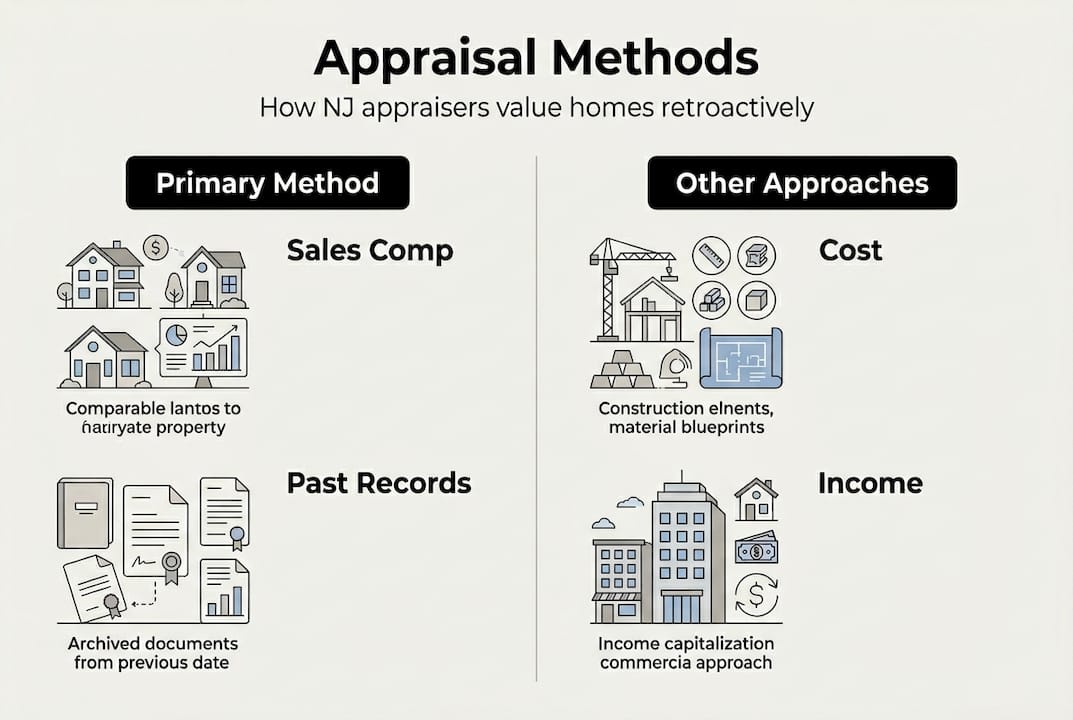
The sales comparison approach is the standard method for retrospective residential appraisals. The appraiser selects comparable sales that occurred near the effective date, then adjusts for differences in size, condition, location, and features. The sales comparison approach relies on historical comps and market condition adjustments to produce a credible value opinion.

The cost approach and income approach are used far less often in residential retrospective work. The cost approach may apply to unique or newer properties. The income approach is typically reserved for rental or commercial properties where income data from the effective date period is available.
| Valuation method | Accepted in NJ courts and IRS filings | Notes |
|---|---|---|
| Sales comparison approach | Yes | Primary method for residential properties |
| Cost approach | Sometimes | Used for unique or newly built homes |
| Income approach | Sometimes | Used for income-producing properties |
| Automated valuation model (AVM) | No | Not USPAP-compliant for legal use |
| Broker price opinion | No | Not a certified appraisal |
Factors that appraisers adjust for in the sales comparison approach include:
- Date of sale: Market conditions change over time, so sales from different months require time adjustments.
- Property size and lot area: Square footage and land size directly affect value.
- Condition and updates: The property's condition as of the effective date, not its current state, is what matters.
- Location factors: Proximity to schools, transit, and commercial areas influences value.
- Market trends: Rising or falling markets in a specific NJ neighborhood require documented adjustment support.
Pro Tip: Automated values like Zillow will not be accepted for legal or IRS cases. NJ tax appeal appraisal standards require certified, USPAP-compliant reports. Submitting an AVM or online estimate risks immediate rejection.
Avoiding hindsight bias is a strict requirement. If a comparable sale closed six months after the effective date, it cannot be used, even if it seems relevant. The appraiser must work only with what was knowable at the time. This is what makes a retrospective appraisal legally defensible and what separates it from a rough estimate. You can also review defensible NJ tax appeal appraisals to understand how this standard applies in tax contexts.
Common pitfalls, edge cases, and making your report bulletproof
Even with a solid process, some crucial mistakes can undermine your appraisal. Here is what to look out for and how to sidestep problems.
The most frequent reasons retrospective appraisals are rejected or challenged include:
- Using automated or online values: Zillow, Redfin, and similar tools are invalid for legal or tax use and will not be accepted by courts or the IRS.
- Missing or incorrect effective date: If the report does not clearly state the required past date, it fails the basic USPAP requirement.
- Lack of certified appraiser: Only a state-licensed or state-certified appraiser can produce a legally valid appraisal report in New Jersey.
- Poor documentation of comparables: Comparable sales must be supported with MLS data, public records, or other verifiable sources from the relevant time period.
- Hindsight bias in the analysis: Using sales or market data from after the effective date, even unintentionally, can invalidate the report.
Certified appraisals with clear methodologies, documented comparables, and explicit effective dates are essential for IRS and court acceptance. A report that skips any of these elements gives opposing counsel or the IRS an easy reason to challenge your position.
Edge cases do come up. Edge cases include very old dates, unique homes, or situations where historical data is limited. For example, if a property was significantly renovated after the effective date, the appraiser must reconstruct its prior condition using permits, photos, or contractor records. If the effective date goes back more than a decade, finding enough comparable sales may require expanding the search area or time range, with clear explanation in the report.
For executors managing estates, review the NJ property valuation steps relevant to your situation before ordering an appraisal. Knowing what documentation you can gather in advance, such as prior appraisals, tax records, or old listing photos, helps the appraiser build a stronger, more defensible report. USPAP guidelines also require the appraiser to document any extraordinary assumptions made when historical data is incomplete, so ask your appraiser to explain those clearly.
Why most people get retrospective appraisals wrong—and what actually works
After more than 26 years working on retrospective appraisals across New Jersey, we have seen the same mistakes repeat. The biggest one is not using Zillow. It is hiring the lowest-priced appraiser without confirming they have specific experience with retrospective assignments. A general residential appraiser may not understand the USPAP rules around effective dates, hindsight bias, or the documentation standards courts and the IRS expect.
What courts and the IRS actually look for is straightforward: a clear effective date, a qualified certified appraiser, documented comparable sales from the relevant period, and a written explanation of every adjustment. The report does not need to be long. It needs to be correct and well-supported.
Our practical advice is to focus on the effective date first. Confirm it with your attorney or accountant before ordering the appraisal. A wrong date means starting over. Also ask your appraiser to include a section on assumptions and limiting conditions in the report. That section provides an extra layer of defense if the report is ever challenged. You can review what defensible appraisal steps look like in practice, and explore the full retrospective appraisal process to know what to expect before you begin.
Get reliable retrospective appraisals in New Jersey
If you need a legally defensible retrospective appraisal for a divorce, estate, or tax appeal in New Jersey, working with a local, state-certified expert makes a real difference.

At NJREAG, our reports are USPAP-compliant, clearly documented, and built to hold up under review by attorneys, courts, and the IRS. Whether you need NJ tax appeal appraisals, divorce appraisals in NJ, or a date of death valuation for an estate, we tailor every assignment to your specific situation and timeline. Our NJ state-certified appraisers are ready to help you move forward with confidence. Contact us today to get a fast quote and find out exactly what your appraisal will involve.
Frequently asked questions
How far back can a retrospective appraisal go in New Jersey?
A retrospective appraisal can use any past date as long as reliable historical data is available for that property. There is no legal minimum or maximum lookback period.
Is a Zillow estimate acceptable for a retrospective appraisal in NJ court or for the IRS?
No. Online tools are invalid for legal or IRS use. Only a certified appraisal performed by a qualified professional meets the required standard.
What does the retrospective appraisal process cost in NJ?
Fees typically range from $595 to $850 depending on the property type and the complexity of the assignment.
What documents are needed for a retrospective appraisal?
You will need the property address and the specific effective date. Historical photos or prior records help strengthen the report but are not always required.
Do I have to allow an appraiser inside my home if it's for a retrospective report?
Not always. If reliable historical records exist, such as prior MLS listings, tax records, or photographs, a physical inspection may not be necessary.