
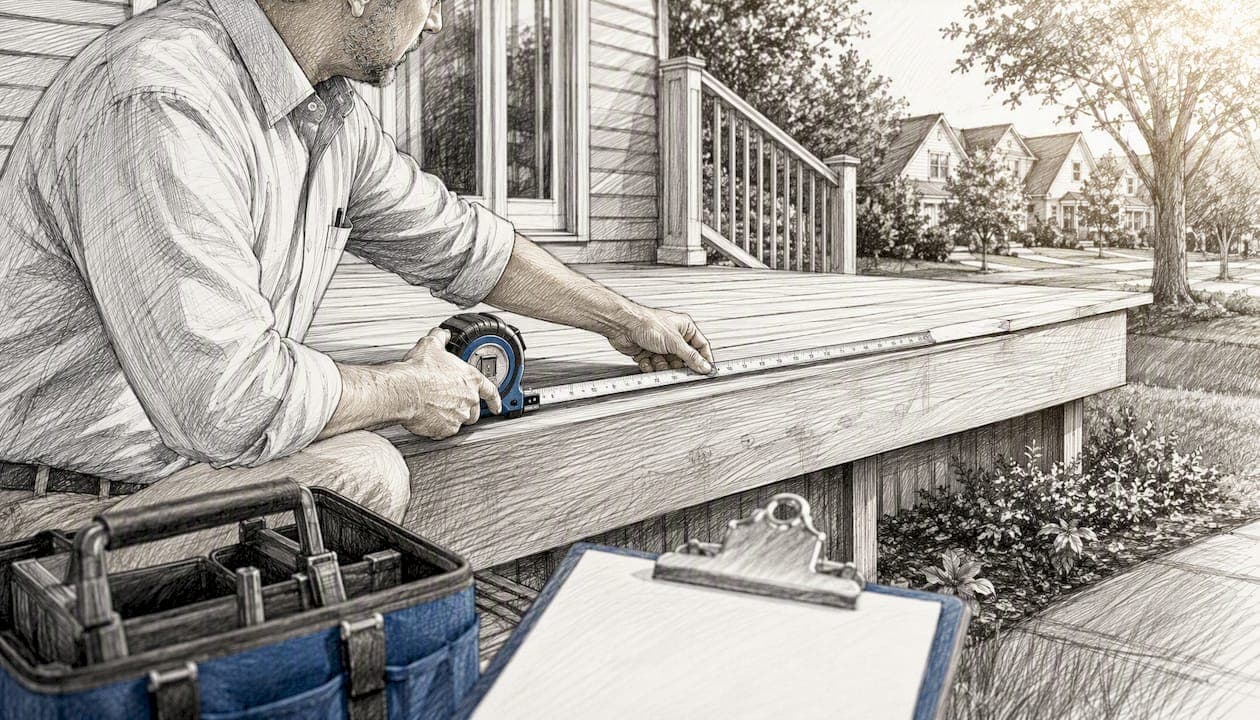
A state-certified appraiser estimates property improvements by documenting scope, applying an accepted cost method (quantity survey, unit-in-place, comparative unit, or trended historical cost), deducting accrued depreciation, and reconciling the result with sales comparison and income indications into a single USPAP-certified improvement value. The delivered report includes:
- A clear improvements description with room list and finish-level notes
- Cost backup: contractor bids, RSMeans or Marshall & Swift (M&S) citations, or both
- Depreciation analysis covering physical, functional, and economic obsolescence
- An ANSI Z765-2021 measurement statement and floor-plan addendum
- A reconciliation paragraph explaining approach weighting
- A USPAP certification signed by a New Jersey state-certified appraiser
That package is what courts, lenders, tax boards, and probate judges in NJ expect. Anything less creates exposure.
Table of Contents
- What documents and site access do you need before estimating improvements?
- How do appraisers estimate improvement value step by step?
- How do you calculate depreciation and contributory value?
- How do appraisers reconcile and report improvement value under USPAP?
- When do you need a state-certified appraiser, and how does NJREAG help?
- How long does the full appraisal process take in NJ?
- Key Takeaways
- What most appraisers get wrong about improvement valuation
- Authoritative sources and further reading
- Court-ready improvement valuations, delivered across New Jersey
What documents and site access do you need before estimating improvements?
Gathering the right materials before the inspection cuts delays and strengthens the defensibility of every cost figure in the report.
| Document / Item | Why It Matters | Typical Timing |
|---|---|---|
| Permits and certificate of occupancy | Confirms legal status of additions or renovations | Gather before inspection |
| Contractor bids and receipts | Primary cost backup; courts prefer original bids | 1–2 weeks to collect |
| Architectural plans and surveys | Supports ANSI measurement and scope verification | Gather before inspection |
| Dated pre- and post-improvement photos | Documents condition at effective date | Ongoing; compile now |
| HOA approvals (if applicable) | Affects permitted scope and value | Gather before inspection |
| Inspection reports (structural, mechanical) | Supports depreciation analysis | 1–2 weeks if not on hand |
| ANSI-compliant floor plan | Required for square-footage reporting | Appraiser measures on-site |
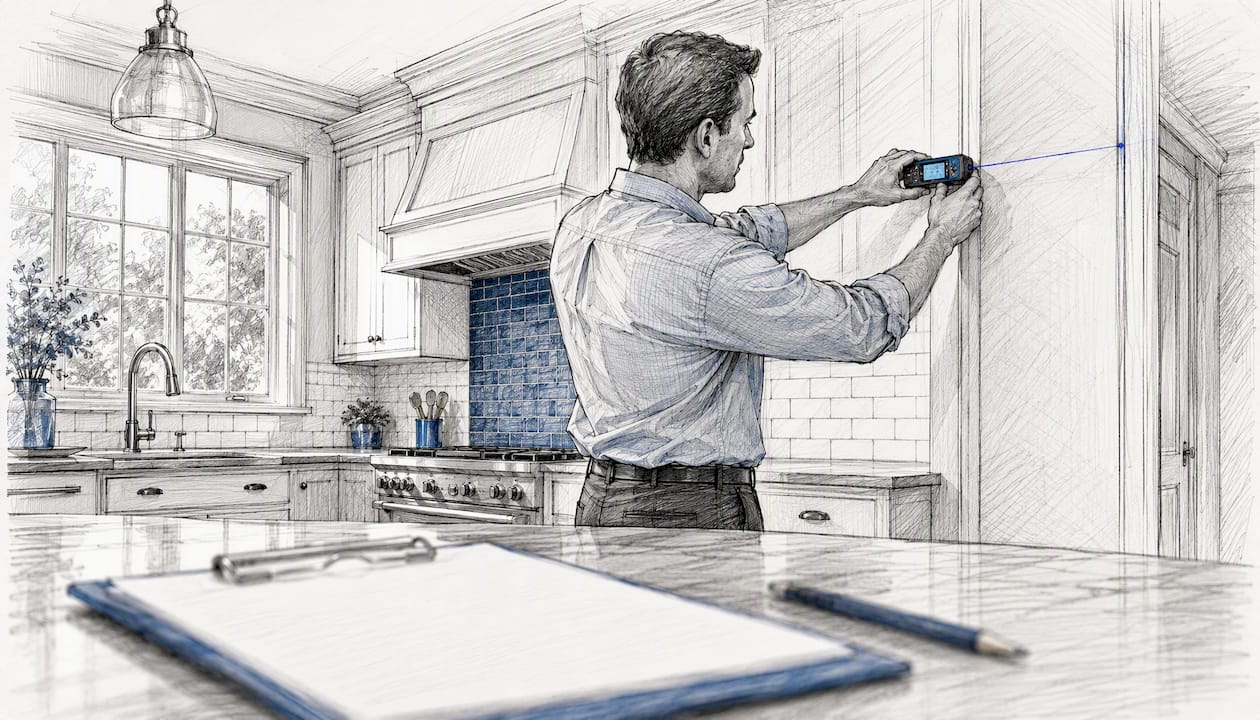
During the inspection, the appraiser records measurements per ANSI Z765-2021, notes finish levels, documents mechanical systems, and flags any evidence of unpermitted work. ADU details require separate reporting under Fannie Mae's Selling Guide. Full document prep typically takes 1–2 weeks; the inspection itself is one day. See the appraisal process steps for NJ homes for a practical prep checklist.
How do appraisers estimate improvement value step by step?
The NJ real property appraisal manual outlines seven appraisal steps; steps 1, 3, 4, and 6 carry the most weight for improvements.
- Define the problem. Set the effective date, intended use (lending, litigation, tax appeal, estate), and whether a retrospective assignment is required.
- Collect data. Gather site, off-site, and improvement information. Measure per ANSI Z765-2021. Pull contractor bids and cost-service data (RSMeans, M&S).
- Select the cost estimation method. Four options exist:
| Method | Best Use | NJ Preference |
|---|---|---|
| Quantity survey | New construction; maximum detail | Litigation, complex improvements |
| Unit-in-place | Component-by-component costing | Common in NJ for residential |
| Comparative unit | Cost per sq ft from cost services | Most common for standard residential |
| Trended historical cost | Indexes original cost to current date | Used when original cost is documented |
- Trend or index costs when using historical data. Apply a recognized cost index (RSMeans, M&S) to bring original construction costs to the effective date. Use local multipliers, not national averages, when the property has specialized finishes or materials.
- Isolate contributory value. Not every dollar spent adds a dollar of value. An addition may cost $80,000 but contribute $55,000 to market value. Distinguish additions (increase GLA), repairs (restore condition), and deferred maintenance (deductible from value). For investment properties, as-is and ARV appraisals clarify how to segregate repair cost from value added.
- Apply accrued depreciation. Subtract physical deterioration, functional obsolescence, and external obsolescence from replacement cost new to reach depreciated improvement value.
- Reconcile. Weight the cost approach against sales comparison and income indications. For unique improvements with few comparable sales, the cost approach typically carries the most weight.
Worked example (simplified): Replacement cost new, accrued depreciation, and depreciated improvement value are estimated based on documented costs and condition, with contributory value confirmed by paired sales; the reconciled improvement value reflects a balanced weighted conclusion.
How do you calculate depreciation and contributory value?
Accrued depreciation is the total loss in value from all causes. Three categories apply:
- Physical deterioration — wear, deferred maintenance, structural issues. Measured by effective age versus total economic life (straight-line/age-life method) or by observed condition breakdown.
- Functional obsolescence — features the market no longer wants (curable: cheap to fix; incurable: cost to cure exceeds value gained). A dated floor plan in a Bergen County colonial is a common example.
- External/economic obsolescence — value loss from outside the property: proximity to a highway, a declining submarket, or zoning changes.
Depreciation checklist — document each of these:
- Effective age (appraiser's judgment, not just chronological age)
- Total economic life from cost service or market data
- Observed condition notes with photos
- Maintenance records and replacement receipts
- Market rental or sales evidence supporting functional or external loss
- Engineering or contractor statements for structural or mechanical issues
Market extraction is the most defensible method when paired sales exist: find two sales where the only material difference is the improvement, isolate the value difference, and express it as a percentage of replacement cost. When paired sales are scarce, the age-life method with a well-supported effective age is the accepted fallback.
Key point: Effective age is not the same as chronological age. A well-maintained 30-year-old kitchen may carry an effective age of 15 years, cutting the depreciation deduction nearly in half.
How do appraisers reconcile and report improvement value under USPAP?
Reconciliation is not averaging. The appraiser weighs each approach based on data quality, the property type, and the intended use. For unique improvements with limited comparable sales, the cost approach typically dominates. When strong paired sales exist, the sales comparison approach provides a market-reality check that can shift the final value.
Report contents checklist:
- Clear improvements description: age, size (ANSI-measured GLA), construction quality, condition, and notable features
- ANSI Z765-2021 measurement statement
- Cost backup: itemized bids, RSMeans or M&S excerpts, or both
- Depreciation analysis with effective age, economic life, and type of obsolescence
- Approach selection rationale: why cost, sales, or income was weighted as it was
- Effective date and intended use statement
- USPAP certification signed by a New Jersey state-certified appraiser
- Addenda: floor plans, photos, permit copies, cost-service excerpts, methodology appendix
Sample reconciliation language: "The cost approach was given primary weight because the subject improvements are of a specialized nature with limited directly comparable sales. The sales comparison approach provided corroborating support, and the indicated values were reconciled to a final improvement value of $[X], reflecting the depreciated replacement cost adjusted for market reaction."
When do you need a state-certified appraiser, and how does NJREAG help?
A state-certified appraiser is required whenever the improvement estimate will be used in:
- Litigation or court proceedings (divorce, partition, condemnation)
- Probate and estate settlement (date-of-death or retrospective valuations)
- Property tax appeals before the NJ Tax Court or county board
- Federally related lending transactions (Fannie Mae, FHA, VA)
- Any assignment where a formal effective date is legally required
A contractor's estimate or a homeowner's spreadsheet does not satisfy these requirements. Only a USPAP-compliant report signed by a state-certified appraiser carries the evidentiary weight NJ courts and agencies demand.
Newjerseyrealestateappraisal delivers state-certified, USPAP-compliant reports with itemized improvement schedules, ANSI-measured floor plans, cost backup from recognized cost services, and expert testimony when needed. We cover all 21 NJ counties, including estate and date-of-death assignments and tax appeal appraisals.
Pro Tip: Before scheduling the inspection, send us your document list. We'll tell you exactly what's missing so the report isn't delayed by a permit gap or a missing bid.
Call us at (908) 517-3913 or request a quote at newjerseyrealestateappraisal.com.
How long does the full appraisal process take in NJ?
| Phase | Typical Duration | Notes |
|---|---|---|
| Document gathering | 1–2 weeks | Permits and bids often take the longest |
| On-site inspection | 1 day | ANSI measurement, photos, condition notes |
| Cost research and trending | 1–2 weeks | RSMeans/M&S lookup, local bid verification |
| Draft report and internal review | 1–2 weeks | Longer for litigation or complex improvements |
| Total (standard) | 3–6 weeks | |
| Total (litigation/complex) | 6–10 weeks | Expert testimony prep adds time |
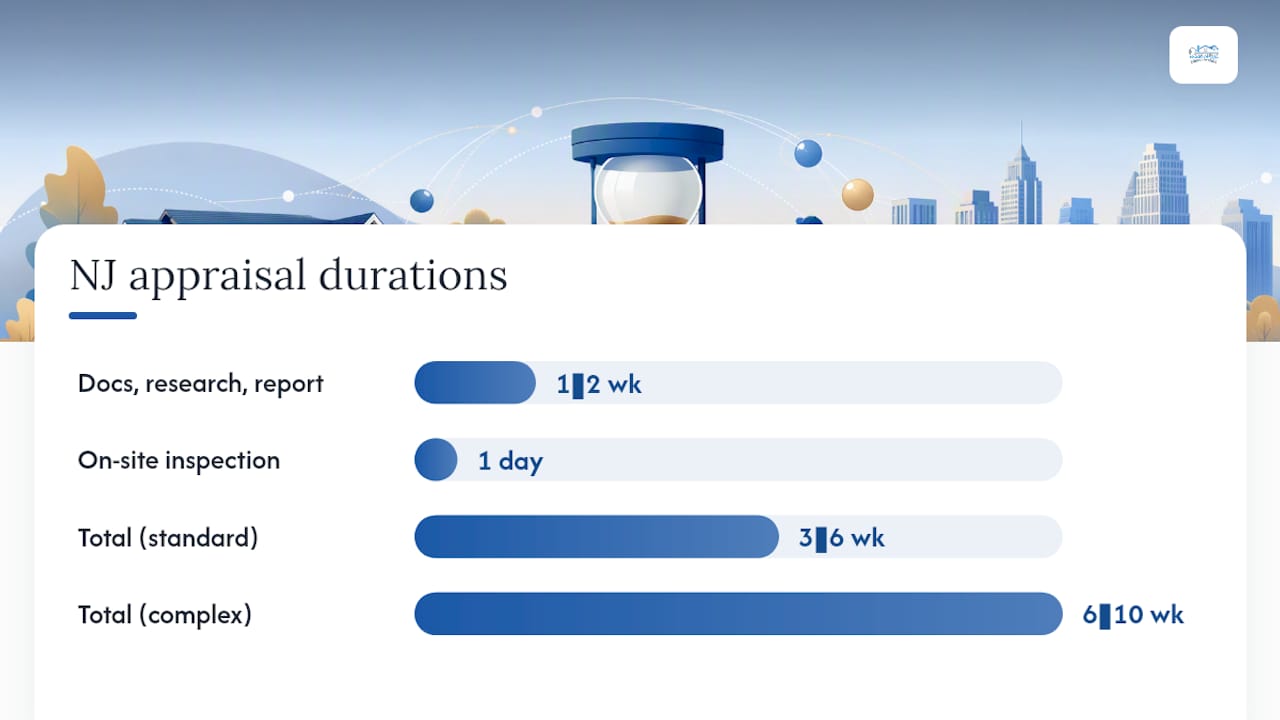
Delays almost always trace back to missing permits or incomplete contractor documentation. Starting document collection before the inspection is scheduled cuts the total timeline by a week or more.
Key Takeaways
A USPAP-compliant improvement estimate requires documented cost backup, a defensible depreciation analysis, and a signed state-certified appraiser certification — not a contractor's quote or a homeowner's spreadsheet.
| Point | Details |
|---|---|
| Cost approach is central | Quantity survey, unit-in-place, comparative unit, and trended historical are the four accepted methods; NJ appraisers most often use unit-in-place and comparative unit. |
| Depreciation must be documented | Effective age, economic life, and type of obsolescence (physical, functional, external) must each be supported by evidence in the report file. |
| Soft costs belong in replacement cost | Permits, design fees, and financing costs are part of replacement cost new; omitting them is a documented weakness NJ courts have criticized. |
| ANSI Z765-2021 is mandatory | All residential square-footage must be measured and reported per this standard; ADUs are reported separately and cannot be blended into GLA. |
| Newjerseyrealestateappraisal covers all 21 NJ counties | NJREAG delivers state-certified, USPAP-compliant reports with itemized cost backup, ANSI measurement, and expert testimony for court, estate, and tax appeal assignments. |
What most appraisers get wrong about improvement valuation
The most common mistake we see is treating the cost approach as a mechanical formula rather than a judgment-driven analysis. Appraisers plug in a cost-per-square-foot from a national database, apply a standard depreciation table, and call it done. NJ courts have pushed back on exactly that approach, and for good reason.
The real work is in the adjustments: verifying that the cost index applies to this property's materials and location, supporting the effective age with observed condition evidence rather than just chronological age, and explaining why the cost indication was weighted the way it was in reconciliation. A report that shows its reasoning survives cross-examination. One that just shows its math usually doesn't.
We've worked across all 21 NJ counties for over 26 years, including high-stakes divorce, estate, and tax appeal assignments where the improvement value was the central dispute. What protects clients is transparency: documented assumptions, preserved evidence, and a methodology appendix that leaves no question unanswered.
Authoritative sources and further reading
- New Jersey real property appraisal manual (NJ Treasury / Lincoln Institute upload)
- Key steps in the appraisal process for NJ homes 2026
- Cost Approach Basics: A Practical Appraisal Guide
- As-Is & ARV Appraisals in NJ | Real Estate Investment Valuations
- NJ property valuation methods for legal success in 2026
Court-ready improvement valuations, delivered across New Jersey

When the improvement value in your appraisal will be reviewed by a judge, a lender's underwriter, or a tax board, you need more than a number. You need a report that shows exactly how that number was reached, what cost sources were used, how depreciation was measured, and why the approaches were weighted the way they were. That's what Newjerseyrealestateappraisal provides on every assignment.
We're state-certified, USPAP-compliant, and have handled improvement valuations for divorce settlements, estate distributions, tax appeals, and lending assignments across all 21 NJ counties. Our reports include itemized cost backup, ANSI-measured floor plans, full depreciation analysis, and a methodology appendix built to withstand cross-examination.
Ready to get started? Call (908) 517-3913 or visit our NJ appraisal services page to request a quote. If you have an estate matter, our estate and date-of-death appraisal service is a direct fit.
This article provides general educational information about appraisal methodology and is not legal, tax, or financial advice. Confirm current standards and requirements with a qualified professional or the relevant regulatory authority.