

TL;DR:
- Accurate, court-accepted appraisals are essential for fair property division in New Jersey divorces.
- Appraisers must follow USPAP standards and possess appropriate credentials, typically licensed or certified.
- Complex assets like businesses and retirement accounts require specialized valuation methods and experts.
Dividing property during a New Jersey divorce or estate settlement is rarely straightforward. Without a credible, court-accepted appraisal, you risk disputes that drag on for months, unfavorable rulings, and financial outcomes that simply do not reflect reality. A formal appraisal is not just paperwork. It is the foundation of a fair resolution. This guide walks you through every critical step, from understanding NJ's legal framework to securing a report that holds up in court, so you and your attorney can move forward with confidence and clarity.
Table of Contents
- Understanding equitable distribution and appraisal basics in NJ
- Preparing for an equitable distribution appraisal: Information and documentation
- How to get a court-accepted real estate appraisal in New Jersey
- Special considerations: Business, retirement, and complex assets
- What to expect after your appraisal: Reports, court process, and common disputes
- Our perspective: The biggest pitfalls and overlooked priorities in NJ equitable distribution appraisals
- Get expert help with court-ready NJ appraisals
- Frequently asked questions
Key Takeaways
| Point | Details |
|---|---|
| Court approval required | Only licensed appraisers' formal valuations are accepted by New Jersey courts for equitable distribution. |
| Full documentation essential | Gathering all relevant documents and tracing ownership ensures smooth and accurate appraisals. |
| Neutral experts reduce disputes | Selecting joint or court-approved appraisers can minimize conflict and increase acceptance. |
| Complex assets need specialists | Businesses, retirement accounts, and high-value items require expert-specific valuation methods. |
| Every case is unique | Valuation and division depend on specific facts, assets, and the application's legal factors. |
Understanding equitable distribution and appraisal basics in NJ
New Jersey is an equitable distribution state, which means marital property is divided fairly, but not necessarily equally. This is an important distinction. A 50/50 split is the starting point in some states, but NJ courts weigh a range of circumstances before deciding who gets what.
Under N.J.S.A. 2A:34-23.1, marital property must be identified and valued before any division can occur, and valuation is typically set to the date the divorce complaint is filed. That date matters because property values fluctuate, and locking in a specific point in time protects both parties from disputes over market changes.
New Jersey courts weigh 14 to 16 factors when deciding how to distribute property. These include:
- Length of the marriage
- Each spouse's income and earning capacity
- Age and health of both parties
- Contributions to marital property (financial and non-financial)
- Tax consequences of the proposed distribution
- Debts and liabilities of each party
- Any written agreements, such as prenuptial contracts
- The needs of any dependent children
Because so many variables are in play, the importance of real estate appraisals cannot be overstated. Courts rely on licensed appraisers, forensic accountants, and actuaries as neutral or jointly retained experts. Tax assessments and comparative market analyses (CMAs) from real estate agents are not accepted as substitutes. They lack the methodology, credentials, and independence that courts require.
"A formal appraisal provides the documented, defensible value that courts need to make fair and legally sound property division decisions."
| Expert type | Asset type covered | Standard used |
|---|---|---|
| Licensed appraiser | Real estate | Fair market value |
| Forensic accountant | Business interests | Fair value |
| Actuary | Pensions, retirement plans | Actuarial present value |
| Certified appraiser | Art, jewelry, collections | Replacement or market value |
Preparing for an equitable distribution appraisal: Information and documentation
Before you contact an appraiser, you need to get organized. The quality of your appraisal depends heavily on the information you provide. Missing or incomplete records create gaps that opposing counsel will exploit.
For residential real estate, gather the following:
- Deed and title documents
- Most recent property tax bill
- Mortgage statements and payoff amounts
- Records of major improvements (receipts, permits, contractor invoices)
- HOA documents if applicable
- Prior appraisals or inspection reports
For business interests, retirement accounts, and other complex assets, documentation requirements go further. Pensions and retirement accounts require actuaries, while simpler assets like savings accounts rely on bank statements. Do not assume that a recent account statement is enough for retirement assets. Actuarial calculations factor in vesting schedules, survivor benefits, and projected growth, none of which appear on a standard statement.

One of the most overlooked issues in NJ divorce cases involves separate property. Assets owned before the marriage are generally not marital property, but the line blurs quickly. Premarital assets can become marital property if they were commingled with marital funds or improved using shared resources, making documentation tracing essential. If you used joint savings to renovate a home you owned before marriage, that appreciation may now be subject to division.
Pro Tip: Keep a dedicated folder, physical or digital, with every document related to each asset. Label items clearly with dates and sources. This makes the appraiser's job faster and reduces the chance of a contested report.
When selecting an appraiser, both parties may agree on a single neutral expert, or each side may retain their own. A joint appraiser saves money and reduces conflict, but only works when both parties trust the process. Review our property valuation guide for a closer look at how to approach this decision strategically.
How to get a court-accepted real estate appraisal in New Jersey
Once your documentation is in order, follow these steps to secure an appraisal that will hold up in court.
- Confirm the appraiser's credentials. Your appraiser must be licensed or certified by the State of New Jersey. For litigation purposes, look for designations such as MAI (Member, Appraisal Institute) or SRA, which signal advanced training in complex valuation.
- Verify USPAP compliance. The Uniform Standards of Professional Appraisal Practice (USPAP) sets the ethical and methodological baseline for all court-accepted reports. Ask directly whether the appraiser follows USPAP guidelines.
- Define the effective date. As noted above, NJ courts typically use the complaint filing date as the valuation date. Make sure the appraiser understands this requirement before work begins.
- Disclose all material facts. Inform the appraiser of any known defects, renovations, encumbrances, or unusual conditions. Withholding information can invalidate the report or expose you to legal risk.
- Review the scope of work. A proper appraisal for divorce appraisal requirements includes a physical inspection, comparable sales analysis, and written adjustments for differences between your property and the comparables.
- Understand the methodology. For residential properties, appraisers primarily use the sales comparison approach. For income-producing properties, the income approach may also apply. For vacant land, review our divorce land appraisal resource for specific considerations.
Courts accept licensed appraisers' reports over tax assessments or CMAs because formal appraisals follow a recognized methodology and are signed by a credentialed professional who can be called to testify.
| Appraisal type | Court-accepted? | Methodology |
|---|---|---|
| Licensed appraiser report | Yes | USPAP-compliant, comparable sales |
| Tax assessment | No | Municipal formula, not market-based |
| Real estate agent CMA | No | Informal, not independently verified |
| Online automated estimate | No | Algorithm-based, no physical inspection |
Pro Tip: Avoid using an appraiser who has a prior relationship with either party. Even the appearance of bias can undermine an otherwise solid report in court.
For a broader look at how appraisals function across different legal matters, our valuation methods for legal cases article covers the full picture.
Special considerations: Business, retirement, and complex assets
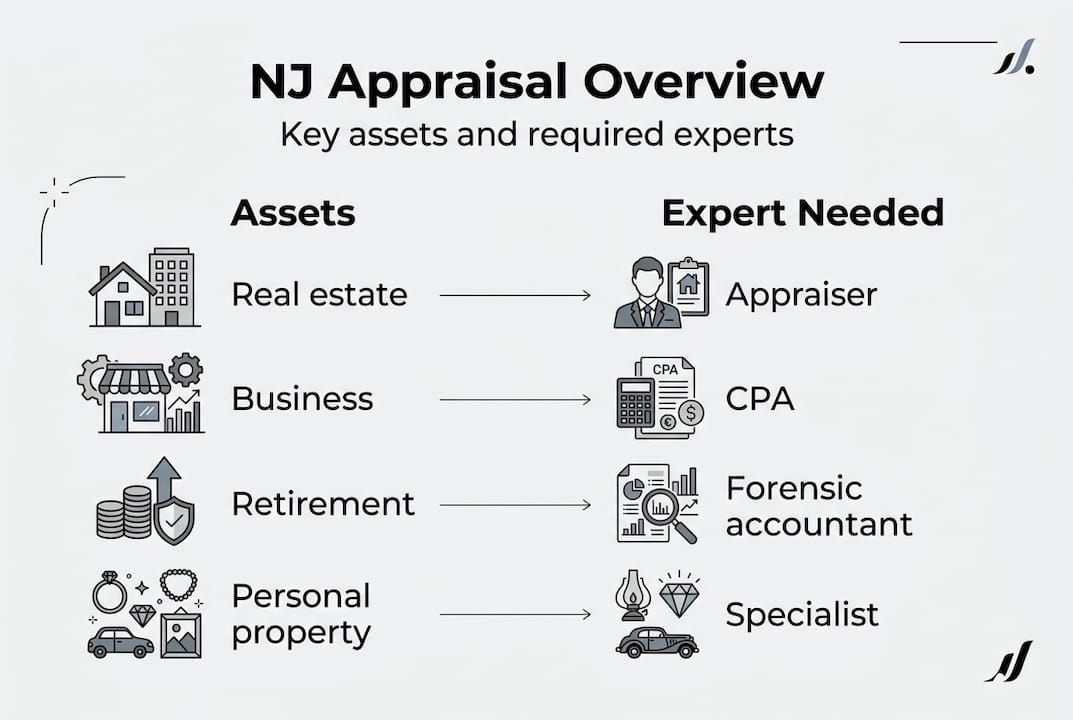
Not every asset in a divorce is a house. High-net-worth cases and long marriages often involve business interests, retirement accounts, investment portfolios, and unique collectibles. Each category requires a different expert and a different standard.
Business interests are valued using the "fair value" standard in New Jersey divorce cases, which differs from the "fair market value" standard used for real estate. Businesses use a fair value standard rather than fair market value, actuarial present value is required for retirement assets, and specialized experts are needed for complex holdings. Business valuation methods include:
- Income approach: Capitalizes or discounts future earnings to present value
- Asset approach: Values the business based on net assets
- Market approach: Compares the business to similar transactions
Retirement accounts are among the most mishandled assets in NJ divorces. A 401(k) balance shown on a statement is not the same as its equitable value. Defined benefit pensions require an actuary to calculate the present value of future payments, factoring in the employee's age, projected retirement date, and survivor benefit options.
| Asset type | Expert needed | Valuation method |
|---|---|---|
| Business interest | Forensic accountant/CPA | Income, asset, or market approach |
| Defined benefit pension | Actuary | Actuarial present value |
| 401(k) or IRA | Financial analyst | Account balance with tax adjustment |
| Art or collectibles | Certified personal property appraiser | Market or replacement value |
High-net-worth cases also raise issues around dissipation (one spouse wasting marital assets), capital gains exposure on appreciated assets, and the tax basis of investments. These are not hypothetical concerns. They directly affect how much each party actually receives after the division is finalized.
Understanding why real estate appraisal matters in this broader context helps you see that each asset class needs its own expert. Trying to handle complex assets with a single generalist is a common and costly mistake. For cases involving out-of-province documentation needs, a notary for divorce documents can help authenticate records when required.
What to expect after your appraisal: Reports, court process, and common disputes
Once the appraisal is complete, you will receive a written report. Knowing how to read and use it is just as important as getting it done.
Your report should include:
- A clear statement of the property's fair market value as of the effective date
- The methodology used and why it was selected
- Comparable sales data with adjustments explained
- The appraiser's credentials and certification statement
- A USPAP compliance certification
In court, the appraiser may be called as an expert witness to defend the report's conclusions. This is why credentials and methodology matter so much. A well-documented report is harder to challenge. Valuations are case-specific, and experts and forensic accountants are essential for court compliance, especially when one party disputes the findings.
Common dispute points include:
- Appraiser bias: One party claims the appraiser favored the other side
- Comparable selection: Disagreement over which sales were used as benchmarks
- Condition adjustments: Disputes over how property condition was rated
- Effective date: Arguments about which date should govern the value
If you and the other party cannot agree on a single value, the court may appoint its own expert or ask each side to present their appraiser as a witness. The judge then weighs the evidence and determines the final value.
Pro Tip: Read your appraisal report carefully before submitting it to court. If you find errors in the comparable data or property description, raise them with the appraiser immediately. Corrections are easier before the report is filed.
For a deeper look at how accuracy affects outcomes, our resource on accuracy in NJ divorce appraisals explains the real stakes involved.
Our perspective: The biggest pitfalls and overlooked priorities in NJ equitable distribution appraisals
After more than 26 years of completing appraisals for NJ divorce and estate cases, we have seen the same mistakes come up repeatedly. The most damaging one is assuming that a faster or cheaper option will hold up in court. It rarely does.
People sometimes push back on the cost of a professional appraisal, especially when they are already dealing with legal fees. But a flawed report costs far more when it gets challenged, delays the case, or forces a second appraisal. Why accuracy is non-negotiable is something we explain to every client from the first conversation.
Here is the contrarian view that most people miss: equitable distribution often starts near 50/50, but the final outcome is shaped by contributions, dissipation, special needs, and documented facts. That means the appraiser's job is not just to produce a number. It is to produce a number that reflects the full picture of what that asset is worth on a specific date, using a method the court will accept. Every case is fact-specific, and every appraisal should be too.
Get expert help with court-ready NJ appraisals
A credible appraisal does more than satisfy a legal requirement. It protects your financial interests, reduces the risk of prolonged disputes, and gives your attorney the evidence needed to negotiate or litigate effectively.

At NJREAG, we provide certified, USPAP-compliant divorce appraisals in New Jersey for every county in the state. Our reports are built to withstand court scrutiny, and our team works directly with attorneys and clients to meet case-specific deadlines. Whether you need divorce settlement appraisals for residential property or valuations for complex estates, we are ready to help. Explore our full appraisal services or contact us today for a confidential consultation and fast quote.
Frequently asked questions
What is an equitable distribution appraisal in NJ?
It is a formal, court-accepted valuation of marital or estate property used to guide fair division in a New Jersey divorce or estate settlement. Under NJ law, marital property must be identified and valued before any division can take place.
When is the valuation date for equitable distribution in New Jersey?
The property valuation date is usually the date the divorce complaint is filed, unless the court finds a different date appropriate. The complaint filing date is the standard starting point under NJ law.
Can we use tax assessments or online estimates instead of an appraisal?
No. NJ courts require licensed appraisers' formal reports using recognized methods. Courts accept licensed appraisers' reports over tax assessments or CMAs because only formal appraisals meet the required legal and methodological standards.
What if we disagree with the appraisal value?
You can request a second opinion, hire another joint expert, or present your case in court for a judge's decision. Valuations are case-specific, and courts have the authority to weigh competing expert opinions and determine the final value.
Who pays for the appraisal in a New Jersey divorce?
Appraisal fees are usually shared equally between both parties, but the court can allocate costs differently based on the circumstances. Experts and forensic accountants are considered necessary costs for court compliance, and judges have discretion over how those expenses are assigned.