
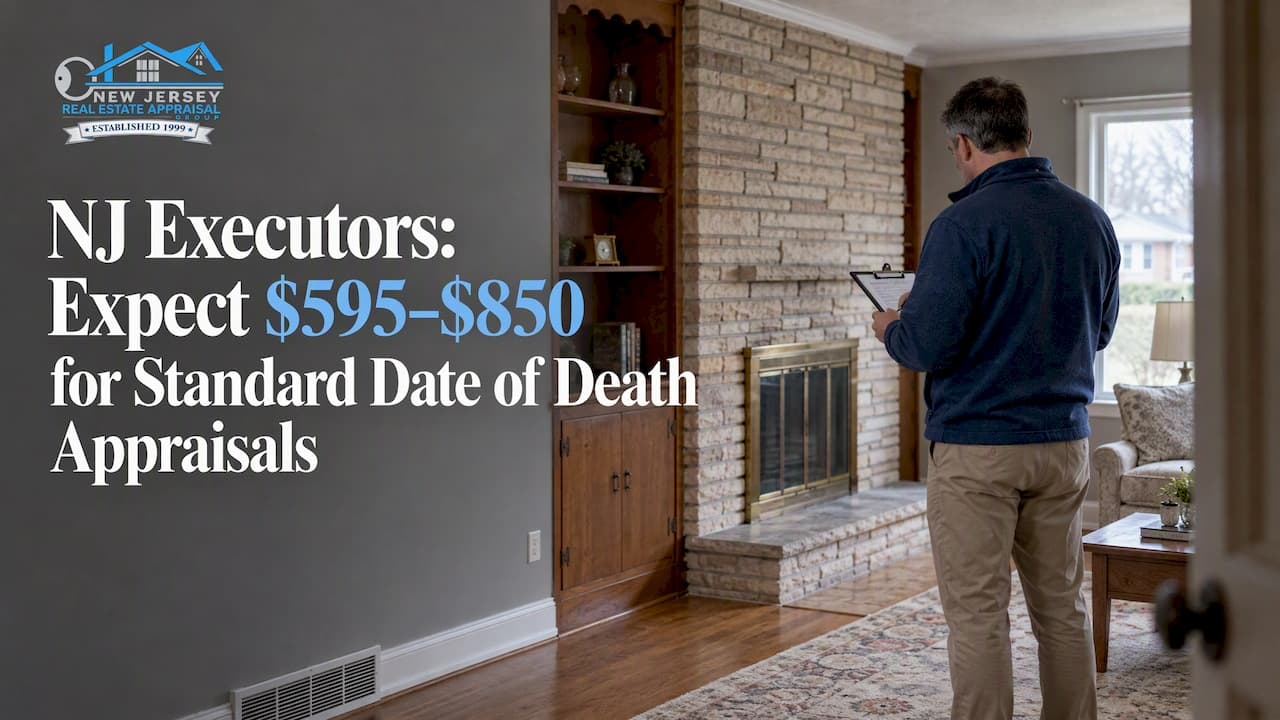
Date of death appraisals for typical single-family homes generally vary in cost, with more complex retrospective assignments involving business interests, partial ownership, or litigation support costing more. The jump in price comes down to one thing: retrospective research takes longer than a current-market appraisal, since the appraiser has to reconstruct value as of a past date instead of today. Reports tied to a Form 706 filing or court proceeding tend to land at the higher end because they require more documentation and a narrative format.
TL;DR:
- Appraisal costs increase with complexity, with standard residential estimates ranging from $595 to $850 in New Jersey, and higher fees for properties with partial interests or additional legal needs.
- Detailed documentation, including deeds, tax records, and leases, reduces costs and helps ensure the appraisal withstands legal or IRS scrutiny.
- A well-executed appraisal typically remains valid and defensible for several years, provided its data and analysis are thorough and well-supported.
- Choosing an appraiser experienced in estate valuation and familiar with Form 706 requirements minimizes the risk of future challenges or costly disputes.
- Prioritizing a detailed narrative report over a simple form reduces potential vulnerabilities, especially when estate values may be scrutinized by tax authorities or involved in litigation.
Table of Contents
- Typical fees explained: simple to complex assignments
- What drives the fee: fee drivers and typical add-ons
- When an appraisal is required or advisable
- How appraisers establish date-of-death value: methods and defensible reporting
- Timeline and validity: how long an appraisal takes and how long it holds up
- What executors and attorneys should provide: a practical checklist
- How to choose a qualified date-of-death appraiser and red flags
- Practitioner perspective: the appraisal fee as insurance against audit and dispute
- Certified estate and date of death appraisals from our New Jersey team
- FAQ
- Sources
Typical fees explained: simple to complex assignments
Fee ranges for date of death appraisals vary by property type, assignment complexity, and how much historical research the effective date requires. A small estate with a straightforward single-family home usually sits at the lower end of the range, while an estate with multiple parcels, a business component, or contested ownership can cost several times more.
Based on typical New Jersey market pricing, here is how costs generally break down by scenario:
- Standard residential date-of-death appraisal: $595 to $850 for a certified estate and date of death appraisal on a single-family or condo property with clear ownership.
- Multi-family or investment property: Fees run higher than standard residential work because the appraiser has to analyze rental income, leases, and operating expenses as of the effective date.
- Complex retrospective assignments: Properties with partial interests, easements, or unusual zoning require deeper archival research and typically command a premium over standard residential fees.
- Business-interest or entity-level valuations: When an estate includes ownership in a closely held company that holds real property, appraisers often coordinate with a business valuation specialist, which adds both time and cost.
These figures are illustrative examples based on typical New Jersey assignment types, not fixed quotes. A detailed breakdown of New Jersey estate appraisal costs shows how local pricing tends to track these same bands. The final number always depends on the specific property, the purpose of the report, and how much documentation the executor can supply up front. A rush request, an out-of-state property, or a request for a formal narrative report built for litigation will push the fee above a standard form appraisal every time.
What drives the fee: fee drivers and typical add-ons
Appraisal fees are not arbitrary. A handful of concrete factors determine whether a report costs a few hundred dollars or several thousand, and understanding them helps you compare quotes meaningfully instead of just picking the lowest number.
- Report type: A simple form report costs less than a narrative report, and a narrative built to withstand IRS scrutiny or court cross-examination costs more than either.
- Historical research depth: Reconstructing market conditions for a date years in the past takes longer than pulling current comparable sales, since the appraiser has to locate archived listings and adjust for market movement.
- Ownership complexity: Partial interests, tenancy disputes, or built-in capital gains considerations add analytical steps that a straightforward single-owner property does not require.
- Logistics: Rush turnaround, travel to a distant property, or the need for expert witness testimony later all add to the base fee.
Pro Tip: Ask upfront whether the quoted fee includes a narrative report or only a form report. If there is any chance the estate will need court-ready documentation, request the narrative format from the start rather than paying for a second report later.
When an appraisal is required or advisable
A date of death appraisal becomes necessary in several common situations, and in each case the report does real work: it establishes a defensible value that protects the estate from later disputes. For federal estate tax purposes, the basic exclusion amount for 2026 is $15,000,000, and estates above that threshold generally must file Form 706, which requires supportable fair market values for all real property held at death.
The IRS treats the basis of inherited property as its fair market value on the date of death, or on the alternate valuation date if one is elected for Form 706, according to IRS guidance on gifts and inheritances. This matters even for estates well under the filing threshold, since heirs who later sell inherited property need that date-of-death basis to calculate capital gains correctly. Probate courts in many cases also require a documented value before property can be distributed or sold, and our guide to property appraisal for probate in New Jersey walks through those state-specific steps.

How appraisers establish date-of-death value: methods and defensible reporting
Retrospective appraisals rely on the same core approaches as any real estate valuation, applied to a past effective date instead of today. The sales comparison approach is the most common: the appraiser locates comparable sales that closed near the date of death, then adjusts for any market movement between that sale date and the effective date. For income-producing property, an income approach using period-appropriate rents and expenses often supports or confirms the sales comparison conclusion. A cost approach can apply when the property is unusual or comparable sales are scarce.
When an estate includes closely held business interests, appraisers often factor in considerations like built-in capital gains at the entity level, since those liabilities can affect what a willing buyer would actually pay for the ownership interest. A defensible report documents every comparable used, explains every adjustment, and ties each conclusion back to verifiable market evidence rather than a general estimate. The American Bar Association's guidance on managing an estate stresses that executors should seek appraisers licensed and experienced in the specific asset category, since a generic residential appraiser may not have the background to handle a business-linked property interest correctly.
Timeline and validity: how long an appraisal takes and how long it holds up
A standard date of death appraisal on a single residential property typically takes one to two weeks from order to delivery, assuming the appraiser can access the property and the executor provides basic documentation promptly. Complex retrospective assignments, especially those requiring archived comparable sales research or coordination with a business valuation specialist, can take several weeks longer.
Once delivered, a well-documented report generally remains defensible for as long as the underlying facts and analysis hold up to scrutiny, whether that scrutiny comes from an IRS audit years later or a dispute among heirs. The report's staying power comes from its documentation quality, not its age: a thin, poorly sourced report can be challenged quickly, while a thorough narrative report with clearly explained comparables tends to withstand later review.

What executors and attorneys should provide: a practical checklist
Organized records speed up the appraisal and reduce the hours an appraiser has to spend on research, which directly affects the fee. The American Bar Association recommends that executors gather key documents before the appraiser's first site visit.
- Deed and property tax records: Confirm legal ownership and current assessment history.
- Mortgage statements and liens: Document any outstanding debt against the property at the date of death.
- Renovation invoices and permits: Show what work was done and when, which affects condition at the effective date.
- Leases or rental agreements: Necessary for any income-producing property in the estate.
- Prior appraisals or sale contracts: Give the appraiser a starting point and a cross-check for their own conclusion.
For personal property mixed in with real estate, such as a home with significant fixtures or outbuildings, flag anything unusual early so the appraiser can bring in a specialist if needed rather than discovering the issue mid-assignment. Our step-by-step guide to getting a date of death property value in New Jersey covers this intake process in more detail.
How to choose a qualified date-of-death appraiser and red flags
Not every appraiser is equipped to handle retrospective estate work, and choosing the wrong one can cost you more in the long run if the report gets challenged. Look for state certification, demonstrated compliance with the Uniform Standards of Professional Appraisal Practice, and direct experience with estate or retrospective assignments specifically.
- Ask about Form 706 experience: An appraiser who has prepared reports for estate tax filings understands what documentation the IRS expects.
- Request a sample report: A redacted narrative report shows whether the appraiser explains comparables and adjustments clearly enough to survive scrutiny.
- Ask about testimony history: If litigation is possible, confirm the appraiser has experience defending a report under cross-examination.
Pro Tip: Treat any appraiser who offers a fee contingent on the final value, or who cannot show documented comparable sales for their conclusions, as a red flag. A credible appraisal fee is fixed regardless of outcome.
According to NAR's overview of appraisal and valuation standards, a non-routine assignment like a narrative or court-ready report typically commands a higher fee than a standard lender form appraisal, which is a reasonable trade-off for the added defensibility.
Practitioner perspective: the appraisal fee as insurance against audit and dispute
After more than 26 years in appraisal and real estate, including hands-on renovation work, we have seen what happens when an estate skips a proper date-of-death appraisal to save a few hundred dollars. A thin, undocumented value estimate can trigger an IRS challenge or a fight among heirs that costs far more than the appraisal fee ever would have. We treat every date-of-death assignment as a document that has to hold up years later, not just satisfy a checklist today. If there is any chance of an audit or a dispute, prioritize a documented narrative report over the cheapest option on the table.
— Alek Petreski
Certified estate and date of death appraisals from our New Jersey team
A documented, defensible appraisal costs far less than the risk of an undervalued estate drawing an IRS challenge or a fight among heirs. We provide court-ready estate and date of death appraisals for New Jersey executors, attorneys, and families, backed by more than 26 years of appraisal and real estate experience and full compliance with the Uniform Standards of Professional Appraisal Practice.

If you need a retrospective value for probate, Form 706, or a buyout among heirs, request your certified estate and date of death appraisal today and get a report built to withstand review.
This article is general information, not a substitute for advice from a qualified financial advisor. Consult a qualified financial professional about your own circumstances before acting on anything here.
FAQ
How much should a date of death appraisal cost?
A standard residential date of death appraisal in New Jersey typically costs between $595 and $850 for certified estate and date of death appraisals. Complex assignments involving business interests, partial ownership, or litigation support cost more due to the added research and reporting required.
Does the IRS require a date of death appraisal?
The IRS requires a documented fair market value as of the date of death for estates that must file Form 706, which applies when the estate exceeds the 2026 basic exclusion amount of $15,000,000. Estates under that threshold often need the date-of-death value to establish the cost basis heirs use when they later sell the property.
How do you value a house at the date of death?
Appraisers use the sales comparison approach, locating comparable sales near the date of death and adjusting for market movement between the sale date and the effective date. Income or cost approaches may support the conclusion when the property produces rental income or lacks sufficient comparable sales.
How long is a date of death appraisal good for?
A well-documented date of death appraisal remains defensible for as long as its underlying analysis and comparables hold up to scrutiny, which can mean years if the estate faces an audit later. The report's age matters less than the quality of its documentation and the clarity of its adjustments.
Sources
- Estate tax | Internal Revenue Service
- How to carry out the duties of managing an estate | American Bar Association (GPSolo eReport)
- Real estate appraisal & valuation | National Association of REALTORS®
Recommended
- $595–$850: What NJ Executors Pay and Who Appoints Estate Appraisers
- NJ Executors: Appraisal Checklist for IT-R, Form 706, and Court Use
- Executors: NJ Probate Appraisal Rules, Statutes, and 8-Month Checklist
- Estate Tax Appraisal Requirements for NJ Attorneys & Executors
This article is provided for general informational purposes only and does not constitute legal, tax, or financial advice. Real estate appraisal requirements can vary by assignment and intended use. For advice specific to your situation, consult the appropriate legal, tax, or financial professional.