
New Jersey requires a clear market value appraisal as of the date of death for any property subject to transfer inheritance tax, and you need a state-certified, USPAP-compliant appraiser to produce it. Skip this step or rely on a Zillow estimate, and you risk penalties, an audit, or a court rejecting your accounting. Order the appraisal soon after your appointment as executor, because the IT-R filing deadline is less than a year away, and retrospective valuations take longer to research than a standard appraisal.
TL;DR:
- Appraisers must produce a USPAP-compliant report valuing property at its true market value as of the decedent’s date of death to support inheritance tax filings.
- Order the appraisal within 30 to 90 days of appointment, especially for retrospective valuations, to accommodate longer research times and meet deadline requirements.
- The appraisal report must clearly state the effective date as the date of death, include comparable sales from that period, and contain supporting photos and a signed certification.
- Failing to obtain a proper date-of-death appraisal risks penalties, audits, or rejection in court, with current market values and non-certified opinions unlikely to suffice.
- The eight-month inheritance tax filing deadline requires early planning, as unpaid taxes accrue interest at 10% annually beyond that point.
Table of Contents
- What Are NJ's Probate Appraisal Requirements Under State Law?
- NJ Probate Appraisal Deadlines: Filing, Interest, and Extensions
- What Belongs in a USPAP-Compliant Date-of-Death Appraisal Report
- Common Mistakes Executors Make With Probate Appraisals
- Court-Appointed Appraisers and the Family Exemption
- How to Hire and Brief an Appraiser for Probate Work
- Why a Defensible Appraisal Protects You as Executor
- Get a Court-Ready Estate Appraisal From NJREAG
- Sources
- FAQ
What Are NJ's Probate Appraisal Requirements Under State Law?
Two separate legal tracks govern probate appraisal requirements in NJ, and executors often confuse them. One deals with the inheritance tax return. The other deals with the court's inventory process. You may need to satisfy both.
N.J.S. 3B:16-2 sets the rules for filing an inventory and appraisal of the estate. Generally, you don't have to file that inventory until three months after you receive letters of administration, unless a family exemption is being set off against the estate, which can trigger an earlier requirement. N.J.S. 3B:16-3 covers what happens when the court gets involved: the surrogate can appoint two impartial appraisers, and those appraisers take an oath to value the property at its "true and intrinsic value."
Separately, and this is the part that trips people up, N.J. Admin. Code § 18:26-8.8 requires that any real, personal, tangible, or intangible property subject to New Jersey's transfer inheritance tax be valued at its clear market value as of the decedent's date of death. This isn't optional guidance. It's the standard the Division of Taxation applies when it reviews your return.
Here's what that means practically:
- If the estate owes inheritance tax, you need a date-of-death appraisal regardless of whether the court requires a formal inventory.
- If a family exemption is being carved out, expect the surrogate to move faster and possibly appoint appraisers directly.
- If there's no tax due and no exemption dispute, the inventory deadline is more relaxed, but you still need documentation supporting whatever values you report.
NJ Probate Appraisal Deadlines: Filing, Interest, and Extensions
Miss the inheritance tax deadline, and the state starts charging interest the day after it passes. Here's the timeline you're working against:
- Eight months from date of death. Form IT-R (resident) or IT-NR (non-resident) is due, with any tax owed paid in full. Miss this and interest accrues on the unpaid balance at 10% per year.
- Nine months from date of death. If the estate is large enough to trigger federal estate tax, IRS Form 706 is due. When both filings apply, ask your appraiser to write the report so it supports both the IT-R and Form 706 at once, since the underlying valuation work overlaps heavily.
- Extension option. Form IT-EXT extends your filing deadline, but it does not extend your payment deadline. If you owe tax, pay an estimate by month eight or the interest clock starts anyway.
- Waivers. Certain Class A beneficiary transfers (spouse, child, grandchild, parent) may qualify for an L-8 self-executing waiver or an L-9 waiver for real property, which can remove the need to file a full return. Rules differ for resident and non-resident decedents, so confirm eligibility before assuming you're exempt.
Given that eight-month wall, the math on ordering an appraisal is simple. Commission it within 30 to 90 days of your appointment. Retrospective, date-of-death appraisals require pulling archived comparable sales and reconstructing property condition from months or years earlier, which takes longer than a same-day valuation. Waiting until month six leaves no room for error if the appraiser needs additional research time or the estate needs a second review.
What Belongs in a USPAP-Compliant Date-of-Death Appraisal Report
A report that gets accepted by the Division of Taxation and holds up in Surrogate's Court looks nothing like a broker's market analysis. It has specific, non-negotiable components.
- Effective date stated as the date of death, not the inspection date or the report date.
- Intended use clearly identified as estate, probate, or inheritance tax purposes.
- Scope of work statement describing what the appraiser researched and how.
- Comparable sales drawn from the valuation period, meaning sales that closed around the date of death, not current listings.
- Condition notes and, ideally, photos documenting the property as it existed on that date, including any damage, deferred maintenance, or improvements.
- Reconciliation of value approaches, showing how the appraiser arrived at the final number.
- Signed certification with the appraiser's state license number and a USPAP compliance statement.
The appraiser should also retain a full workfile, meaning the research notes, comparable data, and supporting documents behind the number in the report. If the Division of Taxation questions the valuation later, that workfile is what proves the number was defensible rather than guessed.
Pro Tip: Ask upfront whether the appraiser has handled retrospective date-of-death work before. It's a specialty. Plenty of licensed appraisers do current-value assignments all day but rarely, if ever, dig into archived sales data from two or three years back.
This is also why lender appraisals, broker price opinions, and municipal tax assessments usually fail probate scrutiny. A lender appraisal is built for a loan decision, not a retrospective legal standard. A BPO isn't produced by a certified appraiser and carries no USPAP backing. A tax assessment reflects the municipality's formula, not clear market value on a specific date. None of them carry the certification language an auditor or a judge expects to see.
Common Mistakes Executors Make With Probate Appraisals
Most of the trouble we see traces back to a handful of avoidable errors.
- Using today's market value instead of the date-of-death value. If the decedent died two years ago and you're only now settling the estate, current comps don't apply. You need a retrospective analysis tied to that earlier date.
- Substituting a tax assessment or an agent's opinion for a real appraisal. These documents were built for entirely different purposes and generally don't hold up to a Division of Taxation review.
- Skipping the written scope of work and certification. If the appraiser doesn't put the intended use and license number in writing, you have no proof the report meets probate standards.
- Failing to keep records. Save every email, invoice, and draft report. If the estate faces an audit or a beneficiary dispute, you'll want a paper trail showing you acted diligently.
Court-Appointed Appraisers and the Family Exemption
If a family member is claiming the statutory family exemption, meaning they're keeping certain personal property or a portion of the estate off the general distribution, the surrogate may move faster on the inventory requirement.
- The three-month window to file an inventory generally applies once letters are granted, but a family exemption claim can force earlier action.
- Under N.J.S. 3B:16-3, the surrogate can appoint two impartial appraisers who take an oath to value the property honestly and without bias toward any beneficiary.
- You don't have to wait for court appointment. In most cases, proactively hiring your own state-certified appraiser gets you a usable report faster than waiting on the court's process. It gives you control over turnaround time.
How to Hire and Brief an Appraiser for Probate Work
Getting the right report starts with giving the appraiser what they need and asking the right questions before you sign anything.
- Gather your documents first. Have the death certificate, deed, mortgage statement, most recent tax bill, and any records of repairs or renovations ready to hand over.
- Vet the appraiser directly. Ask for their state certification number, confirm USPAP compliance, and ask specifically whether they've done date-of-death or retrospective valuations before. Request a sample report excerpt if they have one.
- Get written confirmation on three things: the intended use (estate or probate), the effective date (the date of death, not the inspection date), and a signed certification with license number attached to the final report.
Pro Tip: If the estate might owe both New Jersey inheritance tax and federal estate tax, say so when you order the appraisal. A report scoped for both filings from the start saves you from paying for a second valuation later.
Confirm expected turnaround before you commit. Retrospective work involving archived sales data typically runs longer than a standard current-value assignment, so build that into your eight-month countdown.
Why a Defensible Appraisal Protects You as Executor
As executor, you're personally responsible for how the estate's assets get valued and reported. A vague number pulled from a real estate app doesn't protect you if the Division of Taxation disagrees with it later.
We specialize in state-certified, USPAP-compliant, court-defensible appraisals across all 21 New Jersey counties, and estate work is one of the areas we handle most often. A properly documented, date-of-death report gives you a paper trail that shows you met your fiduciary duty. That reduces your personal exposure and tends to move the estate toward closing faster, since beneficiaries and the court have one clear number to work from instead of competing guesses.
— Alek
Get a Court-Ready Estate Appraisal From NJREAG
You've got an eight-month clock running and no room for a valuation that gets challenged. Newjerseyrealestateappraisal built its Certified Estate and Date of Death Appraisals in New Jersey service specifically around IT-R, IT-NR, and Form 706 requirements, so the report you get is written for the filing you actually need, not retrofitted afterward.

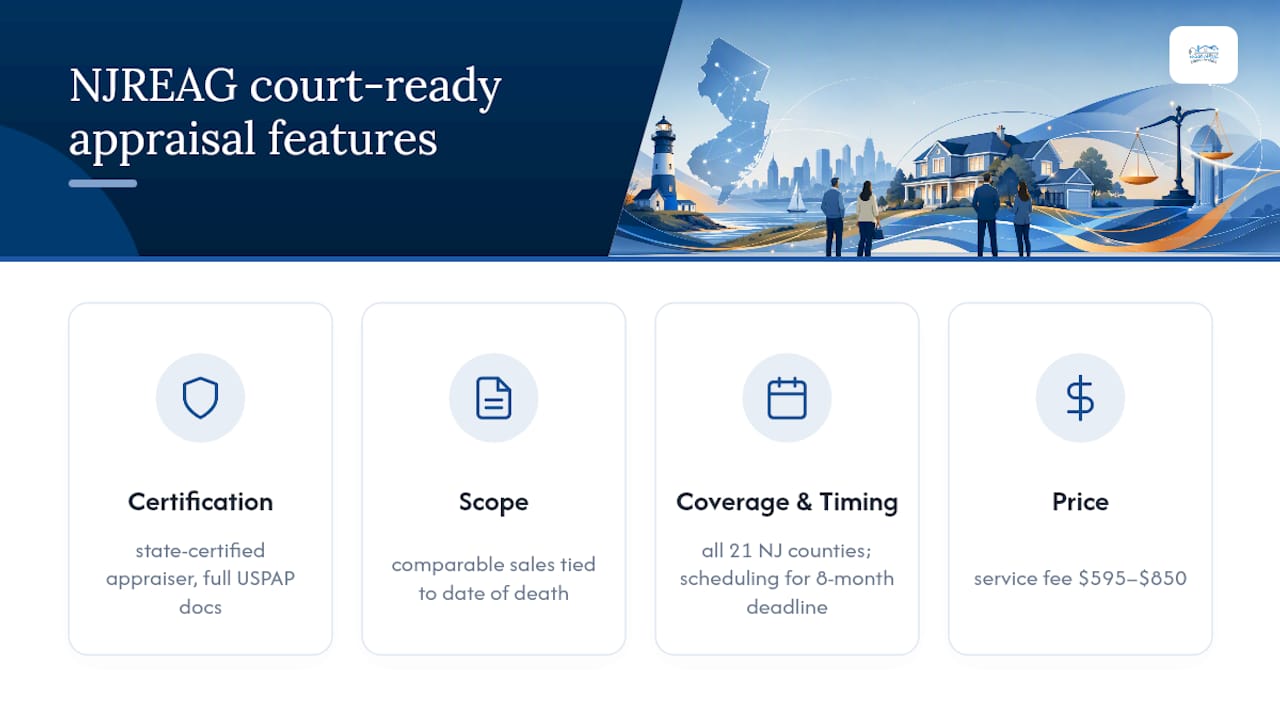
Every report comes from a state-certified appraiser and carries full USPAP documentation, comparable sales tied to the date of death, and a workfile we retain in case the estate faces questions down the line. Pricing for this service runs $595 to $850, and we serve executors across all 21 New Jersey counties, with prompt scheduling built around your eight-month deadline.
Call (908) 517-3913 or visit our estate and date-of-death appraisal page to request a quote and lock in your turnaround window now. This article is informational and not legal advice. Talk to an estate attorney for guidance specific to your situation.
This article is general information, not a substitute for advice from a qualified lawyer. Consult a qualified legal professional about your own circumstances before acting on anything here.
Sources
- N.J. Admin. Code § 18:26-8.8 - Valuations generally (LII / Cornell)
- NJ Division of Taxation - Inheritance and Estate Tax
FAQ
Is an Appraisal Required for Probate in New Jersey?
Yes, if the estate includes property subject to New Jersey's transfer inheritance tax. State regulations require a clear market value appraisal as of the date of death for that property, and the Division of Taxation expects a USPAP-compliant report to support the value reported.
What Are the Probate Laws in New Jersey Regarding Inventory and Appraisal?
Under N.J.S. 3B:16-2 and 3B:16-3, an executor may need to file an inventory and appraisal of the estate, and the Surrogate's Court can appoint impartial appraisers when a family exemption is being claimed. The inventory generally isn't due until three months after letters are granted, unless that exemption speeds things up.
How Long Does an Executor Have to Settle an Estate in New Jersey?
There's no single fixed deadline for closing an entire estate, but the inheritance tax return has a hard clock. Form IT-R or IT-NR is due within eight months of the date of death, and unpaid tax after that point accrues interest at 10% per year.
What Assets Are Exempt From Probate in NJ?
Assets that pass by beneficiary designation, like life insurance proceeds and retirement accounts with named beneficiaries, along with jointly held property with rights of survivorship, generally bypass probate. Some Class A beneficiary transfers may also qualify for an L-8 or L-9 waiver, which can remove the formal filing requirement for certain assets.
How Much Does a Probate Appraisal Cost in New Jersey?
Newjerseyrealestateappraisal's Certified Estate and Date of Death Appraisals run $595 to $850, depending on property type and research complexity. Retrospective valuations sometimes cost more than standard appraisals because they require archived comparable sales and additional documentation.