
If you own, inherit, divide or sell a house on a busy road, the question is not whether traffic matters. It is how much, and whether the number in your appraisal can be defended. Studies put the discount for a house on a busy street anywhere from a few percent to about 10% against similar homes on quieter streets, and the size depends on the road, the lot and the buyers in that micro-market. A credible opinion of value measures that gap from local sales instead of applying a rule of thumb. That is how we approach it at New Jersey Real Estate Appraisal Group, and it matters most when a court, an executor, a tax board or a spouse will rely on the figure.
TL;DR
- Academic studies of U.S. sales find discounts from roughly 3% to 10% for homes close to busy roads, with large differences by location and by how far the house sits from traffic.
- The effect is not one number. Distance, whether the house faces or backs the road, lot depth, screening, speed and traffic volume all change it.
- Multi-unit rental properties can behave differently from single-family houses, so the property type matters.
- An appraiser should support any adjustment with comparable sales on similar roads, not with a percentage borrowed from an article.
- In divorce, estate, date-of-death and tax matters, the road's effect should be documented in the report so it holds up when questioned.
Table of Contents
- What the research says about busy roads and price
- Why the discount is not the same for every house
- How an appraiser handles a busy road
- When the number has to hold up
- Practical steps for owners and sellers
- What we offer
- Our perspective
- FAQ
- Sources
What the research says about busy roads and price
The first empirical study of the question, by Hughes and Sirmans in 1992, found a substantial negative price effect of traffic on single-family homes in a medium-sized U.S. city, and noted that the size of the effect was specific to the location. That caution still applies. Later work gives a range, not a constant:
| Study | Place and period | Finding |
|---|---|---|
| Wuest, 1997 thesis | Portland, 1994 sales | About a 10% lower price very close to a busy arterial, fading quickly beyond roughly two-thirds of a city block |
| Larsen and Blair, 2014 | 9,680 single-family sales | 7.8% average discount for houses adjacent to an arterial street versus similar houses on collector streets |
| Irwin and Livy, 2021 | Baltimore area, 2018 to 2020 | 3.4% discount within 200 feet of a major roadway, about $12,850 at the mean price, before pandemic stay-at-home orders |
| Nelson, 1982 survey | Nine studies, U.S. and Canada | 8 to 10 percent lower prices from traffic noise on a main highway |
Two points follow from the table. First, the studies measure different things: an arterial street (a main road that carries traffic between neighborhoods) versus a collector street (a road that gathers traffic from local streets), or a distance band, or a noise level. Second, none of them is a New Jersey number you can drop into a report. They tell you the discount is real and usually in the single digits to low double digits, and that you need local evidence to place your property inside that range.
Noise is part of the story
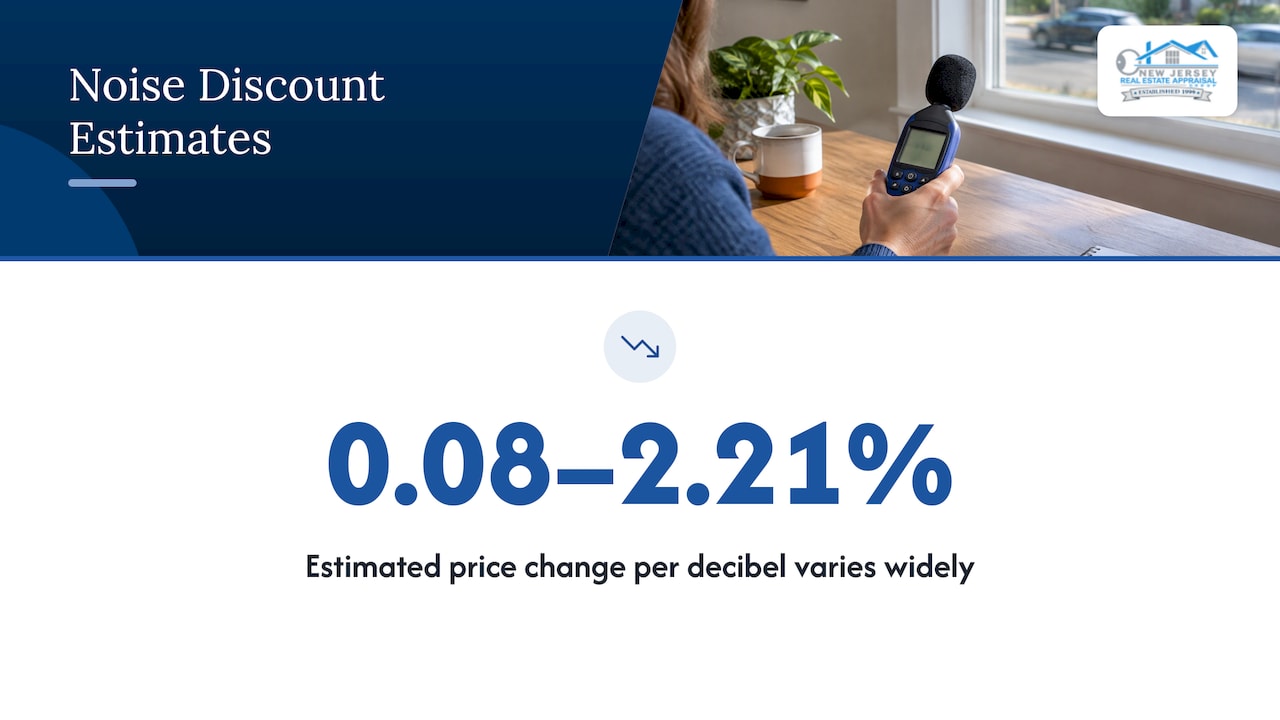
A Shelby County, Tennessee study found that traffic noise had a significantly negative effect on housing values, with larger discounts at higher noise levels. A review of hedonic studies (statistical studies that separate the price effect of one feature from everything else about a house) describes noise impact as a percentage price change per decibel, and notes that estimates in earlier literature ranged widely, from 0.08 to 2.21 percent per decibel. Wide ranges are normal here, which is why a single quoted percentage should make you cautious.
Why the discount is not the same for every house
Two houses on the same road can sit at very different points in that range. The factors an appraiser and a buyer both weigh:
- Traffic volume and speed. A four-lane arterial with 45-mph traffic affects value more than a two-lane street with a 25-mph limit, according to Opendoor's analysis.
- Distance from the road. A house 100 feet back with a deep yard is generally less affected than one at the curb. The Portland study found distance mattered more than traffic volume alone.
- Facing or backing. Backing onto a busy road typically has a smaller effect than facing it, since the main living areas and the entrance are on the quiet side.
- Screening and topography. Mature trees, fencing and natural grade changes can reduce the visual and sound intrusion.
- What the street was like before. A Boston-area working paper found that added traffic cost the median home about 4% of value, but nearly 7% on the quietest streets and almost nothing on the busiest ones, because buyers on busy streets have already priced traffic in. A house on a road that has become busier over time can look different from one that was always busy.
- Property type. Larsen and Blair found that multi-unit rental properties adjacent to arterials sold at a 13.75% premium, with no significant link to traffic volume. For two-to-four-family and other multi-family owners, visibility and access can work in the property's favor, which is a question for comparable sales, not for a single-family rule.
How an appraiser handles a busy road
A busy road is a location influence, and a good appraisal treats it the way it treats any other feature: by looking at what the market actually paid.
- Choose comparables with similar exposure. The cleanest comparable sale is a house on a similar road with similar traffic. When those are scarce, the appraiser looks further out, widens the time frame and explains the choice. Our guide to evaluating comparable properties covers how that selection works.
- Measure the gap from the market. Where a comparable sits on a quieter street, the difference has to be supported by paired sales (two otherwise similar sales that differ mainly in the road exposure), not by an assumed percentage. See how appraisal adjustments are built and why each one needs support.
- Describe the specifics. Facing or backing, setback, lot depth, screening, sight lines and noise are property facts. Condition, renovations, layout and buyer reaction sit alongside them.
- Explain the conclusion. The report should say what was adjusted, by how much and on what evidence.
Mass appraisal offices use formulas instead. Jefferson County, Colorado's 2025 adjustment grid, for example, applies traffic factors that run from 0.98 for local streets down to 0.60 for freeways, and adjusts only for the most value-impacting traffic source on each property. That is a useful picture of how steeply exposure can be graded, but it is one county's tax tool. A fee appraisal for a specific house should rest on that house's market.
When the number has to hold up
For a casual listing conversation, a rough discount is enough. In the situations below, someone else will examine the figure.
Divorce and family buyouts
When a house on a busy road is being divided, one spouse may argue the road should lower the value (to reduce a buyout) and the other may argue the opposite. A court-ready report that documents exposure and supports its adjustments takes the argument off opinion. Our court-ready divorce appraisals run $550 to $800.
Estates and date-of-death values
For an executor, the value is fixed as of a past date, and the road's effect on that date, not today's traffic, is what counts. That is why we pair the work with comparable sales from the relevant period. Our certified estate and date-of-death appraisals are priced at $595 to $850. Traffic counts can change over time too. The Baltimore study showed how a temporary drop in traffic during the pandemic tempered the discount, which is a reminder that the date of value shapes the evidence.
Property tax appeals
If your assessment treats your house like its quieter neighbors, a documented location difference is part of the argument that the value is too high. Our property tax appeal appraisals cost $495 to $750. Our article on mastering appraisal adjustments in NJ legal cases shows how adjustments are presented when they will be challenged.
Pre-listing pricing
If you plan to sell, a supported value gives you a list price that reflects the road from day one. Opendoor's data science team notes that overpricing a busy-road home leads to a long stay on the market, which makes buyers wonder what else is wrong. A pre-listing appraisal is $495 to $750.
Practical steps for owners and sellers
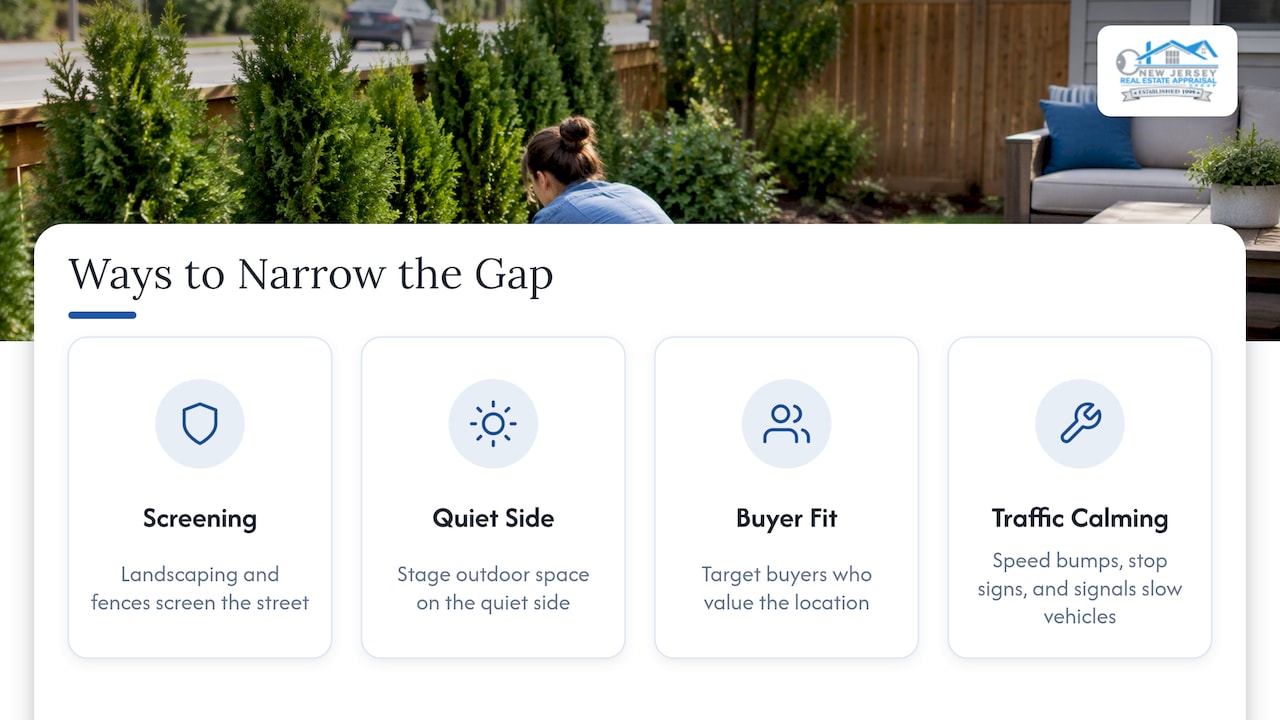
If your house is on a busy road, a few things can narrow the gap. Landscaping that screens the street, a fence, staging outdoor space on the quiet side and positioning the home toward buyers who value the location are the usual approaches. Speed bumps, stop signs and signals can also help by slowing vehicles and reducing the constant hum of fast traffic. Record these features and any improvements, because they feed directly into the appraiser's description of the property. Avoid the common mistakes covered in our guide to home appraisal pitfalls, such as leaving out upgrades that offset the location.
What we offer
We are a state-certified appraisal firm serving homeowners, attorneys, executors, CPAs, investors and lenders throughout New Jersey. Our reports follow USPAP, the Uniform Standards of Professional Appraisal Practice, and our analysis looks past square footage and public records to condition, layout, location influences, marketability and relevant comparable sales. We also use professional data sources and research tools to find and verify market evidence beyond basic MLS data. Standard home appraisals in New Jersey are $495 to $750.

If a busy road is part of your case, tell us the address, the purpose and the effective date of value when you request a quote on our home appraisal page.
Our perspective
Most of the busy-road numbers in circulation are averages taken from other cities. They are fine as context. They are not evidence about your property. In our work, the question is always what buyers in this part of New Jersey paid for houses with this kind of exposure, and what else those houses had or lacked.
With more than 26 years of appraisal and real estate experience, including hands-on renovation and fix-and-flip work, we look at how a house actually lives: where the bedrooms are relative to the road, what the yard does, what the condition and workmanship say to a buyer. A road is one input among many, and it deserves a supported adjustment, not a reflex discount.
That discipline matters most when the value will be argued over. In divorce, estate and tax matters, a report that explains its comparables and adjustments gives attorneys, executors and families something firm to work from.
Alek Petreski
FAQ
How much does a busy road reduce home value?
Studies range from about 3% within 200 feet of a major road in the Baltimore area to roughly 10% very close to a busy arterial in Portland. The effect depends on distance, noise, traffic and the local market, so it needs to be measured with comparable sales.
Does backing onto a busy road hurt value as much as facing it?
Typically less. Backing onto the road usually has a smaller effect than facing it, and lot depth, trees and fencing can reduce it further. An appraiser records these details as property-specific facts.
Do multi-family properties lose value on busy roads?
Not necessarily. One 2014 study found rental multi-unit properties on arterial streets sold at a premium, with no significant relationship to traffic volume. Single-family houses showed a discount. Comparable sales for the same property type are the right test.
Is a busy-road adjustment the same for an estate or divorce as for a sale?
The method is the same, but the date of value and the audience differ. An estate report values the house as of the date of death, and a divorce report must withstand scrutiny from both sides. In both, the adjustment should be supported by market evidence from the right period.
Sources
- Traffic externalities and single-family house prices (Hughes and Sirmans, 1992)
- Price effects of surface street traffic on residential property (Larsen and Blair, 2014)
- Urban traffic arterials and the sale price of single-family homes (Wuest, Portland)
- Measuring environmental (dis)amenity value during a pandemic (Irwin and Livy)
- Highway noise and property values: a survey of recent evidence (Nelson)
- The impact of traffic noise on housing values (Journal of Real Estate Practice and Education)
- What do hedonic studies of the costs of road traffic noise say?
- Measuring and mitigating traffic externalities
- Jefferson County Assessor's comparable sales adjustments, 2025
- How busy roads impact property values (Opendoor)
Recommended
- Private Road Appraisal: What It Values and When You Need One
- What Affects Property Value: Key Factors Explained
- Septic vs. Sewer: How Each Affects Home Value in NJ
- Power Lines and Property Value: What Research Shows
This article is provided for general informational purposes only and does not constitute legal, tax, or financial advice. Real estate appraisal requirements can vary by assignment and intended use. For advice specific to your situation, consult the appropriate legal, tax, or financial professional.