
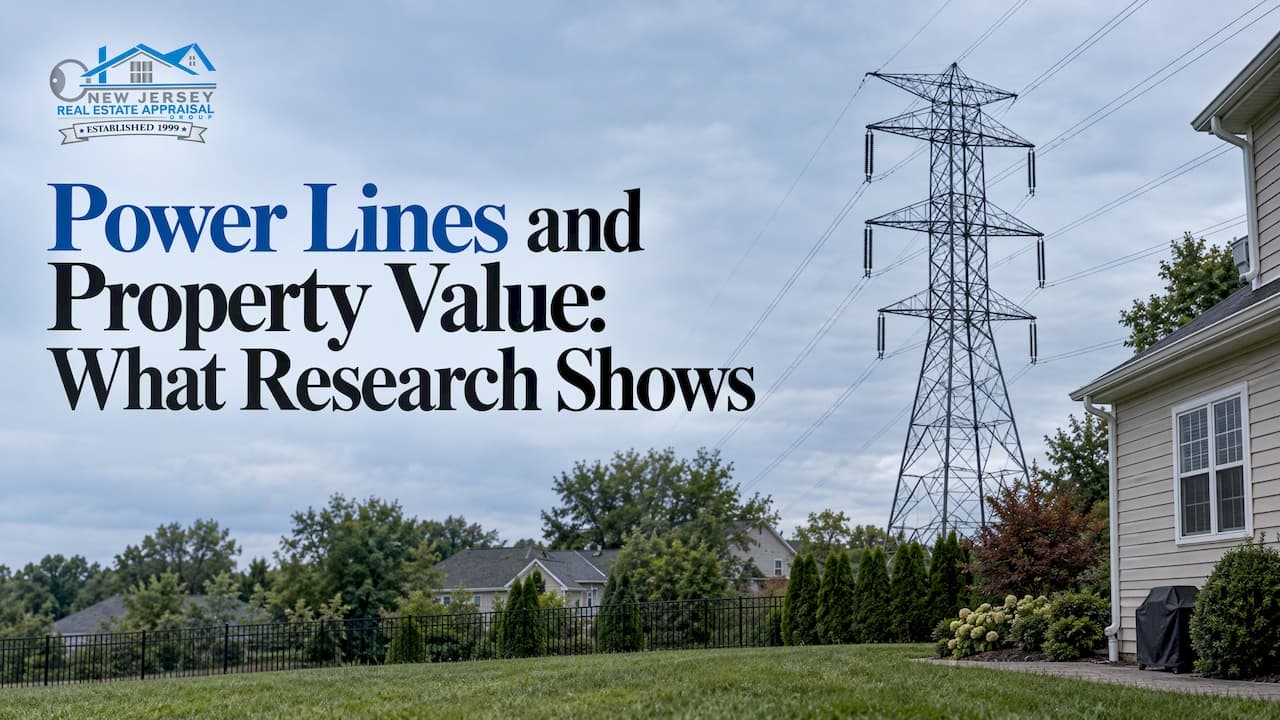
Power lines can lower what a property is worth, but the size of the effect varies a lot. Studies range from a few percent for a home that merely sits within sight of a line to much larger losses for vacant land next to a transmission corridor. For your property, the right number depends on the line, the lot, the buyer pool and the comparable sales nearby. That is why a general statistic should never be used as a value.
This guide explains what the research says, what makes one property near a line different from another, and how the question comes up in New Jersey divorce, estate, tax appeal and easement matters.
TL;DR
- Research finds a measurable discount for many properties near high-voltage lines, but the range is wide: a few percent in some studies, and 10% to 30% for improved properties in valuation guidelines.
- Vacant lots adjacent to lines sold for 44.9% less in one South Carolina study. That figure is not a rule for a New Jersey house.
- Buyer perception drives much of the discount, so local sales evidence matters more than safety debates.
- If a value has to hold up in court, in an estate, or before a county tax board, the line's effect needs to be identified and supported, not assumed.
Table of Contents
- What the research says about the size of the discount
- Why power lines affect value: perception, noise and easements
- Transmission towers, distribution lines and sight lines
- How an appraiser measures the effect
- When a power line matters in a New Jersey valuation
- What owners often miss: severance damages
- Our perspective
- Getting a supported value for a property near power lines
- Before you rely on any number: a short checklist
- FAQ
- Sources
What the research says about the size of the discount
No single percentage fits every property. Here is what the better-known work shows.
| Finding | What it covers | Source |
|---|---|---|
| 44.9% discount for adjacent vacant lots | 5,455 vacant lot sales in Pickens County, South Carolina | Geospatial pricing study |
| 10% to over 30% for improved residential property; 17.9% for non-adjacent lots within 1,000 feet | Summary in a state valuation guideline | South Dakota PUC guidelines |
| Larger effects in urban residential areas than rural agricultural areas | Housing versus farmland comparison | Journal of Housing Economics, 2023 |
| Mixed conclusions across studies, useful as a frame of reference | Testimony citing the research as a whole | Missouri PSC filing |
Two points matter before you apply any of these numbers.
First, the studies measure different things: vacant land versus homes, adjacent versus nearby, transmission versus ordinary neighborhood distribution lines. A 44.9% discount on empty lots in rural South Carolina says little about a Cape Cod in Union County.
Second, the research is not unanimous. A literature review of empirical studies exists precisely because results differ by method and location. Treat any headline figure as a starting question, not an answer.
Why power lines affect value: perception, noise and easements
A buyer does not pay less because of a study. A buyer pays less because of what they see, hear and fear. Several separate factors are usually bundled together.
Visual impact. Towers and wires in the view from the yard, kitchen or primary bedroom are the most common complaint. A tower at the back lot line is a different situation from a distribution line on a pole across the street.
Noise. High-voltage lines can hum, especially in damp weather. Whether that bothers buyers is a local, property-specific question.
Easement rights. A utility easement can limit where you build a pool, shed, addition or fence, and may allow access and vegetation clearing. Those restrictions matter to some buyers and not to others.
Stigma. Concern about health effects can reduce what buyers will pay even where the science does not show harm. The appraisal question is what the market does, not who is right. Research on expert views in eminent domain points out that this perception can be a concrete financial loss.
That same study is the first to use experimental design to separate easement rights from noise. The practical lesson for anyone commissioning a valuation is to itemize each factor rather than apply one blanket percentage. The combination can reduce value by more than the sum of its parts, and a report that lists the pieces is much easier to defend.

Transmission towers, distribution lines and sight lines
Not every power line is the same, and the market treats them differently.
- High-voltage transmission lines on steel towers carry the strongest negative reputation.
- Local distribution lines on wooden poles run along nearly every street in New Jersey and rarely move prices by themselves.
- Buried lines generally remove the visual issue, though an easement may remain.
- Distance and orientation matter. A tower in the back corner of a wooded lot is not the same as a line crossing the middle of the yard.
Land use also changes the picture. The 2023 housing and farmland study found that housing tends to suffer a disamenity effect while farmland can sometimes see a premium when the lines do not interfere with farming. Most New Jersey owners are closer to the housing case.
A separate caution: if a line on your own lot is sagging, damaged or low, that is a safety issue, not a valuation issue. An electrician or the utility should look at it first. For a sense of how contractors treat the hazard, see this Australian electrical contractor's guide to low-hanging power lines. In New Jersey, call your utility.
How an appraiser measures the effect
There are a few accepted ways to isolate a power line's influence. A credible report usually combines them.
- Paired sales. Compare sales of similar homes with and without the line influence, adjusting for size, condition, age and date of sale.
- Market reaction evidence. Look at days on market, price reductions and the story behind failed contracts, which MLS fields alone rarely capture.
- Before-and-after analysis. Where an easement is being acquired, the appraiser estimates the value of the property without the line and with it, and the difference is the starting point for compensation.
- Property-specific inspection. Distance, tower height, screening by trees, noise at the lot, and where the easement crosses all go into the adjustment.
A state valuation guideline frames market value as what a property would sell for on a given date under normal conditions. That is the standard we apply: not a theoretical loss, but what a knowledgeable buyer would pay.
When a power line matters in a New Jersey valuation
Divorce and equitable distribution
When one spouse keeps the house or buys out the other, a line-related discount shifts real money. One side may argue a large discount to lower the buyout, the other may argue none. A neutral, supported opinion keeps the conversation about evidence. Our court-ready divorce appraisals are published at $550 to $800.
Estates and date-of-death value
Executors need the value on a specific date, and heirs often disagree about it. If the home backs onto a transmission corridor, the appraiser must document how the market viewed that on the date of death. Our estate and date-of-death appraisals are published at $595 to $850.
Property tax appeals
If your assessment ignores a line influence that the market clearly prices in, that may support an appeal. In New Jersey, petitions to the County Board of Taxation must be filed by April 1, and Burlington, Gloucester and Monmouth Counties use a January 15 deadline. Check the current rules with your county board, since deadlines can change. Our property tax appeal appraisals are published at $495 to $750.
Easements and eminent domain
When a utility wants rights across your land, the process generally runs from title research and landowner contact to surveys, an appraisal and negotiation. If that fails, the utility can pursue condemnation through the courts, where independent appraisals shape what counts as just compensation. We cover the legal side in our guides to easement valuation and eminent domain valuation.
Selling or buying
If you plan to list, a pre-listing appraisal shows whether the line is likely to be an issue before a buyer raises it in a second showing.
What owners often miss: severance damages
Most landowners assume compensation covers only the strip of land an easement occupies. Often it should also address the loss in value to the rest of the property. Lincoln Institute research describes these as severance damages, for example interference with views, noise or the use of the remaining land, and notes they can exceed the value of the easement land.
The same source notes that just compensation rests on the fair market value of the property before and after the taking, not on what the property is worth to the utility. Negotiated outcomes can also include non-cash items, such as moving a structure or changing a gate.
The lesson: if you are offered a payment for an easement, ask what it covers before signing. An appraisal of the whole property, before and after, is the evidence that lets you and your attorney judge the offer. Get legal advice from a New Jersey eminent domain or real estate attorney on your rights.
Our perspective
We have appraised homes in New Jersey for more than 26 years and have renovated and flipped properties ourselves, so we have seen how a buyer reacts to a tower in the backyard. Our experience is that the discount is rarely the same twice.
The mistake we see most often is using a percentage from an article, including ones like this, as the answer. A 10% figure lifted from a study can be wrong in either direction. Some properties near lines show little effect because the line is screened, distant or ordinary for the neighborhood. Others lose more because the tower dominates the lot.

Our approach is to look at the actual property: condition, layout, the view from the rooms people use, the easement on the survey, and what comparable sales show about buyer reaction. We want the report to separate the line's effect from other things, such as a dated kitchen or a busy road, so that everyone reading it, including attorneys, executors, a mediator or a tax board, can see why the number is what it is.
We also think appraisers should be plain about uncertainty. Where the market evidence is thin, say so and show how the conclusion was reached, under USPAP standards.
— Alek Petreski
Getting a supported value for a property near power lines
If a line affects a divorce buyout, an estate, a tax assessment or a planned sale, we can prepare a state-certified, USPAP-compliant appraisal that addresses it directly. Start with our home appraisals in New Jersey, published at $495 to $750, or see the full list of services. Send us the address, the purpose and any survey showing the easement, and we will tell you what the assignment involves.
Before you rely on any number: a short checklist
- Find the easement on your survey or title report and note what it permits.
- Identify the line type: transmission tower, distribution pole or buried.
- Note distance from the structure and what you see from the main rooms and yard.
- Collect nearby sales, with and without the line influence.
- Decide the purpose and date of value: today, a past date, or the date of death.
- Ask your attorney, CPA or mediator what the report must address.
FAQ
How much do power lines affect property value?
It depends on the line, the property and the market. Studies find discounts from a few percent to well above 10% for homes, and 44.9% for adjacent vacant lots in one South Carolina sample. An appraisal of the specific property is the only way to get a number you can use.
Do you get paid for power lines on your property?
If a utility acquires an easement, it generally negotiates compensation. That compensation can include more than the land the easement occupies, such as damages to the remaining property. An existing line you bought with usually carries no new payment, so review your title and talk to an attorney.
Should you buy a house near power lines?
It can be reasonable if the price reflects the line and you are comfortable with the view, noise and easement limits. Look at how long comparable homes took to sell and ask for the survey. An independent appraisal before purchase can show whether the price accounts for the line.
Can I use power lines to appeal my New Jersey property taxes?
Possibly, if the assessment does not reflect the market's reaction to the line. You file with your County Board of Taxation, usually by April 1, and you will need market evidence such as comparable sales or an appraisal.
Sources
- The Pricing of Power Lines: A Geospatial Approach
- Valuation Guidelines for Properties with Electric Transmission Lines
- Disamenity or premium: electricity transmission lines, farmland and housing
- The Effects of Electric Transmission Lines on Property Values: A Literature Review
- Missouri PSC testimony on transmission line effects
- Power Lines and Perceived Home Prices
- Getting Right-of-Way Right, Lincoln Institute of Land Policy
- NJ Division of Taxation: Assessment and Appeals
Recommended
- What Affects Property Value: Key Factors Explained
- Understanding Property Condition in Valuations
- Solar Panel Appraisals in NJ: Leased Systems Need Proof to Count – New Jersey Property Valuation Insights
- Property Valuation Risk Factors: What Investors Must Know
This article is provided for general informational purposes only and does not constitute legal, tax, or financial advice. Real estate appraisal requirements can vary by assignment and intended use. For advice specific to your situation, consult the appropriate legal, tax, or financial professional.