
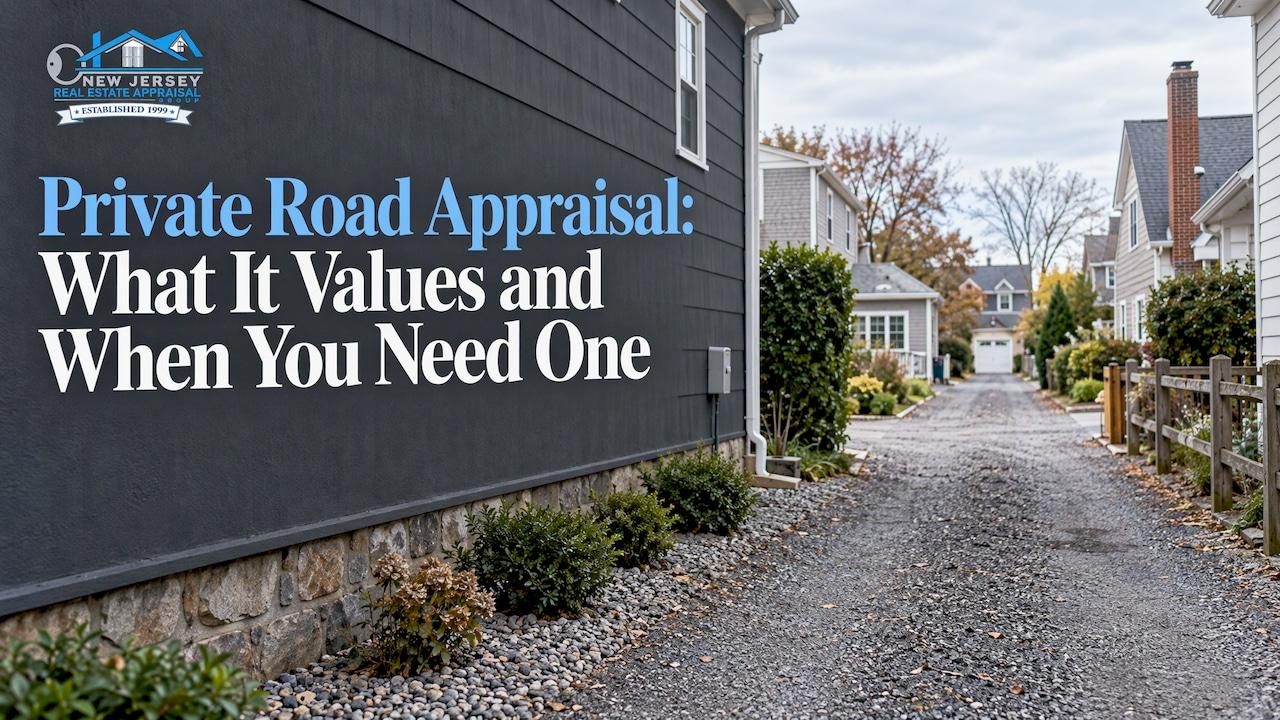
A private road appraisal answers one of two questions. Either it values the road as a parcel of its own, or it measures how a private road, shared driveway or access easement changes the value of the properties that depend on it. Which question applies decides the method, the documents you need and the person who should order the report. If a New Jersey estate, divorce, tax appeal or sale turns on the answer, we prepare certified, USPAP-compliant appraisals for these matters, and you can start from our land appraisals page.
TL;DR
- A private road may be owned outright (in fee) or used under an easement. The ownership interest decides how it is valued.
- Road ownership, recorded access rights and maintenance obligations all feed into the value of the properties on the road.
- Roads taken for public projects are commonly valued by the across-the-fence method, which uses the value of the adjoining land rather than construction cost.
- Lenders look for recorded access and, in many programs, a recorded maintenance arrangement, so a clean paper trail protects marketability.
- Estate, divorce, tax appeal and litigation matters need a report that states its assumptions and scope of work.
Table of Contents
- What a private road appraisal actually covers
- Who needs one and why
- How a private road changes property value
- What an appraiser reviews before valuing
- How the valuation is done
- Why the appraiser, not the client, sets the scope
- Private roads in New Jersey tax appeals
- What it costs
- Our perspective
- Getting a report for your property
- FAQ
- Sources
What a private road appraisal actually covers
People use the phrase for several different assignments. Sorting yours into the right one saves time and fees.
1. The road as a parcel. A strip of land, such as a subdivision road, a lane held by a homeowners' association or a drive owned by one family, can have its own value. A road may be held in full fee or subject to an easement, and that distinction drives the valuation. For right-of-way acquisition, the accepted method is the across-the-fence method, which is based on the fee value of adjoining land rather than what the road cost to build.
2. The effect of the road on the properties it serves. This is the most common request from homeowners, executors and attorneys. The question is how much a shared drive, an unrecorded handshake arrangement or a deficient maintenance agreement adds to or takes from a house or lot.
3. A partial taking or easement. When a public agency or utility needs part of a private road, the appraisal compares the property before and after the acquisition.
4. Retrospective or date-specific value. Estates and some litigation need the value as of a past date, with the road's status on that date. Our estate and date-of-death appraisals are built for this.
If you are only curious what a road might be worth and have no matter pending, a formal report is more than you need. The assignments above are the ones where a signed, supported opinion of value pays for itself.
Who needs one and why
Executors and estate attorneys. An inherited home on a private lane needs a date-of-death value that reflects its access. Buyers, beneficiaries and the tax return all rely on that number.

Divorce attorneys and mediators. If one spouse keeps a house on a shared drive, the equitable distribution figure should reflect that. A neutral, court-ready report keeps the issue from becoming a dispute about whose estimate is right. See our divorce appraisals.
Property owners appealing taxes. If your assessment treats a road or an access-dependent lot as if it had full public frontage, an appraisal can show the gap. We cover the filing side below.
Sellers, buyers and investors. A lot without clear legal access sells to fewer buyers. An investor pricing ARV or a portfolio needs to know whether the road helps or hurts the exit.
Lenders and mortgage professionals. Lenders want evidence that access is legally enforceable and the road will be maintained. The appraisal documents what is in the file and how the market treats it.
How a private road changes property value
The effect depends on the facts, not on the words "private road." A few patterns recur in the literature.
Access is the base layer. Land without a recorded access easement is worth significantly less than a comparable parcel whose access is guaranteed in writing. The same source reports that shared driveway or access easements typically cause a moderate reduction in value, while an access easement that benefits your property increases it.
Unclear access also shrinks the buyer pool. Strong direct access supports value, while unclear or difficult access reduces it by introducing uncertainty, and it can change a tract's highest and best use. Different buyers tolerate different levels of complexity, so the same road may be fine for one buyer and disqualifying for another. That is why an appraiser looks for sales that reflect similar access, not only similar size and style.
Financing sets the floor. For federally backed loans, the rules differ by program:
- Fannie Mae's Selling Guide says minor title impediments must not materially affect marketability, and the lender must indemnify Fannie Mae for losses directly attributed to them.
- USDA's guaranteed loan handbook requires direct access from a public or private street, and private roads must be protected by a permanent recorded, non-exclusive, non-revocable easement or maintained by an HOA, with an all-weather surface.
- VA's 2023 update says maintenance agreements are no longer required because many states have laws on private road and shared driveway maintenance, but a recorded permanent easement or right-of-way to a public road is still required.
The practical takeaway: a recorded easement with a written maintenance agreement is the cleanest case for a buyer's lender, and an unrecorded arrangement is the most likely to stall a closing. An appraisal that leaves out these facts is incomplete.
What an appraiser reviews before valuing
Whoever you hire, expect the work to start with documents, not a drive-by. These are the questions the appraisal has to answer.
- Who owns the road? A road that looks public may be privately owned in fee or subject to easements. The deed, the subdivision map and the title report show which.
- Is the right to use it recorded? Look for a recorded easement or right-of-way running from the property to a public road.
- Who maintains it, and is that in writing? Fannie Mae's rules, as summarized by one legal explainer, call for a recorded, enforceable agreement that sets each owner's share of repair costs, remedies for nonpayment and a term binding future owners. A state statute can stand in for a separate agreement.
- What is the road's physical condition? Width, surface, drainage, gates and emergency-vehicle access all matter to buyers and lenders.
- What are the use conflicts? Disputes among neighbors, gates and shared-cost arrears affect marketability.
If you are an attorney or executor, send these documents with the engagement. If you do not have them, say so. The report can state its assumptions about missing items, but a report built on documents is stronger than one built on assumptions.
How the valuation is done
The method follows the question.
Across-the-fence. Used for a road corridor. Alabama's right-of-way manual defines it as an opinion of corridor value based on adjacent lands, considering market conditions, rights conveyed and location. It assumes the corridor is worth about what typical adjacent vacant land is worth, without adjustments for size, shape, topography or access.
Before and after. Used when an easement or taking affects the remainder. Texas DOT's manual says the appraisal should address the fee value of the easement area and the remainder before and after, using comparable sales with similar easement effects. For a temporary easement that denies use for a term, the value is the present worth of the land's annual rent for that term.
Cost approach, used carefully. Iowa's manual limits the cost approach in these appraisals to nearly new, functional improvements, special-purpose property, or partial takings where cost-to-cure may be the most sensitive method. Iowa DOT's appraisal manual is explicit about that limit.
Courts have corrected valuations that ignored this. In a Connecticut case, a two-mile private road serving 400 condominium units was assessed using a cost approach that double-counted improvements and skipped depreciation, and the court found the assessment a substantial overvaluation. In another, an improved private road the town never accepted was found to have a fair market value of $15,000 for tax years 1983 to 1987, against board figures of $341,100. These cases are from Connecticut, not New Jersey, but they show how far an unsupported number can drift from market evidence.
Why the appraiser, not the client, sets the scope
The scope of work is the plan for the assignment: what will be valued, which interests, as of what date and with which assumptions. Public agency guidance makes the point that identifying the appraisal problem determines the scope, and the appraiser is responsible for setting it, although the client may offer input.
For a private road, tell the appraiser exactly why you need the number. A report for a date-of-death filing is not the same as one for a tax appeal, and neither is the same as a valuation of a road corridor. USPAP, the Uniform Standards of Professional Appraisal Practice, requires a report to state its client, intended use, the property interest appraised, the type of value, the effective date, the scope of work and any extraordinary assumptions. Georgia's DOT chapter lists these required report elements under the Standards Rule 2-3 certification.
A word on terms. An appraisal is a written opinion of value by a licensed or certified appraiser. "Valuation" is the broader word and covers estimates that are not USPAP reports. Courts, estates and tax boards generally want the appraisal.
Private roads in New Jersey tax appeals
If your assessment overlooks a road's effect on your parcel, an appraisal supplies the evidence. The deadline matters: according to the New Jersey Division of Taxation, petitions to the County Board of Taxation or the Tax Court must be filed and received on or before April 1. Appeals to the Tax Court from a county board judgment run 45 days from the date of that judgment. For properties assessed above $1,000,000, the owner can also file directly with the Tax Court. Confirm the current rules on the Division's page before filing. Order the appraisal well ahead of that date so any missing access documents can be tracked down.
Our property tax appeal appraisals are priced from $495 to $750, and the page on appeal costs and value assessment explains what the process involves.
What it costs
Fees follow the assignment, not the label. A report on a single home served by a shared drive is a different job from valuing a road corridor or a multi-parcel acquisition. Our published ranges are:
| Assignment | Published fee |
|---|---|
| Home appraisal | $495 to $750 |
| Property tax appeal appraisal | $495 to $750 |
| Divorce appraisal | $550 to $800 |
| Estate and date-of-death appraisal | $595 to $850 |
| Commercial real estate appraisal | $2,500 to $10,000 |
For land, easement-heavy or multi-property work, describe the assignment and request a quote. Complexity, size and access are what move the fee. Public agencies price this work on schedules too: Indiana's right-of-way fee schedule, for example, sets fees by report type, from $780 for a waiver valuation to $12,910 for a long-form report on improved commercial property.
Our perspective
Most disputes about private roads are not disputes about the road. They are disputes about what a number rests on. When an executor, an attorney or a spouse has to defend a value, the question is whether the access, the easement language and the maintenance arrangements were read and reflected in the analysis.
We have more than 26 years of appraisal and real estate experience, including hands-on renovation and fix-and-flip work, so we look at a property the way a buyer does. A shared drive with potholes, a road that floods and a lane with a recorded maintenance agreement are different properties to a buyer, even when the square footage matches.
That is why our analysis goes past square footage and public records to condition, layout, marketability, location influences and buyer reaction, and why we use professional data sources to verify market evidence beyond basic MLS data. Every conclusion is developed under USPAP. When legal, tax or estate decisions depend on the value, that discipline is what makes the report usable.
Alek Petreski
Getting a report for your property
NJREAG is a state-certified appraisal firm serving homeowners, attorneys, executors, CPAs, investors and lenders throughout New Jersey. For a home or lot on a private road, start with our home appraisals or land appraisals. Easement questions have their own page on easement valuations, and larger holdings can go through our commercial appraisals.
Send the deed, any recorded easement or maintenance agreement, the survey and a note on why you need the value and as of what date. Attorneys can tell us the court or filing the report will serve.

FAQ
How is a private road different from an easement?
A private road is a physical way that is not owned or maintained by a public agency. An easement is a legal right to use land that someone else owns. A private road can sit on land owned by an association, by one neighbor or by several owners, and the users typically hold easements. The appraisal looks at both the ownership and the rights.
Does a private road lower my home's value?
Not automatically. The effect depends on whether access is recorded, who maintains the road and what condition it is in. A shared access arrangement typically causes a moderate reduction, while an access easement that benefits your lot increases value. A recorded agreement and a well-kept road support marketability.
Do I need a road maintenance agreement to get a mortgage?
It depends on the loan program. Conventional lending under Fannie Mae calls for a recorded agreement or a state statute that covers maintenance. VA no longer requires one, but still wants recorded access to a public road. Your lender confirms the rule for your loan.
How do I find out who owns the road?
Start with the deed, the recorded subdivision map and the title report. The county clerk or register of deeds holds the recorded instruments. If the records are unclear, a New Jersey real estate attorney can advise on ownership, and the appraiser can state the assumption used in the report.
Who can order a private road appraisal?
Homeowners, executors, attorneys, lenders, investors and CPAs can commission a report. The report states the client and the intended use, so tell the appraiser up front whether it is for an estate, a divorce, a tax appeal or a sale.
Sources
- Pete Waldman and the IRWA on road ownership and across-the-fence valuation
- Understanding How Easements Affect Property Values
- Land Access, Easements and Right-of-Way Explained
- Fannie Mae: Title Exceptions and Impediments
- USDA HB-1-3555, Chapter 12
- VA Valuation Policy Updates, 2023
- What Is a Private Road Maintenance Agreement?
- Alabama DOT Right of Way Appraisal Manual
- TxDOT: Channel, Private, and Temporary Easements
- Iowa DOT Appraisal Manual
- Pepe v. Board of Tax Review
- Einbinder v. Board of Tax Review
- NY DOT Office of Right of Way report format
- Georgia DOT Right of Way Appraisal chapter
- New Jersey Division of Taxation: Assessment and Appeals
- Indiana DOT Real Estate Services Fee Schedule
Recommended
- Steps to Obtaining a Land Appraisal for Development and Estate
- NJ Land Appraisals for Developers and Estate Attorneys
- Court Ready Easement Valuations in New Jersey, From $495
- Bridge Loan Appraisal: What Lenders Need and What to Expect
This article is provided for general informational purposes only and does not constitute legal, tax, or financial advice. Real estate appraisal requirements can vary by assignment and intended use. For advice specific to your situation, consult the appropriate legal, tax, or financial professional.