

TL;DR:
- Appraisal adjustments are dollar corrections used to account for differences between comparable sales and the subject property. They are essential for credible valuation in legal, tax, and real estate transactions, following USPAP and Fannie Mae standards. Proper documentation and market evidence support these adjustments and ensure the appraisal withstands legal and financial scrutiny.
Appraisal adjustments are dollar-value corrections applied to comparable sales within the sales comparison approach to account for differences between those properties and the subject property. Understanding appraisal adjustments is critical for anyone involved in a property transaction, tax appeal, estate settlement, or litigation in New Jersey. These corrections follow USPAP standards and Fannie Mae guidance, and they directly determine whether an appraised value holds up under legal or financial scrutiny. Get them wrong, and the entire valuation becomes vulnerable.
What are the main types of appraisal adjustments?
Appraisal adjustments are dollar-value corrections where a comparable's superior feature triggers a negative adjustment and an inferior feature triggers a positive one. The logic is straightforward: you're adjusting the comparable's price to reflect what it would have sold for if it matched the subject property. The categories below cover the most common adjustment factors you'll encounter in a New Jersey appraisal report.

Gross living area (GLA): Appraisers calculate a per-square-foot value from market data and apply it to the size difference between the comparable and the subject. A 200-square-foot difference at $100 per square foot produces a $20,000 adjustment.
Condition and quality ratings: Fannie Mae uses a C1–C6 condition scale and a Q1–Q6 quality scale. Moving a comparable from C3 to C4 can carry a dollar impact ranging from several thousand to tens of thousands of dollars, depending on the local market.
Bedroom and garage count: Bedroom adjustments typically fall in the $5,000–$15,000 range per bedroom, while garage adjustments commonly run $8,000–$20,000. These figures are market-derived, not standard across all NJ counties.
Time (market conditions): When a comparable sold six months ago in a rising market, the appraiser must adjust its price upward to reflect current conditions. Fannie Mae requires this analysis to be explicit and documented for every comparable.
Location: Proximity to highways, flood zones, or commercial corridors affects value. Location adjustments require local market evidence, not assumptions.
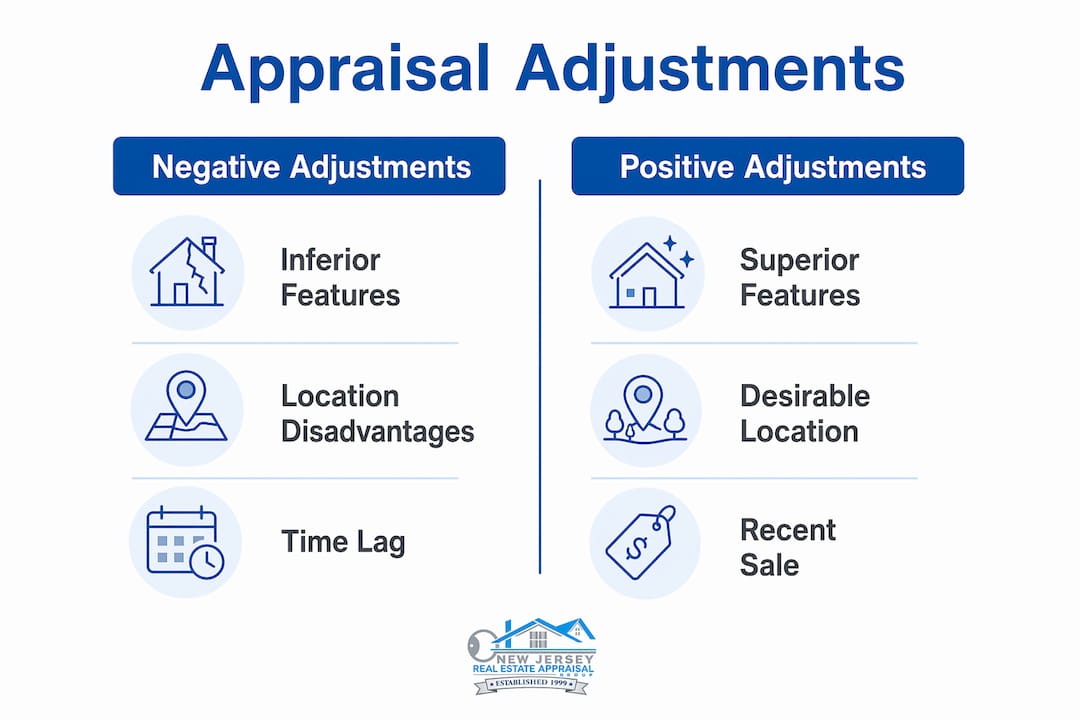
Pro Tip: Negative adjustments reduce a comparable's price; positive adjustments increase it. If you see a long column of large positive adjustments, that comparable may be too dissimilar to be reliable.
How do appraisers derive and support adjustment values?
Credible adjustments come from market evidence, not appraiser opinion. Three primary methods produce defensible numbers.
-
Paired sales analysis: The appraiser finds two sales that are identical except for one feature, then measures the price difference. That difference becomes the adjustment for that feature. This method is direct but requires finding truly matched pairs, which can be difficult in low-volume NJ markets.
-
Regression analysis: Statistical modeling across a larger dataset isolates the value contribution of individual features. This method is more reliable in active markets with sufficient sales data. Advanced appraisal practices now incorporate regression and AI-powered tools to refine adjustment values and defend conclusions with data-driven evidence.
-
Cost approach support: For features like a finished basement or a new roof, the depreciated cost of that improvement can support an adjustment when market data is thin.
"Adjustments must be data-supported, not forced to fit contract prices." — Appraisal Buzz, Fannie Mae Market Conditions Policy
Documentation is where many appraisal reports fail. Flawed appraisal reports often lack documentation for adjustments, and that missing support is the first element challenged in legal or tax appeal proceedings. Every line-item adjustment needs a written explanation tied to market evidence.
Fannie Mae's guidance sets 15% net and 25% gross adjustment thresholds as warning signals, not hard rules. Exceeding them doesn't automatically disqualify a comparable, but large aggregate adjustments signal poor comp selection and demand better alternatives. An appraiser who routinely exceeds these thresholds without explanation is producing a report that won't survive review.
Pro Tip: If you're reviewing an appraisal for a legal matter, check the adjustment grid first. Unsupported or inconsistent adjustments are the fastest path to a credibility challenge.
What are the implications of adjustments for legal and financial decisions?
The appraisal adjustment process directly shapes the final value conclusion, and that conclusion carries real consequences in estate settlements, divorce proceedings, and property tax appeals.
Reconciliation is professional judgment, not math
The final appraised value comes from reconciled professional judgment that weighs comparable quality and data reliability. It is not a simple average of adjusted sale prices. The appraiser assigns more weight to the comparable that most closely matches the subject in location, size, condition, and sale date. Clients often misunderstand this phase, expecting a mechanical calculation when they're actually receiving an expert opinion grounded in market analysis.
Legal and tax appeal standards are stricter
Legal and tax appeal appraisals demand more rigorous documentation of adjustments than routine purchase appraisals. In a New Jersey tax appeal, the appraiser's adjustment grid will be examined by the county board or Tax Court. Every adjustment must trace back to market evidence. An appraiser who writes "$5,000 for condition" without supporting data will face a credibility challenge that can sink the entire report.
The table below shows how adjustment standards differ across common appraisal uses.
| Appraisal use | Adjustment documentation standard | Consequence of weak support |
|---|---|---|
| Purchase/lending | Standard USPAP compliance | Loan denial or underwriter pushback |
| Property tax appeal | Market-derived, court-ready evidence | Dismissal or unfavorable ruling |
| Estate/date of death | Retrospective market data required | Probate court challenge |
| Divorce/equitable distribution | Defensible, neutral methodology | Contested settlement or litigation |
Pro Tip: For estate or divorce appraisals in New Jersey, ask your appraiser specifically how each adjustment was derived. A credible appraiser will explain the market evidence behind every line item without hesitation.
How do time adjustments reflect NJ market trends in 2026?
Time adjustments, formally called market conditions adjustments, correct for price changes between a comparable's sale date and the appraisal's effective date. They are one of the most frequently mishandled adjustment factors in residential appraisals.
Fannie Mae's 2026 policy requires appraisers to analyze and document time adjustments explicitly for all comparables, regardless of whether the market is rising, falling, or flat. A flat market still requires a written explanation confirming that no adjustment is warranted. Silence is not acceptable.
Appraisers support time adjustments using several data sources:
- Home price indices (HPIs): Tools like the FHFA HPI or CoreLogic data track price trends at the county or zip code level.
- Matched pair sales: Two sales of the same property at different points in time isolate the time-driven price change directly.
- Statistical trend analysis: Regression across recent sales measures the monthly rate of appreciation or depreciation in a specific market.
New Jersey markets vary significantly by county. Bergen County and Monmouth County have shown different appreciation patterns than Cumberland or Salem County. A time adjustment appropriate for a Morris County suburb may be completely wrong for a Cape May coastal property. Local NJ valuation expertise matters precisely because these differences are real and measurable.
Underutilizing time adjustments is a common error with serious consequences. An appraiser who ignores a six-month appreciation trend in a rising market will produce a value that is below current market reality. That error affects lending decisions, estate distributions, and tax appeal outcomes. The importance of appraisal adjustments for time conditions is now a regulatory expectation, not an optional refinement.
Key Takeaways
Appraisal adjustments are market-derived dollar corrections that determine whether a property valuation is credible, defensible, and legally sound.
| Point | Details |
|---|---|
| Adjustments follow market evidence | Every dollar adjustment must trace back to paired sales, regression, or cost data. |
| Fannie Mae thresholds are warning signals | Net 15% and gross 25% limits flag poor comp selection, not automatic disqualification. |
| Time adjustments are mandatory in 2026 | Fannie Mae requires explicit documentation for all comparables, even in flat markets. |
| Legal uses demand stricter support | Tax appeal, estate, and divorce appraisals face higher scrutiny than purchase appraisals. |
| Reconciliation is expert judgment | The final value reflects weighted professional analysis, not an average of adjusted prices. |
Why I think most adjustment disputes come down to documentation
After working on appraisals across all 21 New Jersey counties, I've seen the same pattern repeat in contested cases. The adjustment amounts are rarely the core problem. The documentation behind them is.
Attorneys and tax court judges don't object to a $10,000 condition adjustment because the number seems high. They object because the appraiser wrote "condition" in the remarks field and nothing else. That's not a defensible adjustment. That's a guess dressed up as analysis.
The appraisers I respect most treat every line item as if it will be read aloud in a courtroom. They cite the paired sales they used. They reference the market trend data. They explain why they weighted one comparable more than another in reconciliation. That level of transparency doesn't slow down the appraisal process. It protects the client and the appraiser when the report is challenged.
The other issue I see regularly is the misuse of time adjustments. Many appraisers in New Jersey still treat them as optional, particularly in markets they perceive as stable. Fannie Mae's 2026 guidance eliminates that discretion. A flat market requires a written explanation confirming stability. Skipping that step is now a compliance failure, not just a best practice gap.
If you're an attorney, accountant, or property owner relying on an appraisal for a legal or financial decision, read the adjustment grid carefully. Ask questions. A well-supported appraisal will have answers. A weak one will not.
— Alek
Get a defensible NJ appraisal backed by 26+ years of experience

When an appraisal needs to hold up in court, a tax appeal hearing, or an estate proceeding, the quality of the adjustment analysis determines everything. Newjerseyrealestateappraisal delivers state-certified, USPAP-compliant appraisal reports with fully documented adjustment support across all 21 New Jersey counties. Whether you need a property tax appeal appraisal or a court-ready estate valuation, our reports are built to withstand scrutiny. Call us at (908) 517-3913 or request a quote online to get started.
FAQ
What are appraisal adjustments in real estate?
Appraisal adjustments are dollar-value corrections applied to comparable sales within the sales comparison approach to account for differences between those properties and the subject property. Superior features in a comparable trigger negative adjustments; inferior features trigger positive ones.
How do appraisers calculate adjustment amounts?
Appraisers derive adjustment amounts using paired sales analysis, regression analysis, or cost-based support, all tied to local market data. Every adjustment must be documented with market evidence to meet USPAP and Fannie Mae standards.
What are Fannie Mae's adjustment guidelines for 2026?
Fannie Mae requires explicit documentation of time adjustments for all comparables, regardless of market direction, and treats net adjustments above 15% and gross adjustments above 25% as red flags for poor comparable selection.
Why do appraisal adjustments matter in a tax appeal?
In a New Jersey tax appeal, every adjustment in the appraisal grid is subject to review by the county board or Tax Court. Unsupported adjustments are the first element challenged and can undermine the entire valuation.
What is the reconciliation phase of an appraisal?
Reconciliation is the final step where the appraiser weighs the adjusted sale prices of all comparables and applies professional judgment to arrive at a single value conclusion. It is not a mathematical average but a reasoned analysis of data quality and comparability.