

Submit a compliant valuation report by doing three things: deliver a USPAP-compliant document that clearly declares its report type (Appraisal Report or Restricted Appraisal Report) under Standards Rule 2-2, then push it through the correct channel, whether that's an Electronic Appraisal Delivery (EAD) portal built on MISMO 2.6 packaging or a certified paper copy for a court filing. Skip either piece and the file gets bounced back. At Newjerseyrealestateappraisal, we build every report around this sequence because rework costs everyone time and money.
Before you upload or mail anything, confirm these three items:
- Assignment definition is locked. Intended use, intended user, and report type are all documented in writing.
- USPAP SR 2-2 is satisfied. The report states whether it's an Appraisal Report or Restricted Appraisal Report, with client and intended users named.
- The delivery package matches the destination. MISMO 2.6 XML for GSE loan delivery, a lender's proprietary portal for private lending, or certified mail for a courtroom filing.
Pro Tip: Print your assignment definition and tape it to your monitor before you touch the report template. Half of all rejected files trace back to a fuzzy intended use that got clarified too late.
Key Takeaways
A compliant valuation report submission requires a USPAP-stated report type, accurate UAD/MISMO packaging, and confirmed portal or mail delivery before the file counts as done.
| Point | Details |
|---|---|
| Declare report type upfront | State Appraisal Report or Restricted Appraisal Report under USPAP SR 2-2 before writing anything else. |
| Match format to destination | Use MISMO 2.6/EAD for GSE loans, lender portals for private lending, certified mail for court filings. |
| Expect a multi-day review | Lender desk reviews typically run three to seven business days before findings return. |
| Never change your Doc File ID | Correct fatal SSR findings and resubmit under the original identifier to preserve your audit trail. |
| Work with a certified NJ firm | Newjerseyrealestateappraisal builds state-certified, USPAP-compliant reports formatted for portal and legal delivery across all 21 NJ counties. |
Table of Contents
- What Does the Valuation Report Submission Process Cover?
- How Do You Submit a Valuation Report Step by Step?
- What Must a Compliant Valuation Report Include?
- How Do You Deliver a Report Electronically Through EAD and MISMO?
- What Happens After You Submit a Valuation Report?
- What Belongs on Your Final Submission Checklist?
- How We Handle Submissions at Newjerseyrealestateappraisal
- Get a State-Certified Report Built for Your Deadline
- Where to Verify These Standards Yourself
- Frequently Asked Questions
- Sources
What Does the Valuation Report Submission Process Cover?
The submission process is the back half of appraisal development under USPAP: everything from locking your scope of work through confirmed receipt at the destination. It applies any time a certified appraisal changes hands for an official purpose.
Common intended uses include:
- Mortgage loan origination and underwriting
- Property tax appeal filings with a county board
- Divorce or estate litigation support
- Regulatory or institutional compliance review
Electronic delivery through EAD or a lender portal is required for loans headed to Fannie Mae or Freddie Mac. Certified paper copies still rule in many courtrooms and tax appeal boards, so check the venue before you assume digital-only.
How Do You Submit a Valuation Report Step by Step?
Every compliant submission follows the same backbone, whether you're delivering a tree appraisal: get an insurance-ready valuation to a lender's automated underwriting system or hand-delivering a bound report to a Superior Court clerk. Skipping a step doesn't save time. It just moves the delay downstream to a rejection notice.
- Define the assignment. Nail down intended use, intended user, and whether you're writing an Appraisal Report or Restricted Appraisal Report.
- Inspect and collect data. Walk the property, pull comps, verify public record data against what you observe on-site.
- Apply your valuation approaches. Sales comparison, cost, and income approaches as the assignment requires.
- Reconcile your findings. Weigh the approaches and land on a supported value conclusion.
- Prepare the report. Draft the narrative or fill the form (URAR/Form 1004 for most residential mortgage work), attach exhibits, and write your certification.
- Run quality assurance. Check UAD fields, signatures, effective dates, and license numbers before anyone touches "submit."
- Submit through the correct channel. Upload to the portal or send certified mail, matching the format the receiving party requires.
- Log confirmation. Save your Doc File ID or Submission Summary Report (SSR), or your certified-mail receipt, in the workfile.
At each stage, a few fields deserve extra scrutiny. During data collection, verify subject and comp addresses match public record exactly, since a typo here cascades into a MISMO validation error later. During report preparation, confirm every signature block carries a current license number, and that extraordinary assumptions or hypothetical conditions are stated plainly, not buried in an addendum nobody reads. During packaging, make sure your XML export and your PDF narrative say the same thing. Mismatched values between the two are one of the most common causes of a failed Successful SSR.
Pro Tip: Lock your effective date before you start writing the narrative, not after. Changing it mid-report is how appraisers end up with a certification that references the wrong market conditions.
If a portal rejects your file for a formatting reason rather than a content reason, don't guess. Most lender portals and UCDP maintain a help desk specifically for file-structure errors, and calling them beats resubmitting blind three times in a row.
What Must a Compliant Valuation Report Include?
A compliant report needs, at minimum: a stated report type under USPAP SR 2-2 (Appraisal Report or Restricted Appraisal Report), a named client and every intended user, a defined intended use, an effective date and a separate report date, and a signed certification. Miss any one of these and the document is non-compliant on its face, regardless of how sound the value conclusion is.
Build your checklist around these items:
- Report type and scope of work statement, stated plainly in the header
- Client and intended user names, spelled correctly and matched to the engagement letter
- Effective date and report date, clearly distinguished from each other
- Signed certification with license number and expiration
- Statement of limiting conditions and any extraordinary assumptions
- The correct form where one applies (URAR/Form 1004 for most residential mortgage work)
Using an approved form doesn't relieve you of your underlying USPAP obligations. The form is a container. The content still has to meet the standard. Scope of work drives how much detail belongs in the report, since USPAP asks you to give the intended user what they need to understand your conclusion, not to write a document exhaustive enough for every possible reader.
Lender underwriting desk reviews commonly take three to seven business days, and any discrepancy in that window typically triggers a request for corrections before the loan can move forward.
How Do You Deliver a Report Electronically Through EAD and MISMO?
Which portal you use depends entirely on who's receiving the report. GSE loan delivery runs through UCDP/EAD. Private lenders often maintain their own AMC or lender-specific portal. Legal filings still frequently require certified mail or secure email, not a portal at all.
| Delivery channel | Format required | Typical use |
|---|---|---|
| UCDP/EAD | MISMO 2.6 XML with embedded PDF, or UAD 3.6 ZIP | GSE loan delivery |
| Lender or AMC portal | Lender-specified PDF or XML | Private and portfolio lending |
| Certified mail or secure email | Unencrypted PDF, physical original | Court filings, tax appeal boards |
UCDP will reject a file that mixes packaging standards under one Doc File ID, so decide upfront whether you're building a UAD 2.6 or UAD 3.6 package and stick with it end to end. Keep files under the portal's size cap, use consistent filename conventions, and embed photos and maps rather than linking them externally.
Before you upload, walk through this list:
- Confirm the XML export and PDF narrative contain identical values
- Attach or embed every required exhibit, not just reference it in text
- Run the built-in UAD/MISMO validator and clear every fatal finding
- Save the original Doc File ID and SSR the moment you receive it
Pro Tip: Never resubmit under a brand new Doc File ID just because the first attempt failed. That breaks your audit trail. Correct the finding and resubmit under the same ID.
What Happens After You Submit a Valuation Report?
Expect a desk review. For lender delivery, that's typically three to seven business days before you hear back, and the SSR from EAD or UCDP will flag findings as system, UAD, or GSE proprietary errors. Fatal findings need correction and resubmission under the original Doc File ID before the loan can proceed.
Your response protocol should run like this:
- Log the Doc File ID or receipt confirmation the second you get it
- Sort SSR findings by severity, fatal findings first
- Correct and resubmit under the same file identifier, never a new one
- Confirm final acceptance across every portal you touched
Recordkeeping doesn't end at acceptance. Your workfile needs true copies of the written report, summaries of any oral reports, and all supporting data, retained for at least five years, or two years past any related testimony, whichever runs longer.
Pro Tip: Keep your SSR, certified-mail return receipt, or portal confirmation email in the same digital folder as the report itself. When a tax board or attorney asks for proof of delivery two years later, you don't want to be searching three different inboxes.
What Belongs on Your Final Submission Checklist?
Run this before you hit submit or seal the envelope:
- Assignment header states report type, client, intended users, and intended use
- Effective date, report date, and signature block are all filled and correct
- Every UAD field matches your source data exactly
- Exhibits and comps are attached, not just referenced
- File package validated against the destination's format requirements
- Doc File ID or receipt logged in the workfile immediately after submission
A short transmittal letter should accompany paper filings: state the client name, the property address, the intended use, and a one-line summary of the value conclusion, then attach it to the report body rather than sending it loose. A transmittal used carelessly can be mistaken for the report itself, so keep it clearly labeled as a cover document.
Pro Tip: Our internal workflow has one reviewer sign off on UAD accuracy and a second confirm the SSR before a file leaves the building. Two sets of eyes catch what one misses.
How We Handle Submissions at Newjerseyrealestateappraisal
We're a state-certified appraisal firm with more than 26 years of combined experience across all 21 New Jersey counties, and divorce, estate, and tax appeal work make up a large share of what we do. That means we see rejected and reworked reports from other firms more often than we'd like.
The most common failure points we catch: intended use left vague at intake, UAD fields that don't match the narrative, and SSR findings that got ignored instead of resolved before resubmission. Our fix is procedural. We lock the assignment definition before inspection, cross-check UAD data against the narrative during QA, and reconcile every SSR before a file counts as delivered.

If you need a submission-ready appraisal for a lender, court, or tax appeal board, call us at (908) 517-3913.
Get a State-Certified Report Built for Your Deadline
Most appraisal firms hand you a PDF and call it done. Newjerseyrealestateappraisal builds every report to match the destination it's headed to, whether that's a UCDP upload, a lender's proprietary portal, or a certified filing with a county tax board. That means fewer SSR findings, fewer requests for corrections, and no scrambling three days before your deadline.

Our reports are state-certified and USPAP-compliant, and we've handled MISMO and EAD-format submissions across divorce, estate, and tax appeal filings throughout New Jersey. We don't guarantee a specific outcome on any appeal or filing, and nothing here substitutes for legal or financial advice from your attorney or accountant. What we do guarantee is a report built to survive scrutiny.
If you're in Atlantic County and need a certified appraisal delivered on your timeline, request a quote today or call us at (908) 517-3913.
Where to Verify These Standards Yourself
- The Appraisal Foundation publishes USPAP and the Guidance & Reference Manual, the source standard for reporting rules.
- HUD maintains FHA EAD delivery guidance covering portal rule sets and scoring.
- Appraisal Institute guide notes explain proper form and transmittal usage.
Frequently Asked Questions
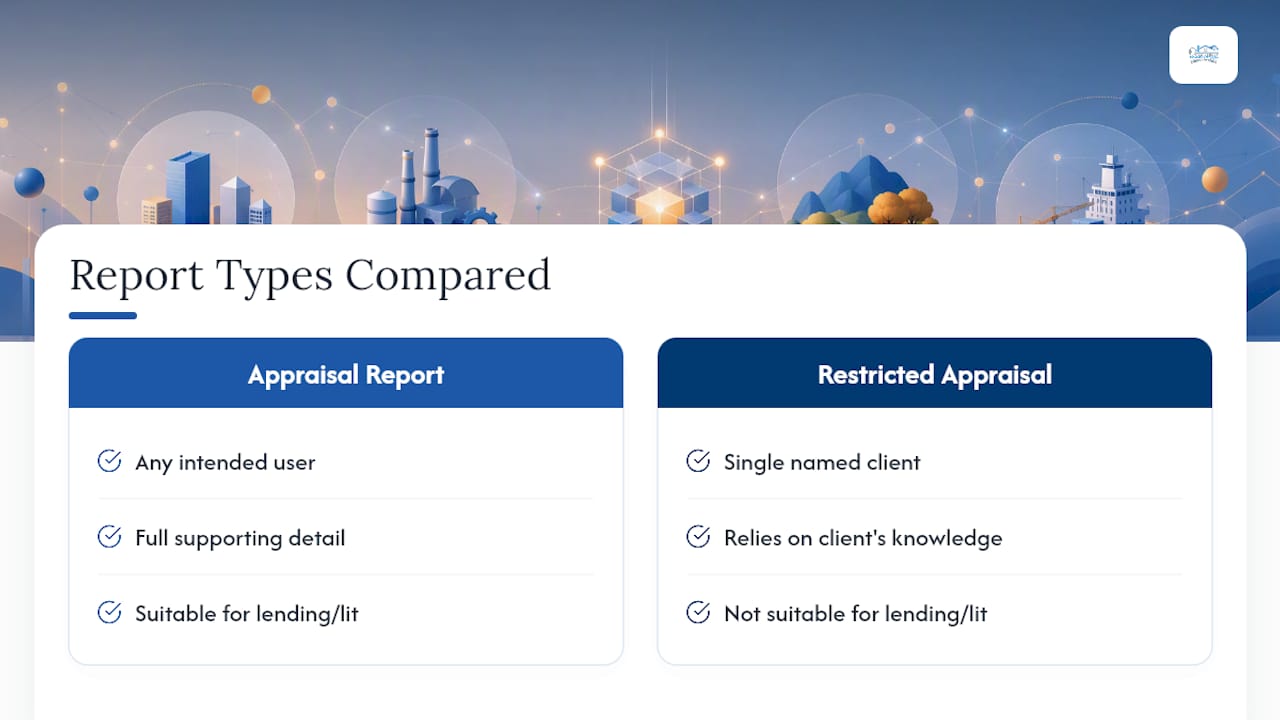
What's the difference between an Appraisal Report and a Restricted Appraisal Report? An Appraisal Report is written for any intended user and includes full supporting detail. A Restricted Appraisal Report is written for a single named client and relies on that client's existing knowledge, so it isn't appropriate for lending or litigation use where multiple parties need to review the reasoning.
Do all valuation reports need to go through electronic delivery? No. Loans headed to Fannie Mae or Freddie Mac generally require EAD or UCDP delivery in MISMO format. Court filings and many tax appeal boards still accept, or require, certified paper copies.
How long does a lender review take after I submit a valuation report? Desk reviews typically take a few business days to complete. If the reviewer finds a discrepancy, expect a request for corrections or supporting documentation before the file clears.
What's the most common reason valuation reports get rejected? Failing to define the intended use clearly at the start. A report scoped for a mortgage often lacks the documentation a tax appeal board or attorney needs later, which forces a rewrite.
Can Newjerseyrealestateappraisal handle divorce or estate valuations that need to go to court? Yes. We regularly prepare state-certified, court-ready reports for divorce, estate, and tax appeal matters across all 21 New Jersey counties. Call (908) 517-3913 to discuss your situation.
This article is general information, not a substitute for advice from a qualified financial advisor. Consult a qualified financial professional about your own circumstances before acting on anything here.
Sources
- Study
- FHA appraisal report and data delivery guidance — HUD
- Appraisal Institute guide notes on standards of professional practice
- How to fill out and submit a real estate valuation form — LegalClarity