

Filing a valuation appeal comes down to one move: submit your written appeal to the county board of equalization (or appraisal review board) before the deadline on your assessment notice, with a comps grid, your property record card, and a signed cover letter attached. Most counties give you a 30 to 45 day filing window from the notice date, and appraisal evidence should follow USPAP Standard 5 reporting rules if you want it to hold up at a hearing. Newjerseyrealestateappraisal handles exactly this kind of evidence for property owners across New Jersey's 21 counties.
Here's the roadmap the rest of this tutorial walks through:
- Prepare your evidence packet
- Notify the assessor and request an informal review
- File the formal county appeal
- Present your case at the hearing
- Know your next-level options if the county says no
Key Takeaways
A valuation appeal succeeds when you file before the county deadline, attach comparable sales as your strongest evidence, and back weak spots with a USPAP-compliant appraisal.
| Point | Details |
|---|---|
| File the notice first | Submit your appeal before the 30 to 45 day deadline even if your evidence packet isn't complete yet. |
| Appeal the value, not the bill | Boards only rule on assessed value, so keep your argument focused there. |
| Lead with comps | Three to five recent comparable sales are the most persuasive evidence class in most hearings. |
| Label your exhibits | A packet organized as Exhibit A through E gets reviewed faster than an unlabeled stack. |
| Hire when the gap is large | Newjerseyrealestateappraisal builds USPAP-compliant, court-ready reports for New Jersey tax appeals when the evidence needs to hold up. |
Where To Check Deadlines And Rules Next
- Your county board of equalization or appraisal review board portal
- USPAP appraisal standards for report requirements
- Your state's board of equalization filing page
Table of Contents
- What You're Actually Appealing (And When You Have to File)
- How Do You Prepare And Submit A Valuation Appeal?
- What Evidence Should You Collect And How Do You Organize It?
- What Forms And Filing Steps Should You Expect?
- What Happens At The Hearing?
- Get A State-Certified Appraisal For Your Tax Appeal
- Frequently Asked Questions
- Sources
What You're Actually Appealing (And When You Have to File)
You're appealing the assessed value the county placed on your property, not the tax rate and not the dollar amount on your bill. Two properties can owe wildly different tax bills off the same assessed value depending on the local rate, so arguing "my taxes are too high" gets your appeal dismissed before anyone looks at your evidence.
Deadlines vary by jurisdiction, but most give you a tight window. Avalara's research puts the typical filing period at 30 to 45 days from your valuation notice date, and some states run stricter calendars entirely. Texas, for example, generally mails notices by May 1 or May 15 and gives owners roughly 30 days to protest.
Miss that county-level deadline and you usually lose your first-level appeal rights for the entire tax year.
- Assessed value is the target, not your tax bill total
- Deadlines run 30 to 45 days in most places, shorter in some
- Missing the county deadline typically forfeits that year's appeal
- Check your notice for the exact date. Don't assume it matches last year's
How Do You Prepare And Submit A Valuation Appeal?
This is the part that actually matters. Follow it in order and you won't waste a filing cycle.
- Read your notice and mark the deadline. Put it on a calendar with a reminder five days before it hits.
- Pull your property record card from the assessor's office. This document lists your home's recorded square footage, bedroom count, condition rating, and lot size. Errors here are common and easy to fix.
- Request the assessor's workpapers. Ask specifically for the sales ratio study behind your valuation.
- Collect three to five comparable sales from the past 6 to 12 months, ideally within a tight radius of your property, or commission a professional appraisal if the value gap is large.
- Assemble your packet with a cover letter stating your requested value and the reasoning behind it.
- File the appeal and request an informal review with the assessor if your jurisdiction offers one.
- Confirm your hearing date in writing and keep the confirmation.
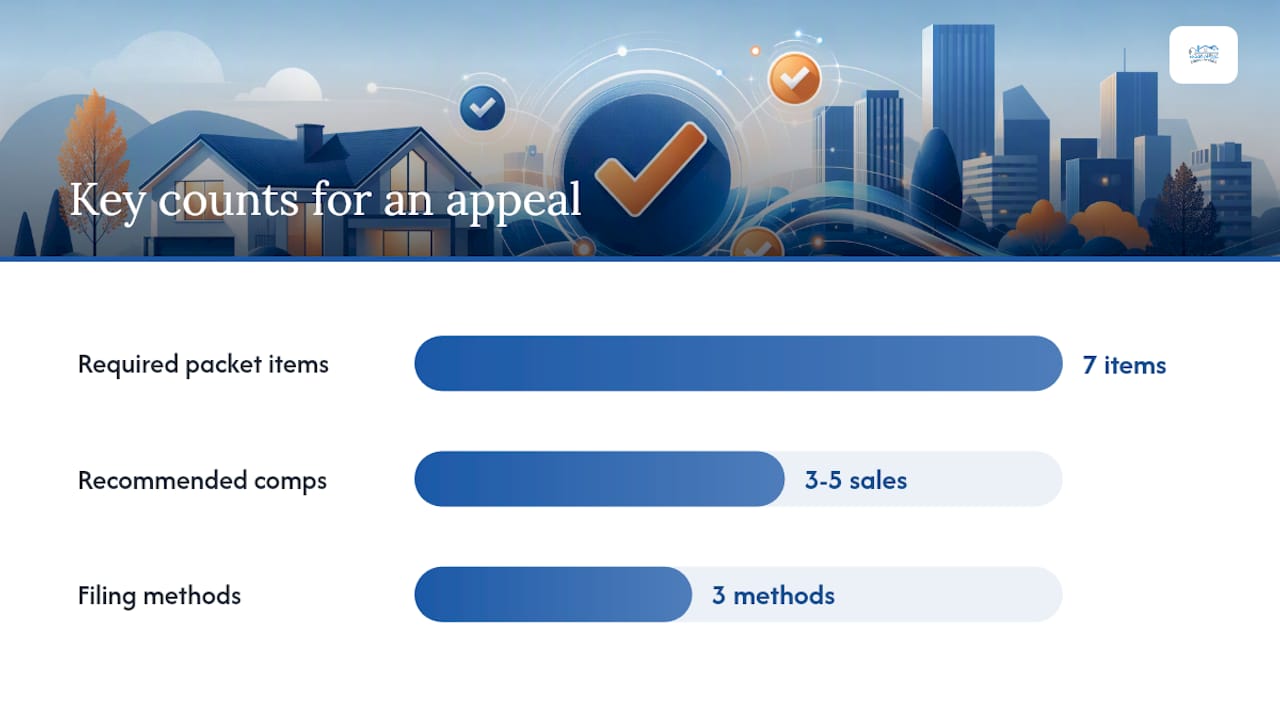
Your packet needs these pieces:
- A cover letter stating your requested reduction and grounds for appeal
- A copy of the assessor's original notice
- Your property record card
- A comps grid with three to five recent sales
- Dated photos of any condition issues
- Repair estimates, where applicable
- A professional appraisal, if you commissioned one
Most counties now accept appeals through an online portal, though certified mail and in-person filing remain valid in nearly every jurisdiction. Arizona's State Board of Equalization outlines a typical online filing flow that other states largely mirror. When you call the assessor's office, keep it simple: "I'm requesting the workpapers and sales ratio study used to value my property at [account number]." That single sentence usually gets you what you need.
Pro Tip: File your notice of appeal the moment you know you're contesting the value, even if your comps aren't finalized yet. A timely, incomplete filing preserves your right to appeal; a complete filing submitted one day late does not.
What Evidence Should You Collect And How Do You Organize It?
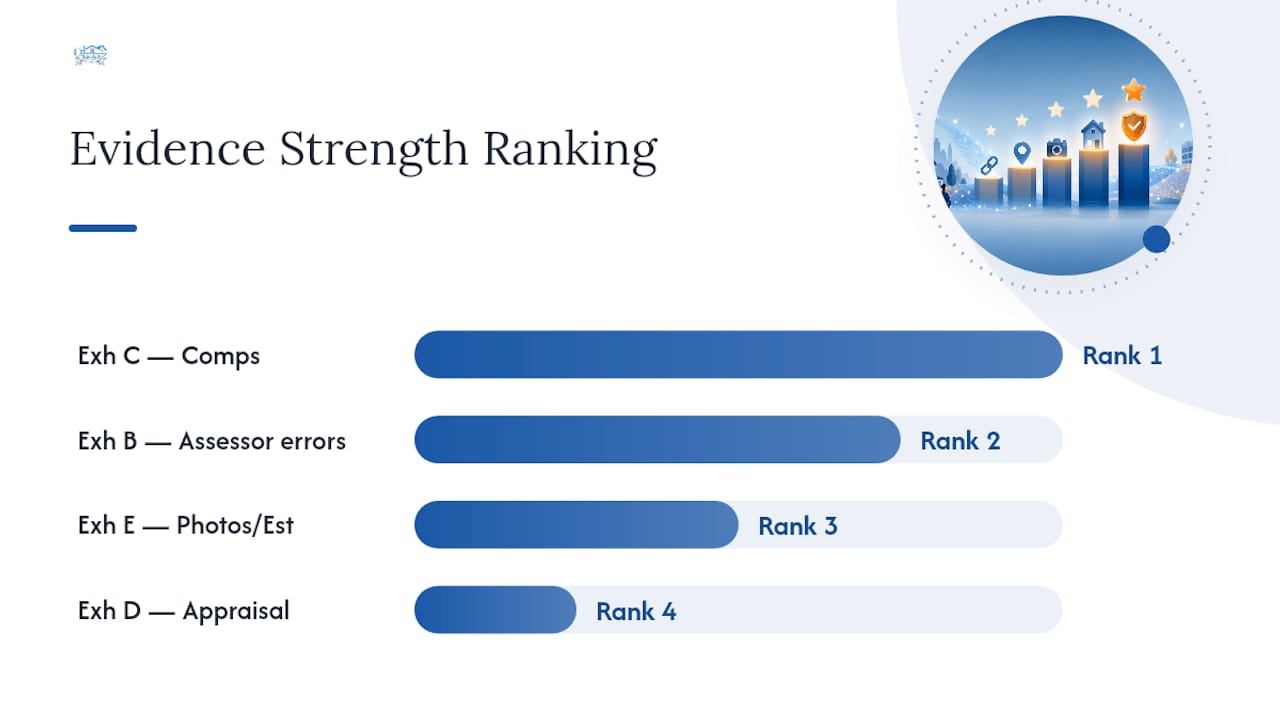
Not all evidence carries the same weight. According to TaxFightBack's evidence ranking, comparable sales are consistently the strongest evidence class, followed by documented errors on the assessor's own record, then condition documentation, then professional appraisals. Lead with your strongest material.
For residential appeals, prioritize in this order:
- Three to five comparable sales from the last 6 to 12 months
- A professional appraisal report, if the gap justifies the cost
- Your property record card, checked line by line for factual errors
- Photos documenting condition issues, dated and captioned
- Repair estimates from licensed contractors
Commercial properties need income and expense statements added to that stack, since boards weigh income approach data heavily for rental and mixed-use properties. A comparable sales analysis that properly adjusts for differences between your property and the comps carries far more weight than a raw list of nearby sale prices.
Label everything as exhibits and reference them by letter in your cover letter: Exhibit A (cover letter), Exhibit B (assessor's record), Exhibit C (comps grid), Exhibit D (appraiser report), Exhibit E (photos and estimates). Boards review dozens of packets a day. One that's labeled and referenced gets read faster and taken more seriously than a loose stack of papers.
Pro Tip: Caption every photo with the date it was taken and a one-line description of what it shows. An undated photo of water damage proves nothing about when the damage occurred.
What Forms And Filing Steps Should You Expect?
Every jurisdiction's form looks slightly different, but nearly all of them ask for the same core fields: your property ID or account number, owner name, current assessed value, your requested value, and your stated grounds for appeal, plus a signature and contact information.
Filing methods generally fall into three categories:
- Online portal: upload your packet as a PDF, common in states like Tennessee, where the State Board of Equalization runs a formal online appeals process
- Certified mail: send with return receipt requested so you have proof of the filing date
- In-person filing: hand-deliver and ask for a date-stamped copy on the spot
Some counties charge a small filing fee or require a deposit for formal hearings, so check your local board's fee schedule before you submit. When requesting workpapers, keep your email short: "Please provide the sales ratio study and comparable sales data used to establish the assessed value for [property address/account number]." Whatever method you use, get written confirmation, an email receipt, a date stamp, or a case number, and keep it with your file.
What Happens At The Hearing?
Most jurisdictions start with an informal conference, a short, low-pressure conversation with an appraiser or assessor's representative where a large share of appeals actually get resolved. If that doesn't produce the result you want, you move to a formal hearing before the board.
Formal hearings run fast, often 10 to 15 minutes per case. Prepare a two-minute opening statement and a one-page summary of your requested value and reasoning. Bring three copies of everything: one for the board, one for the assessor's representative, one for yourself.
Boards can rule three ways: full reduction, no change, or partial reduction. If you're not satisfied, you generally have the right to appeal upward to a state board, administrative hearing body, or court, though each path carries its own deadline. Note that property taxes are usually still due while your appeal is pending, and the rules on what happens if you underpay vary by jurisdiction, so confirm your local policy before you decide how to handle your bill.
- Stay factual and concise. Boards see hundreds of cases and reward brevity
- Never argue the tax rate. Argue the value
- Bring backup copies of every exhibit
- Ask about continuance procedures early if you need more time to gather evidence
When Do You Need A State-Certified Appraisal, And What Should It Include?
USPAP Standards 5 through 8, and Standards 3 through 4 for review work, are the accepted framework for defensible appraisal reporting. Where a county assessor used a mass-appraisal model, a single-property USPAP-compliant report that documents every adjustment and deviation can be the deciding piece of evidence at a hearing.
Hire a certified appraiser when the assessment gap is large, when you own a commercial or income-producing property, when comps are scarce or your home has unusual features, or when the assessor clearly leaned on a generic mass-appraisal model instead of inspecting your property.
A defensible report should include:
- A clearly stated scope of work and inspection date
- All three approaches to value where relevant: sales comparison, cost, and income
- A documented explanation of every adjustment made to the comps
- A retained workfile supporting the final opinion of value
Newjerseyrealestateappraisal builds every tax appeal report to this standard, and if you're unsure whether your situation calls for one, our guide on who needs a property appraisal walks through the common trigger points.
What We See Working Across New Jersey County Appeals
We've handled tax appeal appraisals across all 21 New Jersey counties, and the pattern holds: a well-documented, USPAP-compliant report backed by tight comps moves boards more than passion does. Expect the process to take weeks, not days, and know that clean evidence beats a loud argument every time.
Get A State-Certified Appraisal For Your Tax Appeal
If you're staring down a county deadline and don't have the comps or the confidence to build your own packet, that's exactly where a state-certified appraisal earns its cost back. Newjerseyrealestateappraisal delivers court-ready, USPAP-compliant appraisal reports built specifically for property tax appeals, not generic valuations retrofitted for a hearing.

Our Certified Property Tax Appeal Appraisals come with a full exhibit package, adjustment explanations, and testimony support if your case goes to a formal hearing. Turnaround is typically fast enough to hit tight county filing windows, and if your property sits in a specific county, we also maintain dedicated pages for areas like Atlantic County and Union County. Call us at (908) 517-3913 or request a quote directly through our site to get a report built for your deadline.
Frequently Asked Questions
What's the difference between appealing my assessment and disputing my tax bill? Your assessment is the value the county assigns your property. Your tax bill is that value multiplied by the local tax rate. Appeals only address the assessed value; you can't contest the rate itself through this process.
How long do I have to file a valuation appeal? Most jurisdictions give you 30 to 45 days from your notice date, though some states set specific calendar deadlines. Check your assessment notice for the exact date rather than assuming it matches a prior year.
Do I need a professional appraisal to win my appeal? Not always. Strong comparable sales and a corrected property record card resolve many residential appeals. A state-certified appraisal becomes worth the cost when the value gap is large, comps are scarce, or your property is commercial or unusual.
What happens if the county board denies my appeal? You typically have the right to escalate to a state board, an administrative hearing body, or court, depending on your jurisdiction. Each level has its own deadline, so ask about the appeal window for the next step as soon as you receive the county's decision.
Can I request a continuance if I'm not ready for my hearing? Most boards allow a continuance request if you submit it before your scheduled date and provide a reasonable reason. Contact the board's clerk directly, in writing, as soon as you know you need more time.
This article is general information, not a substitute for advice from a qualified financial advisor. Consult a qualified financial professional about your own circumstances before acting on anything here.
Sources
- Avalara — How to submit property tax appeals
- Texas Comptroller — Appraisal protests and appeals
- Kansas Department of Revenue - DIR24-051 (appraisal guidance)
- TaxFightBack — What evidence works in property tax appeals