
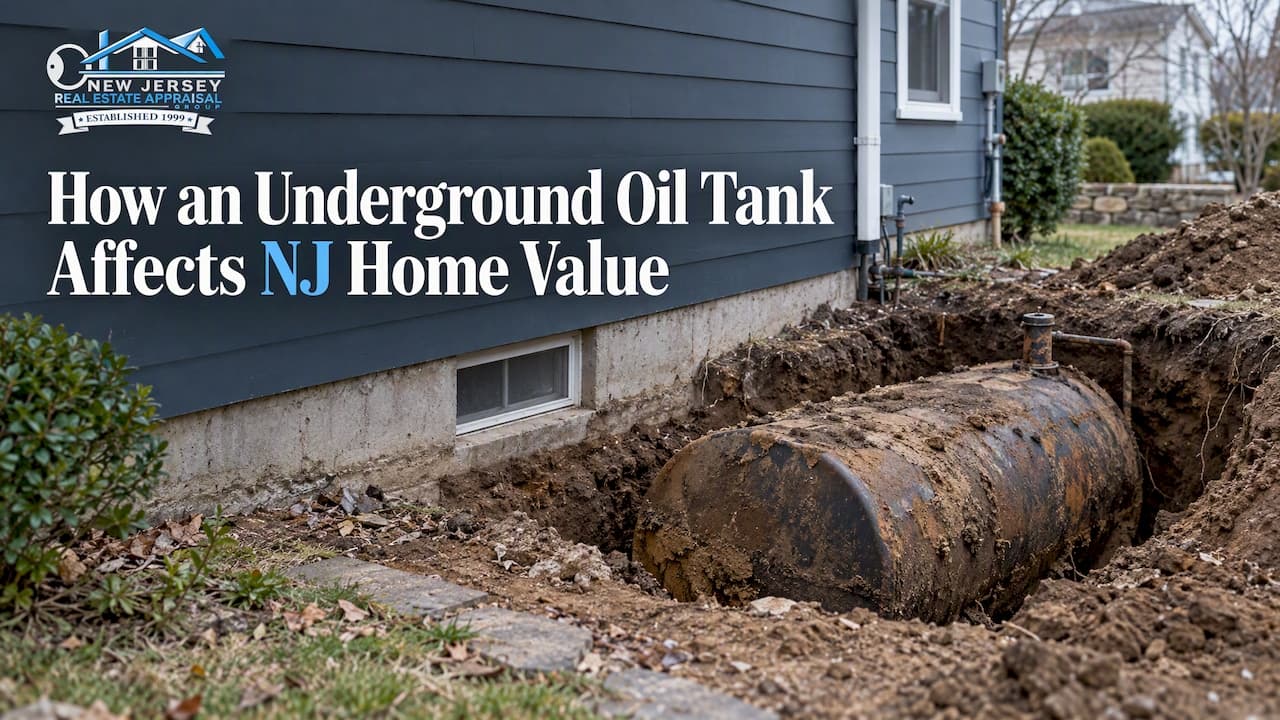
A buried heating oil tank does not automatically cut your home's value, but an undocumented one can stall a sale, a refinance or a settlement. What moves the number is the tank's status (removed, closed in place, or still in the ground), the paperwork behind it, and whether any leak was ever found. In New Jersey, where thousands of homes were heated with oil, we see this question come up in sales, estates, divorces and tax appeals.
This guide explains how an appraiser treats an underground oil tank, what records help, and what to do before you order a report.
TL;DR
- An underground oil tank with no leak and good documentation is usually a manageable item. An unknown, unverified or leaking tank is where value and financing problems start.
- Removal records, closure paperwork and soil sampling results give an appraiser something solid to work with. Without them, the report may carry a hypothetical condition or a required inspection.
- If a discharge is found, New Jersey rules require immediate notice to the DEP and a certified professional to investigate.
- Lender rules matter: Fannie Mae requires appraisers to analyze the measurable effect of a hazard using comparable sales.
- Order the appraisal with the tank's status stated up front, so the opinion of value matches the situation you actually face.
Table of Contents
- How an appraiser treats a buried oil tank
- Removed, closed in place, or still in service: how value differs
- What the research says about value effects
- New Jersey rules that shape the appraisal
- What cleanup and removal cost, and how that enters the value
- Records that help your appraiser
- When the tank issue shows up in other appraisal assignments
- Our perspective
- Get an appraisal that accounts for the tank
- FAQ
- Sources
How an appraiser treats a buried oil tank
An appraiser does not value the tank. An appraiser values the property as it exists, including any condition that a typical buyer would react to. That is a market question, answered with evidence, not a fixed deduction.
For mortgage work, the rules are explicit. Fannie Mae's Selling Guide says that when an appraiser identifies an environmental hazard, the appraiser must note it, analyze its measurable effect on value and marketability using comparable sales, and make the appraisal subject to inspection by a qualified professional. The same guide makes a loan ineligible for delivery to Fannie Mae when a hazard is so serious or so recently discovered that a reliable opinion of value cannot be developed.
Fannie Mae's appraiser update adds a point that helps owners: if comparable market data show no buyer resistance to a hazard, the appraiser should say so in the report. In other words, a tank is not a penalty by default. The market decides.
For a private appraisal used in a divorce, estate or tax appeal, the same logic applies under USPAP. The appraiser identifies the condition, decides what the evidence supports, and states any assumptions clearly so the report holds up when an attorney, a judge or an assessor reads it.

Removed, closed in place, or still in service: how value differs
The status of the tank is the biggest single variable. These are the situations we run into most often.
| Tank status | What the appraiser needs | Typical effect on the report |
|---|---|---|
| Removed, with closure documentation and clean soil results | Removal invoice, permit or closure paperwork, soil sampling results | Often treated as a resolved item; comparable sales without a tank usually apply |
| Removed, but no records | Whatever evidence exists, such as receipts, photos, or a contractor statement | The appraiser may need an assumption or a professional inspection before concluding |
| Abandoned in place (closed) | Closure documentation and a record of how it was filled | Some buyers and lenders still hesitate, so the market reaction is tested with comparables |
| Still in the ground, status unknown | A tank sweep or other professional evaluation | Report may be subject to inspection or carry a stated assumption |
| Known or suspected leak | Environmental consultant findings, cleanup status | Value depends on cleanup cost, stigma and whether financing is available |
This table is our working framework, not a rule from a regulator. Every property is different, and the conclusion comes from local sales evidence.
Removed tanks
A removed tank with documented clean results is the best case. Buyers and lenders can see that the question was asked and answered. The appraiser's job is mostly to confirm the paperwork exists and to avoid applying a discount that the market does not actually impose.
Tanks closed in place
Some tanks are cleaned and filled rather than dug up, often because they sit under a driveway, a deck or an addition. New Jersey's construction code guidance strongly recommends removing out-of-service underground tanks even with no sign of a leak, and notes that mortgage and insurance companies are major drivers of removal because of long-term liability. That is a useful signal about how the market thinks: a closed-in-place tank may need more explanation than a removed one.
Tanks still in the ground
If a tank is simply there and nobody knows its condition, the appraiser faces uncertainty. A buyer's lender may ask for a tank sweep or testing, and the appraisal may be made subject to that inspection. The cleanest path is to settle the tank's status before the appraisal, so the report does not have to hedge.
What the research says about value effects
The evidence on contamination and home prices is real, but it is often misread.
- An EPA study of 17 high-profile cases found that discovery of a release was followed by an average 3% to 6% decrease in home values within five years, with values rebounding by 4% to 9% after cleanup was completed.
- An earlier EPA analysis found that at typical underground storage tank sites the effect on surrounding homes is often negligible, while publicized and more heavily contaminated sites can see depreciation above 10%.
- A 2014 EPA-hosted study found that the probability of a home sale near a leaking tank dropped by about 50% while cleanup was ongoing.
Two cautions apply. These studies look at leaking commercial and community tank sites and the homes near them, not a single residential heating tank in a backyard. And the pattern they show is useful: the damage comes from uncertainty and an open cleanup, and much of it reverses once the problem is resolved. That is the argument for documentation.
The International Association of Assessing Officers notes that the availability of state insurance funds and certification of a tank's current condition may increase the value of properties with underground tanks. Proof of condition has value in itself.
New Jersey rules that shape the appraisal
Residential heating oil tanks fall outside the federal underground storage tank program, as EPA explains. In New Jersey they are handled through the state's unregulated heating oil tank (UHOT) program.
Per the NJDEP FAQ, when a discharge is discovered the owner must notify the DEP hotline immediately, and a certified subsurface evaluator or Licensed Site Remediation Professional (LSRP) must investigate or remediate. The state's construction code bulletin also says that if a construction project leaves an underground tank out of service for one year, it must be removed or abandoned in place under the applicable code.
For an appraisal, this means one practical thing: a discovered leak changes the assignment. An appraiser cannot reach a reliable value without knowing the cleanup scope, so the usual sequence is to bring in the environmental professional first, then appraise with the results in hand.

What cleanup and removal cost, and how that enters the value
Cost matters because buyers and appraisers think in terms of what it takes to fix the problem.
- Removal of a clean tank. One New Jersey removal contractor publishes a typical range of $1,600 to $3,500 for a standard residential underground tank with no contamination. Your quote will depend on tank size, depth and access.
- Cleanup if it leaked. EPA states that cleanup may cost as little as $10,000 for a small amount of soil removal or treatment, while groundwater corrective action typically runs from $100,000 to over $1 million, depending on the extent of contamination (EPA).
The gap between those figures explains why buyers react so strongly to the unknown. A tank you can price is a negotiation. A tank you cannot price is a risk, and risk gets discounted.
An appraiser does not simply subtract a removal quote from value. Where comparable sales show how the market treats similar homes, that evidence leads. A documented cost to cure can support the conclusion, but the market reaction is the test.
Records that help your appraiser
Gather these before ordering a report. State agencies in other states give the same basic advice for buyers and sellers, for example Texas's environmental agency tells owners to request tank records, including removal documentation, and explains how site assessments and no-further-action letters document a tank's closure.
- Oil delivery records. Tickets from your heating oil company can show when the tank was last filled and its size.
- Removal or closure paperwork. Invoice, municipal permit, and any closure or sign-off documents.
- Soil sampling results. Lab results from the excavation, or a consultant's letter summarizing them.
- Tank sweep or testing reports. Useful when the tank is believed to be present and its condition is unknown.
- Cleanup records. If a discharge occurred, the investigation and remediation documents and the status of any sign-off.
- Photos and site plans. Where the tank sat, what covers it, and whether an addition or driveway was built over it.
If you are also lining up other pre-closing items in New Jersey, a backflow inspection before closing is another one buyers and sellers often need to schedule alongside tank paperwork.
When the tank issue shows up in other appraisal assignments
The tank question does not only come up in sales.
- Estates and date-of-death valuations. Executors need a defensible value as of a specific date. If the tank's status as of that date is unclear, the report should say what was known. See our estate and date-of-death appraisals.
- Divorce and equitable distribution. Both sides rely on one number, so conditions that affect it must be handled openly. Our divorce appraisals are built for that scrutiny.
- Property tax appeals. If a tank condition affects value, the appeal needs evidence, not a claim. A tax appeal appraisal can show how the market treats it.
- Pre-listing decisions. Knowing the tank's effect before you list lets you decide whether to remove it, document it, or price around it. Our guide to a pre-listing appraisal walks through the thinking.
Where an older house also has other special conditions, our piece on historic home appraisal challenges and the article on how septic vs. sewer affects value in NJ cover similar questions about systems that a buyer will ask about.
Our perspective
Most of the tank problems we see are documentation problems. The owner knows the tank was dealt with years ago, but there is no paper to show it, and the appraisal, the lender or the other side's attorney treats that gap as risk.
Our approach is to identify the tank's status early, state what is verified and what is assumed, and test the market reaction with comparable sales instead of applying a rule-of-thumb deduction. With more than 26 years of appraisal and real estate experience, including hands-on renovation work, we understand what a buried tank means in practice: access, cost to cure, and how buyers talk about it.
That is what a court, an executor or a lender needs: a clear, market-supported opinion that explains its reasoning and complies with USPAP.
Alek Petreski
Get an appraisal that accounts for the tank
If you own a New Jersey home with a known or suspected buried oil tank, tell us its status when you request a report. We prepare state-certified, USPAP-compliant appraisals for homeowners, attorneys, executors and lenders. Our published fees for home appraisals run from $495 to $750, estate and date-of-death appraisals from $595 to $850, and divorce appraisals from $550 to $800. Complex assignments are quoted individually.

To request a quote, visit our services page or go to New Jersey Real Estate Appraisal Group. For more on fees, see our NJ appraisal fee breakdown.
FAQ
Does an underground oil tank lower my home's appraised value?
Not automatically. The appraiser looks at whether buyers in your market pay less for comparable homes with the same condition. A removed tank with documentation often has little effect, while an unverified or leaking tank can reduce value and complicate financing.
Do I have to remove the tank before selling in New Jersey?
We are not aware of a rule that forces removal at sale, but state guidance strongly recommends removing out-of-service underground tanks. Lenders and insurers often push for it. Ask your attorney and your lender what they will require for your transaction.
What should I do if I find a leak?
Notify the NJDEP hotline right away and hire a certified subsurface evaluator or LSRP, as the NJDEP guidance requires. Order the appraisal after the investigation gives a defined scope, so the value opinion rests on facts.
Can a lender refuse a loan because of a buried tank?
It can. Fannie Mae-backed loans are ineligible when a hazard is too serious or recent to measure with comparable data, and appraisers must analyze a hazard's effect on value. Documentation and clean results make approval much easier.
What does a tank-related appraisal cost with NJREAG?
Fees follow the type of assignment. Our home appraisals are listed at $495 to $750, and estate appraisals at $595 to $850. Contact us with the property details for an exact quote.
Sources
- EPA: Do Housing Values Respond to Underground Storage Tank Releases?
- EPA: To Sell or Not To Sell
- EPA: What Do Property Values Really Tell Us?
- EPA: Frequent Questions About Underground Storage Tanks
- IAAO: Contamination and property value
- NJDEP: Unregulated heating oil tanks FAQ
- NJ DCA Bulletin 95-1B
- Fannie Mae: Environmental Hazards Appraisal Requirements
- Fannie Mae: Appraiser Update, September 2024
- TCEQ: Buying or Selling Property with Petroleum Storage Tanks
- Oil tank removal cost in New Jersey
Recommended
- Septic vs. Sewer: How Each Affects Home Value in NJ
- Historic Home Appraisal Challenges: What NJ Owners Must Know
- Detached Garage: Why Build Cost Won’t Set NJ Appraisal Value
- How to get a home appraisal in NJ: 73% accurate valuation
This article is provided for general informational purposes only and does not constitute legal, tax, or financial advice. Real estate appraisal requirements can vary by assignment and intended use. For advice specific to your situation, consult the appropriate legal, tax, or financial professional.