
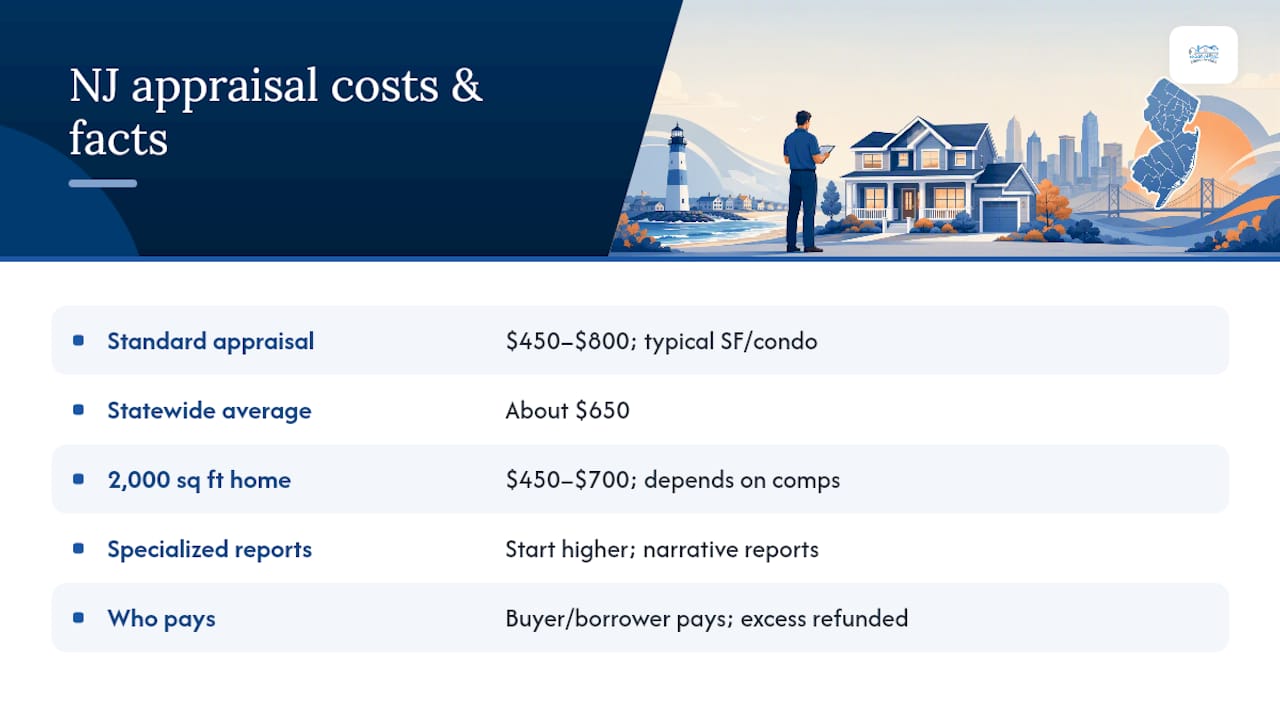
Standard home appraisal cost in NJ typically falls within a range generally between four hundred and eight hundred dollars for a typical single-family home or condo, according to pricing data from across the state. Every appraisal must come from a state-certified appraiser working under USPAP standards, no exceptions.
Here's what that looks like by property type:
- Single-family home: $450 to $650
- Condo or townhouse: $450 to $700
- Manufactured home: $500 to $750
- 2 to 4 unit property: $650 to $900+
Specialized reports for divorce, estate, or tax appeal cases cost more. We'll break down why below.
Key Takeaways
Home appraisal cost in NJ ranges from $450 for standard homes to $900 or more for legal and retrospective assignments, and state law protects you from lender overcharges.
| Point | Details |
|---|---|
| Standard cost range | Single-family and condo appraisals typically run $450 to $800 statewide. |
| Legal assignments cost more | Divorce, estate, and tax appeal reports often start at $600 to $900+ due to narrative requirements. |
| Refund protection exists | N.J. Admin. Code § 3:1-16.2 requires lenders to refund any fee collected above the appraiser's actual cost. |
| Turnaround affects price | Standard reports take 7 to 10 business days; rush requests add 20% to 50%. |
| Choose a certified specialist | Newjerseyrealestateappraisal delivers state-certified, USPAP-compliant reports across all 21 NJ counties. |
Table of Contents
- How Much Does A Home Appraisal Cost In NJ By Property Type?
- What Type Of Appraisal Report Do You Actually Need?
- What Factors Push Your Appraisal Fee Up Or Down?
- Who Pays For The Appraisal, And What Are Your NJ Rights?
- How Long Does A NJ Appraisal Take, And What Does Rush Cost?
- When Do You Need A Specialist Appraisal (Divorce, Estate, Tax Appeal)?
- How Do You Vet A State-Certified NJ Appraiser?
- What Homeowners Get Wrong About Appraisal Pricing
- Get A State-Certified Appraisal From NJREAG
- Frequently Asked Questions
- Sources
How Much Does A Home Appraisal Cost In NJ By Property Type?
Property type drives most of the price difference you'll see between quotes. A straightforward single-family appraisal in a subdivision with plenty of recent comparable sales sits at the low end. A manufactured home or a 2 to 4 unit property takes more research, so it costs more.
Statewide data suggests New Jersey's average appraisal fee is around the mid six-hundreds, which tracks above the national median. New Jersey's density and property variety, from Cape May bungalows to Bergen County multi-families, push fees higher than in more uniform markets.
Here's what a standard fee typically covers:
- A full interior and exterior property inspection
- Research and analysis of at least three comparable sales
- A written report with photos, sketches, and market commentary
- Compliance review to meet lender or client standards
The VA's fee schedule lists benchmark appraisal fees around $600 for single-family and condo properties in many parts of the state. VA and FHA loans often land in a tighter, more predictable range because those programs set clear expectations for appraisers upfront.
Statistic callout: New Jersey's average appraisal fee sits near $650, according to WorldPopulationReview's state-by-state data, placing it among the costlier states for this service.
What Type Of Appraisal Report Do You Actually Need?
Not every appraisal is the same product. Ordering the wrong type wastes money, or worse, gets your report rejected where it matters.
- URAR/form reports. This is the standard form lenders use for purchases and refinances. It's fast, checkbox-driven, and built for underwriting, not litigation.
- Narrative reports. These are longer, fully written reports with detailed reasoning. Courts, the IRS, and tax boards expect this format because it explains the appraiser's logic step by step.
- Desktop or drive-by appraisals. An appraiser skips the full interior walkthrough and relies on public records, photos, or a quick exterior look. Lenders sometimes accept these for low-risk refinances, but they're a poor fit for divorce or estate work.
Legal and retrospective assignments almost always require narrative reports. If you're settling a divorce or valuing a property as of a date years in the past, a form report won't hold up under cross-examination.
What Factors Push Your Appraisal Fee Up Or Down?
Appraisers price a job based on how much work it actually takes, not a flat rate. Here's what moves the number:
- Property complexity: Acreage, outbuildings, additions, or unusual layouts require more measuring and analysis.
- Location: Rural counties with fewer recent sales take longer to research than dense suburban tracts.
- Condition: Deferred maintenance or renovations in progress mean more notes and adjustments.
- Loan type: VA and FHA appraisals include extra property standards checks.
- Intended use: A tax appeal or court case demands more documentation than a refinance.
- Rush requests: Compressing turnaround time always costs more.
- Travel and access: Farther-flung properties or units requiring special scheduling add time.
Pro Tip: Ask upfront whether your quote is a flat form-report price or if it assumes a straightforward, easy-access property. A quote that seems low sometimes doesn't account for a finished basement, a detached garage, or an accessory unit.
Who Pays For The Appraisal, And What Are Your NJ Rights?
In most purchase transactions, the buyer or borrower pays. Refinances work the same way, with the fee usually collected upfront or rolled into closing costs, depending on the lender.
Here's what NJ homeowners need to know about protection against overcharges:
- Lenders can collect an appraisal fee, but they can't pocket more than the actual cost paid to the appraiser.
- Any excess must be refunded at or before closing.
- "Good cause" for extra charges is narrowly defined and has to be documented.
Per N.J. Admin. Code § 3:1-16.2, a lender must refund any amount collected in excess of the direct cost paid to the appraiser, at or prior to closing.
If your closing disclosure shows an appraisal fee that looks padded compared to the appraiser's invoice, ask your lender directly for an itemized breakdown. You're entitled to see it.
How Long Does A NJ Appraisal Take, And What Does Rush Cost?
Timing depends on complexity and how busy your appraiser's schedule is that month.
- Standard single-family or condo: 7 to 10 business days is typical for most NJ assignments.
- Multi-family or complex properties: Expect longer, often two to three weeks, since these require more comparable research.
- Legal or retrospective assignments: These often take the longest because of historical sales research and extra documentation.
Rush requests typically add 20% to 50% to the base fee. If you need a report in 48 hours for a closing deadline, expect to pay for it. Appraisers reshuffle their entire schedule to accommodate you.
When Do You Need A Specialist Appraisal (Divorce, Estate, Tax Appeal)?
Divorce, estate, and tax appeal appraisals aren't priced like a standard purchase appraisal, and that's by design. These assignments typically start around $600 to $900 or more, according to detailed NJ fee breakdowns, because they require narrative reports built to withstand scrutiny.

A defensible, USPAP-compliant narrative report for a divorce or estate case means researching sales from a specific historical date, documenting market conditions as they existed then, and writing conclusions an attorney or judge can follow line by line. That research takes real hours.
Here's what to prepare for:
- Gather deed records, prior appraisals, and any renovation history before your appraiser starts.
- Confirm your deadline early. Tax appeal filing windows in New Jersey are strict.
- Ask whether courtroom testimony is billed separately from the report itself. It usually is.
Pro Tip: If your case might go to trial, hire the appraiser who'll write the report, not a firm that outsources testimony to someone else. Judges notice when the person on the stand didn't do the underlying work.
We handle court-ready divorce appraisals across all 21 counties, and pricing holds firm because the work involved doesn't shrink to fit a lower budget.
How Do You Vet A State-Certified NJ Appraiser?
Comparing quotes on price alone is how homeowners get burned. Run through this before you sign anything:
- Verify state certification. Ask for the appraiser's license number and confirm it's active.
- Confirm USPAP compliance. Every report should meet USPAP standards, no exceptions.
- Ask about assignment-type experience. A divorce appraisal is a different skill set than a refinance form report.
- Get a clear scope of the fee. Ask what's included and what triggers an add-on charge.
- Watch for red flags. A quote far below market rate, near $650 statewide on average, often means a rushed inspection or thin comp research.
Real estate transactions also depend on timing outside the appraisal itself. If you're coordinating a listing, photo turnaround times can affect your overall closing schedule just as much as appraisal delivery does.
What Homeowners Get Wrong About Appraisal Pricing
Most people shopping for an appraisal treat it like a commodity, the same instinct that drives them to compare contractor quotes. That's the wrong lens. A $450 form appraisal and a $900 narrative report aren't competing products. They're built for entirely different jobs.
The conventional advice, "just get the cheapest quote that meets your lender's deadline," works fine for a routine refinance. It falls apart the moment litigation, an estate, or a tax appeal enters the picture. I've seen the pattern play out the same way across pricing data and legal commentary alike: underpriced reports for complex assignments tend to skip the historical research that actually holds up under scrutiny.
If you're budgeting for anything beyond a standard purchase or refinance, prioritize the appraiser's experience with your specific assignment type over the sticker price. Ask what the report actually includes before you compare numbers side by side. The NJ refund rule under N.J. Admin. Code § 3:1-16.2 protects you from lender overcharges, but it won't protect you from an insufficient report that may cost you more later in a courtroom or a tax hearing.
Get A State-Certified Appraisal From NJREAG
Newjerseyrealestateappraisal gives you a faster path to a defensible report than piecing together quotes from multiple firms and hoping one specializes in your situation. We're state-certified, USPAP-compliant, and we've handled residential, divorce, estate, tax appeal, and lending appraisals across all 21 NJ counties for over 26 years.

Here's how an engagement works: you request a quote, we schedule an inspection that fits your timeline, and you get a written, defensible report with a clear turnaround date. For legal and estate work, that means a narrative report built to hold up under questioning, not a stripped-down form.
Whether you need a tax appeal appraisal, an estate or date-of-death valuation, or a standard residential report, start with our full services overview and request your quote today. Call us at (908) 517-3913 to talk through your specific assignment.
Frequently Asked Questions
How much is a home appraisal in NJ? Standard single-family and condo appraisals typically cost $450 to $800, with the statewide average near $650. Specialized reports for divorce, estate, or tax appeal cases usually start higher.
What does a home appraisal cost for a 2,000 square foot home in NJ? A typical 2,000 square foot single-family home falls in the $450 to $700 range, depending on location, condition, and how many comparable sales exist nearby.
What is the typical appraisal fee for a condo versus a single-family home? Condos generally run $450 to $700, close to single-family pricing, though HOA documentation requirements can add a bit of extra time and cost in some buildings.
Who pays for the home appraisal in New Jersey? The buyer or borrower typically pays, either upfront or as part of closing costs. Under N.J. Admin. Code § 3:1-16.2, any amount collected above the appraiser's actual fee must be refunded.
Why do divorce and estate appraisals cost more than a standard appraisal? These assignments require narrative reports with historical sales research and detailed documentation built to withstand legal scrutiny, which takes considerably more time than a standard form report.
Sources
- N.J. Admin. Code § 3:1-16.2 - Fees | Legal Information Institute (LII)
- Appraisal Fees by State 2026 — WorldPopulationReview
- Appraiser fee schedule | U.S. Department of Veterans Affairs (VA)
- NJ Property Appraisal: Standards, Process, and Legal Requirements – New Jersey Property Valuation Insights