
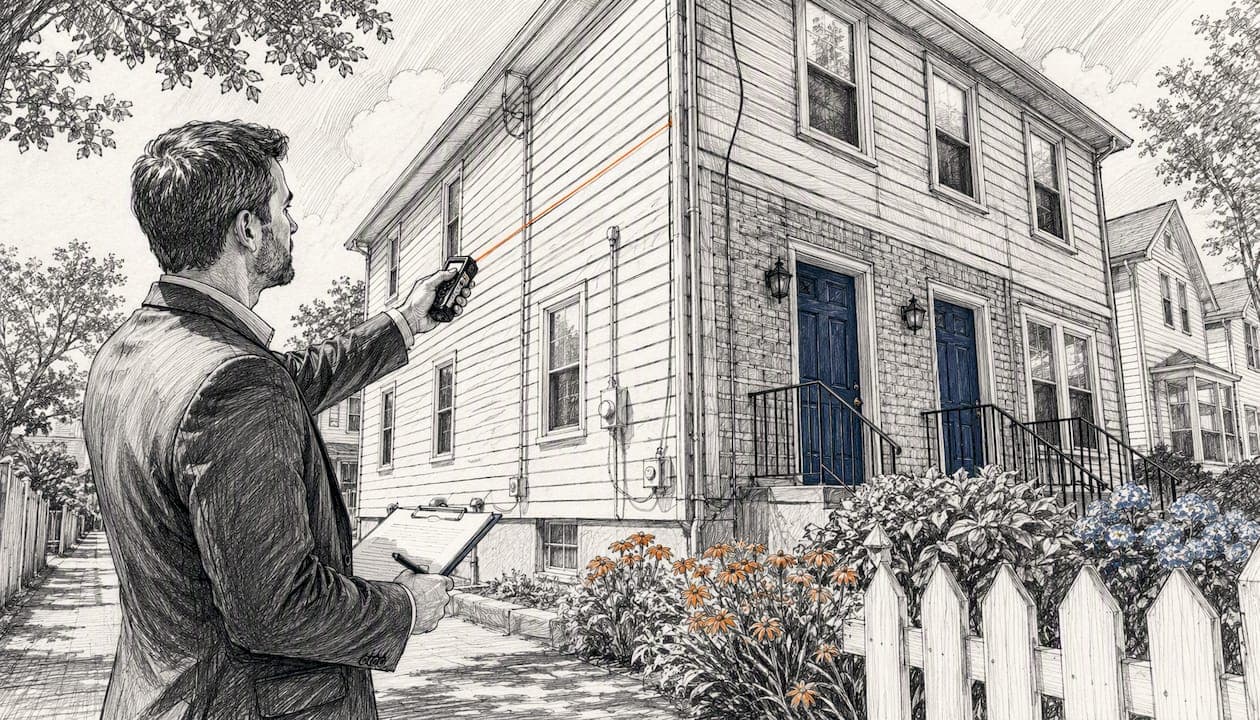
Form 1025 is the Fannie Mae Small Residential Income Property Appraisal Report, and lenders require it for full interior and exterior appraisals of two‑ to four‑unit properties. It covers the unit mix, market value, and rental income analysis a lender needs before closing a loan on a duplex, triplex, or fourplex. If your deal involves a small multi‑family property and the rents matter for underwriting, this is almost certainly the form your appraiser will use.
TL;DR:
- Form 1025 is required for appraisals of two- to four-unit properties where rental income impacts loan qualification or underwriting, including condos and PUDs in this category.
- The report must include exterior and street photographs, labeled maps, a detailed building sketch with GLA, and an operating income statement with verified rents.
- Appraisers are mandated to conduct a full visual inspection, verify comparable data, and adhere strictly to scope-of-work guidelines, especially for atypical properties or complex rent structures.
- Rental income is reported at the unit level, with lenders using 75% of gross rents to determine borrower qualification, requiring supporting lease and deposit documentation upfront.
- Mistakes often stem from incomplete rent verification, inaccurate GLA measurements, or missing exhibits, risking delays and additional costs in the appraisal process.
Table of Contents
- What Form 1025 Covers: Purpose and When Lenders Require It
- What Exhibits Does a Form 1025 Report Require?
- What Scope of Work Does an Appraiser Certify on Form 1025?
- How Does the Income Approach Work on Form 1025?
- Form 1025 vs. Form 1004 vs. Form 1007: Which Do You Need?
- How Do You Prepare for or Order a Form 1025 Appraisal?
- NJREAG Perspective: What We See Go Wrong on 1025 Reports
- Where to Find Official Form 1025 Guidance
- Need a Form 1025 Appraisal in New Jersey?
- Sources
What Form 1025 Covers: Purpose and When Lenders Require It
Fannie Mae built Form 1025 specifically for what the industry calls "small residential income properties," meaning two, three, or four dwelling units on one legal parcel. The Fannie Mae Selling Guide identifies it as the standard document for these traditional appraisals, and that scope includes properties structured as PUDs, condos, or co‑ops when they fall into the two‑to‑four unit category.
The form's stated intended use is narrow and deliberate: it exists to help a lender or client evaluate a property for a mortgage finance transaction. That's the language baked into the certification block, and it's not decorative. Every value conclusion on the report gets measured against a specific definition of market value, the same one Fannie Mae and Freddie Mac use across their appraisal forms. Lenders rely on that consistency to compare properties fairly across different appraisers and different deals.
You'll typically need a Form 1025 valuation in a few common scenarios:
- Purchase transactions on a duplex, triplex, or fourplex where the buyer is financing through a conventional lender.
- Refinances where the rental units generate income that affects loan terms or equity calculations.
- Qualifying scenarios where the borrower wants rental income from the other units counted toward debt-to-income ratios.
- Condo or PUD projects with two to four units, which require an added project addendum alongside the standard 1025 exhibits.
If the property is a single-family home with no rental units, Form 1025 isn't the right tool. And if you're dealing with five or more units, you're in commercial appraisal territory entirely, governed by different reporting standards. Understanding why lenders require appraisals in the first place helps explain why the form's intended use language stays so tightly worded. Lenders need every 1025 report to answer the same underwriting question the same way, deal after deal.
What Exhibits Does a Form 1025 Report Require?
A Form 1025 report isn't complete without a specific set of exhibits, and missing even one can bounce the file back from underwriting. Fannie Mae's guidance spells out exactly what has to accompany the form, and appraisers who skip steps here create headaches for everyone downstream.
- Exterior photographs of the subject property, including the front, the back, and a street scene showing the property in context.
- Front photographs of each comparable sale used in the analysis, so the reviewer can visually confirm the comps are legitimate and comparable in condition.
- A building sketch showing gross living area calculations for the subject property, with enough detail to verify square footage claims.
- A street map displaying the subject property and all comparables, clearly labeled so a reviewer can confirm proximity and market area.
- An operating income statement breaking out unit-level rents, vacancy assumptions, and expense figures for the property as a whole.
Statistic Callout: Photographs of the comparable rental units themselves are generally not required under Fannie Mae's exhibit standards, only photos of the comparable sales. That distinction trips up a lot of new appraisers who assume every rental comp needs a picture.
Sketching tools matter more than people think. A hand-drawn floor plan that's off by even a few hundred square feet can shift the gross living area enough to change the value conclusion, so most working appraisers now use digital sketching software that calculates GLA automatically from measured dimensions. Practical guidance from National Appraisal Services confirms the typical attachment list also includes competitive listings and sales data, giving the underwriter a fuller market picture beyond the closed comps.

Label everything. A map with unlabeled pins is useless to an underwriter three states away who has never seen the neighborhood. The same goes for photos: if a comp photo doesn't clearly identify which sale it corresponds to, expect a stipulation request that delays closing.
What Scope of Work Does an Appraiser Certify on Form 1025?
The minimum scope of work on a Form 1025 assignment isn't optional, and it's spelled out in detail in the form's own instructions. According to the Form 1025 instructions, the appraiser must complete a full visual inspection of both the interior and exterior of the subject property, inspect the surrounding neighborhood, inspect each comparable at minimum from the street, and verify data through reliable sources rather than taking listing information at face value.
That last point matters more than it looks. An appraiser who pulls comp data straight from an MLS sheet without confirming sale terms, concessions, or unit configuration is skipping a certification step, not just cutting a corner.
The certification block itself covers several specific commitments:
- The appraisal was developed and the report was prepared in accordance with the scope of work described in the instructions.
- The appraiser performed a market analysis appropriate to the assignment's complexity.
- All comparable data was verified through appropriate sources before being relied upon in the analysis.
- The value conclusion reflects the market value definition printed on the form, not an adjusted or informal alternative.
USPAP requires appraisers to scale their scope of work to the complexity of the assignment. A straightforward duplex in a stable neighborhood needs less analytical heavy lifting than a legal three-family conversion with an unpermitted basement unit. When a property presents unusual legal, physical, or income complications, the appraiser has to expand the analysis beyond the form's default prompts and document the reasoning for doing so.
Pro Tip: If your subject property has an atypical unit mix, like a converted attic apartment with no separate utility metering, flag it for the appraiser before the inspection. Surprises discovered mid-inspection often mean a scope change, additional research time, and a delayed delivery date.
One rule appraisers can't bend: the certification language itself is fixed. Intended use, intended user, the definition of market value, and the certifications can't be modified to suit a particular lender's preference or an appraiser's shortcut. That rigidity is what keeps a 1025 report reliable across different lenders and different secondary-market buyers.
How Does the Income Approach Work on Form 1025?
Form 1025 captures rental income at the unit level, not as a single blended number, which is what separates it from a standard single-family appraisal. Each unit gets its own rent figure, and those figures roll into an operating income statement that shows gross rent, a vacancy and expense allowance, and net income for the property as a whole.
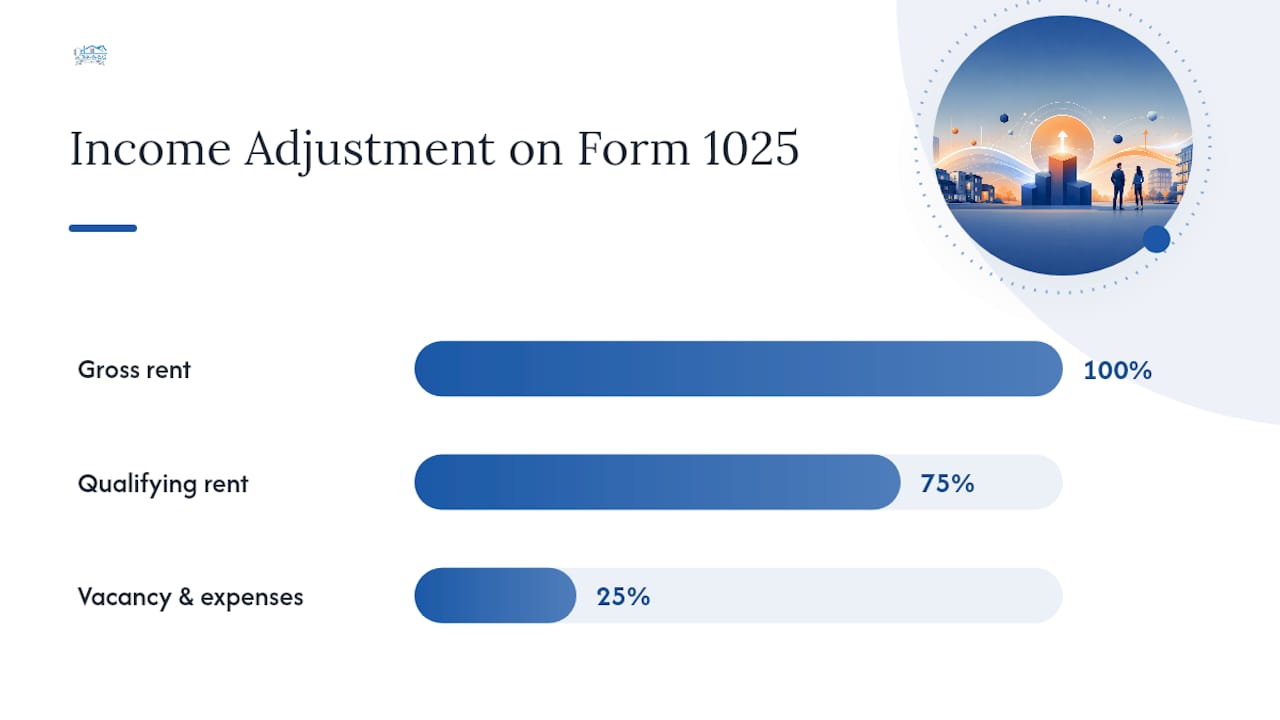
Here's where it gets practically important for anyone trying to qualify on rental income: when a lender uses reported rents from the subject property to help a borrower qualify for a loan, Fannie Mae's guidance calls for multiplying gross monthly rent by 75%, not the full amount.
It builds in a cushion for vacancy periods, maintenance costs, and management overhead that a full gross-rent number would ignore, protecting the lender from overstating a borrower's real qualifying income.
Appraisers and loan officers should line up documentation before the appraisal, not after:
- Signed leases for every occupied unit, current and legible.
- Bank statements or deposit records showing rent actually hitting an account, which matters most when leases are new or informal.
- Vacancy history, if any units have sat empty recently, since that affects the operating income statement's assumptions.
Two consecutive months of deposit evidence is the standard lenders typically accept to verify current rent when a lease is brand new or when a tenant pays informally. If a unit has been vacant, or the owner can't produce a lease at all, the appraiser has to reconcile that gap using market rent for comparable units rather than owner-reported figures. Incomplete rental documentation ranks among the most common causes of underwriting delay on these files, and appraisers routinely ask clients upfront for lease copies and recent deposit records to head off that problem before it starts.
When a property's rent roll is unusually complex, such as a fourplex with month-to-month tenants at four different rates, a separate rent schedule addendum can give the underwriter a cleaner breakdown than trying to cram everything into the form's standard grid.
Form 1025 vs. Form 1004 vs. Form 1007: Which Do You Need?
Picking the wrong form wastes time and money, so here's the practical breakdown.
- Form 1004 covers single-family, one-unit properties. It's the workhorse appraisal report for a standard home purchase or refinance where there's no rental income component to analyze. If you're comparing it directly, our breakdown of Form 1004's scope and exhibits walks through how it differs in structure from the 1025.
- Form 1007 is the Single-Family Comparable Rent Schedule. It doesn't stand alone; it pairs with a 1004 when a single-family home has an accessory unit or when the borrower's primary residence will become a rental and the lender needs a market rent estimate.
- Form 1025 handles two- to four-unit properties specifically, with built-in operating income capture and unit-level rent reporting that neither of the other two forms provides.
The decision rule is straightforward once you know the property type. Count the units. One unit with no rental component means Form 1004. One unit where rental income factors into qualifying might need a 1004 paired with a 1007. Two to four units, regardless of whether the owner occupies one, means Form 1025. Get the unit count wrong at the ordering stage and you'll be reordering the appraisal, which costs both time and money on a deal that's usually already on a clock.
How Do You Prepare for or Order a Form 1025 Appraisal?
Getting a 1025 report done on schedule comes down to preparation before the appraiser ever knocks on the door. Here's the checklist we walk clients through:
- Gather current leases for every unit, signed and dated.
- Pull Schedule E or recent tax returns showing reported rental income, which appraisers use to cross-check against lease figures.
- Collect recent repair or renovation invoices, especially for anything that might affect condition ratings or effective age.
- Arrange tenant access ahead of the scheduled inspection date, including keys or a scheduled walkthrough window for every unit.
- Confirm the unit count and configuration matches municipal records, since a mismatch between what's on file and what's built can trigger zoning questions that slow the whole process.
Tenant access is where most delays actually happen. A landlord who can't get all three tenants to agree on an inspection window in the same week can add days, sometimes weeks, to a timeline that would otherwise move fast. Give tenants at least 48 hours' notice and try to schedule all units for the same visit.
A typical order-to-delivery window runs somewhere in the range of a few business days to about a week for a standard 2‑4 unit property, longer if tenant scheduling or documentation gaps get in the way. Rush requests, condo or co-op project inspections that require additional project-level paperwork, and properties needing a scope expansion for atypical conditions all tend to push fees higher than a standard assignment.
Pro Tip: Send your appraiser the leases and rent roll before the inspection date, not after. It cuts the report turnaround time noticeably because the appraiser can prep the operating income statement in advance instead of chasing documents post-inspection.
NJREAG Perspective: What We See Go Wrong on 1025 Reports
We've reviewed enough small income property files across all 21 New Jersey counties to know where these reports typically fall apart, and it's rarely the value conclusion itself.
Incomplete rent verification is the most common issue. An owner tells the appraiser a unit rents for $1,800 a month, but there's no lease, no deposit record, nothing. That's not a number an appraiser can certify to without pushback from underwriting, and it stalls files that should have closed on time.
Poor GLA sketching is the second-biggest problem. A rushed measurement on a triplex with an irregular footprint can throw off square footage by enough to move the value. We measure every unit ourselves rather than relying on assessor records, because assessor square footage and appraisal-grade GLA frequently don't match.
Missing exhibits round out the list, usually a map that isn't labeled clearly enough for a reviewer or a comp photo that doesn't correspond to the address on the grid.
As a state-certified firm operating under USPAP across every New Jersey county, we document operating income the way underwriters expect: leases cross-checked against deposits, vacancy assumptions grounded in actual market rent data for the submarket, not owner estimates. When a property sits in a condo or co-op project, we flag the need for a project addendum early rather than letting it surface as a stipulation after the file's already in underwriting. That single step avoids most of the delays we see on multi-unit files.
— Alek
Where to Find Official Form 1025 Guidance
If you want to go straight to the source material instead of relying on secondhand summaries, three documents cover nearly everything you'll need:
- The Fannie Mae Selling Guide's appraisal forms section lays out policy language on intended use, required exhibits, and scope-of-work expectations.
- The official Form 1025 document shows the actual form layout and the certification language appraisers sign off on.
- The detailed instructions PDF breaks down minimum inspection steps and exhibit requirements line by line.
Bookmark these if you're ordering or reviewing 1025 reports regularly. They're the primary sources everything in this guide is built on.
Need a Form 1025 Appraisal in New Jersey?
If you've read this far, you already know a 1025 report demands more precision than a standard single-family appraisal: unit-level rent capture, an operating income statement that has to hold up under underwriter scrutiny, and exhibits that can't have a single gap. That's exactly where a lot of appraisal firms cut corners on turnaround to hit volume targets, and it's exactly where we don't.

Newjerseyrealestateappraisal is a state-certified firm with more than 26 years of combined experience in across all 21 New Jersey counties, and small residential income property valuations, divorce, estate, and tax appeal appraisals are where we spend most of our time. Every 1025 report we deliver is USPAP-compliant, backed by verified rent documentation and gross living area measurements we take ourselves rather than borrowing from assessor records.
If your property sits in Atlantic County, our Atlantic County appraisal services page has details on scheduling. Union County property owners can find the same information on our Union County appraisal services page. Call us at (908) 517-3913 to get a timeline and fee quote for your specific property before you lock in a closing date.
Sources
- B4-1.2-01, Appraisal Report Forms and Exhibits (Fannie Mae Selling Guide)
- Small Residential Income Property Appraisal Report (Form 1025) — Fannie Mae
- Small Residential Income Property Appraisal Report (form 1025) — Instructions PDF
- Two-to-Four Unit Residential Appraisal-1025 (National Appraisal Services)