
Fannie Mae Form 1004, the Uniform Residential Appraisal Report, is the standard lender-facing document used to report an appraiser's opinion of market value on a one-unit home. If you're a borrower, attorney, or executor who just needs the official form, here's where to find it before we get into the details.
The Uniform Residential Appraisal Report exists in three official formats, and each one serves a different lending scenario:
- Form 1004 (standard) — the full on-site inspection version, used for the vast majority of one-unit and PUD purchase and refinance loans. Download it here.
- Form 1004 Desktop — a restricted variant that skips the interior walkthrough. Only open this one if your lender has specifically approved a desktop appraisal. View the Desktop form.
- Form 1004 Hybrid — combines a third-party inspection with desktop analysis. Your lender tells you if this option applies to your loan.
Fannie Mae requires every appraisal reported on Form 1004 to follow the Uniform Appraisal Dataset (UAD) specification, a standardized coding system that keeps data consistent from one appraiser's report to the next. If you'd rather see a plain PDF reproduction of the form and its instructions without navigating Fannie Mae's guide pages, the EPA-hosted copy works fine for reference.
One thing to keep in mind before you go further: the blank form is not the appraisal. A state-certified appraiser has to fill it out based on an actual inspection and market analysis. We'll cover exactly when that matters below.
Key Takeaways
Form 1004 is a lender-scoped, USPAP-compliant appraisal document, and its value depends entirely on the certified appraiser's inspection and analysis behind the template.
| Point | Details |
|---|---|
| Form 1004 serves lenders | The intended user is the lender/client, not borrowers, attorneys, or tax boards. |
| Full inspection is standard | Interior, exterior, neighborhood, and comp inspection from the street are all required minimums. |
| Desktop and Hybrid skip the walkthrough | Lenders restrict these variants to lower-risk transactions with strong loan-to-value ratios. |
| UAD keeps ratings consistent | Condition and quality codes (C1 to C6, Q1 to Q6) mean the same thing nationwide. |
| Legal matters need specialty reports | Divorce, estate, and tax appeal cases require a different scope than a lending Form 1004. |
| NJREAG handles both scopes | Newjerseyrealestateappraisal completes standard 1004 assignments and court-ready specialty reports across all 21 NJ counties. |
Table of Contents
- What Form 1004 Covers: Intended Use and Intended User
- Scope of Work and Minimum Requirements for a Form 1004 Appraisal
- Form 1004 Variants: Desktop and Hybrid, and When Each One Applies
- Limitations of Form 1004: When You Need a Different Report Entirely
- How to Request a Form 1004 Appraisal: Documents, Timeline, and Cost
- NJREAG's Take: When a 1004 Fits and When It Doesn't
- How to Read the Key Sections of Your Form 1004 Report
- Who Can Actually Complete a Form 1004 Appraisal?
- What UAD Standardization Actually Requires on Form 1004
- Handling Discrepancies or Disputes on a Form 1004 Report
- The Real Gap Between the Form and the Report
- Get a State-Certified Form 1004 Appraisal in New Jersey
- Frequently Asked Questions
- Sources
What Form 1004 Covers: Intended Use and Intended User
Form 1004 exists for one primary purpose: to give a lender a documented, defensible opinion of market value before that lender finances a loan. Fannie Mae's Selling Guide is explicit about this. The intended user is the lender/client, not the borrower, not a divorce attorney, and not an estate executor. That distinction shapes everything else about the form.
You'll see this "intended user" language stated directly inside the report itself. It's a legal boundary, not a formality. An appraiser signs the report certifying it was prepared for that specific lender and that specific transaction. If you hand a 1004 report to a court, a tax board, or an insurance adjuster and expect it to carry the same weight, you're stretching the document past what it was built for.
Standardization is the other half of the story. Every Form 1004 report gets coded using the UAD specification, which forces appraisers to describe condition ratings, quality ratings, and property characteristics using the same fixed vocabulary nationwide. A "C3" condition rating in a report from Cape May County means the same thing as a "C3" rating in a report from Bergen County. Lenders rely on that consistency to feed appraisal data into automated underwriting systems and risk models without manual translation.
Here's what that standardization buys the lender:
- Faster underwriting, because automated systems can parse the report without a human re-reading every line.
- Fewer disputes over subjective terms like "good condition" versus "average condition."
- A paper trail that regulators and investors (including Fannie Mae itself, when it purchases the loan) can audit later.
The report's core job, stripped of the technical scaffolding, is simple: document one appraiser's independent, USPAP-compliant opinion of what the property is worth on the effective date of inspection. Everything else in the form, from the neighborhood grid to the sales comparison approach, exists to support that single number and show how the appraiser got there.
This is also why a Form 1004 report isn't transferable between lenders in most cases. Some loans allow an appraisal to be assigned to a second lender through a formal transfer process, but that's the exception, not the rule. If you're refinancing with a different bank six months after your last appraisal, expect to order a new one.
Scope of Work and Minimum Requirements for a Form 1004 Appraisal
The Fannie Mae Selling Guide and the URAR form instructions spell out exactly what an appraiser has to do before signing off on a Form 1004 report. This isn't a drive-by estimate. It's a defined process with minimum requirements baked into the form itself.
Here's the sequence a licensed or certified appraiser follows on a standard Form 1004 assignment:
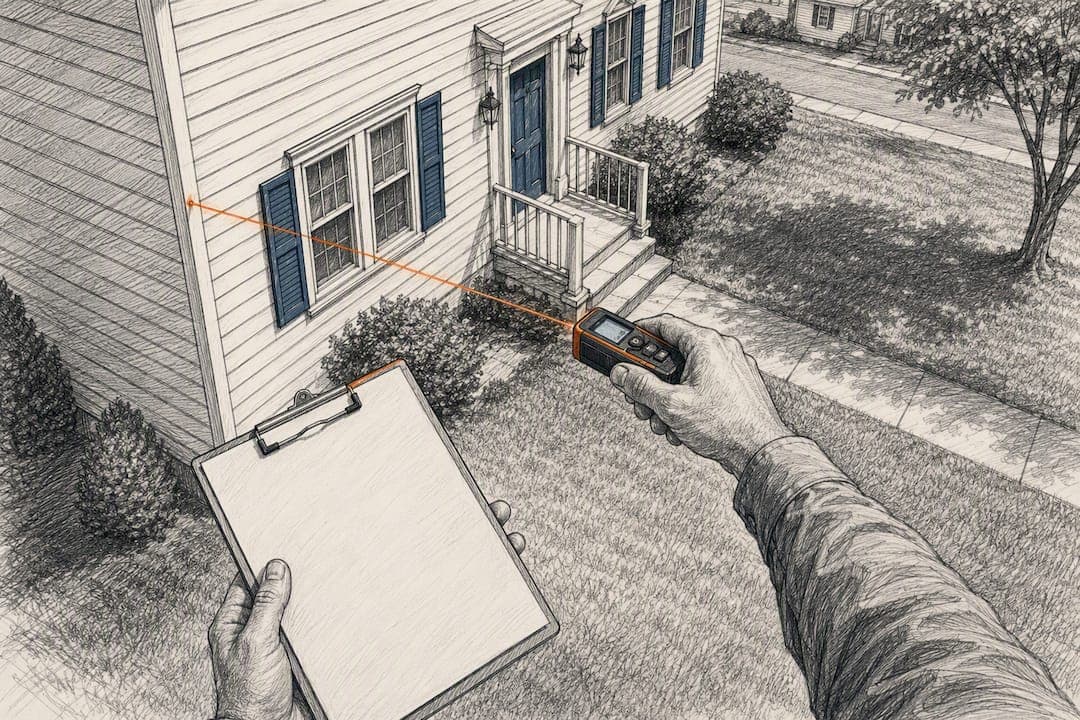
- Complete a full interior and exterior on-site inspection. The appraiser walks every room, checks mechanical systems, and photographs the exterior from multiple angles. This is the requirement that separates a 1004 from its Desktop cousin.
- Inspect the neighborhood. The appraiser drives the immediate area to note market trends, land use, proximity to amenities, and any adverse conditions like nearby commercial zoning or flood risk.
- Inspect at least three comparable sales from the street, at minimum. The appraiser doesn't need to walk through the comps, but a curbside look is required by the URAR's own instructions.
- Calculate gross living area (GLA) using ANSI-based measurement standards, then reconcile that figure against public records and the comps selected.
- Produce a floor sketch showing room layout and exterior dimensions, which supports the GLA calculation.
- Code every characteristic using UAD standards — condition rating, quality rating, view, location, and dozens of other fields that feed directly into Fannie Mae's automated systems.
- Assemble supporting exhibits, including a location map, a comparable sales grid, interior and exterior photos, and backup documentation from public tax records.
That last point deserves its own attention because it's where a lot of borrowers get confused about what they're paying for. A completed Form 1004 package typically includes a comp grid comparing the subject property against three or more recent sales, a full photo set covering the front, rear, street scene, and all major rooms, a location map showing the subject and comps, and copies of public-record data used to verify lot size, year built, and tax assessment history.
Pro Tip: Ask your appraiser for a copy of the comp grid before closing if you're disputing value. Comparable sales adjustments (for square footage, lot size, condition, or garage count) are usually where a low valuation gets challenged successfully, and a resource like this comp adjustment guide breaks down how those adjustments typically get calculated.
None of this happens instantly. An appraiser spending real time on interior inspection, neighborhood research, and UAD coding is why a rushed, cut-rate appraisal often produces a report full of gaps that trigger lender kickbacks and delay your closing.
Form 1004 Variants: Desktop and Hybrid, and When Each One Applies
Not every loan needs a full walkthrough appraisal, and Fannie Mae built two alternate versions of the URAR to handle lower-risk scenarios. You don't get to choose which one applies. Your lender decides based on loan type, loan-to-value ratio, and property risk.
Form 1004 Desktop skips the interior inspection entirely. The appraiser develops an opinion of value using public records, MLS data, tax records, and any floor plans or photos the borrower or a third party supplies. Fannie Mae permits this variant only for certain transactions under lender-specific eligibility rules; it isn't a general substitute for a standard 1004.
Form 1004 Hybrid sits in between. A third party (sometimes a trained data collector, sometimes the borrower using a lender-approved app) gathers interior photos and measurements on-site, and the appraiser analyzes that data remotely to develop the value opinion. The appraiser never sets foot in the property.
Both variants exist to speed up low-risk transactions and cut appraiser travel time on straightforward properties. Here's where the trade-off shows up:
- Desktop and Hybrid reports carry more risk when physical condition or hidden defects materially affect value, since no one with appraisal training is inspecting the interior firsthand.
- Properties with additions, unusual layouts, or deferred maintenance are poor candidates for either variant, because a photo set can't capture what a trained eye catches walking through a basement or attic.
- Lenders generally restrict Desktop and Hybrid appraisals to purchase and refinance transactions with strong loan-to-value ratios, not higher-risk loans.
If your property has any complicating factor, an addition without permits, water damage history, or a nonstandard layout, push for a full on-site Form 1004 even if your lender initially offers a Desktop option. The interior walkthrough is the part of the process most likely to catch something that changes the value materially, and it's the part both alternate forms leave out.
Limitations of Form 1004: When You Need a Different Report Entirely
Here's where a lot of confusion starts. People assume any appraisal is interchangeable, and it isn't. Form 1004 was built for one job: supporting a mortgage transaction. It was not built to survive cross-examination in a courtroom, satisfy a county tax board's evidentiary standards, or hold up against a forensic accountant's scrutiny in an estate dispute.
Fannie Mae's own guidance is direct about the scope: Form 1004 covers traditional one-unit properties and units in planned unit developments, based on an interior and exterior on-site inspection. It's not designed for manufactured homes or most condo and co-op projects, which have their own dedicated forms (1004C for manufactured homes, 1073 for condos). If your property doesn't fit the one-unit, site-built profile, a 1004 is the wrong form before you even get to legal considerations.
Where this really matters is legal and financial work outside of lending. A Form 1004 report typically won't hold up in these situations:
- Divorce and equitable distribution. New Jersey courts expect a valuation that's defensible under cross-examination, often tied to a specific date of separation or complaint filing, not a lender's closing date. Our guide to divorce appraisals in New Jersey covers why this distinction matters.
- Estate and date-of-death valuations. Executors need a retrospective opinion of value tied to a specific historical date, supported by market data from that period, not current comps.
- Property tax appeals. County boards want an appraisal built specifically to challenge an assessment, with different comparable selection logic than a lending appraisal uses.
- Litigation support. Any report that might end up in front of a judge needs additional documentation and a scope of work built for legal scrutiny from day one.
For court-ready or retrospective assignments, appraisers prepare a different report scope entirely, one that includes historical market data, date-of-death valuation methodology, and supporting exhibits a lender-form 1004 simply doesn't ask for. Our post on why appraisal matters for NJ divorce and estate planning walks through specific scenarios where the standard lending form falls short.
The value of a Form 1004, as appraisers who work with these forms regularly point out, comes from the appraiser's USPAP-compliant analysis behind it, not the blank template. A downloaded PDF isn't a substitute for a state-certified appraiser's actual work, and that's doubly true once you step outside a straightforward mortgage transaction.
How to Request a Form 1004 Appraisal: Documents, Timeline, and Cost
Ordering a Form 1004 appraisal is usually straightforward if you're refinancing or buying, since your lender orders it through an appraisal management company. If you're commissioning one directly, here's what to have ready and what to expect.
- Gather your deed and most recent tax bill. These confirm lot size, legal description, and current assessment, and they save the appraiser research time.
- List any improvements made since your last assessment. A finished basement, a new roof, or an addition all affect value, and the appraiser needs to know what's original versus updated.
- Note occupancy status. Owner-occupied, tenant-occupied, and vacant properties get treated differently in the report, particularly for income-producing situations.
- Provide HOA or PUD documents if applicable. Association fees, special assessments, and PUD restrictions all factor into the comparable analysis and reconciliation.
- Confirm access arrangements. The appraiser needs full interior access on inspection day, so coordinate keys, tenants, or alarm codes ahead of time.
Pro Tip: If you're on a tight closing timeline, ask upfront about rush service. Most appraisal firms can accommodate a faster turnaround for an added fee, but property complexity and appraiser availability still set the floor on how fast that can happen.
A typical Form 1004 appraisal runs from initial order to delivered report in a matter of days to about two weeks, depending on the appraiser's current workload and how quickly inspection access gets scheduled. Fee ranges vary by property size, complexity, and how far the appraiser has to travel. A straightforward single-family home in a well-documented market with plenty of recent comps costs less to appraise than a rural property with limited comparable sales or a home requiring detailed measurement due to additions and unusual layouts.
NJREAG's Take: When a 1004 Fits and When It Doesn't
We're a state-certified appraisal firm operating across all 21 New Jersey counties, and we complete Form 1004 assignments regularly for lenders, homeowners, and refinance transactions. That's the bulk of our residential work, and it's straightforward: full interior and exterior inspection, USPAP-compliant analysis, defensible comps, delivered on the lender's timeline.
Where we push back, respectfully, is when someone tries to use a lending-form appraisal for a legal or financial matter it wasn't built for.
We see this constantly with divorce cases: one spouse pulls an old refinance appraisal and tries to use it as the property's current value in a settlement negotiation. It's rarely close to accurate for the actual valuation date the case needs, and it almost never survives scrutiny if the case goes to court.
Estate and tax appeal work follows the same pattern. A date-of-death valuation needs market data from that specific historical period, not today's comps. A tax appeal needs a comp selection strategy built to withstand a county board's review, not a lender's underwriting checklist.
Here's how we approach the technical details that make or break a report's credibility:
- GLA calculations follow ANSI measurement standards, cross-checked against public records, so the square footage figure holds up if challenged.
- Floor plans get drawn from actual on-site measurement, not estimated from tax card data.
- Comparable selection is documented with adjustment reasoning spelled out, not just a final number with no support.
If your situation involves a mortgage transaction, a standard Form 1004 is the right tool. If it involves a divorce, an estate, or a property tax appeal in New Jersey, talk to us before you order anything. Call (908) 517-3913.
How to Read the Key Sections of Your Form 1004 Report
The reconciliation section is usually where people jump first, and that's fine, but it only makes sense in context. Reconciliation is the appraiser's final weighing of the three approaches to value (sales comparison, cost, and income), landing on a single supported opinion of market value. If the sales comparison approach and cost approach land close together, that's a strong signal of a well-supported number.
The neighborhood section, higher up on the form, tells you what market conditions the appraiser considered: whether prices are trending up, stable, or declining, typical marketing time, and any factors like proximity to commercial areas or environmental hazards that could affect value. This section explains why the comps were chosen the way they were.
The sales comparison grid is the heart of the report. Each comparable property gets adjusted, line by line, for differences in square footage, lot size, condition, garage space, and other features. Positive and negative adjustments show you exactly how the appraiser moved from each comp's sale price to an adjusted value supporting the subject property.
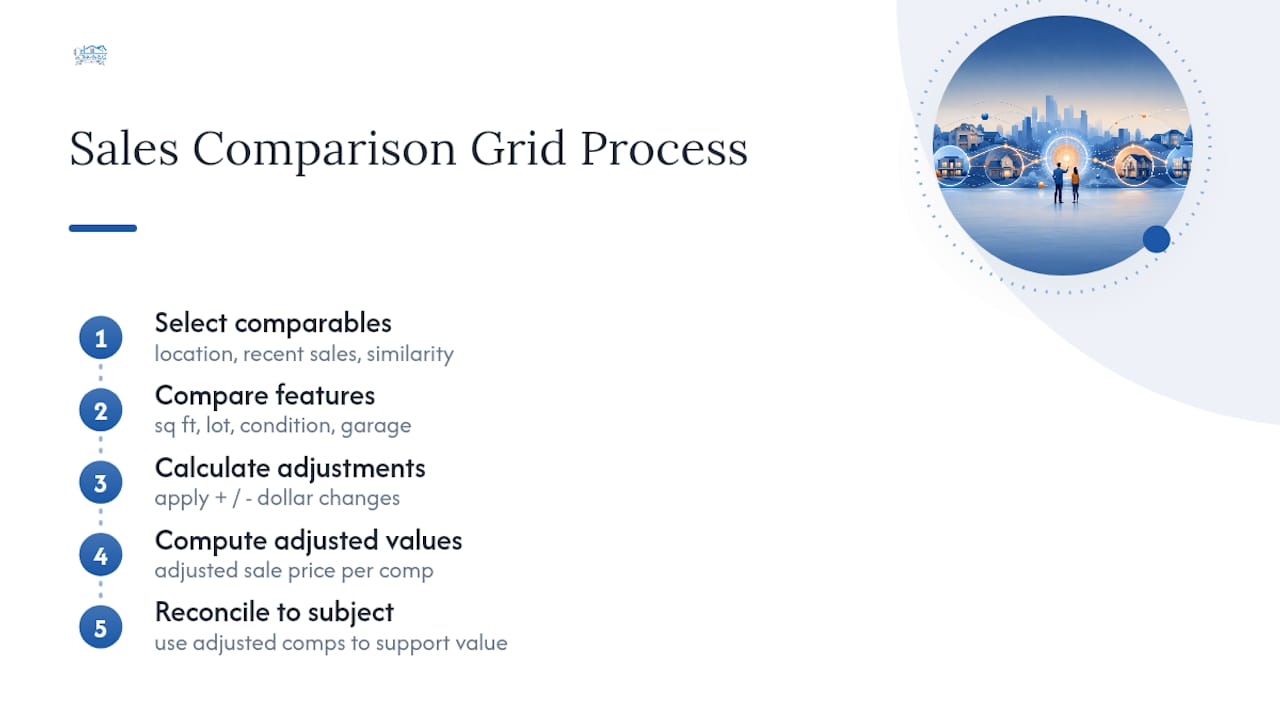
Check the "condition" and "quality" ratings against the UAD definitions if a number looks off. These ratings, coded C1 through C6 for condition and Q1 through Q6 for quality, drive a large part of the comp selection logic, and a mismatched rating is often the root of a valuation dispute.
Who Can Actually Complete a Form 1004 Appraisal?
Only a licensed or certified real estate appraiser can complete a Form 1004 report for a mortgage transaction. Requirements vary by state, but every state ties licensure to a combination of coursework, supervised experience hours, and a state exam, all governed by the Appraiser Qualifications Board's national criteria.
Certified appraisers, as opposed to licensed appraisers, generally hold additional education and experience hours and can appraise higher-value or more complex properties without supervision. Lenders typically require certified status for most conventional mortgage transactions today.
Every appraiser signing a Form 1004 certifies compliance with USPAP, the Uniform Standards of Professional Appraisal Practice. That certification isn't decorative. It's a legal statement that the appraiser inspected the property, developed the opinion independently, and disclosed any prior relationship with the property or parties involved. An appraiser who violates USPAP risks license discipline, so that signature carries real weight.
State certification in New Jersey specifically requires ongoing continuing education, which means an appraiser's license needs periodic renewal tied to coursework, not a one-time credential earned years ago and never revisited.
What UAD Standardization Actually Requires on Form 1004
The Uniform Appraisal Dataset sets fixed definitions for the fields that used to vary wildly from one appraiser's narrative style to the next. Condition ratings run C1 (new or like new) through C6 (needs significant repair), and quality ratings run Q1 through Q6 on a similar scale. Every appraiser working under Fannie Mae's UAD specification uses the exact same code for the exact same condition, regardless of writing style or regional habit.
Beyond condition and quality, UAD standardizes fields like room count methodology, garage and parking descriptions, and view and location ratings. It also governs how gross living area gets calculated and reported, tying appraisers to consistent measurement practice rather than letting square footage figures drift based on individual habit.
This matters to you as a borrower or reader mainly because it makes reports comparable across appraisers and across time. If you ever need to compare an old appraisal to a new one on the same property, UAD coding gives you an apples-to-apples read on how condition or quality assessments changed, rather than trying to parse two appraisers' different narrative descriptions.
Handling Discrepancies or Disputes on a Form 1004 Report
Start with the comp grid if a value comes back lower than expected. Look at which comparables were selected, how far away they are, how recent the sales are, and whether the adjustments for square footage, condition, and lot size make sense given what you know about the property.

If you believe the appraiser missed something material, a permit-approved addition, a recent renovation, or an incorrect square footage figure, ask your lender about a reconsideration of value. This is a formal process where you submit specific, factual evidence (not just an opinion that the number seems low) for the original appraiser or a second appraiser to review.
Reconsiderations work best when you bring concrete documentation: comps the appraiser didn't use, permit records showing improvements, or a factual error in property characteristics like bedroom count or lot size. Vague complaints about the number rarely move anything.
If a reconsideration doesn't resolve the dispute and the situation involves a legal or tax matter rather than a lending decision, that's usually the point to commission an independent, specialty-scope appraisal rather than keep pushing on the original lender-form report. A tax appeal or litigation-focused appraisal is built from the ground up to withstand that kind of scrutiny, which a 1004 report, by design, was never asked to do.
The Real Gap Between the Form and the Report
The conventional advice on Form 1004 stops at "download the form and hire an appraiser," and that's not wrong, exactly. It's just incomplete. The form is a template. What determines whether the resulting report holds up, whether it's for a lender, a court, or a tax board, is the appraiser's judgment behind the numbers.
Where most people get tripped up is assuming any appraisal transfers cleanly to any purpose. It doesn't. A lending appraisal optimized for underwriting speed and a litigation-quality appraisal built to survive cross-examination ask fundamentally different questions of the same property, even when they use overlapping methodology.
Prioritize matching the report scope to the actual use first, before you even think about cost or turnaround time. Get that wrong, and you'll pay for a second appraisal anyway once the first one gets rejected by a court or a tax board.
Get a State-Certified Form 1004 Appraisal in New Jersey
If you need a standard Form 1004 appraisal for a purchase or refinance, Newjerseyrealestateappraisal delivers full on-site inspections with defensible comps and UAD-compliant reporting, not a rushed desktop estimate. That's the difference between a report your lender accepts the first time and one that bounces back with revision requests.

Where we really stand apart is the situations where a standard lending form falls short. If you're navigating a divorce, settling an estate, or fighting a tax assessment anywhere in New Jersey, our team builds the retrospective, court-ready reports those matters actually require, backed by state certification and USPAP compliance across all 21 counties. We handle everything from single-family homes to portfolio and multi-property valuations for investors and financial professionals who need consistent, defensible numbers across multiple assets.
Ready to move forward? Reach out through our Atlantic County appraisal services page or call (908) 517-3913 to discuss your property and get a straightforward answer on timeline and cost.
Frequently Asked Questions
What is Fannie Mae Form 1004? It's the Uniform Residential Appraisal Report, the standard form lenders use to document an appraiser's opinion of market value on a one-unit residential property, based on a full interior and exterior inspection.
Is Form 1004MC required with every 1004 report? Form 1004MC, the Market Conditions Addendum, is generally required alongside a standard 1004 to document trending market data, though your specific lender's requirements govern whether it applies to your transaction.
What is Form 1004 used for? It documents an appraiser's supported opinion of market value for mortgage lending purposes, primarily purchase and refinance transactions on one-unit homes and PUD units.
Is Form 1004D a final inspection? Yes. Form 1004D, the Appraisal Update and/or Completion Report, confirms that repairs or construction items noted in an earlier appraisal have been completed, and it's commonly required before a lender releases final loan funds.
Can I use my Form 1004 appraisal for a divorce settlement or tax appeal? Generally, no. A Form 1004 is scoped for lending, with the lender as the intended user, and it typically won't meet the evidentiary standards a court or tax board expects for legal or retrospective matters.
Sources
If you want to verify anything in this article or pull the forms directly, these are the primary sources:
- Appraisal Report Forms and Exhibits | Fannie Mae
- Uniform Residential Appraisal Report
- Uniform Residential Appraisal Report (PDF)