

A bifurcated appraisal, commonly called a hybrid appraisal, splits property data collection from the appraiser's valuation analysis: a trained collector gathers photos, measurements, and condition details, then a licensed appraiser reviews that data remotely to form the value opinion. It works when the loan investor's guidelines permit it and the property is straightforward with no unusual condition issues. For complex properties, divorce settlements, or estate matters where a report needs to hold up in court, an on-site appraisal is usually the safer call.
TL;DR:
- Hybrid appraisals mainly suit straightforward properties and transactions where recent renovations are well-documented, as complex or unique properties often require on-site inspections.
- The process involves a third-party collector capturing property data, such as photos and measurements, which is then reviewed remotely by a licensed appraiser with no physical visit.
- Lenders, Fannie Mae, and Freddie Mac determine hybrid eligibility through automated systems, with most common use in portfolio loans, refis, and situations where speed and capacity are priorities.
- Quality control relies heavily on trained collectors, technology checks, and clear documentation, with red flags like inaccessible rooms or structural issues prompting on-site inspections instead.
- A hybrid appraisal is USPAP-compliant when properly disclosed, but it still requires careful vetting of data collection, and borrowers should question the process if their property is complex or has recent, unrecorded updates.
Table of Contents
- Bifurcated Vs. Hybrid Appraisal: Same Process, Different Name
- How Does a Bifurcated Appraisal Actually Work?
- When Do GSEs Accept a Hybrid Appraisal?
- What Are the Real Benefits and Drawbacks?
- How Do Appraisers and AMCs Control Quality on a Hybrid File?
- Is a Bifurcated Appraisal USPAP Compliant?
- What Should You Ask Before Accepting a Hybrid Appraisal?
- Our Take on Hybrid Appraisals in New Jersey
- Get a State-Certified Appraisal You Can Trust in Court or at the Bank
- Sources
- FAQ
Bifurcated Vs. Hybrid Appraisal: Same Process, Different Name
"Bifurcated" is the literal term. It means split in two: data collection separated from analysis. The industry has largely moved to calling it a hybrid appraisal instead, and you'll see both terms used interchangeably by lenders, appraisal management companies (AMCs), and even government-sponsored enterprise (GSE) documentation.
The shift happened fast. Pandemic-era restrictions on in-person inspections pushed lenders to lean harder on remote data collection, and Fannie Mae's appraisal modernization push (tied to broader FHFA scorecard goals around appraiser capacity and turnaround times) gave the model a permanent home in mainstream lending, not just as a stopgap.
Here's where you'll run into the terminology:
- Loan documents and Desktop Underwriter (DU®) messaging typically say "hybrid appraisal" or reference a "desktop with property data collection."
- AMC intake forms and appraiser assignment platforms often still use "bifurcated" internally.
- Fannie Mae's own hybrid appraisal fact sheet uses "hybrid" as the standard consumer-facing label, describing property data collection (PDC) submitted through its Property Data API ahead of appraiser review.
Either term points to the same two-step structure. If your lender or attorney says one and your appraisal report says the other, that's not a red flag. It's just industry vocabulary catching up with itself.
How Does a Bifurcated Appraisal Actually Work?
The process runs in two distinct assignments, and the appraiser doing the analysis never sets foot on the property.
- Property data collection. A trained collector, sometimes a licensed appraiser trainee, sometimes a vetted third-party inspector, visits the home and captures interior and exterior photos, room-by-room measurements, a floorplan sketch, and condition notes. Modern PDC tools can log more than 150 standardized data points along with geocoded, time-stamped photo exhibits.
- Appraiser desktop analysis. The licensed appraiser receives the PDC package, cross-references it against MLS listings, public tax records, and recent comparable sales, then builds the value opinion and signs the final certification. No physical visit occurs at this stage.
The data moves through a portal or API rather than email attachments, which is how Fannie Mae's system logs timestamps and prevents tampering with exhibits after submission. AMCs typically manage the handoff between collector and appraiser, scheduling the PDC visit and routing the finished file.
Pro Tip: Ask your lender or AMC how many days separate the PDC visit from the appraiser's sign-off. A gap longer than a week or two raises the odds that market conditions or property details shifted in between.
Most revisions happen because the PDC missed something: an unfinished basement remodel, a fence line dispute, or a garage conversion that wasn't disclosed. When the appraiser spots a mismatch between the data and public records, expect a request for clarification before the report finalizes.
When Do GSEs Accept a Hybrid Appraisal?
Not every loan file qualifies. Fannie Mae and Freddie Mac decide eligibility through their automated underwriting engines, and the decision isn't up to the borrower or even the loan officer to request.
- Desktop Underwriter (DU®) issues specific messaging on a file-by-file basis indicating whether a hybrid or full desktop appraisal is acceptable; it's not a menu option appraisers or lenders choose freely.
- Portfolio loans, home equity products, and certain refinance transactions have historically been the most common candidates for hybrid treatment, according to Fannie Mae's hybrid appraisal fact sheet.
- Modified reporting forms, including versions built around the 1004P framework, disclose that the appraiser relied on third-party PDC rather than a personal inspection. Even when the same person completes both roles, Fannie Mae treats the PDC as a prior, separate service that must be disclosed on the modified form.
- Lenders and AMCs, not appraisers acting alone, generally make the call on whether a specific file is suitable for a hybrid product, weighing loan type, property profile, and investor overlays.
If your loan file gets flagged for hybrid treatment, that's the system responding to investor guidelines and property characteristics, not a shortcut someone chose to save money.
What Are the Real Benefits and Drawbacks?
The trade-offs aren't hypothetical. They show up differently depending on who's involved in the transaction.
Benefits:
- Faster turnaround since appraisers aren't scheduling and driving to inspections themselves.
- More assignment capacity per appraiser, which matters in counties with a thin bench of certified appraisers.
- Potential cost savings passed through in some loan programs, since collection and analysis are split across two workers instead of one.
Drawbacks:
- Data integrity risk: an inexperienced or rushed collector can miss a cracked foundation, water damage, or a room that doesn't match the tax record.
- Renovation blind spots: upgrades finished after the last public record update won't show up unless the collector documents them accurately.
- Revision exposure: if the appraiser catches a gap between PDC data and other sources, the file stalls while someone requests clarification or a second visit.
Industry testing from Accurate Group's whitepaper found that hybrid appraisals can perform comparably to traditional appraisals when the PDC quality controls are strong. That's the operative condition. Lenders benefit most from speed and volume. Appraisers benefit from capacity. Borrowers carry the risk if the collector's work is sloppy, since a flawed data set can undervalue or overvalue a home before the appraiser ever opens the file.
How Do Appraisers and AMCs Control Quality on a Hybrid File?
Quality control is where a hybrid appraisal earns its credibility, or loses it. A vetted network of collectors backed by real oversight is what separates a reliable hybrid workflow from a shaky one, according to R3 AMC's operational guidance on how AMCs manage these assignments.
- Collectors go through training and background vetting before they're approved to submit PDC packages, with periodic sample audits of their work.
- Technology checks confirm geotags match the subject property, photo timestamps align with the visit date, and automated measurement tools flag inconsistent room dimensions.
- Photo completeness rules require every major room, the exterior on all sides, the mechanical systems, and any visible defects before the file moves forward.
- Appraisers document any reliance on PDC data explicitly in the report, including extraordinary assumptions made about areas the collector didn't capture clearly.
Red flags that should trigger a full on-site inspection instead: locked or inaccessible rooms, recent additions not reflected in tax records, visible structural damage in photos, or a property that's unusually complex for the neighborhood. Our guide on avoiding common home appraisal mistakes covers more of these warning signs in detail.
Is a Bifurcated Appraisal USPAP Compliant?
Yes, when it's disclosed properly. The Uniform Standards of Professional Appraisal Practice (USPAP) doesn't prohibit an appraiser from relying on third-party data, provided the Scope of Work Rule is satisfied and the reliance is disclosed, according to the Appraisal Institute's analysis of desktop and hybrid assignments.
- The appraiser must disclose that PDC was performed by someone else and explain how that data was used in forming the opinion of value.
- If a prior PDC service was performed, even by the same individual now completing the appraisal, it counts as a separate engagement requiring its own disclosure.
- Some states restrict who's legally allowed to perform property inspections for valuation purposes. Check with your state appraisal board before assuming a hybrid is even permitted for your transaction.
- Extraordinary assumptions and hypothetical conditions still apply the same way they would in a traditional appraisal. A hybrid doesn't get to skip that disclosure just because the appraiser worked from someone else's data.
The signing appraiser is still the one on the hook for the value opinion. Reviewing our piece on USPAP compliance gives you a fuller picture of what a credible, defensible report requires.
What Should You Ask Before Accepting a Hybrid Appraisal?
If your file gets routed into a hybrid workflow, don't just accept it silently. A few pointed questions protect your interests.
- Ask why a hybrid was selected for your file and who performed the property data collection.
- Request confirmation that the collector is vetted and trained, and ask whether photos include geocoding and timestamps.
- Push for an on-site appraisal if you've completed recent renovations, own a complex or unusual property, or have rooms that weren't accessible during the PDC visit.
- Supply supporting documentation, permits, receipts, before-and-after photos, if you suspect the collector missed something material.
Understanding the appraisal process upfront, covered in our guide on why appraisals are required, helps you know when to speak up.
Our Take on Hybrid Appraisals in New Jersey
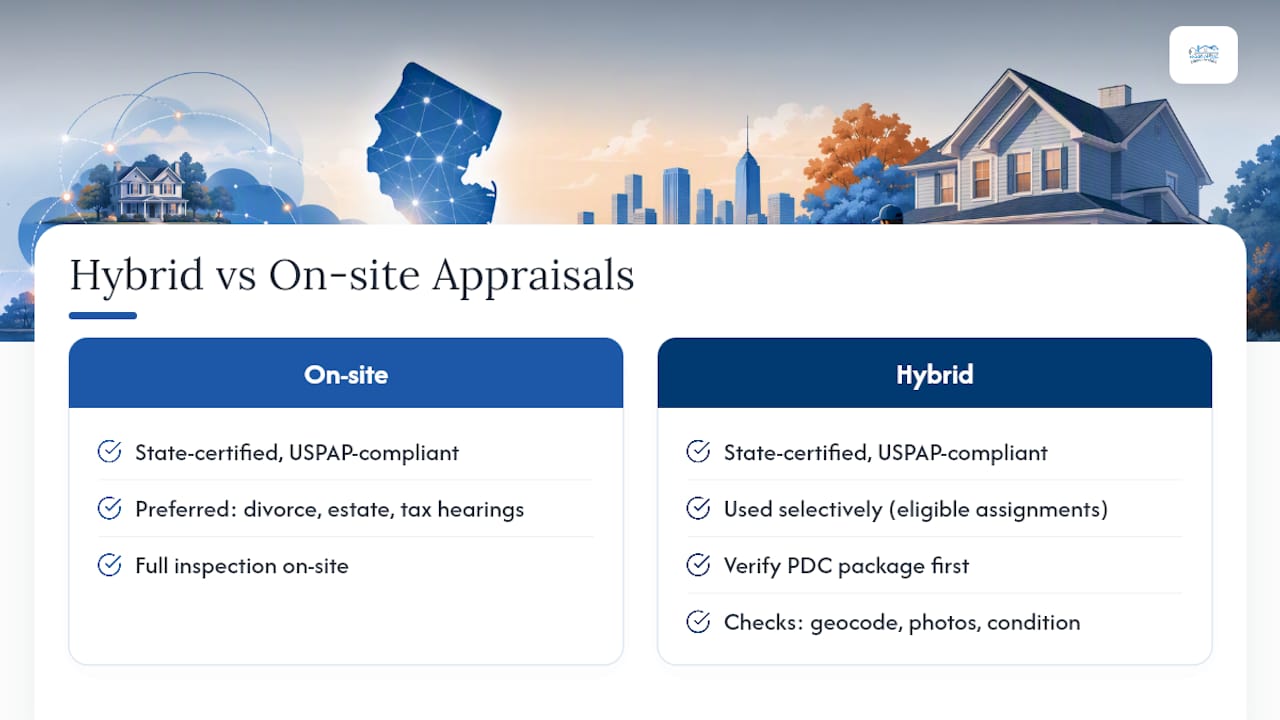
We are state-certified, and every report we deliver is USPAP-compliant and built to hold up under legal or lender scrutiny. That standard doesn't bend based on the assignment type.
For divorce, estate, and tax appeal work, where a report needs to survive cross-examination or a county tax board hearing, we lean toward full on-site inspections. When we do accept hybrid-eligible assignments, we run additional verification on the PDC package before relying on it, checking geocoding, photo completeness, and condition notes against public records ourselves.
— Alek
Get a State-Certified Appraisal You Can Trust in Court or at the Bank
If your property sits in a divorce settlement, an estate matter, or a tax appeal, you need more than a fast turnaround. You need a report an attorney, judge, or county board won't second-guess.

Newjerseyrealestateappraisal delivers state-certified, USPAP-compliant reports across all 21 New Jersey counties, and we handle the on-site inspections these high-stakes matters usually demand rather than defaulting to a hybrid shortcut. Whether you need a court-ready divorce appraisal starting between $550 and $800, a property tax appeal appraisal priced between $495 and $750, or a certified estate and date of death appraisal between $595 and $850, we build the report to withstand scrutiny.
Call us at (908) 517-3913 or request your home appraisal quote today.
Sources
- Hybrid appraisal fact sheet — Fannie Mae
- Understanding Desktop (Bifurcated or Hybrid) Appraisals — Appraisal Institute
- Appraisers, third-party inspections and the rise of hybrid appraisals — Accurate Group (whitepaper)
- What is a bifurcated appraisal (R3 AMC)
FAQ
What Does Bifurcated Mean in Real Estate?
Bifurcated means the appraisal assignment is split into two parts: a third party collects property data on-site, then a licensed appraiser analyzes that data remotely to determine value. It's the same process most people now call a hybrid appraisal.
What Is a Red Flag on an Appraisal?
Red flags include mismatched square footage against public records, missing photos of key rooms, undisclosed renovations, or condition notes that don't match the neighborhood's typical property profile. Any of these should prompt a request for clarification or a full on-site visit.
What Are the Three Types of Appraisals?
The most common categories are full appraisals with an interior and exterior on-site inspection, desktop appraisals completed entirely from existing data with no inspection, and hybrid or bifurcated appraisals that combine third-party data collection with appraiser desktop analysis.
What Are the Three Types of Appraisers?
Appraisers are generally categorized as trainee (working under supervision), licensed residential (limited to less complex properties up to a certain value), and certified residential or certified general (qualified for complex or higher-value residential and commercial properties). We work with state-certified appraisers across residential, commercial, and litigation-focused assignments.
Can I Refuse a Hybrid Appraisal?
You can raise concerns with your lender or attorney, especially if your property has recent renovations or unusual features, but eligibility for a hybrid product is typically decided by investor guidelines and automated underwriting messaging rather than borrower preference.