

Appraisal gap coverage is a contract clause where you agree to pay some or all of the difference if your home appraises below the contract price. The lender still finances only to the appraised value, so you're on the hook for the gap in cash. Cap it at an amount you can pay without touching your required post-closing reserves. Nothing less, nothing more.
TL;DR:
- Offering appraisal gap coverage should be limited to an amount you can pay without depleting your reserves or triggering additional costs like PMI.
- A typical cap ranges from $5,000 to $15,000, with protection applied only if the low appraisal exceeds that amount and within a specified deadline.
- Negotiating the property price or requesting a reconsideration of value are viable options if the appraisal comes in low, depending on your cash reserves and market conditions.
- Never agree to cover "any gap" without a specified dollar amount in the contract, and always confirm how this affects your total cash needs and loan eligibility.
- Getting a certified, USPAP-compliant appraisal before negotiations can strengthen your position and avoid costly surprises during low appraisal disputes.
Table of Contents
- Understanding Appraisal Gap Coverage and Lender Math
- Writing an Appraisal Gap Clause That Won't Backfire
- What to Do When the Appraisal Comes in Low
- How Much Coverage Should You Actually Offer?
- Questions to Ask Before You Sign a Gap Clause
- An Appraiser's View: What Makes an ROV Actually Work
- Three Rules for Every Buyer Considering Coverage
- Get a Defensible Appraisal Before You Negotiate a Gap
- Verify the Rules Yourself
- Sources
Understanding Appraisal Gap Coverage and Lender Math
Contract price and appraised value aren't the same number, and lenders only care about one of them. When you sign an offer, you agree to pay a set price. The appraisal is an independent estimate of market value, and lenders base your loan on whichever figure is lower.
That gap creates a direct cash problem. If you agreed to buy a home for $420,000 and it appraises at $400,000, your lender won't loan against the $420,000.
- At the full contract price, 20% down would be $84,000.
- At the appraised value of $400,000, the loan amount drops, and you need $100,000 down to cover the same purchase, according to Mortgage Daily's example.
- That $16,000 difference has to come from somewhere. Usually your pocket, unless you renegotiate.
Appraisal gaps show up most in competitive bidding wars and with unique properties that don't have clean comparable sales. Waterfront homes, older farmhouses, and heavily renovated properties in NJ counties with thin inventory are common trouble spots.
Writing an Appraisal Gap Clause That Won't Backfire
An appraisal gap clause needs a hard dollar cap, not open-ended language. "Buyer agrees to cover the appraisal gap" with no ceiling is a blank check, and it's the kind of vague wording that creates real financing and legal exposure, according to Rocket Mortgage's coverage breakdown. A defensible clause spells out the maximum dollar amount, a deadline for the appraisal to be delivered, and exactly how it interacts with your appraisal contingency.
There's a real difference between an appraisal guarantee and appraisal gap coverage. A guarantee waives your appraisal contingency entirely, meaning you commit to closing at the full price no matter what the appraisal says. Coverage keeps a contingency in place but caps your exposure at a set number. That distinction changes your risk profile completely.
Effective clause wording usually includes:
- A specific dollar cap, not a percentage of the gap
- A stated deadline tied to your appraisal contingency period
- Language confirming the contingency stays active above the cap
- A requirement that the appraisal be delivered before the deadline for the clause to apply
Common caps run $5,000, $10,000, or $15,000, according to reporting from The New York Times. A $10,000 cap means you're protected above that number. Below it, you're paying cash out of pocket, full stop.
Pro Tip: Never agree to cover "any gap" without a number attached. If your agent drafts the offer, ask them to write the cap in dollars, not percentages, so there's no ambiguity if the appraisal comes in low.
What to Do When the Appraisal Comes in Low
A low appraisal isn't the end of the deal. You've got several paths, and the right one depends on your cash position and how badly you want the house.
- Renegotiate the price. Ask the seller to meet the appraised value, or split the difference. Sellers who need to close on a timeline often say yes.
- Pay the difference in cash. This is what a gap coverage clause commits you to. Confirm with your lender first how this affects your loan amount and required reserves.
- Request a reconsideration of value (ROV). Your agent submits better comparable sales or points out factual errors in the report. This only works with specific, credible new evidence, according to Rocket Mortgage.
- Walk away. If you kept an appraisal contingency and didn't waive it, you can cancel and get your deposit back.
Call your agent first, then your lender, the same day the appraisal comes in low, and consider insights from getting a house for rent in Seattle downtown for understanding property evaluation nuances. Deadlines in your contract are usually tight, often just a handful of business days, so don't sit on a low appraisal hoping it resolves itself.
How Much Coverage Should You Actually Offer?
Run this checklist before you write a number into your offer:
- What are your required post-closing reserves after this purchase closes?
- What closing costs are you already covering, separate from the down payment?
- Do you have an emergency fund left over, or does the gap wipe it out?
- Does covering the gap push your loan-to-value ratio into PMI territory?
Here's the math in practice. If your gap clause caps coverage at that amount, you now owe your original down payment plus the shortfall in cash to close, which represents a notable increase over your initial budgeted cash.
Redfin reports that roughly 8% of appraisals come in below contract price in some markets, which means gap coverage matters most when you're bidding in a competitive county, not on every offer you write.
Don't offer coverage if doing so would drop your reserves below what your lender requires, or if you're already stretching to cover closing costs. That's a red flag, not a negotiating tactic.
Questions to Ask Before You Sign a Gap Clause
Talk to your lender and your agent before this clause goes into your offer, not after.
Ask your lender:
- Does covering this gap change my loan amount or trigger PMI?
- What reserves do I need to hold after closing, and does this gap eat into them?
Ask your agent:
- What have appraisals looked like on recent sales in this specific NJ market?
- Is the seller likely to negotiate, or are they firm on price?
- Does my contract still have an active appraisal contingency, and what's the deadline?
Pro Tip: Get your lender's answer on reserves in writing before you finalize your cap. A verbal "you'll be fine" from a loan officer isn't documentation if something goes sideways during underwriting.
An Appraiser's View: What Makes an ROV Actually Work
We're a state-certified appraisal firm, and we see plenty of reconsideration requests that fail because the buyer's agent submitted opinions instead of evidence. An ROV works when you bring specific, comparable sales the original appraiser missed, or point to a factual error, like a wrong square footage or an ignored recent renovation.
USPAP-compliant reporting matters here because a defensible report holds up under lender review and in legal contexts like divorce or estate matters, where NJREAG does a lot of work. If you're preparing for an appraisal in Bergen, Ocean, or any of NJ's 21 counties, knowing what an appraiser actually needs to see helps more than arguing after the fact. Check our tips for preparing for a home appraisal in NJ before your inspection date, not after a low number comes back.
Three Rules for Every Buyer Considering Coverage
Keep this simple. Cap your coverage at what you can pay in cash without touching required reserves, full stop. Don't cover more just because your agent says it'll win the house.
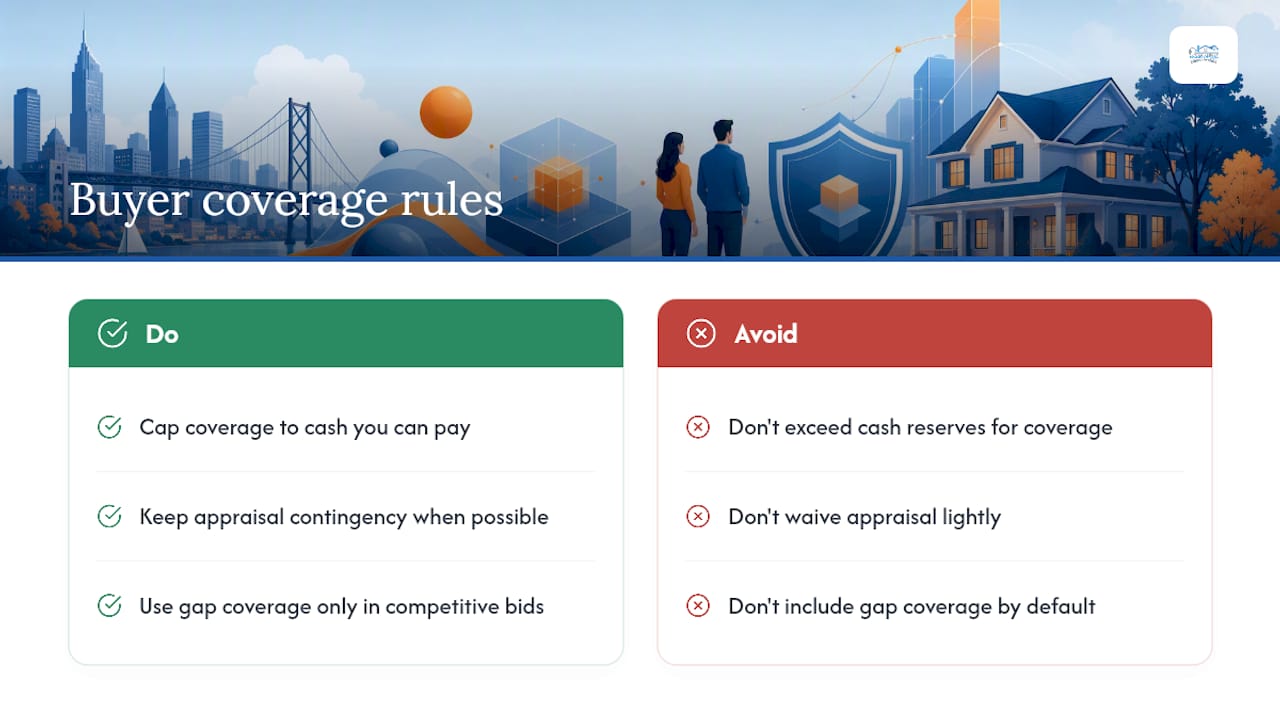
Prefer keeping your appraisal contingency intact unless you have real financing room or the market genuinely forces your hand. Waiving it entirely, an appraisal guarantee, is a different risk level than a capped coverage clause, and you should treat it that way.
Use gap coverage selectively, in competitive bidding situations where it actually moves the needle, not as a default clause on every offer. It's a tool for specific moments, not a habit.
— Alek
Get a Defensible Appraisal Before You Negotiate a Gap
Newjerseyrealestateappraisal gives you something a rushed lender-ordered appraisal often can't: a state-certified, USPAP-compliant report built to hold up if you need to challenge a low value or negotiate with a seller. With 26+ years of combined experience across all 21 NJ counties, we know what comparable sales actually support a valuation in your specific market, not a generic algorithm's guess.

If you're facing a low appraisal and need documentation for a reconsideration of value, or you want a pre-listing appraisal before you ever get into a gap negotiation, we handle residential, estate, divorce, and and tax appeal appraisals with the same defensible rigor. Buyers and sellers in Atlantic County can request a state-certified appraisal directly, and Union County clients can get started with a local appraisal order today. Call us at (908) 517-3913 to talk through your situation before you sign a gap clause you can't afford.
Verify the Rules Yourself
Appraisal rules and consumer protections come from real regulatory bodies, not blog posts. The CFPB's guidance on appraisals covers your right to access appraisal reports and how certain mortgage products are regulated. You can verify any lender's licensing through NMLS Consumer Access, a free public database. For deeper detail on how contingencies protect you separately from coverage clauses, read our guide to appraisal contingencies.
Sources
- Appraisal gap: What it means for buyers
- Appraisal gap: what to do
- CFPB appraisal rules
- What Is an Appraisal Gap and How Does It Work? - Redfin