

An appraiser is a state-certified professional trained to determine the fair market value of real property objectively and impartially. Unlike a real estate agent, who advocates for a buyer or seller, an appraiser has no financial stake in the outcome. Their opinion must be independent, defensible, and produced in compliance with the Uniform Standards of Professional Appraisal Practice (USPAP), the nationally recognized ethical and performance framework authorized by Congress in 1989. Whether the property is a single-family home in Bergen County or a commercial building in Newark, the appraiser's job is the same: deliver a credible, well-supported value conclusion.
Here's what that role covers in practice:
- Conducting physical property inspections and documenting condition, size, and amenities
- Researching public records, sales data, and local market trends
- Analyzing comparable sales to support a final value opinion
- Preparing written reports that meet USPAP and federal regulatory standards
- Maintaining strict independence throughout every assignment
Newjerseyrealestateappraisal (NJREAG) provides state-certified appraisal services across all 21 New Jersey counties, covering residential, commercial, divorce, estate, and tax appeal assignments.
What does an appraiser actually do day to day?
The appraiser job description is more involved than most people realize. It combines field work, data analysis, and formal report writing, all governed by strict ethical rules.
Core responsibilities include:
- Defining the scope of work: Before inspecting anything, the appraiser identifies the problem to be solved, the property rights being valued, and the intended use of the report.
- Inspecting the property: Appraisers examine interior and exterior condition, square footage, layout, upgrades, and any factors that affect marketability. Critically, appraisers focus on market-driven features like location and condition relative to the neighborhood — they do not perform home inspections.
- Researching public records and market data: Deed history, tax records, zoning, and recent sales all feed into the analysis.
- Analyzing comparable sales: The appraiser selects recently sold properties that are similar in size, location, and condition, then adjusts for differences to bracket the subject property's value.
- Reconciling findings into a final opinion: All data points are weighed and reconciled into a single, supported value conclusion.
- Maintaining ethical independence: USPAP mandates that appraisers avoid any fee arrangement tied to the property's value. Attempting to influence an appraiser's opinion is a serious professional violation.
Appraiser vs. assessor: These two roles are often confused. A property assessor works for a local government and values properties in bulk for tax purposes. An appraiser works independently, values one property at a time, and produces reports used for lending, legal, or financial decisions.
What are the main types of appraisers?
Specialization shapes everything from the assignments an appraiser takes to the license they hold. The two primary categories in real estate appraisal are residential and commercial.

Residential appraisers focus on single-family homes, condos, two-to-four-unit properties, and similar smaller real estate. Most mortgage lending appraisals fall into this category. The work is high-volume and deadline-driven, with fees for residential assignments typically range from $200 to $750 depending on complexity as of mid-2026.
Commercial appraisers handle office buildings, retail centers, industrial properties, apartment complexes, and other income-producing real estate. These assignments require deeper financial analysis, including income capitalization and discounted cash flow modeling. Licensing requirements are more demanding, and fees reflect the added complexity.
Both types must hold state credentials and comply with USPAP. In New Jersey, the state licensing board sets specific education and experience thresholds for each credential level. Aspiring appraisers face real barriers to entry: the path to a Certified Residential credential requires completing the 15-Hour National USPAP Course, supervised experience hours, and passing a state exam. Specializing early, in areas like estate or divorce valuation, tends to improve long-term career sustainability.
How does the appraisal process work from start to finish?
The appraisal process follows a structured sequence, and each step builds on the last. Skipping or rushing any stage undermines the credibility of the final report.
| Step | Activity | Typical Timeframe |
|---|---|---|
| 1. Engagement | Define scope, intended use, and effective date | Same day |
| 2. Property inspection | Measure, photograph, and document condition | — |
| 3. Research | Pull comparable sales, public records, and market data | 1–3 days |
| 4. Analysis | Adjust comparables, apply valuation approaches | 1–2 days |
| Reconciliation | Weigh evidence and form a final value opinion | Hours |
| Report preparation | Write and certify the USPAP-compliant report | 1–3 days |
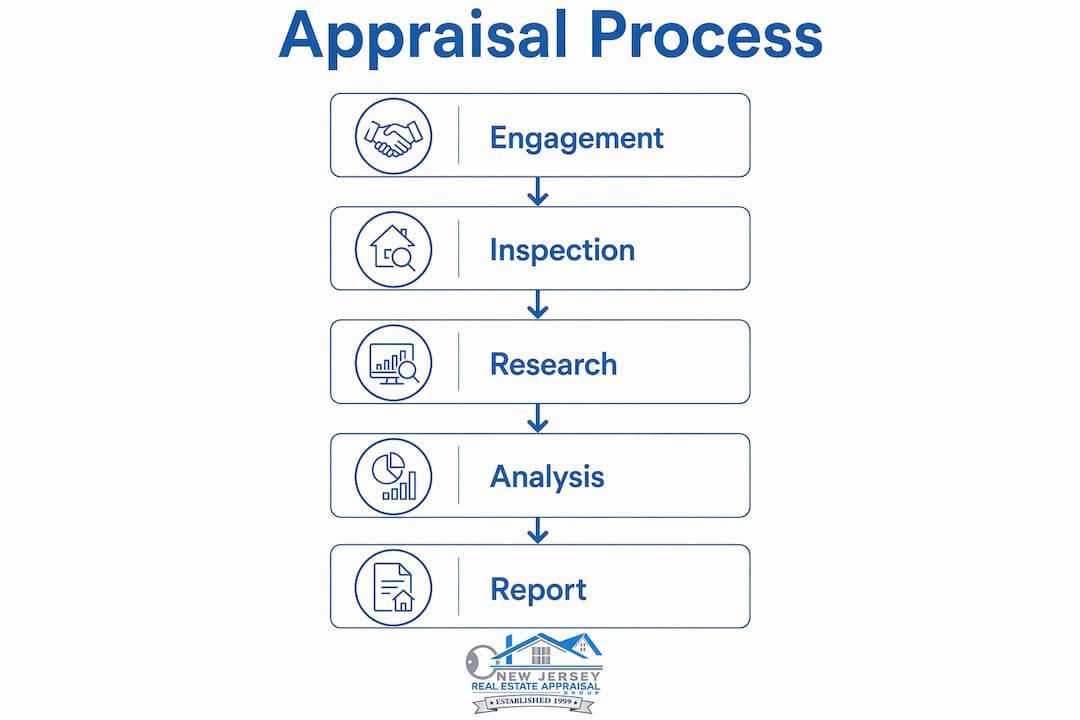
Step 1: Inspection. The appraiser visits the property, measures the living area, notes the condition of systems and finishes, and photographs key features. This is not a home inspection. The appraiser is evaluating what a typical buyer would pay, not cataloging defects for repair.
Step 2: Research. Public deed records, tax assessments, MLS sales data, and neighborhood market reports all inform the analysis. For NJ appraisal assignments, local knowledge of county-level market trends is critical to selecting truly comparable sales.
Step 3: Analysis and reconciliation. The appraiser applies one or more valuation approaches (sales comparison, cost, or income) and reconciles the results into a single opinion of value. Every adjustment must be market-supported and documented.
Step 4: Report. The final written report certifies that the appraiser performed the work independently and in compliance with USPAP. For federally related transactions, this compliance is not optional — it's required under Title XI of FIRREA.
Pro Tip: Provide your appraiser with a list of recent upgrades and their costs before the inspection. Factual renovation data helps the appraiser support adjustments. Trying to influence the value opinion, however, violates USPAP and can invalidate the report.
Why do appraisals matter so much in real estate transactions?
An appraisal protects everyone in a transaction. Lenders use them to confirm that the collateral backing a loan is worth what the borrower claims. Buyers use them to avoid overpaying. Sellers use pre-listing appraisals to price confidently. Courts rely on them in divorce and estate proceedings to establish fair, defensible values.
The federal government recognized this importance when Congress passed FIRREA in 1989, requiring USPAP-compliant appraisals for all federally related real estate transactions. That standard applies to loans made by federally regulated banks and financial institutions across the country.
Beyond lending, appraisal reports are prepared for estate settlements, date-of-death valuations, property tax appeals, equitable distribution in divorce, and litigation support. Each use case demands the same thing: a credible, well-documented opinion that can withstand scrutiny. A report that cuts corners won't hold up in court, and in New Jersey, where property tax appeals have strict filing deadlines, a flawed appraisal can cost you the case entirely.
Why NJREAG's state-certified expertise sets the standard in New Jersey
Newjerseyrealestateappraisal brings over 26 years of combined real estate experience to every assignment, covering all 21 New Jersey counties from Cape May to Sussex. That depth of local knowledge matters because property values in NJ vary sharply by municipality, school district, and even block. A generalist appraiser working from broad regional data will miss those distinctions.
NJREAG specializes in the assignments where accuracy is most consequential:
- Divorce appraisals: Court-ready valuations that withstand cross-examination and support equitable distribution under New Jersey law.
- Estate and date-of-death appraisals: Retrospective valuations tied to a specific date, prepared for probate, IRS reporting, and estate planning.
- Property tax appeals: Defensible reports filed before New Jersey's annual April 1 tax appeal deadline, backed by county-level market analysis.
Every report NJREAG delivers is produced in compliance with regulatory standards and produced by state-certified appraisers. Licensed appraisers must complete the 7-Hour National USPAP Update Course every two calendar years to maintain their credentials, and NJREAG holds to that standard without exception. For attorneys, lenders, and financial professionals who need reports that will hold up under review, that commitment to compliance is the baseline, not a selling point.
Pro Tip: When ordering an appraisal for a tax appeal or legal matter in New Jersey, confirm that the appraiser holds state certification (not just a license) and has direct experience with the specific property type and county. Credential level and local knowledge both affect report credibility.
Get a certified appraisal from NJREAG

When the stakes are high, you need a state-certified appraiser who knows New Jersey's market from the inside. Newjerseyrealestateappraisal serves homeowners, attorneys, lenders, and investors across all 21 NJ counties with USPAP-compliant reports built to support lending decisions, legal proceedings, and financial planning.
Whether you need an Atlantic County appraisal, a Union County valuation, or a specialized estate appraisal for probate or date-of-death purposes, we're ready to help.
Call us at (908) 517-3913 or visit newjerseyrealestateappraisal.com to request your appraisal today.
Key Takeaways
A state-certified appraiser provides an independent, USPAP-compliant opinion of property value that lenders, courts, and financial professionals can rely on for legally and financially consequential decisions.
| Point | Details |
|---|---|
| Appraiser definition | A state-certified professional who delivers an independent, objective property value opinion under USPAP. |
| Residential vs. commercial | Residential appraisers handle homes and condos; commercial appraisers cover income-producing and complex properties. |
| Appraisal fees | Residential appraisal fees typically range from $200 to $750 as of mid-2026, depending on assignment complexity. |
| USPAP compliance | Compliance with USPAP is mandatory for state-certified appraisers in federally related real estate transactions. |
| NJ specialization | NJREAG covers all 21 New Jersey counties with 26+ years of experience in divorce, estate, and tax appeal appraisals. |