

If you own, inherit, divide or contest the value of a rental property, the vacancy rate is one of the few inputs that can move the appraised number by tens of thousands of dollars. The Census Bureau's Q3 2026 Housing Vacancy Survey, released October 28, 2026, put the national rental vacancy rate at 7.6%, up from 7.1% in Q3 2025. That is a market figure. The vacancy rate an appraiser applies to your building is a property-specific conclusion, and it has to be supported, because it flows straight into net operating income and then into value.
This guide shows how that chain works, what lenders and appraisal bodies expect, and where vacancy assumptions go wrong in estates, divorces, tax appeals and investment decisions.
TL;DR
- Vacancy lowers a rental property's effective income. In the income approach, lower income at the same cap rate means lower value.
- Each point of vacancy on a property's gross potential rent reduces income by that amount, and dividing by the cap rate turns it into a value difference. On our example below, 5 points of extra vacancy equals about $92,000 of value.
- The national rate was 7.6% in Q3 2026 according to the Census Bureau, but the number that matters is the one supported by your building's rent roll, collections and submarket.
- Lenders use floors, such as Fannie Mae's 5% combined minimum for vacancy, concessions and bad debt, so a seller's "zero vacancy" pro forma rarely survives review.
- When the value feeds a court filing, an estate return or a tax appeal, the vacancy figure needs documented support from a certified appraiser.
Table of Contents
- What vacancy rate means and why it is not one number
- How vacancy flows into value
- What the market data says, and how to use it
- What lenders require
- Where vacancy assumptions go wrong
- When the vacancy figure carries legal or tax weight
- Our point of view
- Getting a supported valuation
- FAQ
- Sources
What vacancy rate means and why it is not one number
The vacancy rate is the share of rentable units that are unoccupied at a given time. Investopedia gives the basic formula: vacant units divided by total units, times 100. A 300-unit building with 30 empty units has a 10% vacancy rate. A low rate generally signals strong demand, and a high rate signals weak demand.
For valuation, that headline figure is only the start. Appraisers separate three kinds of loss:
- Physical vacancy: units or space that sit empty. In commercial work it is vacant leasable area divided by total leasable area.
- Concessions: free months or discounts that reduce collected rent even when a unit is occupied.
- Collection loss: rent billed but never received, measured as uncollected rents divided by rents receivable.
Indiana's Department of Local Government Finance shows how these combine in an income approach exercise: 6% vacancy (1,200 of 20,000 square feet) plus 1% collection loss gives a combined 7% deduction before expenses. A building can be nearly full and still collect far less than it bills, which is why a single "5% vacancy" line often hides the real picture.
How vacancy flows into value
The income approach works in a fixed order. Start with potential gross income, the rent the property would produce if fully occupied and fully paid. Subtract vacancy and collection loss, and add any other income, to reach effective gross income (EGI). Subtract operating expenses and reserves to reach net operating income (NOI). Then divide NOI by the capitalization rate, the rate of return the market requires, to reach value. Indiana's Level I income approach course walks through this sequence. Its examples include $621,000 of potential gross income less 6% vacancy and collection loss ($37,260), leaving $583,740, and an NOI of $49,500 at an 11% cap rate producing a value of $450,000.
Because vacancy sits at the top of the chain and expenses mostly do not shrink when units empty, a vacancy change lands almost dollar for dollar in NOI. Then the cap rate multiplies it.
A worked example
Take a hypothetical New Jersey fourplex. This is an illustration, not a market data point.
| Line | 5% vacancy | 10% vacancy |
|---|---|---|
| Potential gross income (4 units at $2,500 per month) | $120,000 | $120,000 |
| Vacancy and collection loss | $6,000 | $12,000 |
| Effective gross income | $114,000 | $108,000 |
| Operating expenses | $40,000 | $40,000 |
| Net operating income | $74,000 | $68,000 |
| Value at a 6.5% cap rate | about $1,138,000 | about $1,046,000 |
Five extra points of vacancy cost $6,000 a year in NOI and about $92,000 in value. At a lower cap rate the same $6,000 is worth even more, because the divisor is smaller. That is why a vacancy figure that looks like a rounding choice can decide a buyout price, an estate's reported value or the strength of a tax appeal.
The same logic is behind the methods in our guides on how NOI and cap rate decide investment property value and GRM versus cap rate.
What the market data says, and how to use it
The Census figure of 7.6% for Q3 2026 is the published national rental vacancy rate for that quarter. The survey is released quarterly, and the rate moves with new construction, household formation and rents. The Census Bureau also publishes breakdowns by region, by metro and non-metro areas, and by building size, so a 20-unit building and a two-family house are not measured against the same line.
Treat the national number as context, not as your property's answer. Three reasons:
- Submarkets differ. A building near a rail station in Hudson County and a garden complex in a slower county have different demand even though both sit under the same state average.
- Your building's history matters more. Twelve months of rent roll and collections show what this property actually did.
- Valuation dates are fixed. For a date-of-death or retrospective valuation, the question is what vacancy a buyer would have underwritten on that specific date, not what the survey says now.
The Appraisal Institute describes the idea of equilibrium vacancy: the level of vacancy that puts no upward or downward pressure on rents. Market vacancy above that level tends to hold rents down, and below it supports increases. It is a useful reference when an appraiser decides whether the rent in the model should rise, hold or fall.
What lenders require
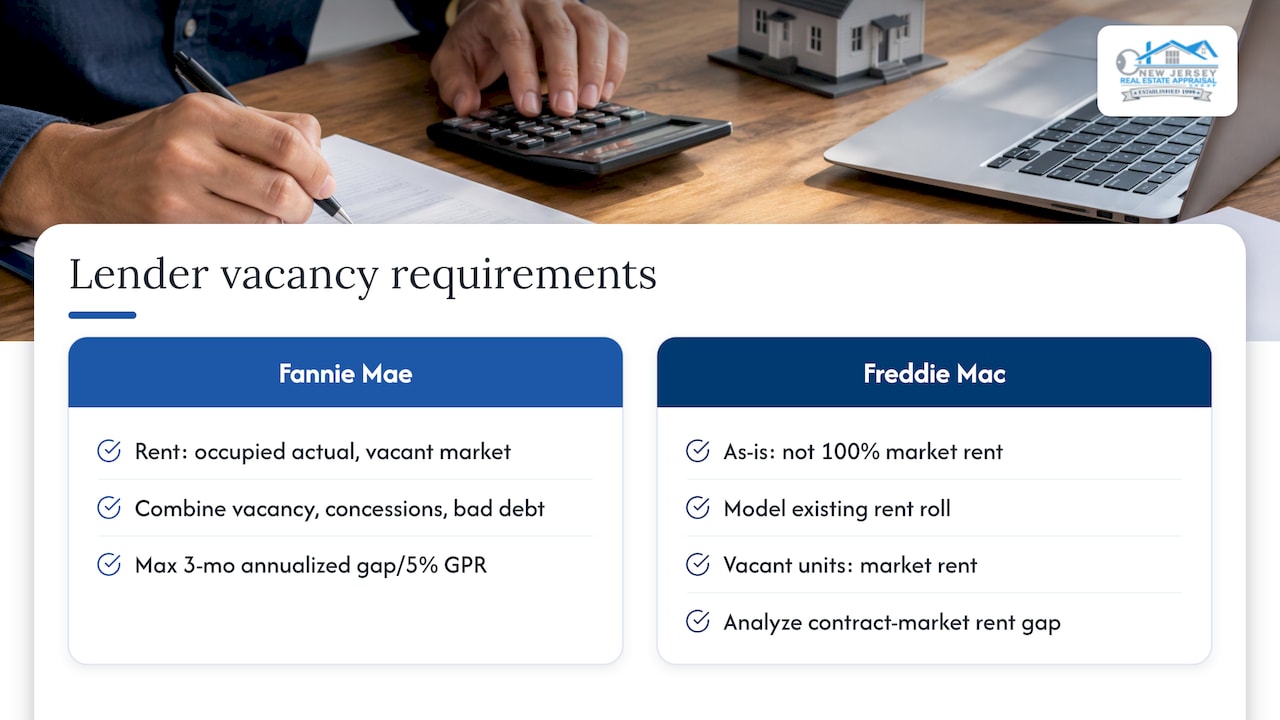
Lenders do not accept whatever vacancy an owner prefers. Fannie Mae's Multifamily Selling and Servicing Guide, in a section effective June 30, 2025, calls for gross rental income built from actual rents on occupied units plus market rent on vacant units, taken from a current rent roll. It also requires physical vacancy, concessions and bad debt combined to equal the greater of the trailing three-month collection shortfall, annualized, or 5% of gross potential rent.
Freddie Mac's June 2022 appraisal guidance adds a point that matters in disputes. Modeling income at 100% of market rent is not the correct method for as-is value. The appraiser should model the existing rent roll, add vacant units at market rent, and analyze the gap between contract rents and market rents.
The practical lesson: a value built on a pro forma with no vacancy line is the version most likely to be challenged by a lender, an opposing expert or a tax assessor. A rent roll that has been checked against leases and deposits is stronger, which is why we cover what gets checked in rent roll verification.
Where vacancy assumptions go wrong
Using the seller's number. Pro formas often show full occupancy. The appraisal should reflect what the property and the market support.
Using last year's vacancy for a different valuation date. A building that was 100% leased in a tight year may have been rented at below-market rents, or a turnover may have just begun. The valuation date controls.
Ignoring non-physical loss. Concessions and unpaid rent reduce income even when every unit is occupied.
Counting a short vacancy as permanent. A unit being renovated between tenants is not the same as chronic weak demand. A property with renovation work underway needs separate treatment, such as an as-is value and an after-repair value, so the temporary vacancy does not distort the stabilized figure.
Mixing up market rent and contract rent. If in-place leases are above or below market, the income model should show it, as the Freddie Mac guidance explains. Our article on market rent analysis covers how fair rent is determined.
When the vacancy figure carries legal or tax weight
Most readers searching this topic are investors, but vacancy shows up in other situations where a documented opinion of value is needed:
- Divorce and family buyouts. When a spouse or sibling is paid out of a rental property, the vacancy assumption moves the payout directly. Each side's attorney will look at it.
- Estates and date-of-death valuations. Executors and CPAs need a value as of one fixed date. The rent roll and market conditions on that date drive the vacancy conclusion.
- Property tax appeals. For income-producing property, an assessment that ignores actual vacancy and collection loss can overstate income and value.
- Refinancing and portfolio reviews. Lenders apply their own floors, as shown above.
In each case the number needs to be explained, not just stated. Our overview of income approach valuation for NJ investors shows how those conclusions are built, and our piece on valuation risk factors lists the other inputs that move value alongside vacancy.
Our point of view
Most vacancy disputes we see come down to one question: what evidence supports this number? A building's rent roll, lease terms, concessions, collection history, condition and location all bear on it. A national statistic does not.
We bring more than 26 years of appraisal and real estate experience, including hands-on renovation and fix-and-flip work, to this question. That background helps us tell a unit that is empty because it is being repaired from one that is empty because the market will not pay the asking rent.
We also use professional data sources and research tools to identify and verify market evidence beyond basic MLS data, and we develop conclusions under USPAP, the Uniform Standards of Professional Appraisal Practice. For attorneys, executors, CPAs and investors, that means a vacancy and income conclusion tied to evidence, which is what a court, a lender or an assessor will ask to see.
If the value matters to a decision, the vacancy line deserves the same care as the sales comparables.
Alek Petreski
Getting a supported valuation
If your property produces rent and the value feeds a legal, tax or financial decision, we prepare state-certified, USPAP-compliant appraisal reports for New Jersey residential and multi-family property. Our published fee ranges are $550 to $800 for court-ready divorce appraisals, $595 to $850 for estate and date-of-death appraisals, and $495 to $750 for property tax appeal appraisals. Commercial real estate appraisals range from $2,500 to $10,000 on our commercial appraisal page.

To discuss a specific property, send us the address, the valuation date and the purpose of the appraisal, and we will take it from there through our website.
FAQ
Is a low vacancy rate good or bad for value?
Low vacancy generally signals strong rental demand, which supports income and value. It can also mean rents are set below market, so an appraiser checks whether in-place rents match what the market would pay before treating a full building as a premium.
How do you calculate vacancy loss?
Multiply gross potential rent by the vacancy rate. For example, $120,000 of potential rent at 5% vacancy is a $6,000 loss. Concessions and unpaid rent are deducted in addition, so the full deduction is often higher than physical vacancy alone.
Does the national rental vacancy rate set my property's vacancy?
No. The Census Bureau's 7.6% for Q3 2026 describes the national rental market for that quarter. Your property's figure comes from its own rent roll, collections history, building type and submarket, as of the valuation date.
Does vacancy matter for an owner-occupied home?
Not in the same way. Single-family homes are usually valued by comparing recent sales, while the income approach and vacancy assumptions apply to rental and multi-family property.
Sources
- Quarterly Residential Vacancies and Homeownership, Third Quarter 2026 (U.S. Census Bureau)
- Vacancy Rate Definition and How to Calculate It (Investopedia)
- 2025 Level II Income Approach Problem (Indiana Department of Local Government Finance)
- Level I Income Approach to Value (Indiana Department of Local Government Finance)
- Market Analysis for Apartment Properties (Appraisal Institute)
- Multifamily Selling and Servicing Guide, appraisal review (Fannie Mae)
- Appraisal Guidance: Modeling Potential Rental Income (Freddie Mac)
Recommended
- What Affects Property Value: Key Factors Explained
- Property Valuation Risk Factors: What Investors Must Know
- GRM vs. Cap Rate: 3 NOI Steps Appraisers Use to Value Rentals
This article is provided for general informational purposes only and does not constitute legal, tax, or financial advice. Real estate appraisal requirements can vary by assignment and intended use. For advice specific to your situation, consult the appropriate legal, tax, or financial professional.