

For lending and most formal purposes, a mixed use appraisal must verify legal mixed-use status and report market value based on the property's residential characteristics, while separately documenting any commercial use and its effect on marketability. That standard comes straight from Fannie Mae's B4-1.4-07 guidelines and USPAP, and it's the framework every state-certified appraiser in New Jersey has to work within.
TL;DR:
- A mixed use property must have verified legal zoning and separate documentation of entrances, utilities, leases, and square footage for accurate appraisal.
- The appraisal must report value based solely on residential characteristics, excluding commercial income or business equipment from the market value.
- Approaches require careful adjustment: revenue streams are separated; comparable sales often rely on extraction methods; and a weighted blend rate must be transparently calculated.
- Documentation needs to include detailed descriptions, zoning verification, income and expense schedules, and photographs of use boundaries to ensure report defensibility.
- Formal, USPAP-compliant appraisals are necessary for lender requirements, estate, tax appeal, or litigation purposes, with preparation of verified records and zoning verification before inspection.
Table of Contents
- What Qualifies as Mixed Use and What You Must Document
- Fannie Mae, Freddie Mac, and USPAP: The Rules That Shape Mixed Use Appraisals
- Applying Income, Sales Comparison, and Cost Approaches to Mixed Use Properties
- What the Appraisal Report Must Include to Be Defensible
- Practical Issues and Proven Tactics for Mixed Use Appraisals
- How a State-Certified Firm Documents a Mixed Use Appraisal
- When You Actually Need a Certified Mixed Use Appraisal
- Get a Mixed Use Appraisal from a State-Certified NJ Firm
- Sources
What Qualifies as Mixed Use and What You Must Document
A mixed use property combines two or more legally distinct uses on one parcel, most often residential and commercial. Think live/work lofts, a storefront with an apartment above it, or a home office that sees walk-in clients. The label matters because it changes what the appraiser has to prove before value even enters the conversation.
Zoning is where that proof starts. We check municipal zoning maps, confirm the use is permitted outright or grandfathered under a prior ordinance, and pull permit history to see whether the commercial space was legally converted or just quietly added over the years. A property that's been running a hair salon out of the ground floor for 20 years without a certificate of occupancy is a red flag, not a footnote.
Once legality is confirmed, the field inspection has to capture specific details that separate a defensible report from a guess:
- Separate entrances for residential and commercial units
- Separate or shared utility metering, and how that affects expense allocation
- Current lease status, rent rolls, and lease terms for any commercial tenant
- Whether the owner occupies the residence, operates the business, or both
- Square footage allocated to each use, measured and documented independently
Skip any of these and the report can't support the conclusions that follow. Lenders and reviewers look for this level of detail because it's the only way to know whether the "mixed use" label reflects reality or just a listing description. If you're working with a property in Bergen, Middlesex, or any of New Jersey's 21 counties, the zoning office is your first stop, not your last.
Fannie Mae, Freddie Mac, and USPAP: The Rules That Shape Mixed Use Appraisals
Lender eligibility rules dictate more of the appraisal process than most people expect, and mixed use assignments are where that shows up hardest. Fannie Mae's B4-1.4-07 guidance requires four specific things from the appraiser:
- A detailed description of the mixed use characteristics, not a generic label
- Verification that the mixed use is legally permissible under local zoning
- An assessment of whether the commercial use creates any adverse impact on marketability
- A final value opinion based on the residential characteristics, not the business operation
That last point trips people up constantly. Business equipment, goodwill, and commercial income do not get folded into residential market value. A thriving dental practice on the ground floor doesn't make the upstairs apartment worth more just because the business is profitable.
Freddie Mac's Guide Section 5601.5 adds its own layer, requiring both interior and exterior inspection with documentation of the mixed use characteristics before the loan can move forward. Skipping the interior walk-through of the commercial space isn't an option under this guidance.
USPAP governs the professional side of the assignment regardless of which lender rules apply. The Uniform Standards of Professional Appraisal Practice requires four things from every state-certified appraiser: competency in the property type being appraised, a clearly defined scope of work, proper record keeping, and an accurate certification statement on the final report.
Statistic Callout: Fannie Mae's own guidelines make explicit that mixed use appraisals must report value based on residential characteristics, not business use, according to Fannie Mae's mixed-use requirements. That single rule reshapes how appraisers approach income analysis, comparable selection, and final reconciliation on nearly every mixed use file.
These aren't bureaucratic hoops. They exist because a lender extending a residential-based loan needs to know the collateral value won't collapse if the business closes. Every phrase in the report, from the description of uses to the final reconciliation, gets built around that concern.
Applying Income, Sales Comparison, and Cost Approaches to Mixed Use Properties
Every mixed use appraisal runs through the same three approaches used on any commercial real estate appraisal, but each one needs adjustment for the dual-use nature of the asset.
Income approach. Separate the revenue streams first. Residential rent (market or actual) and commercial rent (from actual leases or market rent surveys) each get their own expense allocation, their own vacancy assumption, and their own stabilized net operating income. Only after each component is stabilized independently do you consolidate them into a single income stream for capitalization.
Sales comparison approach. True mixed use comparables are the gold standard, but in most New Jersey markets outside the densest corridors, they're scarce. When they're not available, appraisers turn to single-use comparables (pure residential and pure commercial) and apply extraction methods to isolate what each use is contributing to value. This requires more judgment and more explanation in the narrative than a straightforward single-use file.
Cost approach. Less commonly the primary indicator for mixed use, but useful for special-use properties, new construction, or situations where income and sales data are both thin. Land value plus depreciated reproduction or replacement cost gives a floor value that can support or challenge the other two approaches.
Building a blended capitalization rate is where a lot of appraisers get sloppy; understanding rates used by the largest real estate companies can provide helpful market context for your valuation. There are two defensible paths:
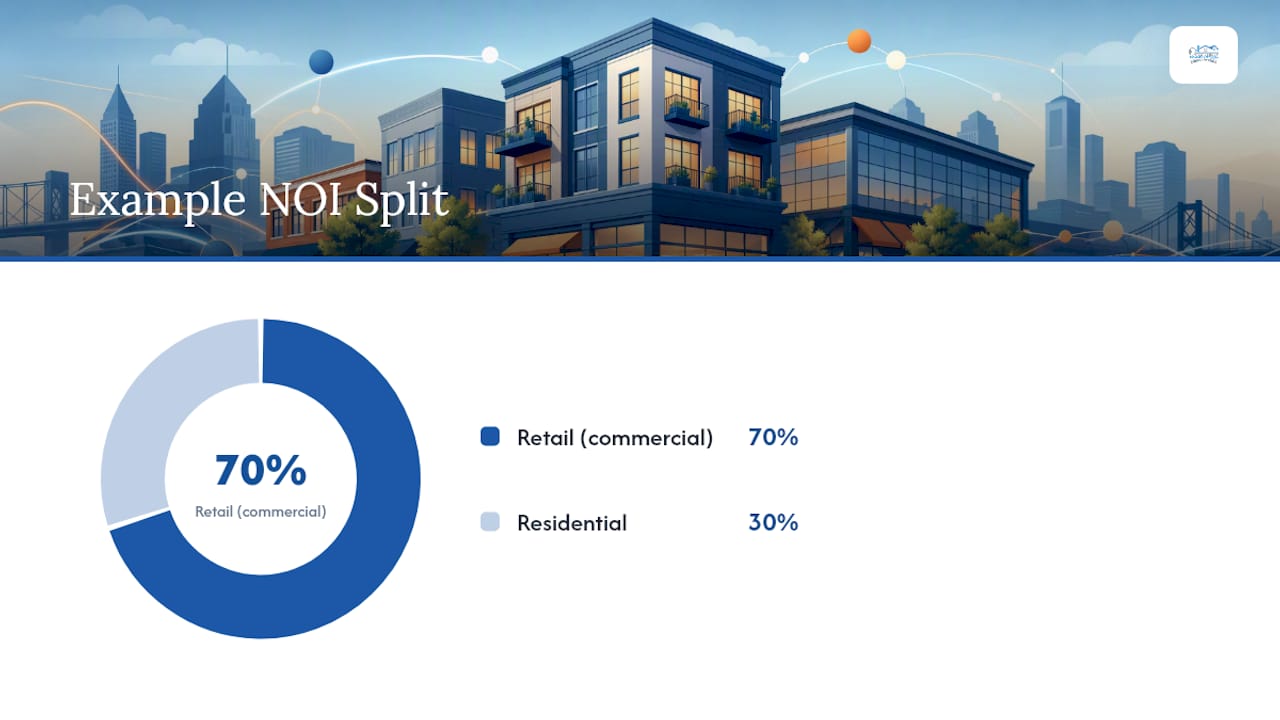
- Calculate a weighted average cap rate based on each component's share of total NOI, so a property with 70% of its income from retail and 30% from residential gets a cap rate weighted accordingly.
- Extract a market-derived blended rate directly from comparable mixed use sales, when enough of them exist to support it.
Pro Tip: Never present a blended cap rate without showing your weighting math in the report. A lender's underwriter or a tax appeal judge will ask how you got there, and "professional judgment" alone won't hold up under cross-examination.
Reconciliation is the step where you explain, in plain language, why you weighted the approaches the way you did. If the income approach carried more weight because commercial leases were long-term and stable, say so. If sales comparison drove the conclusion because comparable sales data was strong, say that instead. The Appraisal Institute's standards of professional practice point to newer property use classification systems that now treat mixed use as its own distinct category, which helps with comparable tracking, but the burden of explaining your reconciliation still sits with the appraiser. A comparable sales analysis that's well documented makes that job significantly easier.
What the Appraisal Report Must Include to Be Defensible
A mixed use appraisal report has to do more explaining than a standard single-family report, because there's more for a reviewer, lender, or judge to question.
The narrative needs to cover:
- A clear, specific description of each use and how the property functions day to day
- Documentary evidence of zoning verification, including permit numbers where relevant
- A full highest and best use analysis, addressing both "as vacant" and "as improved"
- Separate income and expense schedules for each component before consolidation
- Comparable selection criteria and the adjustments applied, explained line by line
USPAP's Record Keeping Rule requires appraisers to retain the workfile, which includes field notes, comparable data, photographs, and any correspondence with municipal offices, for a set retention period after the report is delivered. That workfile is what backs up the report if it's ever challenged in a tax appeal hearing or a divorce proceeding.
One more thing the report has to do clearly: disclose any special business equipment, tenant improvements, or income assumptions that were factored into the analysis, and state plainly that those items were not attributed to residential market value. That disclosure protects the credibility of the report and keeps the appraiser's conclusion aligned with lender guidelines.
Practical Issues and Proven Tactics for Mixed Use Appraisals
Most appraisal databases and MLS systems are built around single-use categories, which creates real friction when you're trying to document a property that doesn't fit neatly into one box. Practitioner guidance from RealQuantum recommends narrative description and multi-improvement records over forcing a mixed use property into a single classification just to make the software happy.
When mixed use comparables are scarce, value each component separately first, then analyze whether the market rewards the combined property with a premium for synergy, or discounts it for reduced marketability. Document that judgment call with bracketing from comparable sales, not just a gut feeling.
Expense allocation across shared building systems is another common failure point. HVAC, roofing, and structural capital expenses often serve both uses, and dividing responsibility fairly requires a clear allocation methodology, not a 50/50 guess.
Pro Tip: Ask the property owner for utility bills, lease abstracts, and any prior certificate of occupancy documentation before your inspection. It saves a second site visit and gives you the paper trail a lender or judge will want to see.
Before the field visit, gather:
- Municipal zoning letter or verification
- Certificates of occupancy for each use
- Current leases and rent rolls for commercial space
- Recent utility bills and capital expense history
How a State-Certified Firm Documents a Mixed Use Appraisal
Our process starts with zoning verification: a call or record request to the municipal office, a permit history pull, and a review of any certificate of occupancy on file. Everything goes into the workfile.
From there, we allocate income between residential and commercial components, reconcile the approaches in plain narrative language, and build an exhibit list lenders and courts expect to see:
- Zoning verification letter or documented record search
- Component income and expense schedules
- Comparable sales grid with adjustment explanations
- Photographs of separate entrances, utilities, and use boundaries
When You Actually Need a Certified Mixed Use Appraisal
State-certified status and USPAP compliance aren't checkboxes. They're what makes a report hold up when someone else has a reason to disagree with your number, whether that's a lender's underwriter, a tax assessor, or opposing counsel in a divorce case.
We recommend commissioning a formal appraisal any time a lender requires it, when a property enters an estate or date of death valuation, when you're filing a tax appeal, or when litigation is on the table. Have your zoning documentation, leases, and utility records ready before you call. It cuts the engagement time down considerably.
— Alek
Get a Mixed Use Appraisal from a State-Certified NJ Firm
Newjerseyrealestateappraisal is the alternative to guesswork when a lender, court, or tax board needs a mixed use valuation that actually holds up. Where a generic online estimate treats commercial and residential value as one lump number, our state-certified appraisers separate the components, verify zoning directly with the municipality, and build a USPAP-compliant report that can survive a challenge.

We've handled mixed use assignments across many New Jersey counties, from live/work lofts to storefront-with-apartment buildings, for lending, estate and date of death, and tax appeal purposes. Before you request a quote, have your zoning letter, current leases, and recent utility bills on hand. It speeds up scheduling and keeps the field visit efficient.
Ready to get started? Visit our appraisal services page to request a quote, or call us directly at (908) 517-3913 to talk through your property before you commit to anything.
Sources
- Mixed-Use Property Appraisal Requirements | Fannie Mae
- Uniform Standards of Professional Appraisal Practice (USPAP) | The Appraisal Foundation
- Guide Section 5601.5 | Freddie Mac
- Appraising Mixed-Use Property | RealQuantum