

TL;DR:
- Reviewing appraisal findings involves verifying data accuracy, evaluating methodology, and ensuring USPAP compliance. It is essential to systematically document discrepancies with supporting evidence before challenging a property valuation report.
Reviewing appraisal findings is the process of systematically verifying a property valuation report for data accuracy, methodological soundness, and compliance with the Uniform Standards of Professional Appraisal Practice (USPAP). Whether you're an attorney handling a divorce settlement, a homeowner challenging a tax assessment, or a financial advisor managing an estate, knowing how to audit appraisal reports protects your interests before decisions get made. A single misreported bedroom count or a poorly chosen comparable can shift a value conclusion by tens of thousands of dollars. Getting this right is not optional.
What critical elements should you verify when reviewing appraisal findings?
The Uniform Residential Appraisal Report (URAR) covers all factors affecting value, including property description, comparables, and reconciliation. That structure gives you a clear map for verification. Start at the front page and work through the report section by section.
These are the core checkpoints every reviewer should cover:
- Property identification: Confirm the street address, legal description, and parcel ID match public tax records exactly.
- Physical characteristics: Verify gross living area, bedroom and bathroom count, lot size, and construction quality against municipal records or prior listings.
- Neighborhood boundaries: Check that the appraiser defined the market area correctly. Boundaries that are too broad can pull in sales that don't reflect your property's actual market.
- Comparable photographs: Compare the photos of the subject property against the comparable sales. A comp with a two-car garage should not be adjusted the same as one with a single-car garage.
- Data consistency: Cross-check figures between the front summary page and the detailed grid. Discrepancies between sections signal data entry errors or incomplete analysis.
Misreported features and neighborhood boundary errors are common and can distort value conclusions. One incorrect physical detail cascades through the adjustment grid and compounds the error across every comparable.
| Verification Checkpoint | What to Check | Why It Matters |
|---|---|---|
| Property identification | Address, parcel ID, legal description | Errors here invalidate the report's legal standing |
| Physical characteristics | GLA, bedrooms, baths, lot size | Misreported features skew all adjustments |
| Comparable selection | Location, size, age, condition | Poor comps produce unreliable value conclusions |
| Neighborhood description | Market boundaries, trend direction | Overly broad areas mask local price movements |
| Reconciliation section | Final value opinion and reasoning | Must be logically supported by the data presented |
Pro Tip: Cross-reference the appraiser's reported gross living area against the municipal tax card. Discrepancies of 100 square feet or more are common and almost always affect the final value opinion.
How do you assess the appraisal methodology and valuation approach?

Three recognized valuation methods exist: the sales comparison approach, the cost approach, and the income approach. For residential properties, the sales comparison approach carries the most weight. For income-producing properties, the income approach takes priority. The cost approach is most relevant for new construction or unique properties with limited comparable sales.
When you review the comparable sales grid, focus on these factors:
- Comparable selection: Were the sales within a reasonable time frame and geographic area? Sales older than 12 months or located in a different school district require strong justification.
- Adjustment logic: Each line-item adjustment should reflect actual market behavior, not a flat dollar figure applied without support. An appraiser who adjusts $5,000 for every bedroom difference regardless of price range is applying unsupported assumptions.
- Net and gross adjustments: Large net or gross adjustments on any single comparable signal that the comp may be too dissimilar to be useful.
- Reconciliation: The final section must explain why the appraiser weighted certain comparables more heavily. Vague reconciliation language is a red flag.
Desk reviews evaluate credibility and methodology without a property visit and cannot produce a new value opinion, but they can identify report deficiencies. That makes them a practical first step when you suspect methodology problems. For a deeper look at how different valuation methods interact in estate and divorce contexts, the guide on reconciling appraisal methods is worth reviewing.
Pro Tip: Ask whether the appraiser's adjustments are supported by paired sales analysis. If the report shows no support for the dollar amounts used, that's a documentable deficiency under USPAP.
Understanding USPAP compliance in methodology is not just a technical exercise. It's the standard a court or tax board will apply when evaluating whether the report holds up.
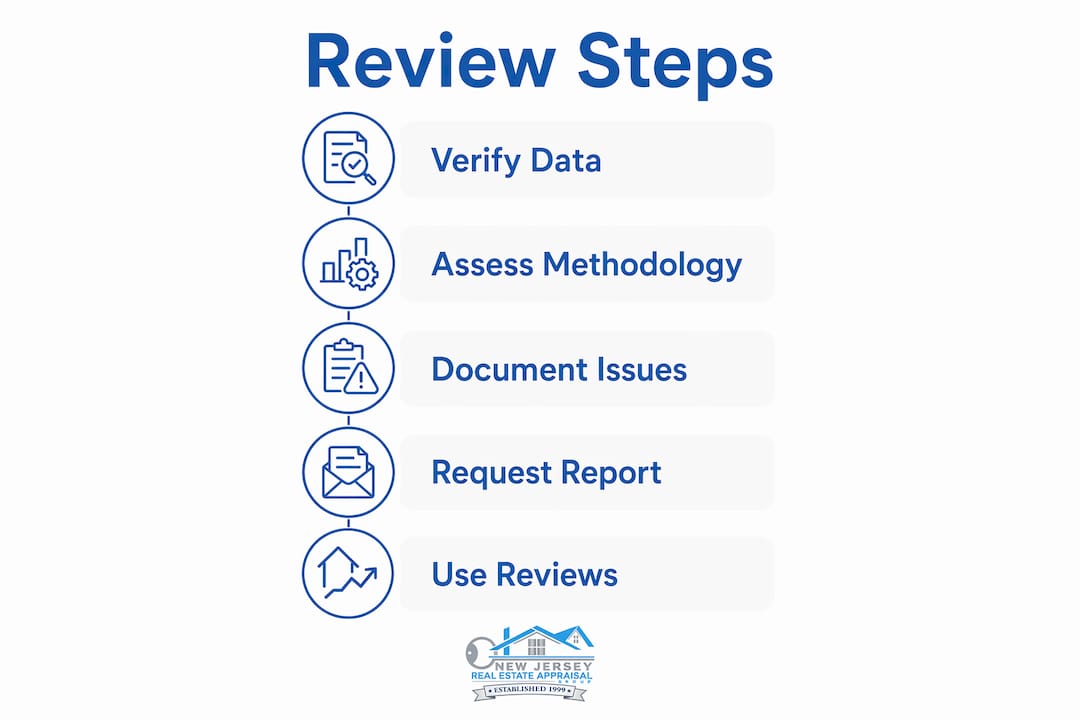
Steps to document appraisal findings and discrepancies effectively
Systematic documentation is what separates a credible challenge from an unsupported complaint. A thorough appraisal workfile is as important as the report itself. Detailed contemporaneous records provide the best defense in legal and tax scrutiny.
Follow these steps to build a defensible record:
- Create a discrepancy log. List every inconsistency with the page number, the reported figure, and the correct figure from your source.
- Gather supporting documentation. Pull the municipal tax card, prior MLS listings, building permits, and photographs of the subject property.
- Document comparable errors. If a comparable sale was misidentified or its features were misreported, obtain the public record for that property and note the difference.
- Write factual correspondence. When requesting a reconsideration of value, state each error clearly and attach supporting evidence. Avoid emotional language. Courts and lenders respond to facts.
- Organize by section. Mirror the structure of the appraisal report in your documentation. This makes it easier for attorneys, tax boards, or lenders to follow your argument.
- Date every entry. Contemporaneous records carry more weight than notes compiled after a dispute begins.
Property owners have the right to request a completed appraisal report, and lenders must provide it within 30 days. That 30-day window is your starting point for building a documentation file.
Pro Tip: When challenging a tax appeal appraisal, attach a copy of the municipal tax card to every discrepancy you document. Tax boards give significant weight to official municipal records over appraiser-reported data.
Common errors worth flagging in your documentation include: incorrect gross living area, wrong year built, misclassified condition ratings, and comparable sales that were not arm's-length transactions.
What are desk reviews and field reviews, and when should you use each?
A desk review is an analysis of an appraisal report conducted entirely from secondary data, without visiting the property. A field review adds an exterior site visit to verify the property's condition and confirm that comparable sales were accurately described. The choice between them depends on what you need to prove and how much is at stake.
Field reviews include physical site visits and are more reliable than desk reviews for catching misreported features or neighborhood changes. If an appraiser described a property as being in good condition but the exterior shows deferred maintenance, a field review captures that discrepancy on record.
| Feature | Desk review | Field review |
|---|---|---|
| Property visit | No | Exterior only |
| Can produce new value opinion | No | Yes, in some cases |
| Best for | Methodology and compliance errors | Physical feature discrepancies |
| Cost | Lower | Higher |
| Turnaround time | Faster | Slower |
| Reliability for court use | Moderate | Higher |
Legal professionals handling divorce or estate matters typically request field reviews when the original appraisal is being contested in court. Financial advisors managing estate assets may start with a desk review to identify obvious deficiencies before committing to a full field review.
- Desk reviews work well for tax appeal preparation when the dispute centers on comparable selection or adjustment logic.
- Field reviews are the right call when physical condition, lot size, or neighborhood classification is in dispute.
- Either review type must be conducted by a state-certified appraiser to carry weight in a legal or regulatory proceeding.
For a broader look at common appraisal mistakes that trigger the need for formal reviews, that resource covers the most frequent errors seen in NJ residential reports.
Key Takeaways
Reviewing appraisal findings requires verifying data accuracy, evaluating methodology against USPAP standards, and documenting every discrepancy with supporting evidence before any legal or financial decision is made.
| Point | Details |
|---|---|
| Verify all property data first | Cross-check address, GLA, and physical features against municipal tax records before anything else. |
| Evaluate comparable selection and adjustments | Adjustments must reflect actual market behavior, not flat figures applied without paired sales support. |
| Document discrepancies systematically | Build a dated discrepancy log with supporting public records to defend any challenge or appeal. |
| Choose the right review type | Use desk reviews for methodology errors and field reviews when physical features or condition are disputed. |
| USPAP compliance is the standard | Any review used in court, tax appeal, or estate proceedings must meet USPAP requirements to be credible. |
What I've learned from watching appraisal reviews go wrong
Appraisal review is about assessing the quality of the work product, not the individual appraiser. That distinction matters more than most people realize. I've seen legal professionals walk into disputes focused entirely on attacking the appraiser's credentials rather than the report's logic. That approach rarely works. Courts and tax boards care about whether the methodology is sound and whether the data supports the conclusion.
Effective appraisal reports for legal use should front-load conclusions and include visual exhibits to aid judge understanding. Judges often skip directly to the summary and the exhibits. If your report buries the value conclusion on page 12 with no supporting chart, you've already lost ground.
The other mistake I see regularly is underestimating the workfile. An organized workfile is critical for defending appraisal findings under legal or tax scrutiny, well beyond USPAP minimums. The appraisers who hold up best in litigation are the ones who documented everything contemporaneously, not the ones who reconstructed their notes after a challenge was filed.
Early identification of errors saves time and money. If you catch a misreported gross living area before a divorce settlement is finalized, you avoid a much more expensive correction process later. Work with state-certified NJ appraisers who know the local market. A reviewer unfamiliar with Bergen County's micro-markets or Atlantic County's seasonal pricing patterns will miss errors that a local expert catches immediately.
— Alek
Newjerseyrealestateappraisal: state-certified appraisals for NJ legal and financial needs
Newjerseyrealestateappraisal delivers USPAP-compliant appraisal reports across all 21 New Jersey counties, with deep local expertise in Atlantic County appraisals and Union County properties. The firm specializes in court-ready estate valuations, divorce appraisals, and certified tax appeal appraisals backed by 26 years of combined NJ real estate experience.

Every report is built to hold up under legal and regulatory scrutiny, with clear methodology, supported adjustments, and organized workfiles. If you need a defensible appraisal for an estate, divorce settlement, or tax appeal, contact Newjerseyrealestateappraisal at (908) 517-3913 or request a quote directly at newjerseyrealestateappraisal.com.
FAQ
What does reviewing appraisal findings actually involve?
Reviewing appraisal findings means verifying data accuracy, evaluating the methodology used, and checking that the report complies with USPAP standards. The goal is to confirm the value conclusion is credible and defensible, not simply to change the number.
How do I document appraisal discrepancies for a tax appeal?
Build a dated discrepancy log that lists each error with the page reference, the reported figure, and the correct figure from a public source such as the municipal tax card. Attach supporting documents to every item you challenge.
What is the difference between a desk review and a field review?
A desk review analyzes the appraisal report using secondary data only, with no property visit. A field review appraisal adds an exterior site visit and is more reliable for disputes involving physical property features or condition.
Can a review appraisal change the original value opinion?
A desk review cannot produce a new value opinion. A field review conducted by a state-certified appraiser can support a revised value conclusion, which is why legal professionals and tax boards give field reviews more weight in contested cases.
How soon must a lender provide an appraisal report after I request it?
Lenders must provide the completed report within 30 days of a property owner's request. That deadline is your starting point for building a documentation file if you plan to challenge the findings.