

Your adjusted basis is calculated with one formula: Adjusted basis = starting basis + capital additions − decreases (depreciation, casualty reimbursements, and similar items). That number determines your taxable gain or loss when you sell, so getting it right matters before you ever sit down with your CPA or file Schedule D.
Before you run any numbers, gather these documents:
- Closing Disclosure or HUD-1 settlement statement from your purchase
- Receipts, permits, and contractor invoices for capital improvements
- Depreciation schedules if the property was ever used for rental or business
- Any Form 1099-S (Proceeds from Real Estate Transactions) you received
- Insurance reimbursement records and casualty loss documentation
Once you have those in hand, follow three steps:
- Gather your documents using the list above.
- Set your starting basis from the purchase price plus eligible closing costs.
- Apply every adjustment — add improvements, subtract depreciation — or hire a state-certified appraiser if records are missing.
Pro Tip: Pull your original Closing Disclosure now, even if you bought the property years ago. Your lender or title company is often required to retain copies, and your county recorder's office may have the deed and transfer documents on file.
Key Takeaways
Accurate property basis calculation requires the right starting number, complete improvement records, and honest accounting for every depreciation deduction taken during ownership.
| Point | Details |
|---|---|
| Use the adjusted basis formula | Adjusted basis = starting basis + capital additions − decreases (depreciation, reimbursements). |
| Exclude all financing costs | Mortgage points, loan origination fees, and lender appraisal fees never belong in your basis. |
| Document every improvement | Permits, invoices, and dated photos are the only evidence the IRS accepts for capital additions. |
| Account for depreciation recapture | Depreciation allowed or allowable after May 6, 1997, reduces basis and may trigger ordinary income tax on sale. |
| Get an appraisal when records are missing | A USPAP-compliant retrospective appraisal is the most defensible solution for estate, divorce, or reconstruction scenarios. |
Table of Contents
- What does "basis" actually mean for tax purposes?
- How to calculate property basis from your purchase documents
- Which home improvements increase your basis?
- What reduces your property basis?
- Special rules for inherited, gifted, and exchanged property
- Allocating basis when property has business or rental use
- Step-by-step numeric examples
- How to reconstruct basis when records are missing
- When to hire a state-certified appraiser for basis support
- An appraiser's perspective on the mistakes that cost sellers the most
- Sources
What does "basis" actually mean for tax purposes?
Tax Topic 703 puts it plainly: basis is generally the amount you paid for the property. Your adjusted basis is that starting number after accounting for every increase and decrease the IRS recognizes over your ownership period.
Two IRS publications set the rules you should trust:
- Publication 551 (Basis of Assets) — the comprehensive authority on what goes into basis at purchase and how it changes over time.
- Publication 523 (Selling Your Home) — covers how to figure gain or loss (amount realized minus adjusted basis), contains Worksheet 2 for allocating between business/rental and personal use, and explains depreciation recapture.
Why does an accurate adjusted basis matter so much? Because it directly controls your taxable gain. A lower basis means a larger gain; a higher, well-documented basis means less tax owed. It also determines whether the Section 121 exclusion can shelter a significant portion of your profit for eligible taxpayers, fully shelters your profit, or whether depreciation recapture creates ordinary income on top of capital gains.
How to calculate property basis from your purchase documents
Your starting basis is not simply the purchase price on the sales contract. Publication 551 specifies which settlement and closing fees you may add and which you must leave out.
Include in starting basis:
- Purchase price (contract price)
- Abstract fees and title search fees
- Title insurance premiums
- Recording fees
- Transfer taxes and real estate excise taxes
- Legal fees directly related to the purchase
- Survey costs
- Sales tax on a purchased building (where applicable)
Exclude from starting basis:
- Mortgage points and loan origination fees
- Lender-required appraisal fees
- Loan application fees and credit report charges
- Hazard insurance premiums paid at closing
- Prepaid interest and escrow deposits
Most property owners mistakenly fold financing costs into their basis. The IRS treats those as costs of getting the loan, not costs of acquiring the property. That distinction can shift your basis by thousands of dollars.
Pro Tip: Go line by line through your Closing Disclosure or HUD-1. Every fee labeled "lender" or "loan" is almost certainly excluded. Every fee labeled "title," "recording," or "transfer" is almost certainly included. When a line item is ambiguous, Publication 551 is the tie-breaker.
If the seller paid some of your closing costs, those amounts generally reduce your purchase price rather than add to your basis. Assumed debt (taking over the seller's mortgage) does count toward your starting basis.
Which home improvements increase your basis?
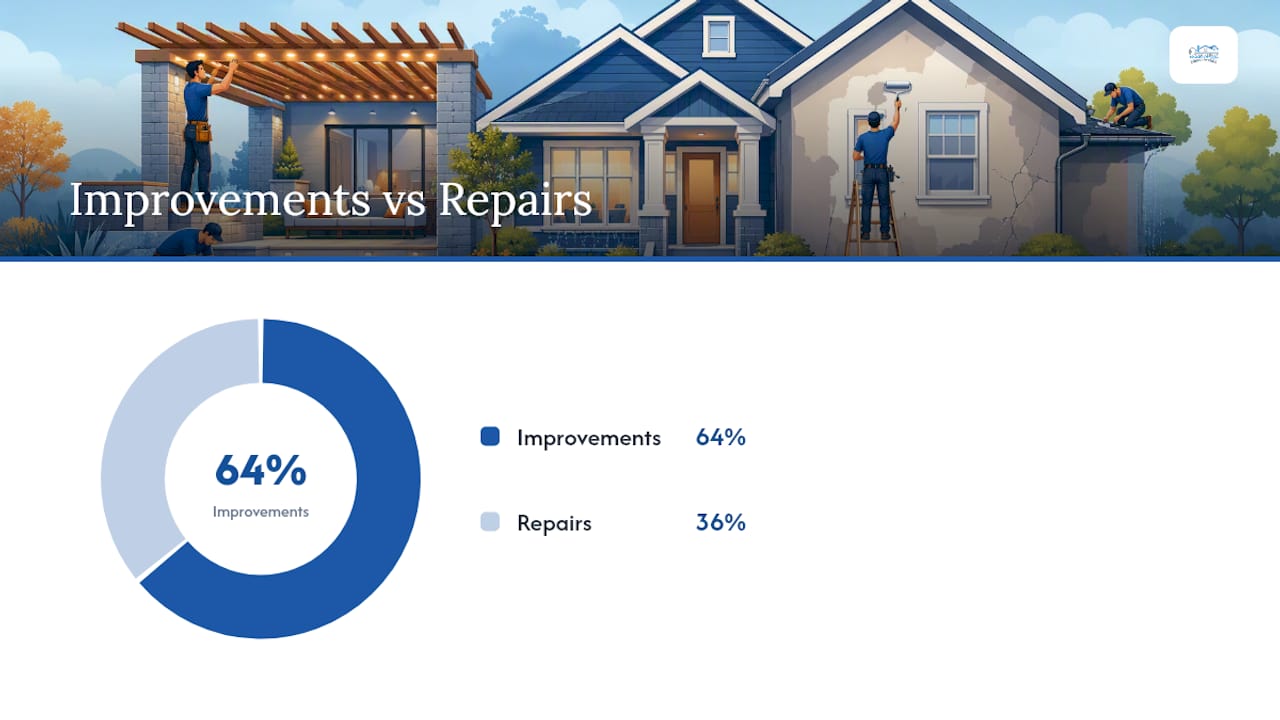
Capital improvements add to your adjusted basis dollar-for-dollar. Repairs do not. The line between them is drawn by the tangible property final regulations, which require capitalization of any expenditure that is a betterment, restoration, or adaptation of the unit of property.
Improvements that increase basis (examples):
- Roof replacement (not patching a few shingles)
- Kitchen or bathroom remodel that adds value or extends useful life
- Room addition or garage construction
- Central HVAC system installation
- New windows or exterior doors replacing original units
- Finished basement or attic conversion
- Landscaping that is permanent and substantial
Repairs that do NOT increase basis:
- Repainting interior or exterior walls
- Fixing a leaky faucet or replacing a broken window pane
- Patching drywall or caulking
- Routine furnace servicing or filter replacement
The facts-and-circumstances test under Regs. Sec. 1.263(a)-3 makes this inherently factual. An expense that merely returns the property to its prior condition is typically a repair. An expense that materially adds value, extends useful life, or adapts the property to a new use must be capitalized.
Pro Tip: Keep a dedicated folder (physical or digital) for every capital improvement: the contractor invoice, the building permit number, before-and-after photos, and the date of completion. Reconstruction years later without permits or invoices is significantly harder to defend during an audit or estate review.
Documentation checklist for improvements:
- Signed contractor invoices with itemized scope of work
- Building permits with permit numbers and inspection sign-offs
- Dated before-and-after photographs
- Proof of payment (bank statements, canceled checks)
- Manufacturer warranties or product receipts for major systems
What reduces your property basis?
Several events decrease your adjusted basis, and ignoring them can cause you to understate your taxable gain — which creates problems with the IRS.
Common basis decreases:
- Depreciation allowed or allowable for business or rental use
- Casualty loss deductions you claimed on prior tax returns
- Insurance reimbursements received for casualty or theft losses
- Certain energy credits and residential energy property credits
- Payments received for easements or rights-of-way granted to others
Depreciation is the one that surprises most sellers. If you ever rented out your home or used part of it as a home office, you were required to depreciate that portion. Publication 523 is explicit: any depreciation allowed or allowable for periods after May 6, 1997, reduces your adjusted basis and may limit your Section 121 exclusion through recapture rules.
That last point catches many sellers off guard. If you skipped depreciation deductions during a rental period, the IRS still reduces your basis by the amount you could have deducted. Pub. 523's worksheets walk you through computing the recapture amount and the resulting taxable gain.
Special rules for inherited, gifted, and exchanged property
The standard purchase-price starting point doesn't apply in every situation. Three scenarios require a different approach.
Inherited property (stepped-up basis):
When you inherit real estate, your basis is generally the fair market value at the decedent's date of death, not what the original owner paid. This stepped-up basis, confirmed by Tax Topic 703, can eliminate decades of appreciation from your taxable gain. Establishing that FMV almost always requires a certified date-of-death appraisal, particularly for estate tax returns or when heirs later sell. See our stepped-up basis appraisal guide for NJ homeowners for a detailed walkthrough.
Gifted property (dual-basis rules):
- For calculating a gain: your basis is the donor's adjusted basis at the time of the gift.
- For calculating a loss: your basis is the lower of the donor's adjusted basis or the property's FMV on the gift date.
- If FMV on the gift date falls between the two, neither a gain nor a loss is recognized on sale.
Divorce transfers and like-kind exchanges:
Transfers between spouses incident to divorce generally carry over the transferor's adjusted basis to the recipient under IRC Section 1041. No gain or loss is recognized at transfer, but the receiving spouse inherits the full tax history of the property.
Like-kind (1031) exchanges defer gain by carrying the old property's basis into the replacement property, adjusted for boot received or paid. The mechanics are complex enough that professional help is not optional for these.
Pro Tip: For any inherited property, get a USPAP-compliant retrospective appraisal dated to the date of death before you sell. Without it, you're relying on an estimate that the IRS can challenge — and the burden of proof is on you.

Allocating basis when property has business or rental use
If you used part of your home as a rental unit or home office, you can't apply a single basis figure to the whole sale. You need to split everything between the personal portion and the business/rental portion.
The IRS recognizes three allocation methods:
- Dollar-amount method: Allocate actual costs directly to each portion where records allow.
- Percentage method: Divide square footage (or unit count for multi-family) of the business/rental area by total square footage, then apply that percentage to basis, improvements, and amount realized.
- FMV allocation: Use appraised values to allocate between portions when square footage isn't a reliable proxy.
Applying the percentage method step by step:
- Measure the total square footage of the property.
- Measure the square footage used exclusively for business or rental.
- Divide business/rental square footage by total to get the allocation percentage.
- Multiply that percentage by your total adjusted basis to get the business/rental basis.
- Apply the same percentage to your selling price and selling expenses to get the business/rental amount realized.
Publication 523 provides Worksheet 2 specifically for this calculation. It walks you through three separate columns: Total, Business or Rental, and Home. You compute gain or loss separately for each portion, because the Section 121 exclusion applies only to the home portion, and depreciation recapture applies only to the business/rental portion.
What to track for each portion:
- Depreciation schedules showing the business/rental basis and accumulated depreciation
- Improvement receipts allocated to each portion (a new roof covers both; a dedicated rental bathroom covers only the rental)
- The allocation percentage used and its supporting calculation
Step-by-step numeric examples
Example A: Owner-occupied single-family home
Married filing jointly, two-year residency test met: Section 121 exclusion covers the full $200,300 gain. No tax owed on the sale.
Example B: Home with rental use (one room, 20% of square footage)
The remaining $39,060 is a capital gain. The $160,240 home gain is sheltered by the Section 121 exclusion (assuming residency requirements are met). These figures would flow through Worksheet 2 in Publication 523 before landing on Schedule D.
Key figures to track in your own calculation:
- Total adjusted basis before depreciation
- Accumulated depreciation by portion
- Selling expenses (commissions, transfer taxes, attorney fees)
- Amount realized by portion
How to reconstruct basis when records are missing
Missing records don't make basis calculation impossible, but they do make it harder to defend. Work through these sources in priority order:
- Closing Disclosure or HUD-1 — your title company or lender may retain copies for years; request them directly.
- County recorder's office — the deed and transfer documents establish purchase date and often the recorded consideration (sale price).
- Mortgage payoff statements — can corroborate the original loan amount and, by extension, approximate purchase price.
- Prior tax returns — Schedule E (rental income) and Form 4562 (depreciation) show depreciation taken and the depreciable basis used.
- Contractor invoices and permits — county building departments retain permit records, often indefinitely; request a permit history for your address.
- Insurance claims and appraisals — prior homeowner's insurance appraisals or claim settlements can support improvement values.
- Photographs with metadata — dated digital photos of completed improvements can corroborate scope and timing.
Once you've gathered what's available, reconstruct in this sequence: identify the purchase date from the deed, obtain the settlement statement or approximate the purchase price from mortgage records, add every documented improvement, then make reasonable estimates for undocumented items and write down your assumptions and sources.
Tax Topic 703 stresses that accurate records are the primary tool for supporting your basis computation. When reconstruction is incomplete or the stakes are high (estate administration, divorce, IRS audit), the right move is a USPAP-compliant retrospective appraisal.
Pro Tip: A retrospective appraisal establishes a defensible fair market value as of a past date using market data from that period. For estate and divorce matters in New Jersey, this is often the only documentation that holds up in court or before the IRS.
When to hire a state-certified appraiser for basis support
Some basis questions can't be answered with a spreadsheet. A state-certified, USPAP-compliant appraiser provides:
- Date-of-death valuations for inherited property stepped-up basis
- Retrospective appraisals establishing value at a prior date for reconstruction or dispute
- Court-ready reports for divorce equitable distribution or estate litigation
- Itemized improvement support reconciling capital additions with market value changes
For estate and inherited-property work, our court-ready estate and date-of-death appraisal services are specifically designed to produce the defensible documentation executors and attorneys need.
What to bring to your appraiser:
- Original purchase documents and closing statement
- Permits and invoices for all capital improvements
- Prior appraisals or insurance valuations
- Tax assessment records and any depreciation schedules
- Photographs of the property at relevant dates
Pro Tip: Bring everything, even documents you think are irrelevant. An experienced appraiser can often use insurance records, permit histories, and tax assessments to corroborate a basis figure that would otherwise be unsupported.

Newjerseyrealestateappraisal serves all 21 New Jersey counties. Our state-certified appraisers specialize in estate, divorce, and tax appeal valuations, and we deliver USPAP-compliant reports that hold up in court, before the IRS, and in estate administration. Call us at (908) 517-3913 or request a quote for appraisal services today.
An appraiser's perspective on the mistakes that cost sellers the most
The most expensive basis errors we see at Newjerseyrealestateappraisal aren't exotic. They're the same three mistakes, repeated constantly.
First: financing costs in the basis. Sellers add mortgage points, loan origination fees, and lender appraisal fees to their starting basis because those amounts appear on the closing statement. The IRS excludes every one of them. The result is an overstated basis that collapses under audit, leaving the seller with a larger gain than they reported and potential penalties on top.
Second: undocumented improvements. A homeowner spends $45,000 on a kitchen remodel and a bathroom addition over ten years, keeps no receipts, and then tries to reconstruct the costs from memory when they sell. Without permits or invoices, the IRS has no obligation to accept those figures. We've seen estate disputes where heirs lost tens of thousands in basis simply because no one kept the contractor paperwork.
Third: ignored depreciation recapture. A seller rents out a room for four years, claims depreciation, then forgets about it when they sell. The basis has been reduced by those depreciation deductions, and the recapture tax is due regardless of whether the seller remembered to account for it. "I didn't know" is not a defense the IRS accepts.
The practical fix is simple: keep a dedicated improvement file from the day you buy, review your basis annually if you have rental use, and call us for a retrospective appraisal before you sell if any records are missing or the property has an unusual history.
Sources
Core IRS references:
- Publication 551 (12/2025), Basis of Assets
- Publication 523, Selling Your Home
- Tax Topic 703 - Basis of assets
Practical tools and records sources:
Keep physical or digital copies of every document in a dedicated property file. When you're ready to sell or need to support a basis claim for estate or divorce purposes, bring that complete file to a state-certified appraiser. A USPAP-compliant report built on solid documentation is the strongest position you can take before the IRS or a court.
This article provides general educational information about property basis calculation and is not a substitute for advice from a qualified tax professional, attorney, or CPA. Consult a professional for guidance specific to your situation.