
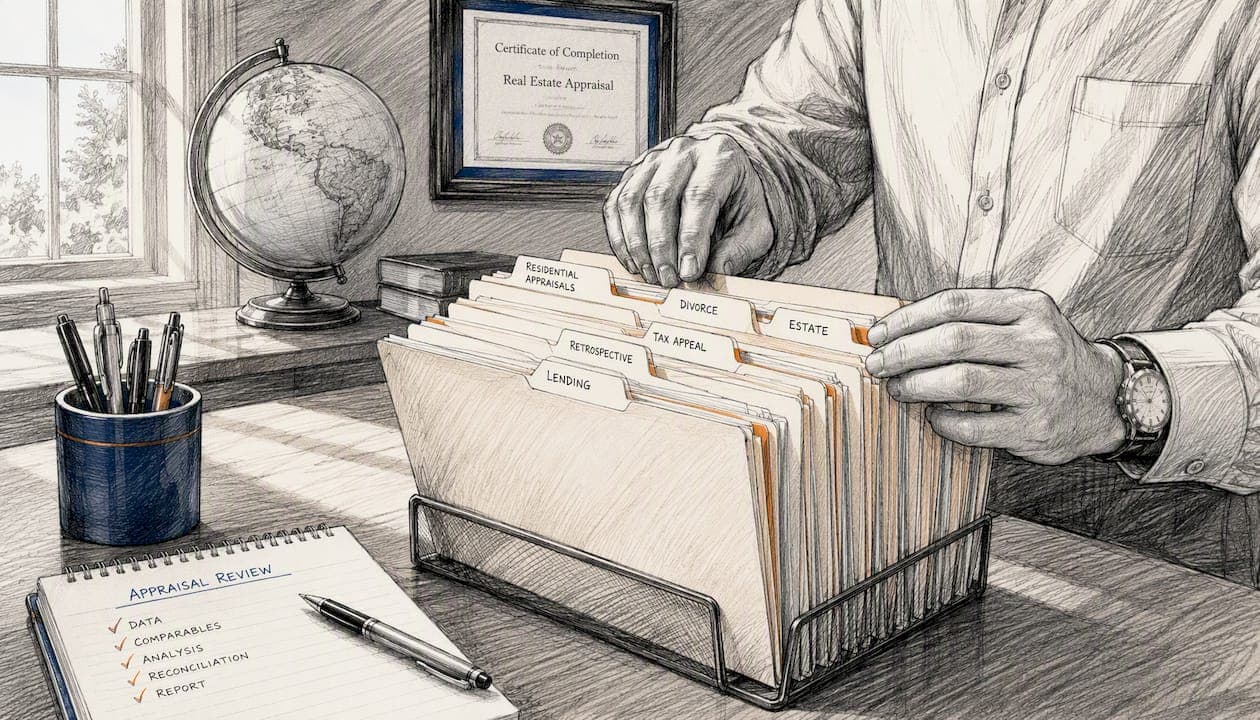
Before you agree to testify, you need one thing above everything else: a documented, reproducible valuation with a USPAP-compliant workfile and a clear method-to-fact map that satisfies Federal Rule of Evidence 702. These guidelines for appraisal testimony aren't theoretical. They're the practical checklist that separates appraisers who survive cross-examination from those who get excluded before they reach the stand.
Before you accept any litigation engagement, confirm you have:
- A complete, contemporaneous workfile that existed before you issued any written or oral report
- Signed and dated certification in the file
- Documented methodology with a clear rationale for every approach selected
- Identified and sourced comparable data with adjustment derivations in writing
- Domain-specific qualifications that match the property type and valuation task
- All assumptions and limiting conditions stated in the report
- Exhibits and demonstratives organized and indexed for fast retrieval
- Disclosures prepared for the expert report or disclosure form required by the court
Pro Tip: Build your workfile as if a deposition subpoena will arrive the same afternoon you issue the report. Contemporaneous comparables-selection notes, adjustment derivations, and a method-to-fact map make cross-examination manageable — retrofitting them under pressure does not.
Key Takeaways
Defensible appraisal testimony requires a USPAP-compliant workfile built contemporaneously, a method-to-fact map that satisfies FRE 702's four-prong reliability test, and disciplined discovery practices that keep the file intact and credible.
| Point | Details |
|---|---|
| FRE 702 reliability is a threshold, not a weight issue | Courts must find admissibility by a preponderance; weak methodology is an exclusion problem, not just a credibility problem. |
| USPAP workfile must exist before any report is issued | Include signed certification, adjustment derivations, data sources, and oral testimony summaries added promptly after any hearing. |
| Retention extends with litigation | Keep the workfile for at least five years after preparation or two years after final disposition of litigation, whichever is later. |
| Non-testability is the most common exclusion trigger | Map every opinion to observable market evidence; show reproducible adjustment logic and sensitivity analysis in the file. |
| NJREAG provides court-ready litigation appraisals statewide | State-certified, USPAP-compliant reports with contemporaneous workfiles for estate, divorce, and tax appeal matters across all 21 NJ counties. |
Table of Contents
- What do courts require under FRE 702 and Daubert?
- USPAP rules that govern your workfile and testimony readiness
- How to write a court-ready appraisal report and expert disclosure
- How to prepare for deposition, direct examination, and cross-examination
- How do you document and defend your valuation methodology?
- Responding to discovery and subpoenas: what you must do
- Desk review, field review, and expert review: what courts expect from each
- What should your CV and expert disclosures include?
- What are the most common reasons appraisal testimony gets excluded?
- How NJREAG prepares files and testimony for New Jersey cases
- Our view on what makes appraisal testimony defensible
- NJREAG offers court-ready appraisal and litigation support across New Jersey
- Sources
What do courts require under FRE 702 and Daubert?
Federal Rule of Evidence 702 sets four requirements the proponent must satisfy by a preponderance of the evidence: the testimony must help the trier of fact, rest on sufficient facts or data, use reliable principles and methods, and reflect a reliable application of those methods to the specific case facts. Every one of those four prongs is a potential exclusion point.
The December 2023 amendment to Rule 702 made the judge's gatekeeping role explicit. Courts must now find by a preponderance that the testimony meets admissibility requirements — they cannot defer reliability questions to cross-examination and treat them as weight issues. That shift matters for valuation experts because it means a weak methodology is an exclusion problem, not just a credibility problem.
How Daubert and Kumho apply to valuation opinions
Under Daubert and Kumho Tire, the federal rules and advisory notes direct judges to assess reliability, falsifiability, error rates where available, and whether the method is accepted in the relevant professional community. Valuation is a technical discipline, not a hard science, so courts apply these factors flexibly. What they will not accept is an opinion that cannot be tested or traced back to observable market evidence.
A common exclusion pattern: a reviewer who critiques the opposing appraiser's work but cannot demonstrate a reliable methodology of their own. In Sullivan v. Loden and similar Rule 702 decisions, courts excluded valuation testimony when the expert lacked domain-specific qualifications or offered only reactive critique without an independent, testable method. After the 2023 amendment, courts increasingly treat the reliability of basis and methodology as threshold admissibility questions — reviewers must be able to show they could have performed the valuation themselves.
Pro Tip: Write your methodology section so a judge with no appraisal background can follow the logic from data selection through final reconciliation. If the path from evidence to opinion requires insider knowledge to trace, a Daubert challenge will find that gap.
USPAP rules that govern your workfile and testimony readiness
USPAP requires a contemporaneous workfile for each appraisal assignment. That file must contain true copies of written reports, summaries or transcripts of oral testimony, and the appraiser's signed and dated certification. The workfile must exist before you issue any written or oral report — not assembled afterward.
Per the USPAP record-keeping rules, a written summary of any oral report must be added to the workfile within a reasonable time after the oral report is given. That requirement catches many appraisers off guard: if you testify orally at a hearing, a summary goes into the file promptly.
What your workfile must contain
| Required Item | Notes |
|---|---|
| True copy of every written report | Including all drafts if revisions were made |
| Summaries or transcripts of oral testimony | Added within a reasonable time after oral report |
| Signed and dated certification | Must match the report's certification language |
| Client identification and intended use | Documented at engagement, not reconstructed later |
| Data sources and market evidence | MLS records, deed transfers, income statements, etc. |
| Derivation of adjustments | Paired-sales analysis, regression output, or market extraction |
| Assumptions and limiting conditions | All stated in writing before report issuance |
| Correspondence with client and counsel | Emails, engagement letters, scope confirmations |
Retention periods and custody
USPAP sets a minimum retention period of at least five years after preparation, or at least two years after final disposition of any judicial proceeding in which you testified, whichever expires later. Litigation routinely extends that obligation well past the five-year floor. Keep the file accessible and intact for that entire period.
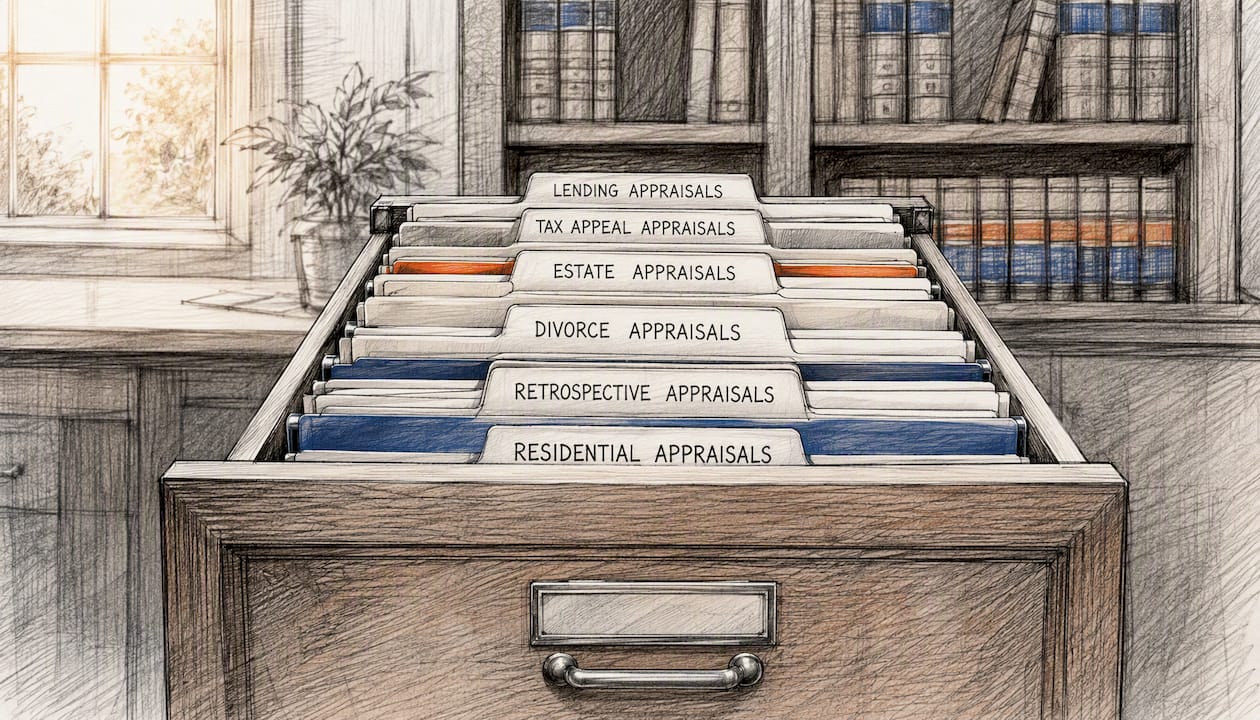
For USPAP compliance in New Jersey practice, custody matters too. If you work with a partner or associate, the file must be retrievable by the firm, not just the individual appraiser. Document who holds the file and where.
Pro Tip: Use a consistent folder structure and file-naming convention from day one: client name, property address, date of value, and version number. When discovery arrives, a clean audit trail signals professionalism before opposing counsel reads a single page.
How to write a court-ready appraisal report and expert disclosure
Your report must state scope, intended use, assumptions and limiting conditions, the method or methods used, reproducible data, and a signed certification that anticipates FRE 702 questions. A report that reads well for a lender will often fail in court because it omits the method-to-fact mapping a judge needs to assess reliability.
Suggested report structure for litigation assignments:
- Scope of work: Property type, date of value, intended use, intended users, and any extraordinary assumptions
- Data and market evidence: Sources identified by name, date accessed, and how each was used
- Methodology: Which approaches were considered, which were used, and why others were excluded
- Sales comparison analysis: Comp selection criteria, adjustment derivations, and reconciliation logic
- Income approach (if applicable): Data sources for income, expenses, and cap rate; derivation shown
- Cost approach (if applicable): Source for cost estimates, depreciation rationale
- Reconciliation: Weighted conclusion with explicit rationale, not just a number
- Assumptions and limiting conditions: All stated, not boilerplate
- Certification: Signed, dated, and tailored to the assignment
Expert disclosure requirements
Federal Rule of Civil Procedure 26(a)(2)(B) requires a written report from a retained expert that includes the complete statement of opinions, the basis and reasons for each, the facts or data considered, any exhibits to be used, the witness's qualifications, a list of prior testimony in the past four years, and the compensation arrangement. State courts have equivalent disclosure rules. Prepare this document in parallel with your report, not as an afterthought.
Sample certification language for court-ready reports:
"I certify that, to the best of my knowledge and belief, the statements of fact contained in this report are true and correct. The reported analyses, opinions, and conclusions are limited only by the reported assumptions and limiting conditions and are my personal, impartial, and unbiased professional analyses, opinions, and conclusions. I have no present or prospective interest in the property that is the subject of this report and no personal interest with respect to the parties involved. My compensation is not contingent on an action or event resulting from the analyses, opinions, or conclusions in, or the use of, this report."
Tailor the language to match USPAP's required certification elements and any court-specific disclosure requirements in your jurisdiction.
How to prepare for deposition, direct examination, and cross-examination
Preparation for deposition and trial is both a procedural and a communication exercise. Rehearse concise direct testimony, anticipate cross-examination lines, and organize exhibits for fast retrieval. The Appraisal Institute's training resources on expert witness preparation cover structuring direct examination and preparing demonstratives — worth reviewing before your first litigation engagement.
Pre-deposition preparation
Meet with retaining counsel at least a week before the deposition. Walk through the report section by section, identify the three or four opinions opposing counsel is most likely to attack, and rehearse your answers aloud. Spoken testimony sounds different from written text, and you need to hear yourself explain adjustment derivations in plain language before you're under oath.
Prepare an exhibit binder with a numbered index. Bring a copy for yourself, one for opposing counsel, and one for the court reporter. If you're using digital exhibits, have a flash drive with clearly labeled files and a printed index as backup. Know your exhibit numbers before you walk in.
Courtroom demeanor and handling hostile questioning
Answer the question asked, nothing more. If a question is compound or ambiguous, ask for clarification before answering. When opposing counsel mischaracterizes your methodology, correct it calmly and specifically: "That's not quite accurate — my adjustment for condition was derived from paired sales, not estimated." Defer to counsel on objections. If your attorney objects, stop speaking and wait.
Credibility is a deliverable. Communication clarity, organized exhibits, and disciplined relevance often determine persuasiveness more than technical minutiae. A judge who can follow your reasoning will trust your conclusion. One who can't will question everything.
For guidance on communicating effectively with attorneys before and during litigation assignments, clear protocols established early prevent misunderstandings at the worst possible time.
How do you document and defend your valuation methodology?
Judges want to see that you used an accepted approach and applied it reliably. That means documenting selection logic, adjustment derivation, and sensitivity analysis in enough detail that another appraiser could reproduce your work from your file alone.
Sales comparison approach
For each comparable, document why you selected it: proximity, physical similarity, market conditions, and time of sale. Show the paired-sales analysis or regression output behind each adjustment. If you made a $15,000 condition adjustment, the file should contain the market evidence that supports that figure, not just the number.
Comp workup documentation checklist:
- Comp selection criteria stated in writing before selection
- Source for each comparable (MLS number, deed book and page, or tax records)
- Photograph or inspection notes for each comparable
- Adjustment derivation for each line item, with supporting market evidence
- Sensitivity analysis showing the value range if key adjustments shift by a reasonable margin
- Reconciliation narrative explaining why the final value conclusion was selected
Income and cost approaches
For the income approach, document your data sources for gross income, vacancy, operating expenses, and cap rate separately. Show how you derived the cap rate from market transactions, not just cited a range from a survey. Courts want to see the derivation, not the conclusion.
Pro Tip: Run a sensitivity table showing how the final value changes if the cap rate moves 25 or 50 basis points in either direction. That table demonstrates you understand the model's error bounds and preempts the cross-examination question "What if your cap rate is wrong?"
Responding to discovery and subpoenas: what you must do
When discovery arrives, preserve the intact workfile immediately. Do not alter originals. Any analysis prepared after a subpoena is received must be labeled "amended" and dated, with the original preserved separately.
Step-by-step protocol:
- Preserve immediately. Stop all edits to the workfile the moment you receive a subpoena or discovery demand. Save a timestamped copy of the file as it exists at that moment.
- Notify retaining counsel. Contact the attorney who retained you before producing anything. Confirm what is privileged and what must be produced.
- Review the scope of the demand. Identify exactly which documents are requested. Do not volunteer materials beyond the scope of the demand.
- Prepare a production set. Copy (do not move) the responsive documents. Label each page with a Bates number or production identifier.
- Redact appropriately. Redact only what counsel confirms is privileged. Document every redaction with a privilege log entry.
- Label any post-subpoena work. If you prepare additional analyses after receiving the subpoena, label them "amended" with the date prepared and keep the original intact.
- Respond within the required timeline. Federal rules generally require responses within 30 days of service; state court timelines vary. Confirm the deadline with counsel.
- Consult counsel before voluntary production. Never produce documents voluntarily beyond what is legally required without explicit guidance from retaining counsel.
Professional guidance from the American Society of Appraisers) is clear: respond truthfully in depositions, produce non-privileged documents responsive to proper subpoenas, and never alter or destroy requested files. Changes after a subpoena is received must be labeled "amended."
Desk review, field review, and expert review: what courts expect from each
Courts expect an expert reviewer to have and document a methodology of their own. A pure critique without an independent, reliable methodology risks exclusion under FRE 702 — the reviewer must be able to show they could have performed the valuation themselves.
| Review Type | What It Includes | Typical Deliverable | Litigation Use |
|---|---|---|---|
| Desk review | Analysis of the report and file without a property inspection | Written review report with conclusions | Challenging methodology or data in the opposing report |
| Field review | Report analysis plus an exterior or interior inspection | Review report with independent observations | Cases where condition or physical characteristics are disputed |
| Expert review | Full independent methodology applied to the same valuation problem | Complete independent appraisal or review report with own value conclusion | Highest-stakes litigation; courts expect an independent, testable opinion |
When you serve as a reviewing expert, structure your report around the method you would have used. Courts look for an independent, reliable methodology rather than purely reactive critique. A desk review that only lists errors in the opposing report, without showing how you would have reached a different conclusion, is vulnerable to a Daubert challenge.
What should your CV and expert disclosures include?
Match the credentialing detail to the valuation task. List domain-specific experience, relevant publications, prior testimony, and methodology-specific training. A CV that lists general appraisal experience but omits your specific work with the property type at issue gives opposing counsel an easy target.
CV checklist for litigation assignments:
- State certification number, state, and expiration date
- Designations (MAI, SRA, ASA, or equivalent) with awarding organization
- Years of experience, broken down by property type where relevant
- Geographic coverage (for New Jersey assignments, list counties where you have active experience)
- Methodology-specific training (income approach, mass appraisal, litigation support courses)
- Prior testimony history: number of cases, jurisdictions, and whether as plaintiff or defense expert (without identifying confidential matters)
- Publications, presentations, or peer-reviewed contributions relevant to the valuation task
- Any prior exclusions or Daubert challenges, with outcome (courts will ask; disclose proactively)
Expert disclosure checklist
- Complete statement of all opinions you will offer
- Basis and reasons for each opinion, with specific data references
- List of all facts and data considered, including data you reviewed but did not rely on
- Exhibits you intend to use at trial
- Your qualifications, including the CV above
- List of prior testimony in the past four years (cases, courts, and whether deposition or trial)
- Compensation rate and total compensation for the engagement
Frame any limitations of your opinion explicitly. If your opinion is limited by the data available, say so. Staying within reliable application bounds is better than overstating confidence and being impeached on cross-examination.
What are the most common reasons appraisal testimony gets excluded?
Most exclusions hinge on non-testability and weak documentation, both of which are fixable through disciplined workfile practices and explicit method-to-fact mapping. The failure is rarely that the appraiser was technically wrong. It's that the court couldn't verify the reasoning.
Common red flags and how to fix them:
- Unsupported adjustments. The file contains the adjustment but not the derivation. Fix: add paired-sales analysis, regression output, or market extraction documentation to the workfile before the report is issued.
- Cherry-picked comparables. Only favorable sales were selected, with no documented selection criteria. Fix: write out your comp selection criteria before you run the search, and keep the search results showing what you considered and excluded.
- Late changes to the file. Edits made after the subpoena arrived, without labeling. Fix: implement version control from day one; label all post-subpoena changes "amended" with the date.
- Lack of domain-specific methodology. The reviewer critiques the opposing report but offers no independent methodology. Fix: structure every review around the method you would have applied; show you could have done the valuation yourself.
- Vague reconciliation. The final value conclusion appears without a clear rationale for weighting the approaches. Fix: write a reconciliation narrative that explains why each approach received the weight it did, tied to the specific characteristics of the property and market.
- Missing or incomplete workfile. The file was assembled after the fact or is missing required items. Fix: build the workfile contemporaneously; use the checklist in the USPAP section above as your standard.
For a broader look at common appraisal mistakes that become cross-examination weak points, the patterns repeat across property types and assignment types.
When a red flag is serious enough — missing data you cannot reconstruct, a conflict of interest you cannot cure, a property type outside your competence — the right answer is to decline the engagement. USPAP's competency provision requires it, and a declined engagement causes far less damage than an excluded opinion.
How NJREAG prepares files and testimony for New Jersey cases
NJREAG prepares litigation files with a reproducible, USPAP-compliant workflow that emphasizes contemporaneous documentation, clear method mapping, and demonstrative readiness. Our state-certified appraisers have worked across all 21 New Jersey counties, with particular depth in divorce, estate, and tax appeal matters where court-ready documentation is non-negotiable.
NJREAG court-readiness checklist:
- Pre-acceptance conflict check. Confirm no prior relationship with any party, property, or counsel that creates a conflict. Document the check in the file.
- Scope confirmation in writing. Confirm the intended use, intended users, date of value, and property rights appraised before any field work begins.
- Contemporaneous workfile creation. Open the file on the day of engagement. All field notes, photographs, and data downloads go in immediately.
- Version control from day one. Every draft is saved with a date stamp. No file is overwritten. The final report is clearly labeled as such.
- Adjustment derivation documentation. Every adjustment is supported by market evidence in the file before the report is issued.
- Exhibit preparation. Location maps, comparable photographs, adjustment grids, and income/expense summaries are prepared as standalone exhibits, formatted for courtroom display.
- Attorney coordination. We confirm the scope of our testimony with retaining counsel before deposition and before trial. We do not discuss opinions with opposing counsel without counsel present.
- Post-testimony workfile update. Summaries of oral testimony are added to the workfile within a reasonable time after any hearing or deposition.
Sample engagement-to-trial timeline
For a typical New Jersey estate or divorce litigation assignment, our milestones run as follows: engagement letter and conflict check within 48 hours of inquiry; field inspection within 5–10 business days; draft report to retaining counsel within 15–20 business days; final report and workfile complete before any oral report or testimony; exhibit package prepared at least two weeks before deposition; trial-ready update completed after deposition transcript is received.
For estate and date-of-death appraisals in New Jersey, probate court timelines in counties like Essex, Bergen, and Middlesex can compress the schedule significantly. We build that into the engagement timeline from the start.
Pro Tip: Organize your digital workfile in three folders: "Pre-Report" (all data, field notes, and drafts), "Final Report" (the issued report and certification), and "Post-Issuance" (all correspondence, deposition summaries, and amendments). That structure makes discovery production straightforward and demonstrates a clean chain of custody.
Our view on what makes appraisal testimony defensible
We've prepared court-ready appraisal files across all 21 New Jersey counties, and the pattern is consistent: the appraisers who hold up under cross-examination are the ones who built the file right the first time. Not the ones with the most impressive credentials, and not the ones who wrote the longest reports.
State-certified and USPAP-compliant isn't a marketing phrase for us. It's the baseline we hold ourselves to on every assignment, whether it's a divorce equitable distribution in Monmouth County or a date-of-death valuation for a Bergen County estate. Our specialties in divorce, estate, and tax appeal appraisals mean we work in litigation contexts regularly, and we know what attorneys and judges expect to see.
The non-negotiable is integrity in record-keeping. Credentials must match the task. A residential appraiser opining on a complex commercial property, or a reviewer who can't show an independent methodology, will face a Daubert challenge they can't answer. We decline engagements outside our competence, and we document why. That discipline is what keeps our opinions admissible.
NJREAG offers court-ready appraisal and litigation support across New Jersey
When you need a state-certified appraisal that will hold up in court, NJREAG delivers USPAP-compliant reports built for litigation from the first day of engagement. Our litigation support services cover the full range of New Jersey legal matters: estate and date-of-death appraisals, divorce and equitable distribution valuations, property tax appeal appraisals, retrospective valuations, and deposition and trial testimony across all 21 counties.

Every report we deliver includes a contemporaneous workfile, documented adjustment derivations, and a signed certification that anticipates FRE 702 scrutiny. We coordinate directly with retaining counsel on scope, timeline, and exhibit preparation so nothing is left to reconstruct under pressure.
To request a litigation appraisal or discuss your case, contact NJREAG at (908) 517-3913 or visit Newjerseyrealestateappraisal. We typically confirm engagement within 24–48 hours and can discuss turnaround timelines specific to your court schedule.
This article provides general educational information about appraisal testimony practices and is not legal advice. Consult a licensed attorney for guidance specific to your jurisdiction and case.
Sources
- Rule 702. Testimony by Expert Witnesses | Federal Rules of Evidence | LII / Legal Information Institute
- USCODE-2024-title28-app-federalru-dup2-rule702 — govinfo
- Federal Rules of Evidence — United States Courts (rules PDF)
This article is general information, not a substitute for advice from a qualified lawyer. Consult a qualified legal professional about your own circumstances before acting on anything here.